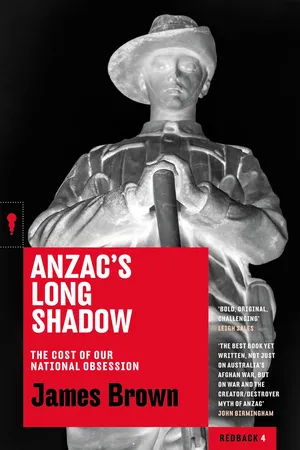
A century ago we got it wrong. We sent thousands of young Australians on a military operation that was barely more than a disaster. It's right that a hundred years later we should feel strongly about that. But have we got our remembrance right? What lessons haven't we learned about war, and what might be the cost of our Anzac obsession?
Defence analyst and former army officer James Brown believes that Australia is expending too much time, money and emotion on the Anzac legend, and that today's soldiers are suffering for it.
Vividly evoking the war in Afghanistan, Brown reveals the experience of the modern soldier. He looks closely at the companies and clubs that trade on the Anzac story. He shows that Australians spend a lot more time looking after dead warriors than those who are alive. We focus on a cult of remembrance, instead of understanding a new world of soldiering and strategy. And we make it impossible to criticise the Australian Defence Force, even when it makes the same mistakes over and over. None of this is good for our soldiers or our ability to deal with a changing world. With respect and passion, Brown shines a new light on Anzac's long shadow and calls for change.
Longlisted for the 2014 John Button Prize
'Bold, original, challenging - James Brown tackles the burgenoning Anzac industry and asks Australians to re-examine how we think about the military and modern-day service.' —Leigh Sales
'The best book yet written, not just on Australia's Afghan war, but on war itself and the creator/destroyer myth of Anzac.' —John Birmingham
'Anzac's Long Shadow is refreshing and engaging. It is also frank and no-nonsense. James Brown sets himself apart as a leader in this new generation of Anzacs by asking the hard questions.' —Peter Leahy, Chief of the Australian Army, 2002-08
'One of Australia's most insightful strategic analysts, James Brown, lays bare our cult of Anzac. As our diggers return from war, this book is more necessary than ever before. It's now time for us to remember not only our fallen, but our living.' —Michael Ware, Former CNN Baghdad correspondent.
'Brown, as both an intelligent military theorist and an engaging storyteller, is able to tackle such a controversial issue with humour and candour. A personal, challenging and informative work [with] the potential to contribute a great deal to Australia's understanding of our own military service, and how we think about war itself.' —Readings Monthly
'Brown is lucid, bright and fierce – exceptional qualities in a writer and, no doubt, a soldier – and he's written an important prelude to our Anzac centenary.' —The Saturday Paper
'It is the combination of academic insight and lived experience that gives this book its particular edge…. A good, a necessary and an important book.' —Canberra Times
'This is the most interesting and original book I have read on contemporary Australian public policy for a long time.' —Judith Brett, The Monthly
- 192 pages
- English
- ePUB (mobile friendly)
- Available on iOS & Android
eBook - ePub
About this book
Trusted by 375,005 students
Access to over 1.5 million titles for a fair monthly price.
Study more efficiently using our study tools.
Information
CHAPTER 1: SELLING REMEMBRANCE
The breathless Irish voice on the end of the phone had been singing for four minutes straight on the majestic scale of the Anzac centenary. ‘It will be the biggest thing you’ve ever seen,’ she said. ‘It’s going to start with a gorgeous re-creation of the Gallipoli convoy departure in Albany, Western Australia, on 1 November 1914, to bookend the whole centenary of celebrations.
‘Everybody’s involved,’ she gushed from her call centre: ‘Legacy, the City of Albany, the West Australian Government, the RSL, the Australian Light Horse Association – it’s going to be magnificent. You don’t want to miss out.’ Untroubled by the silence from my end of the phone, she homed in with her sales pitch: ‘So we’re producing the commemorative publication for the whole centenary, Gallipoli 100, distributed to 84,000 people and with introductory letters from the likes of the prime minister. Would you like to book a message of support and show the defence forces what you do?’ She outlined the options: the best spots upfront had already been taken by the National Australia Bank and a ‘gorgeous’ advertisement from the Australian Submarine Corporation, but $14,950 would buy me a full page. For a 50 per cent premium she could reserve a special spot right after the ode of remembrance.
I hesitated, and asked her to email me through a pamphlet. She duly did so. A thoroughly unsentimental advertising rate card was placed alongside a sweet photo of a World War II veteran being helped along to an Anzac march. ‘Gallipoli 100 aims both to commemorate the sacrifice of Australians who fought at Gallipoli, and by extension in other wars, and to educate the reader about what actually happened during the Gallipoli campaign,’ it read. ‘Many other scholarly and popular books are likely to appear for the Gallipoli centenary. This unique publication will stand out as the most comprehensive, accessible and attractive of them all.’ With the promise of fifty ‘lavishly photographed’ and ‘thought-provoking and satisfying articles’ written by world experts, it was hard to say no. I told my new friend Nicky I needed time to think about it. She promised to follow up with me in a few days, adding, without the slightest trace of irony, ‘Lest you forget.’
A century after the war to end all wars, Anzac is being bottled, stamped and sold. Nicky is not the only one spruiking the Anzac spirit. The Anzac industry has gone into hyperdrive. The year 2015 will be a bumper one for battlefield tour operators as thousands of Australians wing their way to Gallipoli for what is being marketed as a once-in-a-lifetime opportunity. One company, with a flash of brilliance and a tenuous link, is arranging a surf boat race across the Dardanelles. Another is organising marathon swimmers to make their way from Europe to Asia Minor. Off the shores of Suvla Bay and Anzac Cove, cruise ships will anchor so that thousands might nestle alongside the Anzac legacy. By morn on 25 April, pilgrims will embark in small boats as Anzacs once did, to join the throngs on the sand. By night they’ll rock away to Daryl Braithwaite and Kate Ceberano. Bert Newton will narrate the war.
It’s an all-Australiana jamboree. Just issuing tickets for the Gallipoli event will cost more than half a million dollars, and an events management company in Melbourne is pocketing a cool $27 million for a multi-year contract to keep everything well organised on the day. What started as a simple ceremony is now an enormous commercial enterprise. Cartoonist Michael Leunig has captured it best: ‘they’ve put a big thumping hoon outboard motor on the back of a tragedy’.
Anzac Day is also a time to honour and remember. That might best be done with a purchase from Australia Post’s limited edition ‘Sands of Gallipoli’ range of keyrings and medallions, which promises to ‘keep the spirit alive’ while earning millions for its savvy creator. In the view of the historian Ken Inglis, these little vials of sand are ‘relics from the holy land’. For just five instalments of $39.99 plus $19.99 in postage and handling, the Bradford Exchange offers the chance to ‘honour a loved one who served our country courageously’ by purchasing a ‘Lest We Forget Remembrance Watch’ with ‘iconic rising sun and slouch hat reproduced in shimmering golden-tone’. The Australian War Memorial, too, is devising an official ‘Anzac Centenary Merchandising Plan’ to capitalise on ‘the spirit’.
Selling Anzac is not a new phenomenon: one of Australia’s official World War I historians wrote of the scandal when a real estate venture was advertised as ‘Anzac on Sea’. Had the sacred word not been protected, he wrote, ‘the name was likely to become vulgarised’ and ‘Anzac companies would soon have sprung up like mushrooms’. For that reason, since the early 1920s the federal government has legislated to protect the word Anzac from commercial misuse. But just as restrictions on Anzac Day sporting events and trading hours have wearied over the years, so too have restrictions on the commercialisation of the spirit.
Preparation for the four years of the Anzac centenary is, in every sense, monumental. Governments, rarely able to lift their gaze beyond daily, even hourly, media cycles, have meticulously prepared for this anniversary for nearly half a decade. A federal Minister for the Anzac Centenary has been appointed under successive governments. In a small country already home to thousands of war memorials, debt-struck governments are quarantining funds for more commemoration. The numbers are staggering. Australia will outspend the United Kingdom on the commemoration of the Great War by more than 200 per cent. All told, the centenary will cost Australian state and federal taxpayers nearly $325 million. With an additional $300 million expected in private donations, commemorating the Anzac centenary might cost as much as two-thirds of a billion dollars.
While there is bipartisan consensus that the actual defence force is underfunded by 25 per cent, Australians are racing to outdo one another with bigger, better, grander and more intricate forms of remembrance. In Canberra a $27-million renovation of the Australian War Memorial’s First World War galleries will give the gore of interminable trench warfare new zest. In Albany, Western Australia, a $9-million Anzac Interpretive Centre will rise on the shores of the Indian Ocean alongside a further $8 million of Anzac infrastructure providing a peace park, an Avenue of Honour, an improved lookout and a refurbished war memorial. In Europe, years of diplomatic effort with the governments of France and Belgium will underpin a $10-million Australian Remembrance Trail to link the Western Front’s most significant Australian battlefields and another interpretive centre. In Sydney, the state government is considering funding a multimillion-dollar ‘NSW Commemorative/Educational Centre of Excellence’. In Victoria, $45 million will go towards new World War I ‘Galleries of Remembrance’ at Melbourne’s already magnificent Shrine of Remembrance. The Queensland government has pledged more than $60 million towards the centenary, including a major capital project to upgrade Brisbane’s Anzac Square.
A cacophony of ceremonies will be needed to maintain the spirit for the full four years. The federal government is providing $125,000 to every electorate for community activities focused on World War I. The NSW and Tasmanian state governments will provide similar grants as well as funding the refurbishment of local war memorials. In anticipation, bronzing and stone masonry companies are advertising to veterans groups, helpfully advising them on how to best capitalise. The official start of the centenary will be a $3-million re-staging of the departure of the first Anzac troop convoys from Albany to Egypt. Current soldiers from the Australian Army and Royal Australian Navy will be ordered to reprise the roles of their doomed forebears setting sail for defeat and bloodshed at the hands of the Ottoman Empire. This festival will be broadcast live nationally. In New South Wales, ceremonies will pay tribute to the families of World War I veterans and multicultural and Indigenous communities. Specially established ‘live event’ sites will beam these ceremonies across the state. To accompany them, a ‘music project’, Anzac Notes, has been commissioned. It promises to give ‘an interesting insight into both war and music’.
Government’s role in all this will be hyperactive, leaping over veterans groups to become the ‘choreographer of commemoration and guardian of public memory’. The NSW Anzac Commission has recommended that the government ‘negotiate with media agencies for a palette of stories in daily newspapers, television, web, social networks and mixed media to provide a historical narrative throughout the Centenary period’. The NSW Ambulance Service has offered to sport commemorative banners on the side of all ambulances for the duration of the centenary. The NSW Roads and Maritime Service wants an Anzac logo to be placed on all departmental documentation. Sporting authorities have suggested convening international commemorative test matches. In New South Wales and Victoria, governments are leading the wholesale renaming of roads, avenues, rest areas and bridges in accordance with Anzac themes.
No priority is greater than raising awareness of Anzac. A $10-million travelling exhibition with truck-mounted interactive panels the size of backyard swimming pools will traverse the country for four years to immerse Australians in World War I’s battlefields and ‘assist with education and understanding’. Anzac ambassadors, advertising budgets and a school education program will also contribute. Hours of TV programming will include 100 personal stories from the Australians at War Film Archive guaranteed to ‘blend human interest with a broad sweep of history’. New history research grants will allow families to learn about their military ancestors. A new $1-million prize in Queensland will reward schoolchildren who can show how Anzac has shaped the nation with a ‘once in a lifetime’ trip to Anzac Cove to connect personally with the legend. A commemorative school student procession will be led across the Sydney Harbour and Anzac bridges.
From the community, too, commemorative ideas have flowed. The NSW Centenary of Anzac Commemoration Committee took soundings throughout the state and compiled 300 original ideas. A National Commission held more than thirty-six public forums across Australia and received more than 600 submissions. Communities are mustering horses to re-enact recruitment marches. A graphic design firm has spent a year digitally recreating every contour of the geography at Gallipoli. The Gallipoli Symphony, a ten-year project ‘involving the commissioning of ten leading composers from Turkey, Australia and New Zealand to tell the narrative of the Gallipoli campaign’, will culminate in 2015 with a performance at Anzac Cove, and a subsequent tour through Turkey, Australia and New Zealand. An Anzac centenary public fund aims to solicit $300 million in donations from corporate Australia. ‘Who wants to be the company that said no to Anzac?’ said one multimillion-dollar corporate donor I spoke to, who was nevertheless unsure how their donation would be spent.
It is entirely fitting and proper to commemorate World War I and Australia’s military campaigns. Yet all of this ingenuity and industry is for an anniversary which is ultimately arbitrary. The only reason the centenary of Anzac is considered a special, once-in-a-lifetime experience is because we have imbued it with that meaning. To be sure, we often mark centuries as significant. But the struggle and sacrifice of our forebears at Gallipoli will not be any greater in 2015 than it is in 2014, or was in 1915. The centenary marks an epoch that we have chosen for ourselves. And we have chosen not to commemorate it with a respectful silence and quiet reflection. At the War Memorial in Sydney’s Hyde Park, inscribed words decree: ‘Let silent contemplation be your offering.’ Instead, Australians are embarking on a discordant, lengthy and exorbitant four-year festival for the dead.
‘If there is anything in the Australian landscape that is above politics, it is the centenary of Anzac,’ says one federal parliamentarian. But the genesis of this four-year festival is in politics, and commemoration has become an increasingly valuable commodity for political leaders. It is far too cynical to suggest that Anzac commemoration has been nurtured exclusively for political benefit, but it would be equally naive to ignore that this has become an area of public policy where political narratives can be shaped and secular objectives secured. Though Anzac is sacred, dissecting this sacredness reveals a series of political decisions along the way that have moulded our efforts to remember. After all, even temples have to be zoned and financed.
Nicholas Bromfield, a student at the University of Sydney, is completing a PhD that charts the political uses of Gallipoli. In a scholarly paper he traces the way Bob Hawke, as prime minister, took up Anzac as a means to build bridges with Vietnam veterans and tie them into a broader national consensus. In the early 1980s, Vietnam vets were ‘dissatisfied with their treatment by government and the wider public after their return from war, as there was widespread apathy and indifference to their experience’. Hawke began engaging with them by restoring links with the Returned and Services League (RSL), addressing its national conference five times between 1985 and 1991. For his predecessors Whitlam and Fraser, Anzac was contested ground, but for Hawke it became ‘sacred [and] untouchable’, ‘at once pregnant with meaning and significance about national identity, national values and lessons for the present, but also vague, unspecific and malleable,’ Bromfield wrote. Hawke was the first prime minister to speak of making a ‘pilgrimage’ to Gallipoli. Bromfield points out that although Hawke took few tangible measures to care for Vietnam veterans, he announced that new war memorials were to be constructed in Canberra, convinced the Turkish government to rename the Australian landing site at Gallipoli ‘Anzac Cove’, and sent surviving veterans to Gallipoli anniversary celebrations in 1985. An important Welcome Home march for Vietnam veterans in 1987 sealed the deal. To mark the seventy-fifth anniversary of the Gallipoli landings in 1990, Hawke took fifty-nine Gallipoli veterans, support staff and seventy journalists to Anzac Cove, and at Lone Pine he declared a new understanding of the Anzac spirit:
in that recognition of the special meaning of Australian mateship, the self-recognition of their dependence upon one another – these Australians, by no means all of them born in Australia, drawn from every walk of life and different backgrounds, cast upon these hostile shores, twelve thousand miles from home – there lay the genesis of the Anzac tradition … And at the heart of that tradition lay a commitment. It was a simple but deep commitment to one another, each to his fellow Australian. And in that commitment, I believe, lies the enduring meaning of Anzac, then and today and for the future. It is that commitment, now as much as ever – now, with all the vast changes occurring in our nation, more than ever – it is that commitment to Australia, which defines, and alone defines, what it is to be an Australian. The commitment is all.
Hawke also issued an injunction with special resonance for the 2015 centenary:
the Anzac tradition, forged in the fires of Gallipoli, must be learned anew, from generation to generation. Its meaning can endure only as long as each new generation of Australians finds the will to reinterpret it – to breathe, as it were, new life into the old story …
That same year, for the first time since 1942, the crowd at the Australian War Memorial became too big for the Anzac Day service to be held in the internal courtyard. Although remembrance was led from the top, it found a willing audience among Australians looking to place their country in a wider global and historical context.
Since Hawke renewed the practice, commemoration has become an important element in the political armoury of Australian prime ministers. Paul Keating, in the words of the historian James Curran, attempted to ‘shift the epicentre of Australian nationalism from Gallipoli to Kokoda’. Keating inaugurated a comprehensive program called Australia Remembers, with grants made to local communities to remember military history. He interred the Unknown Soldier at the Australian War Memorial, and travelled to Papua New Guinea, where he delivered a landmark speech and, with a theatrical flourish, kissed the base of a memorial. He declared Kokoda our neglected battleground, where Australians ‘fought and died, not in defence of the old world, but the new’. (Later, another Labor prime minister, Kevin Rudd, continued the Pacific War trend, choosing Kokoda and Long Tan for his most important commemorative activities.)
Prime Minister John Howard returned the emphasis firmly to World War I. As Ken Inglis observed, during Howard’s leadership the Department of Veterans Affairs ‘was doing more than any government agency had ever done to enhance Anzac observance’. Context is important here: Howard’s commemorative impulse came at the same time that he was fundamentally strengthening the budget and capabilities of the ADF as well as committing the nation to conflicts in East Timor, the Solomon Islands, Iraq and Afghanistan. Prime Minister Tony Abbott is the second Coalition prime minister to prefer commemorating the European Great War. Memories of conflict are splitting along party lines.
The major parties now compete with each other to deliver more commemoration, more meaningfully. At the 2007 federal election, the Labor Party promised that, if elected, a Battle for Australia Day would be inaugurated on the first Wednesday in September. In 2012, the Coalition noted that one of the five pillars of its policy for stronger borders was to have 19 February declared a Day of National Significance, to be known as Bombing of Darwin Day. Awarding new medals to thousands of veterans has become a feature of election campaigns. In 2004, the parties found themselves in a bidding war over a proposal for a new medal commemorating little more than that an individual had served in the military. The Coalition pledged to award the Australian Defence Medal after four years’ military service, Labor three. After the Coalition won the election, 242,000 of these medals were issued in ceremonies presided over by parliamentarians. In 2010, the Labor government promised new medals for those who had served in Korea. The Opposition responded with a new Governor-General’s Cross to be presented to the next of kin of defence force members who had died since 1948. ...
Table of contents
- Other books in the Redbacks series
- Copyright
- ANZAC’S LONG SHADOW
- Contents
- Dedication
- Epigraph
- Prologue: On Parade
- Introduction: Outside the Hall of Memory
- Chapter 1: Selling Remembrance
- Chapter 2: An Afghan Complex
- Chapter 3: No Metric but Death
- Chapter 4: The Widening Chasm
- Chapter 5: War is a Profession
- Chapter 6: Legend and Reality
- Chapter 7: Caring for Veterans
- Chapter 8: Anzac Day
- Chapter 9: A Distant Shore
- Acknowledgments
- Notes
- References
Frequently asked questions
Yes, you can cancel anytime from the Subscription tab in your account settings on the Perlego website. Your subscription will stay active until the end of your current billing period. Learn how to cancel your subscription
No, books cannot be downloaded as external files, such as PDFs, for use outside of Perlego. However, you can download books within the Perlego app for offline reading on mobile or tablet. Learn how to download books offline
Perlego offers two plans: Essential and Complete
- Essential is ideal for learners and professionals who enjoy exploring a wide range of subjects. Access the Essential Library with 800,000+ trusted titles and best-sellers across business, personal growth, and the humanities. Includes unlimited reading time and Standard Read Aloud voice.
- Complete: Perfect for advanced learners and researchers needing full, unrestricted access. Unlock 1.5M+ books across hundreds of subjects, including academic and specialized titles. The Complete Plan also includes advanced features like Premium Read Aloud and Research Assistant.
We are an online textbook subscription service, where you can get access to an entire online library for less than the price of a single book per month. With over 1.5 million books across 990+ topics, we’ve got you covered! Learn about our mission
Look out for the read-aloud symbol on your next book to see if you can listen to it. The read-aloud tool reads text aloud for you, highlighting the text as it is being read. You can pause it, speed it up and slow it down. Learn more about Read Aloud
Yes! You can use the Perlego app on both iOS and Android devices to read anytime, anywhere — even offline. Perfect for commutes or when you’re on the go.
Please note we cannot support devices running on iOS 13 and Android 7 or earlier. Learn more about using the app
Please note we cannot support devices running on iOS 13 and Android 7 or earlier. Learn more about using the app
Yes, you can access Anzac's Long Shadow by James Brown in PDF and/or ePUB format, as well as other popular books in History & 20th Century History. We have over 1.5 million books available in our catalogue for you to explore.