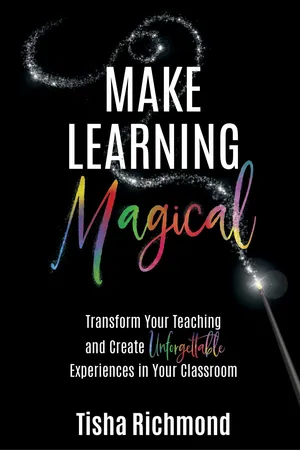
In Make Learning MAGICAL, educator Tisha Richmond pulls back the curtain to reveal strategies you can use to transform your classroom. Laughter, fun, and gamified experiences can make school a place where students are inspired, empowered, and immersed in learning—and it doesn't require illusions or smoke and mirrors. The actionable techniques Tisha shares will equip you to put your students center stage in their learning experiences.
eBook - ePub
Make Learning Magical
Transform Your Teaching and Create Unforgettable Experiences in Your Classroom
- English
- ePUB (mobile friendly)
- Available on iOS & Android
eBook - ePub
Make Learning Magical
Transform Your Teaching and Create Unforgettable Experiences in Your Classroom
About this book
Information
Topic
EducationSubtopic
Education General1
Magical Learning
Ask what makes you come alive and go do it. Because what the world needs is people who have come alive.Howard Thurman
I have two children, both extremely intelligent but wired differently. My daughter has always played the game of school really well. She understands the rules, and when they change slightly from one teacher to the next, she adapts. My son, on the other hand, has never quite understood the game. He is an out-of-the-box thinker who, instead of learning the rules, wants to make his own. He always seeks to understand the relevance of what he is learning and how it connects to life. I get that because I remember sitting in class listening to the teacher’s instructions with all my might. I wanted to understand what was being said but was often unable to connect the pieces. It was common for me to turn to my neighbor after receiving an assignment and ask in embarrassment, “So what are we supposed to do?” In the few classes that had me up and moving, creating, thinking critically, and collaborating, I found ways to make meaningful learning connections. I thrived in those classes. Unfortunately, I didn’t have enough of these experiences to find my true passion or to discover joy in learning; in fact, I went through my high school years feeling like I wasn’t smart or creative enough to reach for my dreams. I went to college with no idea about what I wanted to do. I hoped that, somehow, I would find my passion along the way. Interestingly enough, it was not knowing that helped me find my true calling.
Some people feel an inexplicable pull toward education. For others, teaching is a childhood dream come true. My story isn’t so romantic. Having begun college with an undeclared major, I felt a wave of terror when, at the end of my sophomore year, my college guidance counselor told me, “Tisha, your time is up. You must declare a major.”
Although I didn’t have a career path mapped out, I knew I wanted to make a difference in the lives of others. I had no clue what that would look like, and quite frankly, I lacked the confidence to believe I could make a meaningful impact. In retrospect, I can see that my own confusion and fear about not knowing what to do with my life served as the catalyst that propelled me toward education; I wanted to help students discover their life’s purpose. With that passion as my purpose, I have taught more than 5,040 students in the past twenty-plus years. It brings me such joy to know I have had the opportunity to help so many students discover their passions and become empowered to pursue them. The best moments I have experienced in my career are those when the light in my students’ eyes shine—and you can all but see them thinking, I can learn this. I want to learn this. And even better, I want to share this with others! To me, that’s magical.
Don’t Miss the Magic
Magical moments are rare in most classes—and in life in general. Or rather, they are rarely noticed. One day during my holiday shopping a few years back, I came across a wall hanging with a Roald Dahl quote that made me pause:
“And above all, watch with glittering eyes the whole world around you because the greatest secrets are always hidden in the most unlikely places. Those who don’t believe in magic will never find it.”
The words made me think: How often do I miss the magic in the mundane and busy moments of life? Do I truly watch the world around me with glittering eyes, or am I too hurried, consumed, and pre-occupied to notice?
From that moment, I tried to be intentional about enjoying the slower pace of what was left of the winter break. I determined to view the world through glittering eyes and experience the magic of life. Just a few days later, the girls in my family went to a local musical production of Mary Poppins. As the stage came to life with singing, dancing, beautiful costumes, and special effects, I watched my six-year-old niece’s eyes glitter with wonder. She was completely mesmerized by every scene.
I could relate because I felt the same excitement and wonder the first time I watched Mary Poppins at the movie theater as a child. It quickly became my favorite movie. I listened to the soundtrack on a record over and over again until I had memorized the words to every song. I can still remember hanging upside down on our backyard jungle gym repeating the word “Supercalifragilisticexpialidocious” until I was able to speak it fluidly. But I didn’t stop there. Once I had mastered learning how to say that fantastical word, I learned how to say it backwards. The magic of Mary Poppins captivated me; I wanted to bring that magic into my own life by learning everything I could about it.
That is how I want my students to feel about learning in my classroom. I want their eyes to glitter with anticipation and wonder. I want them to go home and take the learning further by practicing the cooking methods and adding their own special twists and creative touches. I always hope they will share their learning with others by serving their creations to their family and friends. The goal is to do far more than create one-off experiences. Each magical learning moment will lead to another. If you watch for magic, it can become an everyday occurrence.
A Spoonful of Sugar
Mary Poppins knew how to make even the most mundane tasks fun and memorable. When she sang “A Spoonful of Sugar,” the chore of cleaning turned into a game, which makes me think, Why do we so often treat learning like a chore? What if we approached learning itself as fun—as something to be undertaken in wonder, curiosity, and play?
My childhood hero, Fred Rogers, said, “Play is often talked about as if it were a relief from serious learning. But for children, play is serious learning. Play is really the work of childhood.” I have found this statement to be absolutely true in my teaching experience and have worked hard to create a classroom environment that makes exploration and play integral in the classroom. The truth is that no matter what topic, when we are doing something we enjoy, the learning becomes meaningful; we make associations with the learning that are rich and memorable.
Play and fun are not synonymous with simple and easy. There is an abundance of challenge, strategy, and deep thinking associated with play. My six-year-old niece has a wild imagination. I’m always astonished by the stories she conjures up when we play together. We’ll often enter a make-believe world where our surroundings come to life (not unlike the world of Mary Poppins). The impressive degree of creativity she uses to develop this world and the vocabulary she engages in are almost always related to things she’s recently experienced or learned at school. Playing make-believe is her way of demonstrating her understanding of the world around her. Board games reveal another aspect of play. Each move she makes shows the strategy and deep thinking she is experiencing. She is immersed fully and thinking about what she needs to do to win!
When students learn through play, it changes their perspective from one of compliance to one of wonder and curiosity. It allows them to delve deeper into the content, ask questions, and think more critically about what they are learning than if I simply feed them information to memorize. When students experience learning this way, they are truly able to tap into the joy of learning and discover their passions. Creating a classroom that is playful is all about mindset and how you approach learning. If you get excited and show enthusiasm for what you are teaching, your enjoyment will be contagious. Students will catch it, and their mindset toward learning will change, too, from a chore to one of curiosity. Making this move toward play doesn’t necessarily mean completely uprooting all of the teaching practices you’ve honed over the years. Start thinking about your course content in a playful way, and just as Mary Poppins suggests, “find the fun, and snap! The job’s a game!”
Laughter Is the Best Medicine
One of the most enjoyable side effects of play is laughter. You’ve heard the saying, “Laughter is the best medicine.” I completely agree. I can immediately think of the people in my life who are “contagious laughers.” They find the funny in most any situation, and their laughter is so contagious that soon, everyone around them is laughing too.
My mom is one of my favorite contagious laughers. Her ability to find the humor in life makes her fun to be around. She is the best person to watch a comedy with because her laugh is so genuine and boisterous that the whole room rolls laughing right along with her.
In Mary Poppins, Bert, played by Dick Van Dyke, is a “contagious laugher.” Bert is a kite salesman, chimney sweep, one-man band, and sidewalk chalk artist, and he finds joy in each job. A song that demonstrates his joy beautifully is “I Love to Laugh” that he sings with Uncle Albert, who suffers from a serious condition that is triggered by laughing. When he gets going, he can’t stop, and that uncontrollable laughter causes him to float to the ceiling. As Bert, Mary Poppins, and the children arrive to help Uncle Albert off the ceiling, Bert says, “Whatever you do, keep a straight face. Last time it took us three days to get him down.” Of course the more they all try to keep a straight face, the more they laugh, and before long, they’re all floating and singing about how much they love to laugh.
Laughter, like smiling, is contagious. When we are around laughter, it’s difficult not to join in. Someone begins to giggle, and before long, others do too. And that’s a good thing! In a Forbes magazine article titled “Six Science-Based Reasons Why Laughter Is the Best Medicine,” the writer refers to laughter as a “potent drug with the contagious power of a virus that conveys a slew of benefits for the mind and body.” Among the benefits listed are . . .
Laughter is a potent endorphin releaser.
Laughter contagiously forms social bonds.
Laughter fosters brain connectivity.
Laughter is central to relationships.
Laughter has an effect similar to antidepressants.
Laughter protects your heart.
Wow! Those are some pretty powerful benefits! I want to be more like Bert and Uncle Albert, fostering a classroom so full of joy from contagious laughter and learning that I can’t get my students down from the ceiling. I want to create learning opportunities that foster laughter . . .
More play,
More games,
More challenges,
More creativity,
More wonder,
More collaboration,
More silliness.
Because laughter, like play—like magic—makes learning stick. Joy-filled moments make learning meaningful. They help students make connections to the material in ways that stodgy, traditional teaching approaches simply can’t.

Create Magical Experiences
We can be intentional about creating magical experiences for our students just as the amazing cast of Mary Poppins did. Magic is all around us if we truly look for it; it’s all about perspective. Stop for a moment and con...
Table of contents
- Praise for Make Learning Magical
- Title Page
- Copyright
- Dedication
- Contents
- What’s the Secret Ingredient?
- Introduction
- 1. Magical Learning
- 2. Memorable Beginnings
- 3. Authenticity and Agency
- 4. Gamified Experiences
- 5. Innovation
- 6. Creativity, Collaboration, and Curiosity
- 7. Authentic Audience
- 8. Legacy
- 9. Go Make Some Magic!
- Invite Tisha Richmond to Bring a Little Magic to Your School or District
- More from Dave Burgess Consulting, Inc.
- About the Author
Trusted by 375,005 students
Access to over 1.5 million titles for a fair monthly price.
Study more efficiently using our study tools.
Frequently asked questions
Yes, you can cancel anytime from the Subscription tab in your account settings on the Perlego website. Your subscription will stay active until the end of your current billing period. Learn how to cancel your subscription
No, books cannot be downloaded as external files, such as PDFs, for use outside of Perlego. However, you can download books within the Perlego app for offline reading on mobile or tablet. Learn how to download books offline
Perlego offers two plans: Essential and Complete
- Essential is ideal for learners and professionals who enjoy exploring a wide range of subjects. Access the Essential Library with 800,000+ trusted titles and best-sellers across business, personal growth, and the humanities. Includes unlimited reading time and Standard Read Aloud voice.
- Complete: Perfect for advanced learners and researchers needing full, unrestricted access. Unlock 1.5M+ books across hundreds of subjects, including academic and specialized titles. The Complete Plan also includes advanced features like Premium Read Aloud and Research Assistant.
We are an online textbook subscription service, where you can get access to an entire online library for less than the price of a single book per month. With over 1.5 million books across 990+ topics, we’ve got you covered! Learn about our mission
Look out for the read-aloud symbol on your next book to see if you can listen to it. The read-aloud tool reads text aloud for you, highlighting the text as it is being read. You can pause it, speed it up and slow it down. Learn more about Read Aloud
Yes! You can use the Perlego app on both iOS and Android devices to read anytime, anywhere — even offline. Perfect for commutes or when you’re on the go.
Please note we cannot support devices running on iOS 13 and Android 7 or earlier. Learn more about using the app
Please note we cannot support devices running on iOS 13 and Android 7 or earlier. Learn more about using the app
Yes, you can access Make Learning Magical by Tisha Richmond in PDF and/or ePUB format, as well as other popular books in Education & Education General. We have over 1.5 million books available in our catalogue for you to explore.