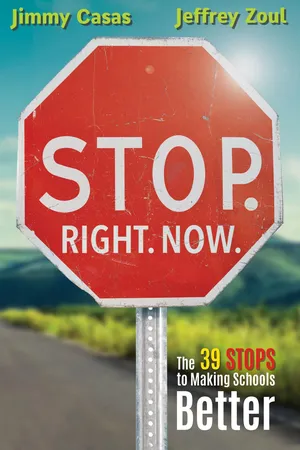
In Stop. Right. Now. authors and education leaders Jimmy Casas and Jeffrey Zoul identify 39 practices, programs, processes, philosophies, and people problems that schools must eliminate in order to improve education for students—and the the entire school community. The status quo and average results are no longer acceptable! There are some "best practices" that we simply need to stop right now.
- English
- ePUB (mobile friendly)
- Available on iOS & Android
eBook - ePub
About this book
Trusted by 375,005 students
Access to over 1.5 million titles for a fair monthly price.
Study more efficiently using our study tools.
Information
Topic
EducationSubtopic
Education GeneralPART ONE
Let’s Start … STOPPING
THE “PITSTOP” AREAS

When we began examining “things to stop” in education, our initial list ranged in scope, size, and type. We eventually organized (albeit loosely and unscientifically) our “stops” into five “Pitstop” Areas, each beginning with the letter P: practices, programs, processes, philosophies, and people. Each Stop probably falls into at least two, and in some cases perhaps all five, Pitstop Areas, though most are strongly aligned to a single area. Although what educators need to start—and continue—doing in education can also be placed into one or more of these five areas, our purpose here is to identify a variety of ineffective, inefficient, unimportant, and nonurgent things educators should simply stop doing in schools. And the sooner, the better. Preferably now.
Practices
Many Stops described in this book are the actions educators take or the techniques they employ each day, individually as educators or collectively as teams, schools, or entire districts. All you can do is use the best teaching or leadership practices you know today. When you learn better practices, you need to stop using your old ones and start using the better ones.
Programs
Schools can adopt an almost limitless number of educational programs, most of which come with a financial commitment. Although some programs are more effective than others, no program by itself guarantees school or classroom success—or failure. You must be very selective about which programs you adopt and regularly reevaluate those you select to ensure they are producing the desired results. If they are not, you should stop using them.
Processes
Some Stops in education relate to the processes you follow in your work. These processes must be as efficient as possible while yielding specific results you should be able to measure. When you learn that a process is not effective, you should stop following it.
Philosophies
If we had not wanted another “P” word, we could have called this category “Mindsets.” Many of the Stops in education involve the views educators hold, the long-held philosophies they believe simply because they have always believed them. In recent years, much has been written about promoting a “growth mindset,” and we applaud this movement. We believe a growth mindset should apply to everything educators believe about education. Philosophies—just like programs—should be periodically reviewed and evaluated. When you find a better mindset for the work you do, you should stop holding onto a philosophy solely for the sake of tradition.
People
We realize this Pitstop sounds a bit harsh at first glance. Stop people?! However, we consider this “P” the most important component of any school. People are so important, in fact, that educational leaders must ensure they have the right people serving in the right roles at the right times. If they do not, they must act, and act swiftly. Todd Whitaker’s wisdom is compelling: Programs are never the problem in our schools and they are never the solution. People are always the problem—and they are always the solution.
Let us be clear: Most educators we know are hardworking, dedicated professionals whose hearts are in the right place. Let us also be honest: In every school district we visit, we find a handful of staff who probably should not be working with kids—or at least should be working in a different role from the one they currently hold. Educational leaders must do everything in their power to select the right people for every position in every school. We know this may sound harsh, but leaders also must stop allowing the ineffective to serve. The work of an educator—and the students they serve—is too important to settle for less than the very best.
THE 39 STOPS
STOP. RIGHT. NOW. is a manifesto of sorts, in which we share our views on thirty-nine things educators can stop doing, improving the future of society by improving the future of education. The idea to begin a conversation and a call to action with this number of Stops came about, in part, from Jeff’s interest in classic movies. He was watching Hitchcock’s The 39 Steps when Jimmy contacted him with the idea for this book. Thus, “The 39 Stops” were born. Although this list is by no means exhaustive, we feel strongly it provides—somewhat ironically—a starting point for what to stop.
Each of these Stops applies to the Pitstop Areas introduced previously. We did not organize these Stops in any particular manner; however, we do suggest which of the five Pitstops each Stop might apply to. Our general approach within each Stop is to …
- describe the item
- suggest why it must stop
- offer thoughts on how educators can do better
We realize a book about things educators should stop doing could be perceived as negative or as a collection of complaints. Please know that our intent is precisely the opposite. Our hope is that this discussion is an affirmation of what excellent educators currently do, as well as a provocative, positive call to action for all educators to insist on what works, while getting rid of what doesn’t. Together we can make a difference.
Schools are inspiring and joyous places, but they can be so much better. In some ways, however, for them to be more, they must first be less. Thank you for joining us in this campaign to …
- put an end to more solely for the sake of more
- stop doing things merely because they have always been done
- hold off full-scale adoptions of new elements and, instead, insist on new and better
- do whatever it takes—including saying no to what doesn’t work—to best serve schools and students
Finally, we realize that thirty-nine Stops in education merely scratches the surface, and we invite you to join the discussion. What additional things are not working in your district, school, or classroom? What practices are no longer effective? What philosophies or mindsets are getting in the way of forward progress? What processes are bogging you down? What programs are lacking proven results? What types of people are inhibiting the very best outcomes for students? We invite you to connect with us at any time and share your thoughts via Twitter, using the hashtag #StopRightNow.
PART TWO
Let’s STOP …
STOP #1
Making Assumptions
Possibly the most formidable obstacle standing in the way of educators making changes in education—particularly deciding to stop something they currently do—is their proclivity for assuming that they cannot change the current reality. They must stop making these types of assumptions. Frankly, they should stop making assumptions at all.
We experienced a small case in point recently. I (Jeff) was listening to a phone conversation between Jimmy and a close friend of ours, who happens to be one of the most passionate educators we know. I heard Jimmy consoling our friend, telling her it was fine for her to back out of a commitment she had made to us. I became visibly agitated and insisted to Jimmy that she honor her commitment. Still on the phone and now clearly agitated himself, Jimmy waved away my comments and finished his conversation. When he hung up, Jimmy turned to me and said, “Would you please stop making assumptions?”
I had a humbling—if not humiliating—moment. However, it opened my eyes to the perils of making assumptions. When Jimmy explained why our friend called to cancel her commitment, I realized her reason was significant and something she had agonized over. Frankly, I wanted to crawl under a rock and hide, knowing that I had assumed the worst about someone we both respect a great deal. Based solely on limited information from one side of a conversation, I had assumed I knew why she was canceling.
Why Must It Stop?
Too often we are guilty of making assumptions instead of truly trying to understand another person’s motives, perspectives, and actions. We know many other educators who have fallen prey to this trap as well. They are so busy and stressed that they simply begin making assumptions about why people act the way they do, whether it is a student who misbehaves, a parent who gets upset with them, or a colleague who lets them down. Jumping to conclusions never helps and only increases the likelihood of misunderstandings, sadness, and drama. Making assumptions is bad enough in one’s personal life, but when educators make them in schools and classrooms, they are failing in a critically important arena and perhaps creating long-lasting repercussions.
How Can Educators Do Better?
One of the best changes educators can make is to stop making assumptions altogether. Alternatively, educators could choose to assume the best about others—giving them the benefit of the doubt, delaying judgment, or asking more questions to ensure they have as much information as possible. Perhaps the student wants to please you and is trying to find a way to let you know she needs help. Maybe the parent has been working two jobs to make ends meet and wants the very best for his child. Perhaps the colleague respects you and wants to help but is unsure about his own capabilities and is afraid he will let you down.
Educators must stop making assumptions based on limited information or on the belief that they cannot change what is currently in place. If you must make an assumption, assume the best—about students, parents, fellow teachers, and your ability to effect dramatic change when you believe there is a better way forward for education. This Stop alone can completely t...
Table of contents
- INTRODUCTION
- PART ONE
- THE “PITSTOP” AREAS
- THE 39 STOPS
- PART TWO
- STOP #1
- STOP #2
- STOP #3
- STOP #4
- STOP #5
- STOP #6
- STOP #7
- STOP #8
- STOP #9
- STOP #10
- STOP #11
- STOP #12
- STOP #13
- STOP #14
- STOP #15
- STOP #16
- STOP #17
- STOP #18
- STOP #19
- STOP #20
- STOP #21
- STOP #22
- STOP #23
- STOP #24
- STOP #25
- STOP #26
- STOP #27
- STOP #28
- STOP #29
- STOP #30
- STOP #31
- STOP #32
- STOP #33
- STOP #34
- STOP #35
- STOP #36
- STOP #37
- STOP #38
- STOP #39
- PART THREE
- START. STOP. CONTINUE.
- CONCLUSION
- BIBLIOGRAPHY
- More From Dave Burgess Consulting, Inc.
- ABOUT THE AUTHORS
Frequently asked questions
Yes, you can cancel anytime from the Subscription tab in your account settings on the Perlego website. Your subscription will stay active until the end of your current billing period. Learn how to cancel your subscription
No, books cannot be downloaded as external files, such as PDFs, for use outside of Perlego. However, you can download books within the Perlego app for offline reading on mobile or tablet. Learn how to download books offline
Perlego offers two plans: Essential and Complete
- Essential is ideal for learners and professionals who enjoy exploring a wide range of subjects. Access the Essential Library with 800,000+ trusted titles and best-sellers across business, personal growth, and the humanities. Includes unlimited reading time and Standard Read Aloud voice.
- Complete: Perfect for advanced learners and researchers needing full, unrestricted access. Unlock 1.5M+ books across hundreds of subjects, including academic and specialized titles. The Complete Plan also includes advanced features like Premium Read Aloud and Research Assistant.
We are an online textbook subscription service, where you can get access to an entire online library for less than the price of a single book per month. With over 1.5 million books across 990+ topics, we’ve got you covered! Learn about our mission
Look out for the read-aloud symbol on your next book to see if you can listen to it. The read-aloud tool reads text aloud for you, highlighting the text as it is being read. You can pause it, speed it up and slow it down. Learn more about Read Aloud
Yes! You can use the Perlego app on both iOS and Android devices to read anytime, anywhere — even offline. Perfect for commutes or when you’re on the go.
Please note we cannot support devices running on iOS 13 and Android 7 or earlier. Learn more about using the app
Please note we cannot support devices running on iOS 13 and Android 7 or earlier. Learn more about using the app
Yes, you can access Stop. Right. Now. by Jimmy Casas, Jeff Zoul in PDF and/or ePUB format, as well as other popular books in Education & Education General. We have over 1.5 million books available in our catalogue for you to explore.