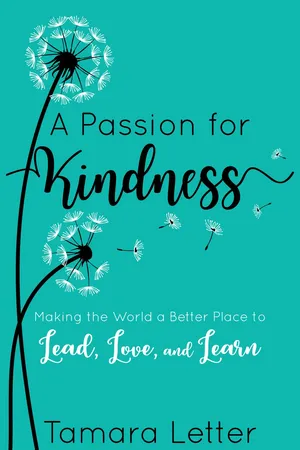
eBook - ePub
A Passion for Kindness
Making the World a Better Place to Lead, Love, and Learn
- English
- ePUB (mobile friendly)
- Available on iOS & Android
eBook - ePub
About this book
In a fast-paced era of technological advances and digitized experiences, it's easy to miss simple opportunities to strengthen our humanity. But when we watch for and respond to those moments with kindness, even tiny actions can renew hope and reveal compassion and gratitude. In A Passion for Kindness, educator Tamara Letter shares her own kindness journey and showcases experiences from other kindness cultivators around the world. Through personal stories of vulnerability and vitality, you will discover unique ways you can make a positive difference in the lives of friends, family, coworkers, neighbors, and even strangers.
Trusted by 375,005 students
Access to over 1.5 million titles for a fair monthly price.
Study more efficiently using our study tools.
Information
Topic
EducationSubtopic
Education GeneralPart I
Seeds of Inspiration

If I cannot do great things, I can do small things in a great way.Martin Luther King, Jr.
1
The Power of Words

Kind words can be short and easy to speak, but their echoes are truly endless.Mother Teresa
“Has anyone ever been the new kid in town? Anyone move in the middle of a school year? What was that like for you?”
I posed that question to a class of fifth graders, who immediately raised their hands and voices, eager to share stories of feeling awkward and uncomfortable, of being afraid, embarrassed, and humiliated. But not one student shared a story of kindness.
I dug a little deeper with my questioning. “What was it like that first day? What do you remember?”
More stories of fear and nervousness, wanting to cry, feeling the glare of others staring back at you. Still no kindness.
Eventually a soft-spoken girl raised her hand to speak.
“The first day was hard, but my teacher was really nice to me.”
Other students turned to face her, and I breathed a sigh of relief.
Finally. Something positive.
Once she shared her experience, another girl chimed in with a happy memory, then another, and another, and another. All of a sudden, this class that, moments before, was knee-deep in sorrow and despair had sailed into a calmer sea of fond reflections. Unfortunately, we still had one glaring problem before us, the elephant in the room.
Many of these students were not being kind to one another.
I brought them together to share my own personal story of being the new kid in town. I wanted them to see the power of their words and how words spoken at the age of ten could still resonate in the heart of an adult decades later. This is where my kindness story begins.
The Picked-On Kid
I was the picked-on kid. Short. Freckles. Glasses. A recipe for social disaster when you’re the new kid in town. We had moved only ten miles east, but you would have thought we landed in a new world. Everything was different.
New house. New school. New rules.
It was the middle of my third-grade year, and all I saw was loss. Before my mom could finish packing my metal Strawberry Shortcake lunchbox, I knew my first day would be a disaster. I didn’t want to leave the friends I knew so well. I didn’t want a new beginning, and I was filled with conflicting emotions that I couldn’t describe. Everything felt out of control.
My panic rose as I walked through the unfamiliar hallways on that first day in my new school. What if I entered the wrong classroom? What if nobody played with me at recess? What if I had to go to the bathroom? What if I got on the wrong bus to go home? I was consumed with worry and wanted to run away, but there was nothing I could do to relieve the fear. I had to enter the classroom and find my seat.
That’s when I heard the whispers.
“She’s the new kid.”
“Where did she come from?”
“What’s her name again? Tammy . . . PAYNE?”
“Oh yeah, I bet she is a pain, too. You can already tell.”
“Her glasses look like Coke bottles.”
I had barely taken off my coat when the cruel words filled my ears. It was the first time I realized my last name was a homophone. Their careless comments reddened my cheeks as I slid farther down in my seat, the fear and embarrassment immobilizing any attempt at unpacking my supplies.
I was the new kid in class, and they already hated me.
I paused my story, the past fading into present day as I looked at the fifth graders sitting there. The silence in the room was deafening. Some students fiddled with their fingers in their laps. Some looked away when my eyes met theirs. Everyone felt the weight of my words.
“That happened to me when I was eight years old. I am now in my forties, and I can still hear their taunts in my mind as if it was yesterday. I am sharing this story with you for one reason alone: Your. Words. Matter. Choose them wisely, for they will last longer than the notebooks you are writing in today.”
When students were given an opportunity to share their voices by completing an online survey on friendship, they poured their hearts out on the final question: “What do I want my teacher to know?”
Their responses revealed who was being excluded and why, who got into an argument with a friend, and who was not playing fairly at recess. When given a chance to share their voices, it was clear who was being kind and who was not. It was time to readjust my lessons. I needed to provide some intentional grouping with a variety of activities that provided more opportunities for communication and collaboration. I had to reflect on the words I used with students. Did they lift others up or tear them apart? How did my responses translate back to them? These insights into my own behavior reminded me, yet again, of the power of words.
The Social Dilemma
Social dynamics in the classroom can make or break your year. Students spend at least six hours a day in the confines of a classroom or a school, and during that time they are expected to master the curriculum taught while also navigating the tumultuous waters of social interaction. Are we guiding them in the power of their words as they do this?
How do we approach students who are being unkind with their words? Is it their issue or one we pass along to the school counselor, assuming they will be able to fix the problem? Do we interrupt them halfway through their comment in class, with no alternative way for them to share their thoughts with others? What is our role in shaping students as they converse with their classmates?
Every person in the school community has a stake in the game of guiding students to be respectful, productive citizens. We can’t turn away and assume someone else will deal with the issues that arise. When we sign that contract each year to continue our journey as educators, we commit to teaching students not only the state-mandated curriculum but also the unspoken nuances of working together, building relationships, and growing into adults who can harness their own potential to make their mark in this world.
What opportunities are we providing students to practice these skills in class? Are we teaching them to be aware of the weight of their words?
It starts with us.
In Chapter 5 of Shift This!: How to Implement Gradual Changes for MASSIVE Impact in Your Classroom, Joy Kirr provides practical examples of how to shift discussions in the classroom so that students are empowered to share their voices:
- Whole-group Discussions: All students respond to one question with a limited number of answers, splitting the room into halves or fourths, then take turns to share their perspectives in a respectful way.
- Fishbowl Discussions: A small group of students sit in the center of the room with remaining classmates spanning out in circles behind to act as observers or recorders until they want to join in the conversation.
- Backchannel Discussions: Students add their thoughts to a discussion digitally without speaking aloud.
- EdCafes: Questions are placed around the room to prompt small group discussions based on interest or preference.
- Harkness Method: Students sit around a table and discuss questions about their current topic of study.¹
Whether you implement traditional modes of communication such as speaking face-to-face or choose to demonstrate the power of technological tools such as Google Apps, Flipgrid, or Seesaw, student voice is essential to creating a kind culture in and out of the classroom. It’s imperative to provide a safe place where students can practice digital communication before they engage in real-time online banter, which can have life-changing consequences if used inappropriately.
Kind words are evident in our day-to-day lives. The challenge is recognizing those moments when they occur. Starbucks employees ask for your name so when your order is ready, it’s a more personable experience than just shouting out, “Who ordered the tall, skinny, nonfat, mocha latte?” Chick-fil-A employees complete every action with, “My pleasure.” These simple statements are small, yet powerful, ways to make someone’s day a little brighter.
Whether you are an educator, business owner, parent, or coworker, the same principles apply.
Your. Words. Matter.
To boost the impact of your message, reflect on the words you use with others on a regular basis: in conversations, d...
Table of contents
- Cover
- Endorsements for A Passion for Kindness
- Title Page
- Copyright
- Dedication
- Contents
- What Goes Around
- Part I
- Part II
- Kindness Campaigns and Organizations
- Notes
- Acknowledgments
- Invite Tamara Letter to your school, business, or social event.
- More from Dave Burgess Consulting, Inc.
- About the Author
Frequently asked questions
Yes, you can cancel anytime from the Subscription tab in your account settings on the Perlego website. Your subscription will stay active until the end of your current billing period. Learn how to cancel your subscription
No, books cannot be downloaded as external files, such as PDFs, for use outside of Perlego. However, you can download books within the Perlego app for offline reading on mobile or tablet. Learn how to download books offline
Perlego offers two plans: Essential and Complete
- Essential is ideal for learners and professionals who enjoy exploring a wide range of subjects. Access the Essential Library with 800,000+ trusted titles and best-sellers across business, personal growth, and the humanities. Includes unlimited reading time and Standard Read Aloud voice.
- Complete: Perfect for advanced learners and researchers needing full, unrestricted access. Unlock 1.5M+ books across hundreds of subjects, including academic and specialized titles. The Complete Plan also includes advanced features like Premium Read Aloud and Research Assistant.
We are an online textbook subscription service, where you can get access to an entire online library for less than the price of a single book per month. With over 1.5 million books across 990+ topics, we’ve got you covered! Learn about our mission
Look out for the read-aloud symbol on your next book to see if you can listen to it. The read-aloud tool reads text aloud for you, highlighting the text as it is being read. You can pause it, speed it up and slow it down. Learn more about Read Aloud
Yes! You can use the Perlego app on both iOS and Android devices to read anytime, anywhere — even offline. Perfect for commutes or when you’re on the go.
Please note we cannot support devices running on iOS 13 and Android 7 or earlier. Learn more about using the app
Please note we cannot support devices running on iOS 13 and Android 7 or earlier. Learn more about using the app
Yes, you can access A Passion for Kindness by Tamara Letter in PDF and/or ePUB format, as well as other popular books in Education & Education General. We have over 1.5 million books available in our catalogue for you to explore.