eBook - ePub
Available until 23 Dec |Learn more
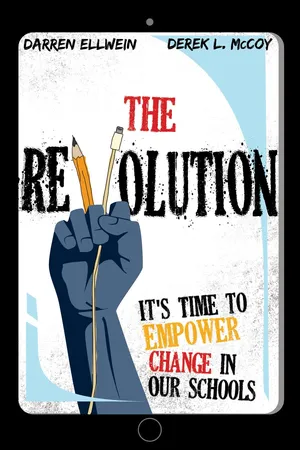
The Revolution
It's Time to Empower Change in Our Schools
This book is available to read until 23rd December, 2025
- English
- ePUB (mobile friendly)
- Available on iOS & Android
eBook - ePub
Available until 23 Dec |Learn more
About this book
No revolution is easy, but with our learners' futures at risk, the stakes in education have never been higher. In The Revolution, Darren Ellwein and Derek McCoy lead the charge for change by identifying ways that passionate, forward-thinking educators can inspire globally connected cultures of innovation and creativity.
Frequently asked questions
Yes, you can cancel anytime from the Subscription tab in your account settings on the Perlego website. Your subscription will stay active until the end of your current billing period. Learn how to cancel your subscription.
No, books cannot be downloaded as external files, such as PDFs, for use outside of Perlego. However, you can download books within the Perlego app for offline reading on mobile or tablet. Learn more here.
Perlego offers two plans: Essential and Complete
- Essential is ideal for learners and professionals who enjoy exploring a wide range of subjects. Access the Essential Library with 800,000+ trusted titles and best-sellers across business, personal growth, and the humanities. Includes unlimited reading time and Standard Read Aloud voice.
- Complete: Perfect for advanced learners and researchers needing full, unrestricted access. Unlock 1.4M+ books across hundreds of subjects, including academic and specialized titles. The Complete Plan also includes advanced features like Premium Read Aloud and Research Assistant.
We are an online textbook subscription service, where you can get access to an entire online library for less than the price of a single book per month. With over 1 million books across 1000+ topics, we’ve got you covered! Learn more here.
Look out for the read-aloud symbol on your next book to see if you can listen to it. The read-aloud tool reads text aloud for you, highlighting the text as it is being read. You can pause it, speed it up and slow it down. Learn more here.
Yes! You can use the Perlego app on both iOS or Android devices to read anytime, anywhere — even offline. Perfect for commutes or when you’re on the go.
Please note we cannot support devices running on iOS 13 and Android 7 or earlier. Learn more about using the app.
Please note we cannot support devices running on iOS 13 and Android 7 or earlier. Learn more about using the app.
Yes, you can access The Revolution by Derek McCoy, Darren Ellwein in PDF and/or ePUB format, as well as other popular books in Education & Education Teaching Methods. We have over one million books available in our catalogue for you to explore.
Information
Topic
EducationSubtopic
Education Teaching MethodsChapter 1
The True Revolution@ries

Don’t wait for the perfect moment, take a moment and make it perfect.
—Aryn Kyle
Like most educators, our experience as students led us to this great profession. The entertaining and knowledgeable teachers we had growing up provided us with some memorable classroom experiences, and those memories drive us to create that same kind of learning environment for our own students. Even our not-so-great teachers served as examples by showing us what not to do in the classroom.
My (Derek) middle school experience happened more than thirty years ago in a small, rural town in Georgia. It was a model of textbook classrooms:
- Desks in rows, perfectly aligned
- Teacher’s desk immaculate and separate (remember those old-school brown planners?)
- Students arranged by last name or grade
- Quiet
- Chalkboards in the front
- Learning meant giving the right answers, reciting definitions, or spelling words correctly
- Textbooks were the curriculum
- Teacher-driven classes
- Regimented classes with fixed grading
- Homework was always a couple of pages in the textbooks (and if you were lucky, you could find the answers in the back)
Our days were pretty standard and designed to be that way day after day, year after year. It was a measure of success—teacher standing at the front of the classroom, students facing forward and working quietly while following the teacher’s instructions to the letter. Success was measured by compliance and reduced noise levels. In our small community, my teachers knew me because they had taught my family members and because my mother worked as a professional. But I think it’s safe to say they didn’t know the real me—how much I needed to move, how I liked to socialize, how I disliked drawing and handwriting, and how competitive I was. They didn’t really know how I learned. In most of our classes, the teacher would tell a story or make a presentation or offer a demonstration, and we would watch from our seats. Independent research was limited to reading the textbook pages the teacher assigned, completing the work, and waiting on our grade to indicate whether or not we learned something.
This isn’t criticism. Our teachers did the best they could with the resources they had at the time. And more importantly, they were good people implementing systems and practices they learned from others that were the agreed-upon best strategies at the time. The one-room schoolhouse mindset is powerful and deeply embedded in our society and what we believe about education. That model focused on control and work completion. There have always been those who believe learning is different from what we practice in schools, but it has been hard for that belief to take root. Unless we are on a mission to unlearn the trappings of our traditional educational experiences, we are doomed to repeat and reinforce this cycle.
Back to my own experience. In our school we had an ‘A’ class and a ‘B’ class, and they were exactly what they sound like. Once in them, students could not move out or change groups. Regardless of maturity or progress over time, once a student was labeled, that was it. It’s not a stretch to say that our present tendency to label or separate some students from others is a carryover from those days. How do you see it in your school? Is the teaching in those classes equitable? Is there any flexibility for students who may blossom later than others or have the benefit of a teacher who fires them up? Are all students getting an equal shot at all levels of opportunity or learning? We once called this tracking, but whatever name we place on it, it means the same thing—some get more than others.
Rectifying this has become a mission of ours. I was fortunate to have had one parent who worked in my school and fought hard to keep her active son out of remedial classes at the urging of teachers. My mother still fondly talks about her fight to keep me from being tested for remedial classes. To her credit, in the third grade our school got its first gifted teacher who also tested all students, and once she tested me, she validated my mom’s thoughts with a simple statement all progressive educators are familiar with: you all aren’t teaching him how he needs to be taught. It turns out I loved to read anything about Greek and Roman mythology and loved to talk about it!
I want to state plainly here that I am not bashing my teachers. I loved them for what they committed to do every day, and they genuinely loved me. They came to school to make a difference for us, to be a difference. The women in my small rural town knew that if they didn’t commit to educating us, it wouldn’t happen. We loved them for what they did.
But it does lead to some reflection points: Why did you decide to become a teacher? Was your goal to duplicate the learning experience you had when you were in school? Are you looking to give your students the same middle school experience you had?
If you’re like me, someone who attended middle school thirty years ago, the answer is probably an emphatic “No!” Not only because they don’t make film strip projectors anymore, but also because you have a strong conviction that much of your own middle school experience should not be repeated or held up as a best practice. There is much room for improvement. Now apply that thought to your elementary, high school, or collegiate experience—would you want to give that same experience to your students? Would you want that same experience for your own children?
Every Revolution Needs a Good Teacher
Take a look around your classroom and/or school and reflect on your answer. Do you see practices and results that reflect your answer? Darren and I had to admit that we didn’t see them in our own schools.
I became an educator after a heart-to-heart with my former wife. It took a good, frank talk to help me put some cold, hard facts on the table about my pursuit of a graduate degree in political theory. The most important fact? I absolutely wasn’t passionate about it.
The only jobs I had enjoyed had been in college when I tutored students in math in non-traditional settings that allowed us to fill in gaps and have good conversations.
If I were to work with students in a classroom, where could I have the most fun and impact? The clear answer for me was in a math classroom, not in a political science classroom.
Although those talks happened more than twenty years ago, I remember them like we had them yesterday. I remember sharing with my wife about two of my high school teachers who were great influences in my life. One of those teachers was Mr. Stubbs, my tenth-grade geometry teacher. Back in the day, we taught geometry with proofs (a lost art form), so not only did you have to know math, but you also had to be able to articulate the process, especially when there was a problem on the board. Mr. Stubbs was a great teacher—he was funny, knowledgeable about math, and he took time to know his students well. He made the uncomfortable work of doing math proofs in front of the class fun, describing it as creating a feeling of “elation.” When I reflect on Mr. Stubbs’ class, my memories are primarily positive. In his classroom, I felt entertained, I felt smart, I knew I belonged there, and I actually learned a great deal. That kind of classroom, I told my wife, was what I wanted to create.
When my wife, Fatima, and I talked, we didn’t make a list of qualities for my ideal classroom, but if we had, I think it would have looked something like this:
- A fun, inviting learning environment
- Challenging curriculum
- Lots of laughter and talks with friends
Think about your list. Why did you become a teacher? If you are in a different role, why did you choose that role? Why are you a principal? Instructional Coach? Department Chair?
Now the Rub
Darren and I became fast friends and project partners because as we talked more about middle schools today, our personal and familial educational journeys, and K–12 learning environments in general, we developed a theory: educators aren’t remembering their lists.
At the end of this chapter, we’re going to ask you to share your list, so be ready. For now, however, we want to dive deeper into the spirit of the list. What’s the underlying message of an educator’s list? Think of this as your mission in life for working with learners. Try to remember what your thoughts were when you began your commitment to serve learners.
A Look at Now
We’re going to offer two points as challenges for you:
- Does your classroom or school look how you want it to? Is it in its ideal form?
- Does your classroom or school feature a learner-centered or teacher-centered design?
While we know most educators put a lot of thought into designing their learning environments, many of those same educators overlook powerful and simple modifications that can make these same environments more fun and engaging for learning. Unfortunately, this oversight is often the result of a distrust in our learners that has been handed down in, or even beaten into, our professional schema.
As educators we’ve been conditioned to believe it’s the safer and better practice to assume the worst is just around the corner, especially if we don’t plan for every possible problem in the classroom. Any hint of student flexibility is dangerous, so we’re expected to keep a tight control. And the same goes for the parents of our students, most of whom think a safe, productive...
Table of contents
- Preface
- Introduction
- Chapter 1: The True Revolution@ries
- Chapter 2: Add Some Revolution to Your Mindset
- Chapter 3: Revolution@ry Learning Spaces
- Chapter 4: Revolution@ry Cultures
- Chapter 5: Revolution@ry Connections
- Chapter 6: Revolution@ry Innovations
- Chapter 7: Create a Maker Revolution
- Chapter 8: Empowering Learners to be Revolution@ries
- Chapter 9: Revolution@ry Leaders
- Chapter 10: Revolution@ry Learning
- A Final Call to Action
- Bibliography
- About the Authors
- More From Dave Burgess Consulting, Inc.