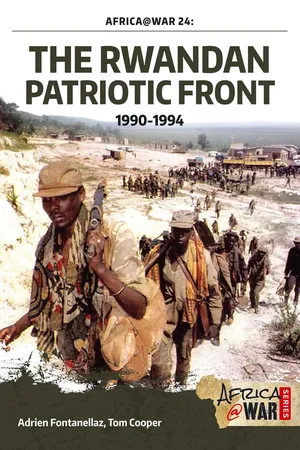
On 1 October 1990, hundreds of Banyarawanda militants that served with the Ugandan Army deserted their posts to form the Rwandan Patriotic Front (RPF) and invade Rwanda. Thus began the Rwandan Civil War, which was to culminate in the famous genocide of nearly one million of Tutsi and moderate Hutus, in 1994. Starting with in-depth descriptions of the history of Rwandan political, military and security development, this volume traces the history of the RPA from its emergence as a small-scale insurgent group formed from the ranks of Rwandan refugee diaspora in Uganda; its military operations and related experiences during nearly four years of war against the Rwandan government; and its establishment of control over Kigali, in July 1994. As such, the narrative presented here provides a fascinating and unique insight into the military story behind the emergence of modern-day Rwanda and its military; considered by many to be the 'Israel of Africa'. Providing minute details about RPF's tactics and doctrine – that strongly influenced developments in a number of other modern-day African wars – this volume is foremost an offering that provides highly interesting backgrounds for and a prequel to, nearly all of the subsequent wars in the neighboring Democratic Republic of the Congo. Illustrated with over 150 photographs, color profiles, and maps describing the equipment, colors, and markings, and tactics of the RPF and its opponents, this is a unique study about the emergence of one of the most important US allies on the African continent.
- 72 pages
- English
- ePUB (mobile friendly)
- Available on iOS & Android
eBook - ePub
The Rwandan Patriotic Front 1990-1994
About this book
Information
Subtopic
20th Century HistoryIndex
HistoryCHAPTER ONE:
INTRODUCTION
This is the second of two volumes that are providing a history of interrelated military conflicts in Uganda and Rwanda that were raging from 1960s well into the 1990s. While it is safe to say that majority of African conflicts tend to attract very limited attention of the public in the West, this was clearly not the case for Rwanda of 1994, when a three-years-long civil war culminated in a genocide that nearly eliminated the Rwandan Tutsi community and radically changed the political landscape of the country. More than 20 years later hundreds – if not thousands – of scientific works have been published about tragic events that occurred in 1994, and that is without mentioning earlier reports, articles, and books. Theoretically, most aspects of this part of that country’s history – like internal politics, involvement of the UN and various foreign powers – are relatively well-researched and documented.
Paradoxically, military aspects of the civil war in Rwanda of 1990-1994 – the very topic of this volume – remain poorly covered. At best, data about specific operations, units and people involved are scattered in a myriad of published sources. Precisely this was the impulse that prompted the work on this project. Namely, during the work on books Great Lakes Holocaust (Africa@War Volume 13) and Great Lakes Conflagration (Africa@War Volume 14), it transpired that this conflict was interconnected with earlier wars in Uganda and in Rwanda, and that there is a need for a closer study of related military operations, experiences, and relations between leading personalities in Uganda, Rwanda and Zaïre/Democratic Republic of the Congo. Related work resulted in this account, which is attempting to dissect and summarise the military history of the Rwandan Civil War between October 1990 and August 1994, with special emphasis on coverage of coming into being of the Rwandan Patriotic Front.

The mountains of Rwanda, as seen on an officially-released postcard from the 1970s. (Mark Lepko Collection)
Of course, military operations are never happening in a vacuum but are a part of a wider context, and therefore we decided to add descriptions of geopolitical circumstances as necessary. Although these are kept to an absolute minimum and used solely to explain the backgrounds for specific developments, the reader should be forewarned that this account is no attempt to provide a ‘full spectrum’ history of Rwandan tragedy. Rwandan Patriotic Front, 1990-1994, is merely a complement to the numerous and authoritative – but not focused on military – works already published.
In slightly different practice than usually in our works of this kind, research for this book is based on primary documents, numerous scientific studies, and reputable publications, and rather few interviews with participants and eyewitnesses. This results in what might appear as rather ‘intensive’ use of endnotes: that was necessary because history as a science progresses by peer-reviewing. One author has to allow others that are – or are going to – study the same subject, to have a clear indication of the origin of the information used in the work in order to either agree with and build on them, or disagree, or relativise them according to own perspectives. Of course, we had to take into consideration other factors as well, foremost the requirement for this book to remains ‘reader-friendly’. Therefore, we decided not to add notes for publications consulted during our work that we consider – to the best of our knowledge – for ‘generally accepted’. On the other hand, we have systematically provided sources whenever our own conclusions differ from relative – or at least ‘partially mainstream’ – historiography.
Some of titles listed in Bibliography might appear ‘controversial’ to well-informed readers. Through our research and travels, the authors are uncomfortably familiar with the many bloody wars fought in Africa over the last 50 years. We consider any source to be relevant until it can be proven beyond doubt to be without merit. It is a matter of fact that governments, national and private organisations, private companies and certain individuals face harsh ramifications when their influence and/or participation in such conflicts become public.

A typical settlement of cattle-herders in Rwanda of the early 20th Century. (Mark Lepko Collection)
The authors therefore carefully collected all the available information, cross-examined various sources, correcting and updating their findings with the aim of offering the most detailed and dependable insight possible, with the objective of providing a comprehensive set of answers to questions like who, when, where, how and why. Furthermore, we have gone to great lengths in order to ‘depoliticise’ the manuscript. This meant avoiding the use of terms such as ‘regime’, ‘rebels’, ‘terror’ or ‘terrorist’. Clearly, one man’s ‘freedom fighter’ is another’s ‘terrorist’. Reason is that having no political axe to grind, we have instead concentrated on recording and describing the military history of Rwanda, and have thus made all efforts to maintain a nonpartisan narrative that remains readable and easy to understand.
For similar reasons, but also in order to simplify the use of this book, all names, locations and geographic designations are as provided in The Times World Atlas, or other traditionally accepted major sources of reference.
Land of the Thousand Hills
Rwanda is a small country landlocked in Central Africa. With 26.338 square kilometres (10.169 square miles), it is smaller than the Federal State of Maryland in the USA, or the Former Yugoslav Republic of Macedonia in southern Europe. It borders to Uganda in the north, Tanzania in the East, Burundi in the South and the Democratic Republic of the Congo (DRC) in the West.
Most of Rwanda lies at altitudes over 1,000 metres (3.280ft) above the sea surface. Central portion is dominated by a hilly plateau averaging about 1,700m (5,600ft) in elevation that gave it the nickname ‘The Land of the Thousand Hills’. Eastward, the land slopes downward to a series of marshy lakes along the upper Kagera River. On the western side is a mountain system averaging about 2,740m (about 9,000ft), forming the watershed between the Nile and Congo river systems. The Virunga Mountains, a volcanic range that forms the northern reaches, includes Vulcan Karisimbi (4,507m/14,787ft), Rwanda’s highest peak. West of the mountains the elevation drops to about 1,460m (about 4,800ft) in the Lake Kivu region.
The climate is generally mild with an average annual temperature of 18°C, but there are wide temperature variations because of elevation differences. Indeed, in the mountains of the northwest frost occurs at night through all of the year. Rwanda has three main seasons: a short dry season in January, the major rainy season from February through May, and another dry period from May until October. The yearly rainfall is heaviest in the western and north-western mountain regions.

A parade of the Royal Guard during the occupation of German East- Afrika by Belgians, in 1916 or 1917. (Mark Lepko Collection)
Rwanda used to be covered by extensive forests of eucalyptus, acacia, and oil palms, but forests now cover over only about 12.5% of the land and are concentrated in the western mountains and Lake Kivu area. Because Rwandans traditionally rely on firewood for up to 90% of their energy, the country’s forests have been preserved through reforestation efforts, and overall 14.7% of Rwanda is designated as protected area. Wildlife is including elephant, hippopotamus, crocodile, wild boar, leopard, antelope, and flying lemur – and is protected in Akagera National Park. The Virunga Mountains are the home of famous mountain gorillas.
Traditional Rwandan economy was subsistence economy. Hoe is still used as the main tool, and the main cash crop is coffee, with amounts of tea and pyrethrum produced too. Because of intensive agriculture, the country not only suffers from soil erosion and occasional droughts, but lacks major mineral resources too, although mines used to be Rwanda’s second most important source of foreign exchange (after agricultural products) in the 1960s-1980s period. Namely, while there is some cassiterite (tin ore), wolframite (tungsten ore), columbite and there are reports about large natural gas reserves near the border to the Democratic Republic of the Congo (DRC), due to drops in world commodity prices the mining of cassiterite was halted in 1986. The following year the country’s wolframite mines were closed for the same reason. Some exploitation was re-started in 1991, but only in very modest amounts: political instability has caused frequent disruptions in trade and decline in exports, leading ever more people to revert to subsistence agriculture, in turn increasing environmental problems.
Because of its hospitable climate – more favourable for agriculture than in neighbouring countries – Rwanda is one of most densely populated countries in Africa. The land is intensively farmed: as of 1990, about 92% of the Rwandan workforce used to be involved in agriculture, which in turn resulted in deforestation, exhausting and overgrazing, and even to desertification throughout the country.
As of 1990, three ethnic groups made up the population: the Hutu (about 86%); the Tutsi (14%); the Twa (1%), and pygmoid people thought to be the original inhabitants of the region. Most of the people live in family groups housed in grass huts in farms scattered over country’s many hills, but majority are concentrated in the south. Traditionally, the principal goal in life was parenthood. About half the population was Roman Catholic, 39.4% Protestant (including 12.2% Adventist and 27.2% other Protestant), 4.5% other Christians, 1.8% Muslim, while the remainder of the people follow traditional religions. The official languages were Kynarwanda (a Bantu language) and French. Schooling was free and compulsory for children aged 7 through 13, but only about 80% of the adult population was literate. The civil war of 1990-1994 greatly disrupted the ethnic and geographic distribution of the population and caused massive numbers of deaths, although the density of population remains high.

A panoramic view of Kigali and the hills surrounding the city. (Adrien Fontanellaz Collection)
Rwanda was divided into 12 prefectures (administrative structure has significantly changed since 1994), each ofwhich was administered by a prefect appointed by the president. Prefectures were further divided into districts and municipalities. Principal cities were Kigali (the capital) and Butare (former colonial capitol). The country had a relatively good road network of 12,000km (7,456miles) but only a small portion of this was paved as of 1990. There used to be no railroad, although Rwanda was linked to the Uganda-Kenya railroad system: majority of Rwanda’s international trade passed through the Kenyan port of Mombasa. The main international airport was Grégoire Kayibanda International Airport (IAP), outside Kigali (renamed since 1994).
Early History of Rwanda
Despite hospitable climate and intensive agriculture, centralised political entities appeared only relatively late in Rwanda. The first known inhabitants were the Twa, while the Hutu – probably from the Congo Basin – established themselves in the area only by the 15th Century, ...
Table of contents
- Cover
- Copyright
- Contents
- Map
- Glossary
- Chapter One Introduction
- Chapter Two Rwandan Patriotic Army
- Chapter Three Invasion
- Chpater Four Re-birth of the RPA
- Chapter Five Unleashing the Apocalypse
- Chapter Six The 100-Days Campaign
- Notes
- Bibliography
- Acknowledgements
- Author
Trusted by 375,005 students
Access to over 1.5 million titles for a fair monthly price.
Study more efficiently using our study tools.
Frequently asked questions
Yes, you can cancel anytime from the Subscription tab in your account settings on the Perlego website. Your subscription will stay active until the end of your current billing period. Learn how to cancel your subscription
No, books cannot be downloaded as external files, such as PDFs, for use outside of Perlego. However, you can download books within the Perlego app for offline reading on mobile or tablet. Learn how to download books offline
We are an online textbook subscription service, where you can get access to an entire online library for less than the price of a single book per month. With over 1.5 million books across 990+ topics, we’ve got you covered! Learn about our mission
Look out for the read-aloud symbol on your next book to see if you can listen to it. The read-aloud tool reads text aloud for you, highlighting the text as it is being read. You can pause it, speed it up and slow it down. Learn more about Read Aloud
Yes! You can use the Perlego app on both iOS and Android devices to read anytime, anywhere — even offline. Perfect for commutes or when you’re on the go.
Please note we cannot support devices running on iOS 13 and Android 7 or earlier. Learn more about using the app
Please note we cannot support devices running on iOS 13 and Android 7 or earlier. Learn more about using the app
Yes, you can access The Rwandan Patriotic Front 1990-1994 by Tom Cooper, Adrien Fontanellaz in PDF and/or ePUB format, as well as other popular books in History & 20th Century History. We have over 1.5 million books available in our catalogue for you to explore.