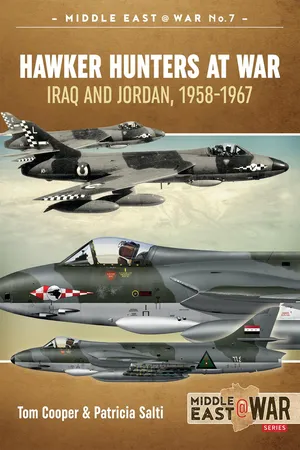
Designed by Sydney Camm as a swept wing, daytime interceptor with excellent maneuverability, the Hunter became the first jet aircraft manufactured by Hawker for the Royal Air Force. It set numerous aviation records and saw widespread service with a large number of RAF units in Europe and abroad. When the Royal Air Force received newer aircraft capable of supersonic speeds to perform the interceptor duties, many Hunters were modified and re-equipped for ground-attack and reconnaissance missions instead. Because they were deemed surplus to British requirements, most of these were subsequently refurbished and exported to foreign customers – so also to Iraq and Jordan. Hawker Hunters at War covers every aspect of Hunter's service in the two countries, from in-depth coverage of negotiations related to their export to Iraq and Jordan, to all-important details of their operational service during 1958-67. It culminates in detailed examination of their role in the June 1967 Arab-Israeli War (also known as the 'Six Days War') and extensive tables listing all aircraft delivered and their fates. Almost entirely based on interviews with retired commanding officers and pilots of the former Royal Iraqi Air Force, Iraqi Air Force and Royal Jordanian Air Force - as well as plenty of unpublished official documents from British, Iraqi and Jordanian archives - the narrative is providing an unprecedented insight into a number of contemporary affairs. Profusely illustrated with well over 100 photographs and 15 color profiles showing all aspects of camouflage, markings and various equipment, Hawker Hunters at War is the ultimate profile of Hunter's colorful and action-packed service in Iraq and Jordan during a period when this legendary type formed the backbone of local air forces.
- 72 pages
- English
- ePUB (mobile friendly)
- Available on iOS & Android
eBook - ePub
About this book
Information
Subtopic
Middle Eastern HistoryIndex
History1
SPECIAL RELATIONSHIP
At a first look, the history of the Hawker Hunter jet in service in Iraq and Jordan might appear not to have much in common, as if not requiring an entire volume to tell. Actually, the two countries and their air forces share not only a mutual border but also much of their history. Carved out of several former Ottoman provinces by the pens of British and French diplomats within the frame of the Sykes-Picot agreement, during the first 20 years of their existence, the kingdoms of Iraq and Transjordan were heavily dependent upon British assistance for their survival. Their militaries were established with British help and equipped with the Hunter at a time when they not only maintained very close ties with London, but also during the formative years of their air forces. In both countries, the Hunter was to see a long, colourful and action-packed service – especially during the first 10 years after their delivery, when they represented the backbone of both the Iraqi and Jordanian air forces. While Hunters of the Royal Air Force (RAF) flew combat air patrols during the Suez War of 1956, Iraqi and Jordanian Hunters not only became the first aircraft of this type to see combat, but became involved in a number of fierce air combats with the Israeli Defence Force/Air Force (IDF/AF).
IRAQIS GEARING UP
The Iraqi Air Force is the oldest of all Arab air arms. Established as the Royal Iraqi Air Force (RIrAF) on 22 April 1931, it was almost completely destroyed during the British intervention in that country in 1941. It had re-emerged by the early 1950s as a relatively seasoned air arm that maintained very close ties to the RAF. This went so far that not only were its uniforms, equipment, traditions and training essentially British, but once British troops officially vacated Iraq in 1955, the RIrAF – since November 1954 under the command of Brigadier General Abd el-Kad’m ash-Shieh Abadi – also took over the task of ‘air policing’ the northern part of the country, inhabited by Kurds who were nearly always in opposition to the central government in Baghdad.
Good relations with London and continuously increasing oil income gave Iraq the ability to acquire a sizeable number of relatively modern military aircraft. Between 1949 and 1954, the RIrAF purchased a total of 55 Hawker Fury FB.Mk 11 fighter-bombers and five Fury T.Mk 20 conversion trainers, 12 de Havilland Vampire FB.Mk 52 fighter-bombers and 10 Vampire T.Mk 55 conversion trainers, 13 de Havilland Venom F.Mk 1s (reconditioned to FB.Mk 50 fighter-bomber standard before delivery) and six Venom FB.Mk 50s (mainly used as sources of spares).
In 1956, the RIrAF adopted a five-year development plan, which envisaged a significant expansion, including the training of no less than 200 pilots and 40 navigators in the UK over a period of two years. This was to be followed by the establishment of three new fighter and two bomber squadrons by 1960 (for a total of six fighter squadrons with 96 aircraft, and two bomber squadrons with 24 aircraft). Special arrangements were made to ensure that sufficient vacancies would be available for Iraqi students at RAF flying training schools to meet the two-year programme, which began in January 1957. However, due to recruiting and financial difficulties, only about 120 Iraqi students had arrived by March and May 1958, including 20 already qualified pilots and 25 NCO ground technicians. At the request of the Iraqi government, and in accordance with the terms of the ‘Special Agreement’ reached between Baghdad and London in 1955, a team of RAF instructional personnel had been established in Iraq to assist in organising and training the RIrAF to meet its planned expansion programme and to enable the air force to fulfil its allotted tasks. Headed by Group Captain Wells (RAF), who was also appointed Air Adviser to Iraq and the official adviser to the Chief of General Staff, Iraq Armed Forces, this team comprised 24 officers and 16 NCOs in various branches and trades. The team became instrumental in reorganising the RIrAF’s supply and maintenance system, such that it was, based on similar lines to the RAF system, and establishing facilities for obtaining supplies from the UK on a government-to-government basis. Finally, following the acquisition of the first two radar stations (apparently one each of Marconi Type 13 and Type 14) from the UK, training for Iraqi radar crews was provided by the International Aeroradio company in Iraq, in cooperation with an RAF signals unit, which brought Type E training equipment for this purpose to Iraq.1
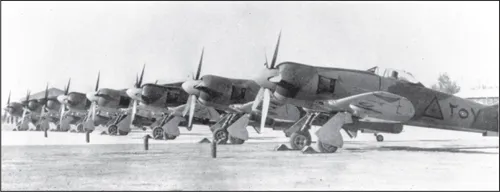
No fewer than 55 Fury FB.Mk 11 fighter-bombers acquired from the UK formed the backbone of the Royal iraqi Air Force, starting from 1948. While they were forward deployed in egypt and Syria during the latter stages of the Arab-israeli War of 1948 1949, several were subsequently donated to Morocco and the rest saw intensive service during fighting against Kurds in northern iraq well into the 1960s. (Albert Grandolini collection)
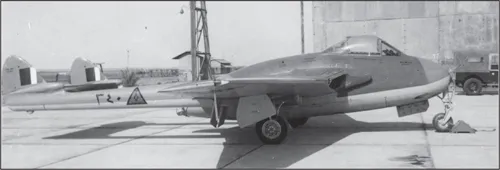
The Vampire FB.Mk 52 entered service with No. 5 Squadron, RIrAF, in August 1953. While a few were lost in training accidents and during fighting with Kurds in the early 1960s, iraqi single-seat Vampires were withdrawn from service and two-seaters were donated to Somalia in 1964. (John Fricker collection, via Simon Watson)
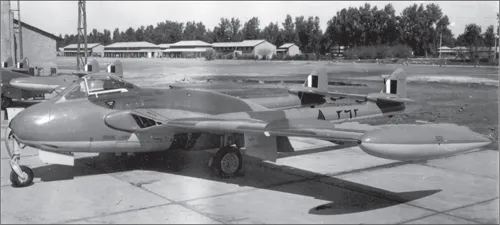
The Venom FB.Mk 50 entered service with No. 6 Squadron in August 1953. the type remained in service well into the 1960s. (John Fricker collection, via Simon Watson)
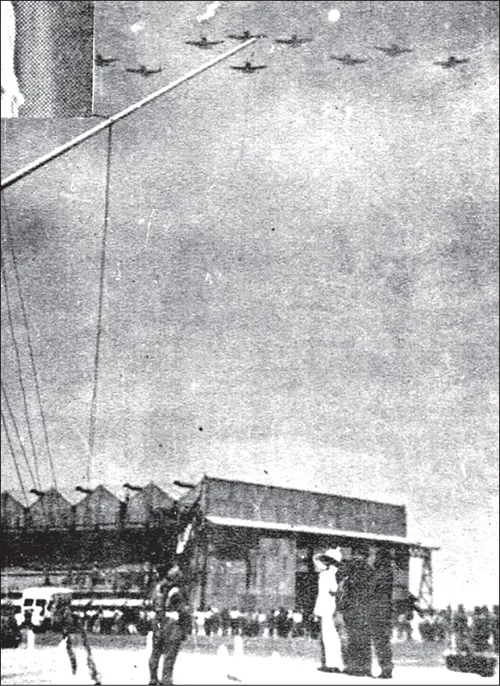
On 2 May 1955, the RIrAF officially took over the former RAF Shoibiyah airfield, near Basrah. A major air parade was staged on the occasion, including a flypast by a number of aircraft. This strategically positioned air base was subsequently renamed ‘Wahda’ (meaning ‘Freedom’ in Arabic). (Albert Grandolini Collection)
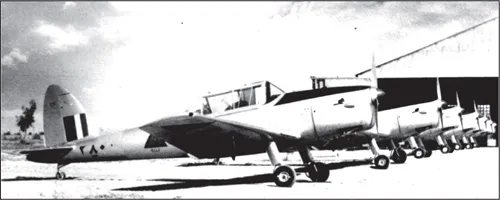
Taken during a parade at Rashid airfield in 1955, this photograph shows a row of seven Chipmunk T.Mk 20 (alternative reports cite T.Mk 51) training aircraft (with one in the foreground wearing serial number 280). The RIrAF acquired a total of 15 such aircraft from 1951, and they served with the Flying College well into the 1960s. (Albert Grandolini Collection)
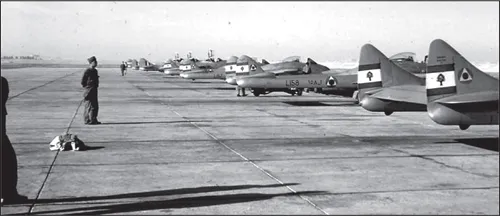
In 1957, a sizeable delegation from the Lebanese Air Force visited Habbaniyah airfield, in western Iraq, as well as Baghdad. A row of Lebanese Vampires are shown at Habbaniyah. (Vatche Mitilian Collection)
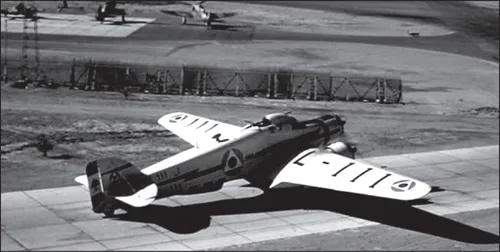
One of four Lebanese Savoia-Marchetti SM.79 bomber-transports, used to carry colonel Boustany on a visit to habbaniyah in 1955. Note the prominent insignia on this aircraft, as well as two RIrAF Furies and a Venom in the upper-left corner of the photograph. (Vatche Mitilian Collection)
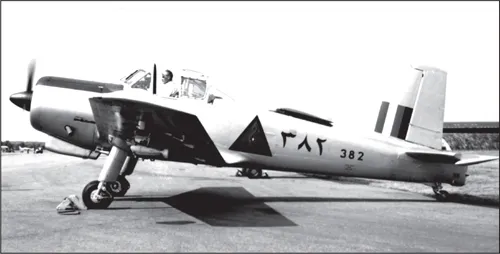
A pre-delivery photograph of a provost t.Mk 53 trainer destined for iraq. the RIrAF acquired at least 15 such aircraft from Great Britain, beginning in 1954. (Albert Grandolini collection)
THE HUNTER ARRIVES
In early 1956, the Iraqi government expressed its intention to obtain 10 Hunter F.Mk 6 fighters equipped with Mk 5 gunsights and Avon 121 engines. Related negotiations encountered considerable problems: the British were only willing to sell the Hunter F.Mk 4s that were surplus to RAF requirements, while the Iraqis wanted these to at least be equipped with more advanced Mk 8 gunsights and rails for 88mm unguided rockets. Baghdad also did not want its payments to start until April 1957. Because F.Mk 6s equipped with Mk 8 gunsights were not considered ‘surplus to RAF requirements’, and doubtful of the Iraqi ability to pay for the aircraft and necessary spares, the British embassy in Baghdad and the Air Ministry in London both voiced their doubts that such aircraft could be delivered at all. Negotiations for the deal continued well into 1956, even after the first group of seven Iraqi pilots arrived in the UK to start training. It was only later that year that – in light of the Iraqi standpoint concerning the Suez War – London changed its mind and in February 1957 expressed its readiness to provide Iraq with five Hunter F.Mk 6s and a three-month spares package.2
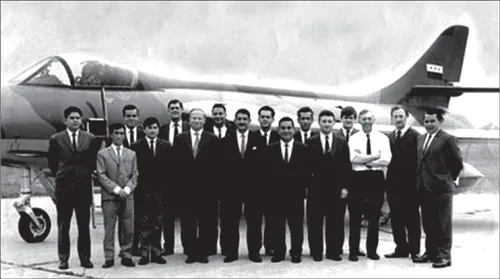
The first group of irAF pilots with their British instructors during the delivery ceremony at chivenor in January 1967. (Ahmad Sadik collection)
The first group of 10 Iraqi pilots underwent conversion courses at the Hunter OCU at RAF Chivenor in England, starting in October 1956. Throughout 1957, six additional pilots and 25 NCO technicians completed their training in the UK. Led by Squadron Leader Arif Abd ar-Razzaq, the 16 pilots included Lieutenants Muna’am Abed al-Ameer, Nimma Abdullah ad-Dulaymi, Ahmed al-Glabi, Izzat, Fahmi Jalal, Mohammad Jassem, Gharib Mahmmoud, Mumtazz Abdel Ali as-Saydoon, Mufeed Sayd, Khalid Jerjis Sarah, Hamid Sha’ban at-Tikriti and Jamal al-Windawi.3 All of these had previously completed conversion courses in the UK and possessed experience of flying de Havilland Vampires and Venoms. Thus, their training proceeded at the expected pace and without major problems. However, on 20 November 1956, one of the Hunters slated for delivery to Iraq – RIrAF serial number 399 – crashed during a training mission over the English Channel. Despite a safe ejection, its pilot, 1st Lieutenant G. Mahmmoud, died of hypothermia after remaining in the cold sea for too long. Following hasty preparations, the first five Hunters were delivered to Iraq in April 1957.4
Although short of the finances required to pay for additional aircraft due to a Syrian decision to cut the flow of oil through the pipeline connecting central Iraq with the port of Tartus, Baghdad still intended to equip an entire squadron with Hunters, and continued negotiating the acquisition of 10 additional jets. In July 1957, Washington began signalling its preparedness to provide financial support to Iraq through an Offshore Purchase Contract, in the same way the US government financed the production of many Hunters delivered to the RAF and various NATO partners. While it remains unclear if the US indeed provided such financial support, following addit...
Table of contents
- Cover
- Title
- CONTENTS
- Map
- Copyright
- Acknowledgments
- Abbreviations
- 1 Special Relationship
- 2 Crisis of 1958
- 3 New Start in Iraq
- 4 First Battles with Mirages
- 5 June 1967 War
- 6 Battle for H-3
- 7 Post-Scriptum
- Bibliography
- Notes
Trusted by 375,005 students
Access to over 1.5 million titles for a fair monthly price.
Study more efficiently using our study tools.
Frequently asked questions
Yes, you can cancel anytime from the Subscription tab in your account settings on the Perlego website. Your subscription will stay active until the end of your current billing period. Learn how to cancel your subscription
No, books cannot be downloaded as external files, such as PDFs, for use outside of Perlego. However, you can download books within the Perlego app for offline reading on mobile or tablet. Learn how to download books offline
Perlego offers two plans: Essential and Complete
- Essential is ideal for learners and professionals who enjoy exploring a wide range of subjects. Access the Essential Library with 800,000+ trusted titles and best-sellers across business, personal growth, and the humanities. Includes unlimited reading time and Standard Read Aloud voice.
- Complete: Perfect for advanced learners and researchers needing full, unrestricted access. Unlock 1.5M+ books across hundreds of subjects, including academic and specialized titles. The Complete Plan also includes advanced features like Premium Read Aloud and Research Assistant.
We are an online textbook subscription service, where you can get access to an entire online library for less than the price of a single book per month. With over 1.5 million books across 990+ topics, we’ve got you covered! Learn about our mission
Look out for the read-aloud symbol on your next book to see if you can listen to it. The read-aloud tool reads text aloud for you, highlighting the text as it is being read. You can pause it, speed it up and slow it down. Learn more about Read Aloud
Yes! You can use the Perlego app on both iOS and Android devices to read anytime, anywhere — even offline. Perfect for commutes or when you’re on the go.
Please note we cannot support devices running on iOS 13 and Android 7 or earlier. Learn more about using the app
Please note we cannot support devices running on iOS 13 and Android 7 or earlier. Learn more about using the app
Yes, you can access Hawker Hunters At War by Tom Cooper, Patricia Salti in PDF and/or ePUB format, as well as other popular books in History & Middle Eastern History. We have over 1.5 million books available in our catalogue for you to explore.