- 400 pages
- English
- ePUB (mobile friendly)
- Available on iOS & Android
eBook - ePub
Cricket
About this book
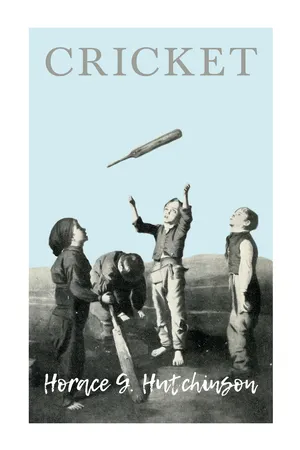
First published in 1903, H. G. Hutchinson's "Cricket" presents the reader with a fantastic, illustrated history of the game of cricket. It includes a large number of authentic pictures of players from by-gone times, offering a picture-history of the costumes of the game from the old-fashioned players who wore top hats to play, to those heroes of yesteryear clad in conspicuous braces. This volume will appeal to those with an interest in the history of the game, and it is not to be missed by collectors of related literature. Contents include: "Some Points in Cricket History", "Early Developments of the Cricketing Art", "Batting", "Bowling", "Fielding", "County Cricket", "Amateurs and Professionals", "Earlier Australian Cricket", "English and Australian Cricket from 1894 to 1902", etc. Many vintage books such as this are increasingly scarce and expensive. It is with this in mind that we are republishing this volume now in an affordable, modern, high-quality edition complete with the original text and artwork.
Information
Print ISBN
9781528711890
CHAPTER VI
County Cricket By W. J. Ford
It has been always cast in the teeth of us Englishmen by our Continental critics that we take our amusements seriously—that our idea of recreation is to go forth and kill something, and that anything of the nature of excitement is unknown to us; even our wars seem to them to be conducted by us in a cold-blooded, business-like, almost saturnine fashion, such as the foreigner cannot understand. Our almost fanatical excitement over the relief of Mafeking and of Ladysmith might have served to disenlighten our neighbours to a certain degree, but they probably regarded those wild bursts of enthusiasm as a mere phase of a fever, as one of the periodic alternations of heat and cold that are characteristic of a severe attack of ague. It is for the historian and the student of human nature to decide whether our nature is phlegmatic or merely proud, and whether these rare outbursts are not in reality a genuine eruption of violent volcanic feelings which have long smouldered beneath the crust of our real nature. The true account seems to be that in matters of a public and, still more, of an international character, insular pride does not allow us to reveal the fact that the Englishman possesses a certain amount of that excitability which we choose to attribute to the southern and the Latin races: it is only a special stress that reveals this side of our nature. When, however, the Englishman’s foot is on English soil, and when his only critics are of the same blood as himself, then and only then does he allow the true keenness of his disposition to run riot. The Englishman, in short, only casts aside his phlegm, his reserve, and his pride when he is in congenial society, and the presence of the necessary society is in no place more apparent than on the scenes of those sports that afford him the amusement and, in some cases, the means of life. Those scenes may be narrowed down to the football field, the race-course, and the cricket ground. It is with the last of these that our business at present lies.
It would be impossible to lay down any cast-iron reason for the fact that general interest in cricket has increased by leaps and bounds in the last twenty years. The fact is incontrovertible, whatever the cause may be, but to most of those who have watched the course of cricket events, the progress of county cricket will present itself as the primary cause of the progress of the game as a whole. At the same time, there is a fair field left for those who choose to maintain that the impetus given to county cricket is really due to the rapid spread of the game itself and the attendant enthusiasm of its admirers; while there is, as usual, a third course left to us, which is to maintain that the two things, general cricket and county cricket, have advanced pari passu, each owing much to the other. And at this point we may abandon the question as one that will produce abundant controversy and no conviction, especially as all the theorists can meet and agree as to the one common effect, differ as they may as to the cause, namely, that both players of the game and lovers of the game have increased by innumerable multiples during the last fifteen or twenty years. There are those who think it good to decry this desperate enthusiasm for a pastime—who declare that it is a symptom of national decadence, and declare that a mere game is an irrational thing, inasmuch as a rational treatment of it at once destroys its existence as a game in the true sense of the word. We are hardly prepared, however, to have our pastimes handled in this Socratic manner. A game is a game, and if it is a good game, we who love it consider that it deserves something more than casual and ephemeral treatment; hence we throw ourselves into it heart and soul, and those who like to see heart-and-soul work have only to go to the nearest county ground on a match day to see how energy and rivalry can, on the principle enunciated above, turn a game into a no-game.
Nor is it illogical at this point to assume that county cricket is to us the highest popular embodiment of our pastime; it is true that a certain and a limited number of special matches attract more attention, for sentimental reasons, than do mere county matches, but it is on the latter class of games that genuine and general interest is mainly expended, earning for those who exhibit it a certain amount of contempt from those who hold that to lavish interest on a game is to squander a valuable asset. Political economy and its votaries would doubtless tell us—indeed, they do tell us—that such labour as is expended on hitting, or on bowling, or on stopping, or on catching a mere ball, is unproductive labour, and consequently labour lost, while they show no limit to their contempt for those who, not being actual players themselves, squander—so they call it—valuable time in watching other people waste time that is equally valuable. However, the cynic and his butt, like the poor, are always with us; all that we can desire and all that we can hope for is that he will confine himself to his dwelling, and leave us to enjoy ourselves in peace, while we may fairly ask him to reflect in the recesses of his barrel as to what the watchers of cricket would do with themselves if there were no cricket to watch. That they would be better employed is possible; that they would be worse employed is probable; and he would be a poor philosopher indeed who would find fault with the open-air stage of Lord’s or the Oval, and would yet allow the music-hall and the theatre to stifle their nightly victims. The strictest of Puritans could hardly find fault with bat and ball as being the inculcators of evil principles; rather, like the study of the ingenuous arts, do they “soften our characters and forbid them to be savage.” The cynic and the rhymer have had their say, but cricket is still with us, and seems likely to stay, howl as they will.
In connection with the game’s advance, it would be unjust not to acknowledge the fillip that has been given to it by the periodical visits of Australian elevens, the first of which occurred as far back as 1878, combined with the return of their calls by our men. It was a new truth to us that there was growing up in Greater Britain a race of men who, taught by ourselves, profiting by our lessons, and in the process of time perhaps improving on our methods, were able to withstand us to our face, the pupil often proving the superior of the master; and it may be that to this fact, and the perhaps unconscious conviction that “the old man” must not be “beaten by the boy” at cricket as at chess, is due the uprise of county cricket as the readiest means of ascertaining our strength and organising our resources, though it was not till several years after the first visit of Australians that any real attempt to organise county cricket into a formal competition succeeded. Such an attempt had been made in 1872 by the Marylebone Cricket Club, which offered a cup in that year for competition among the counties, but the offer was coldly received, the counties that entered were so few that such words as “competition” and “championship” became misnomers, and the offer was withdrawn. Not that the word “champion” had not been and still was applied to some county or another as soon as the last ball of the season had been bowled, but the expression was visionary; it was merely the outcome of the views of the press or of individuals, and it naturally happened that when these views conflicted there were “two Richmonds in the field,” both styled champion by their respective supporters. It was not till the representatives of counties met in peaceful conclave, coded laws and bye-laws, with the request that the M.C.C. would exercise a fatherly and presidential rule over county cricket, that the latter became historical fact.
It seems to me that the ...
Table of contents
- A Short History of Cricket
- PREFACE
- Some Points In Cricket History By The Editor
- Early developments of the cricketing art by the editor
- Batting By P. F. Warner
- Bowling By D. L. A. Jephson
- Fielding By S. L. Jessop
- County Cricket By W. J. Ford
- Amateurs And Professionals By The Hon. R. H. Lyttelton
- Earlier Australian Cricket By The Earl Of Darnley
- English And Australian Cricket From 1894 To 1902 By A. C. Maclaren
- University Cricket By Home Gordon And H. D. G. Leveson-Gower
- Country-House Cricket By H. D. G. Leveson-Gower
- Village Cricket By C. F. Wood
- Foreign Cricket By P. F. Warner
- Cricket In South Africa By P. F. Warner
- Cricket In New Zealand By P. F. Warner
- Cricket Grounds By Messrs. Sutton And Sons, The King’s Seedsmen, Reading
Trusted by 375,005 students
Access to over 1.5 million titles for a fair monthly price.
Study more efficiently using our study tools.