eBook - ePub
Available until 23 Dec |Learn more
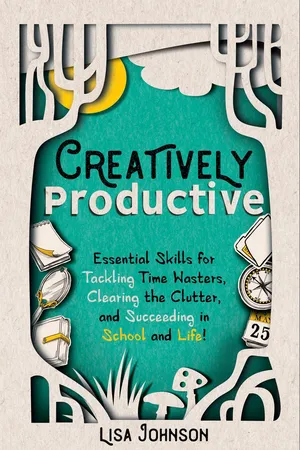
Creatively Productive
Essential Skills for Tackling Time Wasters, Clearing the Clutter and Succeeding in School and Life
This book is available to read until 23rd December, 2025
- English
- ePUB (mobile friendly)
- Available on iOS & Android
eBook - ePub
Available until 23 Dec |Learn more
Creatively Productive
Essential Skills for Tackling Time Wasters, Clearing the Clutter and Succeeding in School and Life
About this book
Keeping track of time, data, and ideas, not to mention assignments, can sometimes seem impossible. And if you struggle with organization and efficiency, just imagine how much more your students may be struggling to keep up with life's daily demands. In Creatively Productive, Lisa Johnson gives you tools and strategies that will help you equip your students with skills and resources they need to succeed in school—and in life.
Frequently asked questions
Yes, you can cancel anytime from the Subscription tab in your account settings on the Perlego website. Your subscription will stay active until the end of your current billing period. Learn how to cancel your subscription.
At the moment all of our mobile-responsive ePub books are available to download via the app. Most of our PDFs are also available to download and we're working on making the final remaining ones downloadable now. Learn more here.
Perlego offers two plans: Essential and Complete
- Essential is ideal for learners and professionals who enjoy exploring a wide range of subjects. Access the Essential Library with 800,000+ trusted titles and best-sellers across business, personal growth, and the humanities. Includes unlimited reading time and Standard Read Aloud voice.
- Complete: Perfect for advanced learners and researchers needing full, unrestricted access. Unlock 1.4M+ books across hundreds of subjects, including academic and specialized titles. The Complete Plan also includes advanced features like Premium Read Aloud and Research Assistant.
We are an online textbook subscription service, where you can get access to an entire online library for less than the price of a single book per month. With over 1 million books across 1000+ topics, we’ve got you covered! Learn more here.
Look out for the read-aloud symbol on your next book to see if you can listen to it. The read-aloud tool reads text aloud for you, highlighting the text as it is being read. You can pause it, speed it up and slow it down. Learn more here.
Yes! You can use the Perlego app on both iOS or Android devices to read anytime, anywhere — even offline. Perfect for commutes or when you’re on the go.
Please note we cannot support devices running on iOS 13 and Android 7 or earlier. Learn more about using the app.
Please note we cannot support devices running on iOS 13 and Android 7 or earlier. Learn more about using the app.
Yes, you can access Creatively Productive by Lisa Johnson in PDF and/or ePUB format, as well as other popular books in Personal Development & Time Management. We have over one million books available in our catalogue for you to explore.
Information
Topic
Personal DevelopmentSubtopic
Time ManagementPart I
Ideas to Shrink Your Problems
1
Calming the Chaos

I move that the meeting adjourn, for the immediate adoption of more energetic remedies.Dodo, Alice's Adventures in Wonderland
Amulet: A Folder
We just met a few pages ago, and now I am going to wax intellectual with tips for you and your classroom and/or campus. I would never do that in the real world—the real world in which I am an educational technologist and where my livelihood is built on trust, which boils down to ethos (my character and credibility), pathos (passion and emotion), and logos (reason and research). And I hope to do no differently amongst these pages. Pathos and logos are baked into each chapter, as I am passionate about organization, time management, note-taking, goal setting, journaling, and reflection, and I try to seamlessly weave in research and best practices regarding these topics throughout. So I thought it best to start with ethos. To do that, we must go back, way back, to get to know each other a bit.
1.1 It All Started When I Was a Wee Girl
I was an only child for four years before my brother was born. I eventually had two brothers, but because I was the only girl, I never had to share a room. Why is this important? It means I had literally almost two decades to fine-tune my organizational process without being bothered or impeded by a roommate. But it wasn’t just my room that was neat and tidy (and really, it wasn’t so much neat and tidy as organized). It should be noted that one of my “selling qualities” to my husband was the fact that he perceived me to be a neat-freak. Later he realized I am more of an organization freak. How do those “freak” traits differ? Simple. One makes sure that all the books and compact discs are alphabetized and has an uncanny knack for the ability to recall what is in any drawer, closet, container, or cabinet in the house at any given time. (Although that trait doesn’t seem to apply to keys and credit cards, which get misplaced daily.) The other is concerned with things like laundry, dirty dishes in the sink, and dust bunnies in the corner. This is not to say that I like living in filth (I can clean when need be), but there is a distinction between neat and organized. Now that we have made that distinction clearer and revealed my dirty little secrets, I would have to say that from about the age of four or five, I have reveled in my knack for organization whether it be archiving my own school papers (which I did from elementary through college) or generating my own to-do lists and taking inventory of my Beanie Babies and DVD collection. And unlike Beanie Babies and compact discs, organization wasn’t a fad for me.
Fast-forward to my current job. Every year our team gets to vote for members of the group to be attributed with an adjective (kind of like a high school yearbook). Without fail, my senior superlative is “Most Organized.” That’s because, while everyone is reading or watching their favorite cinematic delicacies on a flight, I am . . . wait for it . . . organizing, renaming, and weeding/pruning my docs and folders on my laptop. If you are of my generation (the Xennials, balancing precariously on the precipice of Generation X and the Millennials) or simply had eighty-five hours to binge watch all two hundred thirty-eight episodes of the ten-season run of Friends, you might see me as Monica without the manic cleaning. Remember that episode where Chandler randomly put away the CDs in different CD cases based on the ones he listened to last. Seriously, that would drive me insane. If I were Monica and you were Chandler, we would pull an all-nighter to ensure that collection was free of orphan or mismatched CDs and that every case was in its proper place. To this day, I still organize my DVDs by genre (e.g., romance, blockbuster, classic, and compilation) and then alphabetically within that genre. And just like that time Monica took her label maker to Phoebe’s apartment to help with packing so Mike (played by Paul Rudd) could move in, I too get a dopamine kick from reorganizing a room or even a cabinet. I haven’t gone as far as inventorying my coffee mugs with a number to ensure that none go missing . . . so there’s that.
Clearly, organization is part of who I am. It’s in my bones and psyche, and seeing things lined up neatly on the shelf or in little color-coded folders on my screen just makes me happy. But the reason organization is so important to me is that it helps me find and do what I set out to find and do. I accomplish more when my mind, life, and surroundings are well organized than when things are scattered or in disarray. Which brings me to the next point . . .
1.2 Why Organization Is Important for Your Students
You have heard my story and know my sordid past but may not be moved to why organization is so important for us today as well as why it is so important for our students. I could wax intellectual about how there are actual stores (e.g., the Container Store) devoted to organization, times of year (e.g., spring cleaning) dedicated to it, and a bestselling book with more than twelve thousand Amazon reviews illuminating the art of it (e.g., The Life-Changing Magic of Tidying Up: The Japanese Art of Decluttering and Organizing). I could tell you that while content is taught with fidelity within the classrooms I see, study skills, organization, and note-taking skills are just a few soft skills that I have discovered are only taught in classes like MAPS (Methodology for Academic and Personal Success) or AVID (Advancement Via Individual Determination).
But what moves me to action is looking at colleges and careers and providing students with skills that are transferable to whatever they choose to do after their time with us. While writing my first book on the topic of communication, I found that these soft skills (social emotional learning skills) tended to top the charts for what employers were looking for in applicants. If you are familiar with CASEL’s Social and Emotional Learning skills, this will sound familiar. If you aren’t, I highly recommend visiting their site and checking out the five competencies: self-awareness, self-management, social awareness, relationship skills, and responsible decision-making. The first two chapters of this book focus on self-management, which breaks down into skills that fall under the umbrella of organization and time management. To truly understand why organization is so important, we must recognize the shift that has happened in the world and how it impacts our own thinking as well as how we approach the topic of organization with our students.
The first shift was away from the reliance on analog objects that held limited space for documents to digital objects that hold unlimited space. Think back to high school, college, or even your first year of teaching. I personally relied on a computer with a blinking orange cursor that took five-and-a-quarter-inch floppy discs in high school. That was replaced by my first Dell desktop (with a three-and-a-half-inch disc drive) in college. It wasn’t till my first year of teaching that I discovered there was a better way to transfer documents from home to work than to burn them to a compact disc. I will never forget that day. My fellow teammate walked in wielding this magic object around his neck. It was a shiny, small USB drive (which, ironically, most of our current students have never seen or have only heard of). The fact that I could now take larger docs back and forth from home to school and not have to burn CDs was life changing. At that time, sharing documents was hocus pocus. I still had a filing cabinet brimming with handouts and a bookshelf with binders of transparencies, master copies, and pretty much everything I would need to dazzle seventh-grade students with fractions and decimals and percentages . . . Oh, Pi!
By all accounts, paperless classrooms and unlimited storage seemed like a step forward—a good thing. And with one exception, it was. I was easily able to manage all those files and housed them in two drawers of a four-drawer cabinet. A traditional four-drawer cabinet holds roughly 8,448 folders or approximately 2,500 pages per drawer. So at most, I imagine I had 5,000 pages, but to be fair, most of those were multiple copies of the same handout or test. By my last count on my personal computer, I have 29,573 individual files (most are multiple pages or multi-slide decks). That is six times what I had in my classroom. And if you do the math, most of those files in the cabinet were sets of twenty or thirty, which means I probably had at most two hundred individual files. Before we find ourselves full throttle in a Dan Meyer math video, I am narrowing in on a point: When files were limited to size or how many would fit in a filing cabinet (or on a disc), they were easier to manage. I could efficiently and tangibly take the wayward documents lying on my desk or on top of the filing cabinet and refile them with ease.
Yes, the ways of digital unlimited file abundance come standard with a search, but you must remember where you put the file—and there is typically more than one place to look. While I have nearly 30,000 individual files on my MacBook, I have another 1,400 in Evernote, 516 in my personal Google Drive account (not counting the 134 shared with me), and don’t even get me started on my school Google Drive account (where many staff members by default share all their documents with all members of the organization). Oh, and let’s not forget the 27,871 photos I have floating in cyberspace. So searching takes time.
File sharing and archiving isn’t just limited to file services like Google Drive and Evernote. Files and websites are constantly shared v...
Table of contents
- Praise for Creatively Productive
- Title Page
- Copyright
- Dedication
- Contents
- Beware the Jabberwocky
- Part I
- Part II
- Working Wisdoms
- Bring Lisa Johnson to Your School or District
- The TechChef4u Story
- Acknowledgments
- More from Dave Burgess Consulting, Inc.
- About the Author