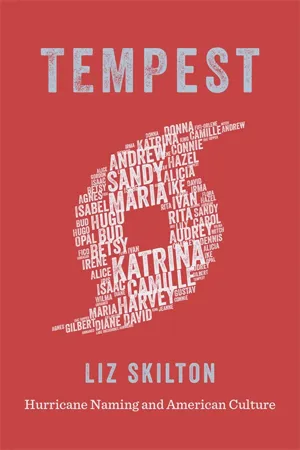
Liz Skilton's innovative study tracks the naming of hurricanes over six decades, exploring the interplay between naming practice and wider American culture. In 1953, the U.S. Weather Bureau adopted female names to identify hurricanes and other tropical storms. Within two years, that convention came into question, and by 1978 a new system was introduced, including alternating male and female names in a pattern that continues today. In Tempest: Hurricane Naming and American Culture, Skilton blends gender studies with environmental history to analyze this often controversial tradition. Focusing on the Gulf South—the nation's "hurricane coast"—Skilton closely examines select storms, including Betsy, Camille, Andrew, Katrina, and Harvey, while referencing dozens of others. Through print and online media sources, government reports, scientific data, and ephemera, she reveals how language and images portray hurricanes as gendered objects: masculine-named storms are generally characterized as stronger and more serious, while feminine-named storms are described as "unladylike" and in need of taming. Further, Skilton shows how the hypersexualized rhetoric surrounding Katrina and Sandy and the effeminate depictions of Georges represent evolving methods to define and explain extreme weather events. As she chronicles the evolution of gendered storm naming in the United States, Skilton delves into many other aspects of hurricane history. She describes attempts at scientific control of storms through hurricane seeding during the Cold War arms race of the 1950s and relates how Roxcy Bolton, a member of the National Organization for Women, led the crusade against feminizing hurricanes from her home in Miami near the National Hurricane Center in the 1970s. Skilton also discusses the skyrocketing interest in extreme weather events that accompanied the introduction of 24-hour news coverage of storms, as well as the impact of social media networks on Americans' tracking and understanding of hurricanes and other disasters. The debate over hurricane naming continues, as Skilton demonstrates, and many Americans question the merit and purpose of the gendered naming system. What is clear is that hurricane names matter, and that they fundamentally shape our impressions of storms, for good and bad.
- 320 pages
- English
- ePUB (mobile friendly)
- Available on iOS & Android
eBook - ePub
About this book
Information
Subtopic
North American HistoryIndex
HistoryTable of contents
- Cover
- Title Page
- Copyright Page
- Dedication
- Contents
- Acknowledgments
- Introduction
- 1 Maria and the Birth of Modern Meteorology
- 2 Camille and Cold War Sexual Politics
- 3 Roxcy and the Feminist Resistance
- 4 Andrew and the Business of Storms
- 5 Katrina and Hurricane 2.0
- 6 Tempest: Assessing Current Conditions
- Notes
- Selected Bibliography
- Index
Trusted by 375,005 students
Access to over 1.5 million titles for a fair monthly price.
Study more efficiently using our study tools.
Frequently asked questions
Yes, you can cancel anytime from the Subscription tab in your account settings on the Perlego website. Your subscription will stay active until the end of your current billing period. Learn how to cancel your subscription
No, books cannot be downloaded as external files, such as PDFs, for use outside of Perlego. However, you can download books within the Perlego app for offline reading on mobile or tablet. Learn how to download books offline
Perlego offers two plans: Essential and Complete
- Essential is ideal for learners and professionals who enjoy exploring a wide range of subjects. Access the Essential Library with 800,000+ trusted titles and best-sellers across business, personal growth, and the humanities. Includes unlimited reading time and Standard Read Aloud voice.
- Complete: Perfect for advanced learners and researchers needing full, unrestricted access. Unlock 1.5M+ books across hundreds of subjects, including academic and specialized titles. The Complete Plan also includes advanced features like Premium Read Aloud and Research Assistant.
We are an online textbook subscription service, where you can get access to an entire online library for less than the price of a single book per month. With over 1.5 million books across 990+ topics, we’ve got you covered! Learn about our mission
Look out for the read-aloud symbol on your next book to see if you can listen to it. The read-aloud tool reads text aloud for you, highlighting the text as it is being read. You can pause it, speed it up and slow it down. Learn more about Read Aloud
Yes! You can use the Perlego app on both iOS and Android devices to read anytime, anywhere — even offline. Perfect for commutes or when you’re on the go.
Please note we cannot support devices running on iOS 13 and Android 7 or earlier. Learn more about using the app
Please note we cannot support devices running on iOS 13 and Android 7 or earlier. Learn more about using the app
Yes, you can access Tempest by Liz Skilton, Craig E. Colten in PDF and/or ePUB format, as well as other popular books in History & North American History. We have over 1.5 million books available in our catalogue for you to explore.