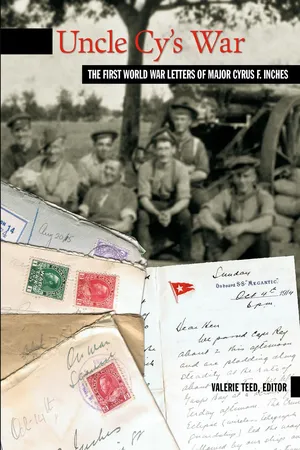
At 31 years old, Major Cyrus Inches resolved to survive the Great War, and did so without losing his sense of humour, in spite of the tragedies he constantly faced. His letters home were stored and left undisturbed for almost ninety years. Cleverly written with wit and humour, they reveal voluminous details of life during the war. Cyrus Inches also kept a diary and published a booklet called The 1st Canadian Heavy Battery in France — Farewell Message to NCOs and Men, which chronicled the movements and the battles of his battery. The booklet and letters combine to create a complete history of one Canadian officer's experiences — from Valcartier and the First Battle of Ypres to Mons, and the months of demobilization after that.
- 304 pages
- English
- ePUB (mobile friendly)
- Available on iOS & Android
eBook - ePub
About this book
Information
Chapter One
Valcartier to Salisbury Plain
The battery was mobilized in Montreal in 1914 as a four gun battery, went to the concentration camp at Valcartier, thence to Salisbury Plain with the 1st Canadian Contingent, and accompanied the 1st Division to France, landing there on February 15, 1915. The pre-war establishment of a Division provided for one Heavy Battery. It is a matter of no small pride to us that at one time we were 1st Division men personnel, men of “the old red patch.”
August 28, 1914
The Windsor Hotel
Montreal
Dearest Ma,
I arrived here all right and immediately ran into, in different places, several Saint John people, including Aubrey Schofield and Tom Stewart. I transacted considerable business this morning and in a short time will go to lunch with Tom. I expect to go from here to Quebec this evening or tomorrow morning and will meet the Saint John battery on their arrival there on Sunday — and from thence to Valcartier.
Everything is uncertain as to just what disposition they will make of my proffered services, but as to that I will write you in due course. It is not likely the artillery will go across for some weeks and then it will, for them, be England — probably Oakhampton, according to what Colonel McLean told me yesterday morning.
I saw Connie and Charlie on the veranda as I went by Westfield. Please do not send me any money as I do not require it. Messrs. Barnhill, Ewing, and Sanford2 will collect your mortgage interest while I am away. They have full particulars of everything. Mr. Ewing had a letter from Mr. Morrison a few days ago stating that the money would be forwarded to Saint John this week. As soon as the succession duties are adjusted, Messrs. Barnhill, Ewing, and Sanford will pay the legacies. They are the best family solicitors in Saint John, and you can trust them implicitly.
With much love,
Cyrus
September 9, 1914
Valcartier, P.Q.
Dear Ma,
This week has been rather uneventful because of the rain. The review of the troops before the governor general Sunday took place in a heavy rain and the men got pretty thoroughly soaked.
I got a letter from Connie yesterday, which is the first letter I have received from either you or Connie, and I take it your letters have gone astray like many others that the boys have been looking for. The snapshots of Pat and Janice are excellent and are a credit to Charlie’s skill as a photographer. I suppose that when Charles goes back to college, you will be turning your thoughts to Saint John, even though you ought to stay out [in Westfield] as long as possible for the sake of Connie and the children. As Campbell is just leaving for the post office, I will close with love.
Cyrus
September 17, 1914
Valcartier, P.Q.
Dear Ma,
Very little of any movement has occurred since I wrote you last. There is nothing official yet as to who will be chosen or the date of sailing, but it will probably be near the first of next month.
Our daily routine of taking care of the horses still continues. Morning stables at 6 a.m., noon stables at 11:15 a.m. and evening stables at 4 p.m. Then the horses have to be branded and numbered, and likewise the wagons and other stores. I have a horse which is all right when allowed to go in the direction it wants to and when there are no automobiles around, so I am trying to get another which can adapt itself more thoroughly to the surroundings.
Kelly has been appointed paymaster to another corps, so I now have the tent to myself. My batman went to Quebec on leave yesterday, so the surroundings are in a state which closely resembles my room at home after I have been there by myself for a few days.
The worst baby of the lot over inoculation proved to be the doctor himself of our division. The way he complains of his sore arm is quite the joke of the mess. For two days now I have wagered whoever I happen to sit beside that he dare not ask the doctor how his arm is and have lost both times, but it has raised the subject for the doctor to dilate upon to the amusement of the others.
With much love,
Cyrus
September 21, 1914
Valcartier, P.Q.
Dear Ma,
Frank Magee, who was in command of the fourth section of our column, has been transferred . . . and his command, for a few days until a permanent appointment is made, has fallen on my shoulders. In the reorganization, it is expected that a captain from outside will command No. 4. Today Len Tilley spent an hour with me. He has been to Ottawa with reference to the formation of a rifle club of a hundred men and other similar clubs in Saint John. He introduced me to his brother-in-law from Winnipeg, who is a captain in an infantry battalion.
Yesterday was full of interest. In the morning we proceeded to the review ground, where a short service was held. The attendance was voluntary so there were not as many there as there were in the big review before the duke in the afternoon. In this review we were mounted. When one comes to think, it was quite funny from our standpoint. We turned out with fifty farm wagons . . . these being the vehicles for the ammunition. In my section there were nine wagons — two horses in each wagon with a driver and one gunner on the seat — two other lieutenants besides myself. Hoodless and Dunlop of Hamilton (known to me as Hoodlum and Dewdrop — both of them more experienced men than I am) were both immensely amused over the exigency which put me in charge for the day. The drill was new to me and I had to have one on each side to coach me in what commands to give. We had to go through some pretty rough ground before reaching the saluting point, which caused tremendous confusion, but by covering the wagons in the section ahead we managed to collect ourselves after a fashion and were in fairly straight formation by the time we reached the Royal party.
My horse was as entirely new to me as the situation was to him, and as I could have but one hand on the rein, while the other was saluting — the result was that my horse side stepped all the way past. I got off better than some officers in another battalion, who went by with both arms around their horses’ necks to keep from falling off. I will always look back at the day I was in charge of farm wagons in a grand review of troops as one of the big days of my career.
Today two of the men in our section were brought up before me for being drunk while on leave in Quebec. The men had with them instructions from the provost marshal in Quebec that they be dealt with according to Camp Order No. 400 and something, which on looking up I found contained a pre-emptory order to discharge them and send them home, but curiously enough the instructions have been mislaid somewhere, and the men, both of them good soldiers, are now back again in the ranks.
Yours with much love,
Cyrus
September 25, 1914
Canadian Pacific Railway Hotel System
Château Frontenac, Quebec
Dearest Ma,
I received your fine long letter and also the express parcel and do not know how to express my gratitude. Consider that I have kissed you for it.
It is hard to keep the run of the days here but three days ago we got orders to embark — that is, to leave camp — as soon after noon as possible. These orders were shortly changed to a command to take all our horses in and put them on the Montezuma3 together with a hundred men, so the whole column rode in that night starting at 10 and arriving in Quebec at 6:20 the next morning — nearly nine hours in [the] saddle. We got the horses on and went back by official train that afternoon, not stopping to load our stores because the men had gotten some liquor somewhere and were being arrested right and left. That night in camp there was a small riot between our section and No. 2 Section owing to the antipathy shown by some of No. 2 Section towards a few Saint John men transferred recently from 4 to 2. After this was quelled, it was discovered that two civilians had entered the tents while we were in town and they were put under arrest, the goods having been found on them. The next morning, court was duly held and drunks and thieves disposed of in dispatch, which would make Judge Ritchie green with envy.
In the afternoon, I was sent into the boat on some business, then to the Château [Frontenac] for general head scouring. When I came to pay the barber, I missed fifty dollars (which, by the way, has just been returned to me; by mistake I included it in some money I paid a lieutenant on board the boat). Had to borrow to buy a dinner ticket in the Château . . . and while waiting in line for the ticket, I felt my arm patted and, looking around, discovered Kelly, and we had a merry reunion. I wanted to stay all night and take in the theatre but could not get our headquarters on the phone and so did not care to take a chance, and returned to camp by the 9:00 p.m. train.
This morning the adjutant, Major Long, sent me in to the steamer again. When I got in two and a half hours late, I found the boat had been moved out into the stream four miles up the river opposite Wolfe’s Cove, and by much good luck I happened to spy Colonel Good of Woodstock [who was] just leaving for the same steamer in a Fruemaker4 boat belonging to the Quebec Harbour Commission, so I joined forces with him after counting the horses on board — an hour’s job...
Table of contents
- Cover
- Title Page
- Copyright
- Contents
- Who’s Who in the Inches Letters
- Introduction
- Chapter One
- Chapter Two
- Chapter Three
- Chapter Four
- Chapter Five
- Chapter Six
- Chapter Seven
- Chapter Eight
- Chapter Nine
- Chapter Ten
- Chapter Eleven
- Chapter Twelve
- Appendix
- Acknowledgements
- Selected Bibliography
- Photo Credits
- Index
- The New Brunswick Military Heritage Project
- The New Brunswick Military Heritage Series
- About the Author
- Back Cover
Trusted by 375,005 students
Access to over 1.5 million titles for a fair monthly price.
Study more efficiently using our study tools.
Frequently asked questions
Yes, you can cancel anytime from the Subscription tab in your account settings on the Perlego website. Your subscription will stay active until the end of your current billing period. Learn how to cancel your subscription
No, books cannot be downloaded as external files, such as PDFs, for use outside of Perlego. However, you can download books within the Perlego app for offline reading on mobile or tablet. Learn how to download books offline
Perlego offers two plans: Essential and Complete
- Essential is ideal for learners and professionals who enjoy exploring a wide range of subjects. Access the Essential Library with 800,000+ trusted titles and best-sellers across business, personal growth, and the humanities. Includes unlimited reading time and Standard Read Aloud voice.
- Complete: Perfect for advanced learners and researchers needing full, unrestricted access. Unlock 1.5M+ books across hundreds of subjects, including academic and specialized titles. The Complete Plan also includes advanced features like Premium Read Aloud and Research Assistant.
We are an online textbook subscription service, where you can get access to an entire online library for less than the price of a single book per month. With over 1.5 million books across 990+ topics, we’ve got you covered! Learn about our mission
Look out for the read-aloud symbol on your next book to see if you can listen to it. The read-aloud tool reads text aloud for you, highlighting the text as it is being read. You can pause it, speed it up and slow it down. Learn more about Read Aloud
Yes! You can use the Perlego app on both iOS and Android devices to read anytime, anywhere — even offline. Perfect for commutes or when you’re on the go.
Please note we cannot support devices running on iOS 13 and Android 7 or earlier. Learn more about using the app
Please note we cannot support devices running on iOS 13 and Android 7 or earlier. Learn more about using the app
Yes, you can access Uncle Cy's War by Valerie Teed in PDF and/or ePUB format, as well as other popular books in History & Military Biographies. We have over 1.5 million books available in our catalogue for you to explore.