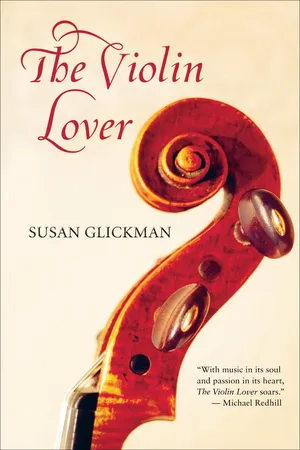
Set in Jewish London in the 1930s, Susan Glickman's The Violin Lover is written against the backdrop of Hitler's escalating campaign against the Jews. This beautifully written novel tells the story of Clara Weiss and Ned Abraham, "the violin lover, " brought together by Clara's 11-year-old son, Jacob. A successful doctor and amateur violinist, Ned is pressured to practice a duet with Jacob by the boy's piano teacher. Though reluctant at first, Ned is charmed by the young prodigy and surprised by Jacob's dedication and passion for music. In him Ned sees his younger self, so young and full of promise. A friendship is soon built on a mutual love for music. A dinner invitation to spend Passover with the Weiss family seals Ned's fate and a clandestine love affair begins. Although they both agree that no one must ever know — especially not Clara's family — their affair inevitably comes to a crashing end, with disastrous, life-altering consequences. Unfolding like a melody, The Violin Lover is infused with music and told in three voices. It is a powerful novel about the love one feels for family, friends, culture, faith and music, and the passion that comes with it — regardless of the outcome.
- 242 pages
- English
- ePUB (mobile friendly)
- Available on iOS & Android
eBook - ePub
The Violin Lover
About this book
Information
Spring
January and February were unusually cold. Jacob walked to school glumly, his satchel thumping against his legs, coming home chilled and argumentative. Evvie and Danny, cooped up inside, became increasingly rowdy. Clara found herself asking Millie to look after them more and more often so she could go for a walk alone, striding quickly as she never could with their short legs stumbling alongside and their shrill voices complaining. In summer she had the patience to stop every few feet to count the aphids on a rose or to watch an ant’s progress under a single grain of rice, but not now. She wanted to march out her frustrations all by herself and then come home to a nice cup of tea and a lapful of affection.
For her part, Millie was happy to do anything that got her away from chores. She was an ineffectual housekeeper at best but so sweet-natured Clara didn’t have the heart to let her go. The children loved her because she indulged them in every way. She spooned the plumpest strawberries from the jam, placing one on each scone. Her crumpets dripped butter; her cinnamon toast glittered with sugar. She even wrapped cheese sandwiches in a clean towel and filled old lemonade bottles with water for them to carry off to a desert island. With Millie in charge, Evvie piled the sitting room cushions into castles or draped chairs with sheets to make Indian tents for hours of make-believe. Danny tried to help but usually knocked everything down, which led to tears of wrath on Evvie’s part and tears of remorse and frustration on his. Then millie, displaying remarkably little reluctance, wasted most of the afternoon rebuilding their ephemeral constructions instead of doing the laundry and barely had time to put everything to rights and get supper on the stove before she had to leave.
So when the children were with her, Clara usually encouraged more orderly pursuits like drawing or pasting cut-outs in an album or listening to stories. They brought piles of books home from their weekly trip to the library, mostly fairytales, with delicate watercolour illustrations of Aladdin rubbing his magic lamp and an enormous Genie billowing out like blue smoke, the Snow Queen carrying off a sleepy boy in her thrilling chariot of ice, Red Riding Hood knocking on the cottage door as the wolf, in a frilly lace cap, bared yellow fangs from Grandma’s bed.
They had an unquenchable appetite for disaster, these little ones, as long as conclusive reversals followed. One rainy March afternoon, Jacob, half-listening as he doodled away at some music theory, suddenly had a revelation.
“They’re all in sonata form, Mum.”
“What are?”
She had just reached the part when Hansel offers the witch a scrawny chicken bone instead of his chubby finger, and Danny (who had to be the boy in every tale) was clutching Evvie (who was always the girl) with an enthusiastic combination of terror and delight.
“Fairytales. They all start off happy. Then the adventure begins and there’s a new key, that’s the sad or scary part. And then it all comes right in the end. Happy, sad, happy — major key, minor key, major key.”
“Hmm. Perhaps. But what about Hans Christian Anderson? Some of his stories end so miserably. Like ‘The Little Mermaid’ or ‘The Steadfast Tin Soldier’ or worst of all, ‘The Red Shoes.’ Imagine chopping off a little girl’s feet to punish her for vanity!”
“Whose feet get chopped off, Mama?” Only two and a half, Danny was tantalised by violence.
“Only in a story, pet. No one real,” Clara replied. “It’s just a story.”
“Read that one!”
“Maybe another time. We already started a new book today,”
“Finish it now, Mama,” said Evvie. “Let’s get to when the witch goes in the oven. That’s my favourite part.”
“Well, there are some sonatas that go sad, happy, sad, but I don’t like those as well either,” Jacob remarked. Experience had taught him that nobody could finish a conversation around Evvie and Danny unless he forged ahead, right over every bump and detour.
“Everyone loves a happy ending,” said Clara. “Now that spring’s finally coming, we think of the nice weather as the way it ought to be and winter as just an in-between part.”
And spring was finally coming. First it was nothing but a rumour. The rain fell as coldly as ever on the naked arms of trees, and nothing stirred in the dull mud of a thousand stalled gardens. But one day there was a softness, a faint green haze at twig-tip. Birds sang earlier and preened shiny wet feathers on the lawn. Lawns themselves looked a little warmer, a little richer. Worms coiled on grass that bent and swayed, unburdened by frost. And a buoyancy entered everyone’s step; even their dour milkman whistled as he lined up the shining glass bottles — one, two, three — under the crabapple tree.
In Clara’s garden, brilliant blue scilla flowed through the grass; crocuses unfurled peach and cream and purple stripes; birds strutted and sang, flaunting their courting plumage. The children became fascinated by bugs, turning over every stone to see what wakened, what squirmed, what crawled. They filled jars with specimens and demanded that Clara look them all up in the library, then label each container with both Latin and English names. Danny and Evvie learned the difference between spiders and insects, moths and butterflies. The fairy stories were abandoned. Real creatures that really flew had usurped their interest.
Mostly Jacob stayed indoors, practising the piano. His concert was scheduled for May. Any day now he would have to meet with that serious-looking doctor and play for him. Miss Westerham seemed to feel he was good enough, but Jacob wasn’t sure. How could Mozart have composed this piece when he was even younger than Jacob? Mozart was a genius, of course, and he was not, but still . . . He could see his whole life stretching out ahead of him, years and years of never writing anything as good as the music Mozart wrote when he was only ten.
His mother was impatient with this premature despair. She was forever digging in the compost or starting seedlings in a pot or dividing perennials. The house spilled over with catalogues and seed packets and smelled of wet earth. When the children came down for breakfast only Millie would be in the kitchen, singing as she stirred the porridge. Clara was already in the garden, wearing an old shirt of their father’s, spearing dandelions or killing slugs. Sometimes she leaned on her spade, daydreaming, or sat peacefully sipping a steaming mug of tea. But mostly she worked until the sweat ran down her face, moving plants around, making room for new specimens. Another clematis for the south-facing wall, or perhaps this year she’d try an espaliered pear.
“Your mother’s gone mad, I think,” said millie. “She makes more work for herself than that wee bit of garden can hold!”
“Mama loves flowers,” said Evvie loyally.
“Of course, darling. And who doesn’t?” Millie replied, giving the girl an affectionate pat on the head. “I meant no offence, surely.”
“She’s getting ready for our father’s yahrzeit,” remarked Jacob. “You know, the anniversary of his death. It’s next week. We’re going to light candles in the garden and say a prayer there.”
“Are you now? Well, isn’t that a beautiful idea. We put a lilac on my gran’s grave after she died, and I always said I wanted the same someday myself. Flowering trees last such a long time. Longer than memory, sometimes.”
“We have a lilac,” said Danny. “It smells purple.”
“Purple is a colour, you silly,” declared Evvie. “It doesn’t have a smell.”
“It does so!” Danny started to cry. “Mama said.”
“Your mother is right, and so are you,” Millie said. “Now eat your porridge.”

The big clock in the hall read ten to four. Ned flipped through some sheet music impatiently; he hated waiting but had arrived earlier than anticipated. Too many memories were associated with years and years of waiting in halls like this, hearing muffled sounds of other people practising behind rows of closed doors. Somewhere a flute laughed, a cello moaned; the old windows in their warped frames vibrated to a timpani’s steady thud. He closed his eyes and leaned his head against the damp, peeling wallpaper.
Back in Leeds, there had been a time when he tried to arrive early for music, to sit near Lucy Chadwick and watch her sharp white teeth bite into the red apple she invariably brought with her. Ivory teeth. Neat little bites like struck keys. Her piano lesson took place right across the hall from his violin class with the imperious Mr. Nash. But whereas Ned always arrived dishevelled (shirt untucked, boots scuffed), Lucy was the cleanest-looking person he had ever seen. Her nails were shining white moons and her hands spotless. She even smelled like rain.
Ned’s mother was extremely well groomed, but there was something counterfeit about her appearance. Maybe it was that he knew how much effort it cost for her to be fashionable: the haggling at the draper’s over each yard of stuff, the late nights sitting up over a pattern, the painstaking hand-stitching. But Lucy just sat there, fresh as the dawn of Creation, fair hair knife-edged and shining, eating her apple round and round. Her method fascinated Ned. She always finished with a symmetrically shaped core, which she held by the stem and popped back in her paper bag. Then she folded down the edge of the bag, ran a clean white finger along the edge to sharpen the fold, and dropped it in the dustbin.
Lucy seemed able to concentrate on one thing at a time and therefore to do it perfectly. But for Ned the world drifted, full of conflicting enticements. So he munched apples absent-mindedly, spitting out the seeds, the sharp membrane at the centre caught between his teeth. Even in school it was his quick-wittedness, not his concentration, that saw him through. From the tail end of a teacher’s query, echoing behind the sound of his own name, he could usually reconstruct the whole question and answer it. Lucy’s apples became an inspiration to sharpen his attention: to do only one thing at a time and to do it properly. Even now he thought of the sun as an apple that rose each day anew to be eaten neatly round the core.
Lucy became aware of his attention and smiled back shyly. Soon he started to bring apples, eating them in her methodical fashion. And after several weeks of companionable apple-eating, they began going for walks, first around the building and then outdoors in fair weather, meeting earlier and earlier. Sometimes they were actually late for their music lessons, running in apologetic and out of breath, having wandered too far, deep in conversation.
What did they talk about? Ned can’t even remember. All he recalls is the spontaneity of their exchanges, something new to him, who had been raised to scrutinize his every thought, to speak in accordance with the right motives and values or prepare to be cross-examined. At home, every conversation was a minefield. With Lucy, such caution was not required; he was free to sound silly, to contradict himself, to speculate without fear of reproach. She was a sweet soul, without prejudice or rancour, and as sensitive as he was.
But Lucy’s teacher must have said something to Lucy’s mother, who suddenly appeared, glamorous but unyielding, at the music school one day. They sat together across the hall from Ned, who heard the mother murmur, as she straightened, one by one, the soft kid fingers of her gloves, that Lucy should have nothing more to do with that shabby little Jew.
Within weeks, their relationship was severed. Mrs. Chadwick changed Lucy’s lesson to another time, and he never saw her again. When his father disappeared a year later, Ned was better prepared for that loss than he had been for his first, the loss of Lucy.
“Dr. Abraham?” called a tentative young voice. Lucy? Ned opened his eyes with a start and saw not the distant bright angel of his dream but Jacob Weiss, rumpled, dark and boyish.
“Oh, how are you, Jacob? Excuse me, I must have nodded off.” He checked his watch. “I got here a bit early, and Miss Westerham hasn’t opened her door yet.”
“Well, sometimes she’s late. But I don’t mind,” Jacob hastened to add, “because she gives me extra time whenever that happens. She’s very nice, Miss Westerham.”
“You’re lucky. A nice teacher makes music much more fun. My first teacher, Mr. Nash, really, he suited his name. He used to rap me across the knuckles with his baton when he got annoyed. And he got annoyed very easily.”
“Really?” said Jacob, horrified. “Miss Westerham would never hit anybody!”
“No, I doubt she would. Music makes her happy. But some people have higher expectations, I guess, or are more easily disappointed.”
“Is there a difference?”
“That’s a good question. I’d have to think about it more to be able to answer you,” said Ned, laughing.
“Well, I suppose you could have low expectations and still be disappointed all the time, like the Latin master at my school. He thinks we’re all idiots. He expects everyone to make stupid mistakes, but he’s still cross when we do.”
“There you go, then.”
“But could you have high expectations of people and not be easily disappointed?”
“I suppose so. If the people around you were terribly talented.”
“Or if you just thought they were. Like my mother. She thinks we’re all geniuses.”
“You mean you’re not? Then I’ve been misinformed, my good sir, and I believe we should cancel our rehearsal.”
Jacob burst out laughing, hugely relieved that this severe-looking man was kind after all. He hoped the music would go well and they would become friends. Just then the door opened. A chubby blond girl trotted out, clutching her mother’s hand, and Miss Westerham’s deep contralto boomed, “Come in, come in! Let’s get started, gentlemen.”
Jacob picked up his music, Ned his violin, and they entered her big, untidy studio. It was very hot, and the dusty windows bloomed with an amazing collection of African violets. Miss Westerham wore a tight-fitting purple tweed suit, which gave rather more emphasis than was attractive to her ample behind. Nonplussed by the sight of her and by the jungly smell of the violets, Ned momentarily forgot why he had come.
“Shall we dive right in?” the woman was asking, “or would you rather talk about the piece first? How do you find the Rondeau? I’ve always found it a bit disappointing in a way. The Adagio is so unforgettable, but I can never keep the second movement in my head.”
“Perhaps we should play it first and see what we’ve each discovered on our own,” Ned suggested. “I’m sure we’ll find lots to talk about when we put the parts together.”
“How is that with you, Jacob?” Miss Westerham asked the boy.
Jacob was so nervous he just nodded. If he could only get to the piano, Mozart would rescue him, throw him a net of triplets flowing one over the other, hand over hand, and he wouldn’t have to speak at all.
Soon they were deep in the music, all three. Could they be hearing the same thing? Science has determined that the frequency of middle C is precisely 256 vibrations per second, but sensation alone is not meaning. To Jacob, middle C was home, the place you start from, safe haven. Even on the page it resembled a smiling face or a sun. But on Ned’s violin, the note had no special status. It was one of many gradations of sound, one colour in the rainbow. He did not orient himself from or to it; to him, there was no middle, for he did not see the notes laid out in a row. He felt for them along an infinite scale of possibility.
Miss Westerham, watching them, was struck — not for the first time — by the differences instruments elicit in those who play them. Violinists were swimmers, she felt, pulling and pushing the water back and forth with their arms and shoulders. They were inside the sound; it was their element. Pianists were more like climbers, scrabbling up a mountain whose peak glinted above the clouds like a mirage. Or maybe it was just a matter of scale, the violin being so small, warm, and mammalian, nestled beside the chin, the piano glittering black and white, slate and marble, dwarfing whoever sat at it.
But at the same time, the piano was bright and the violin dark, befitting their vintage. Innocence and experience...
Table of contents
- Cover Page
- Title Page
- Copyright Page
- Dedication
- Contents
- Autumn — Winter 1934
- Spring — Summer 1935
- Autumn 1935 — Spring 1936
- Acknowledgements
Trusted by 375,005 students
Access to over 1.5 million titles for a fair monthly price.
Study more efficiently using our study tools.
Frequently asked questions
Yes, you can cancel anytime from the Subscription tab in your account settings on the Perlego website. Your subscription will stay active until the end of your current billing period. Learn how to cancel your subscription
No, books cannot be downloaded as external files, such as PDFs, for use outside of Perlego. However, you can download books within the Perlego app for offline reading on mobile or tablet. Learn how to download books offline
Perlego offers two plans: Essential and Complete
- Essential is ideal for learners and professionals who enjoy exploring a wide range of subjects. Access the Essential Library with 800,000+ trusted titles and best-sellers across business, personal growth, and the humanities. Includes unlimited reading time and Standard Read Aloud voice.
- Complete: Perfect for advanced learners and researchers needing full, unrestricted access. Unlock 1.5M+ books across hundreds of subjects, including academic and specialized titles. The Complete Plan also includes advanced features like Premium Read Aloud and Research Assistant.
We are an online textbook subscription service, where you can get access to an entire online library for less than the price of a single book per month. With over 1.5 million books across 990+ topics, we’ve got you covered! Learn about our mission
Look out for the read-aloud symbol on your next book to see if you can listen to it. The read-aloud tool reads text aloud for you, highlighting the text as it is being read. You can pause it, speed it up and slow it down. Learn more about Read Aloud
Yes! You can use the Perlego app on both iOS and Android devices to read anytime, anywhere — even offline. Perfect for commutes or when you’re on the go.
Please note we cannot support devices running on iOS 13 and Android 7 or earlier. Learn more about using the app
Please note we cannot support devices running on iOS 13 and Android 7 or earlier. Learn more about using the app
Yes, you can access The Violin Lover by Susan Glickman in PDF and/or ePUB format, as well as other popular books in Literature & Literature General. We have over 1.5 million books available in our catalogue for you to explore.