![]()
Chapter One
Voluntary Recruitment
To Germany! To Germany! the cry is everywhere,
Resounding throughout Canada upon the winter Air.
And our noble boys in khaki are a-longing to be there,
To fight for our Motherland.
— Private D. Palmer, 26th Battalion, 1914
Despite the lessons learned in South Africa only twelve years earlier, when war broke out in 1914, recruitment appears to have been an afterthought in the mind of Sir Sam Hughes, Canada’s abrasive minister of militia and defence. It was, after all, his responsibility to mobilize domestic forces for use overseas, just as it had been Sir Frederick Borden’s task between 1898 and 1902, when Canada sent more than seven thousand men to South Africa. This time, the stakes were considerably higher: if a brigade could save the Empire, then surely a corps might help save the world. Colonel Willoughby G. Gwatkin, the British staff officer who was appointed as Canada’s chief of the general staff, had developed just such a plan only three years earlier. His Memorandum C.1209 completely updated Canada’s aging mobilization scheme by expanding militia strength in the western provinces and proposing that no more than one infantry division and a mounted brigade serve outside Canada in the event of war. Although not without its flaws, the plan had the benefit of drawing manpower relatively evenly across the country. Units called up in Ontario and Quebec would be balanced by those from the West and the Maritimes. Had this plan been put in place, New Brunswick would have supplied a thousand men to the First Contingent. All of them would have been drawn from existing units of the province’s non-permanent militia, and the vast majority would already have been trained.
Hughes, however, was not one for simplicity. Having discarded Gwatkin’s plan only days after war was declared, the minister, an ardent imperialist and self-appointed martial leader, devised a new mobilization scheme that reflected ideals he believed were important. Prior military training, for instance, was of immense benefit to a potential volunteer, but not an absolute necessity. In fact, newspaper advertisements that followed Canada’s entry into the war made no such specification whatsoever: all were welcome to join the CEF so long as they met minimum medical standards. Hughes, of course, was a strong proponent of the militia myth that even the most docile Canadian possessed the warrior ethos. Not surprisingly, most Canadians supported Hughes. His drive and determination reflected their own ambition to take this fight to the very heart of the enemy.
Britain’s declaration of war, so enthusiastically received on the steps of the Gleaner building in downtown Fredericton, would have worked its way down the Saint John River valley quickly, certainly faster than any of the province’s major newspapers could have been delivered to Gagetown or Chipman by steamship on their thrice-weekly runs. A few residents would have received the news by telephone. The manager of the Minto Coal Company, John Henderson, had a direct line to Fredericton courtesy of the trunk line he shared with the Canadian Pacific Railway (CPR). Dr. James A. Casswell, a leading citizen of Gagetown and one of the first private residents of Queens County to possess a telephone, likewise would have been the source of much local news. It might have taken longer for some outlying areas of the county to receive the news, but war was no doubt the subject of many a sermon in the weeks to follow: “I will be as the dew unto Israel,” affirmed the rector of Gagetown to his congregation shortly after war was declared, “he shall grow as the lily, and cast forth his roots as Lebanon.” Promised the protection of God if they remained faithful, the only question that remained was whether local boys would make it to the front lines in time to share the spoils of certain victory.
For a select few, that question was moot. British immigrants, particularly those with former service in the Regular or Territorial Army, had little choice in the matter. Within days, the bulk of this class residing in Canada and collecting pensions was mobilized for service. At Minto, dozens of British reservists put down their pick axes and prepared to return to their former units. Single or not, all were advised by British authorities to embark at Montreal, although many reported to Ottawa instead to join the newly formed Princess Patricia’s Canadian Light Infantry. In Queens County, several men were recalled to their former units, including Staff-Sergeant Major Basil F. Swain of Hamilton Mountain, who had come to Canada from England with his wife in 1906, was recalled in 1915, and was killed in action two years later with the Royal Sussex Regiment. Similar scenarios were played out for other nationalities. René Lefait of Minto, a Belgian national, was recalled in 1914, but miraculously survived the war despite the heavy toll on his fellow countrymen. Of course, German and Austro-Hungarian nationals were equally compelled to return home at the outbreak of war, although they found it increasingly difficult to leave Canada as the war progressed.
Until a more formal process was established, recruiting for the First Contingent was conducted through the province’s five militia regiments: the 62nd St. John Fusiliers, the 67th Carleton Light Infantry, the 71st York, the 73rd Northumberland, and the 74th Brunswick Rangers from Sussex. Each was given a strict quota of 125 men and a narrow timeline to mobilize them. Equivalent shares were drawn from the 3rd New Brunswick Regiment of Canadian Garrison Artillery at Saint John and the 10th Field Battery at Woodstock, while the 19th Field Battery from Moncton was fully mobilized. Lesser numbers were also drawn from other branches of the service, including the Army Service Corps and No. 8 Field Ambulance. New Brunswick’s initial contribution totalled 1,134 men. Some were entirely new to the military, but the greater proportion were active and former members of the non-permanent militia.
New Brunswick’s subscription to the First Contingent differed significantly from that of the rest of Canada. Ontario and the West, magnets for British immigration in the decade preceding the war, faced mounting pressure to rid themselves of excess labour during the economic recession of 1913 and 1914. War provided a convenient outlet, and battalion after battalion was filled with unemployed British men looking to return home. Conditions in New Brunswick, however, were not the same as in the rest of Canada. Immigration to the province had been relatively limited, and the stability provided by its agricultural foundation and large-scale infrastructure development up and down the Saint John River valley translated into almost full employment for the province’s men. Consequently, as New Brunswick’s militia units opened their doors to volunteers, recruits tended to be adventurous clerks and tradesmen. Moreover, unlike elsewhere in Canada, most were native born.
In Queens County, only thirteen of the twenty-nine volunteers who departed with the First Contingent were born outside Canada and, contrary to the county’s agrarian roots, all but a few declared some form of skilled employment. From butcher to brakeman, most were relatively well paid in comparison to the $1.10 per day promised by the military authorities. Captain A.E. Barton, for instance, was a clerk for the Intercolonial Railway before eventually taking command of No. 8 Battery of the 2nd Brigade, Canadian Field Artillery. Like so many others who worked for the railroad, he took comfort from the fact that his wages were guaranteed for the duration of the war. At just under nineteen years of age, however, Private John Caldwell had no such luxury. The youngest of Queens County’s “old originals,” he received from the military a wage that was little more than he would have earned as a simple day labourer.
Why did they enlist? Historians suggest that volunteerism was motivated by patriotism, a sense of duty, and a need for adventure. All three appear to have factored into the decisions of Queens County men to join the CEF. Although not a prerequisite to enlistment, half of the twenty-nine who volunteered in August and September 1914 reported prior militia experience, including Privates Abner Barnett Belyea of the 71st Regiment and Gardiner Porter of the 62nd Fusiliers. Even young Caldwell claimed to have spent three years with the 28th New Brunswick Dragoons before enlisting for service. Besides the camaraderie of passing their summers together at Camp Sussex, militia training instilled in county volunteers the same imperial values that drove so many from across the Maritimes to join the CEF. Furthermore, the fact that this first group averaged less than twenty-three years of age suggests that impulsiveness was another quality many of these volunteers shared.
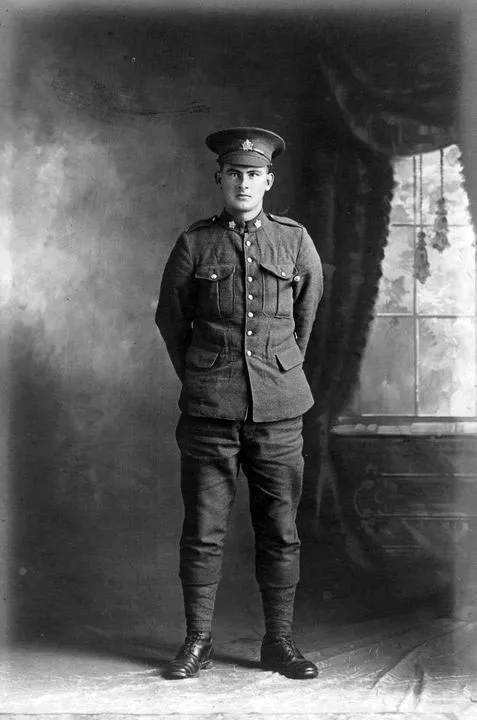
Corporal Walter Colwell of Upper Jemseg was a nineteen-year-old bank clerk before joining No. 9 Siege Battery in 1915.
Courtesy of Charrie Worden
Unfortunately, not all who wanted to join the First Contingent were successful. While Sam Hughes fretted over how to enlarge the First Contingent from an initial establishment of twenty-four thousand men to include the entire thirty-three thousand who arrived at Valcartier, some Queens County boys failed to pass the CEF’s stringent physical requirements, which called for able-bodied men between the ages of eighteen and forty-five. Infantry volunteers were further limited to those standing 5 feet 3 inches and higher, and with a girth measuring no less than 33½ inches. Ernest Shiels, feted only weeks before by the residents of Gagetown, suffered the ignominy of being rejected at Valcartier on medical grounds, while his brother Kingsley departed for England in the best of health. Gordon Parlee, a member of the Chipman troop of Boy Scouts, was too young to join on his first attempt in 1915. Thomas C. Dougherty tried five times to enlist for overseas service before opting to work in the munitions industry. It was said that “his rejection on account of bad eyesight was a great disappointment to him.” Ferguson Thompson of Hampstead was similarly blocked — most likely by his wife — in his efforts to join the First Contingent. With more men than positions to fill, Thompson might not have been aware of an all-too-important condition imposed by military officials: married men required their wives’ permission to enlist. Until this condition was waived a year later, men such as Thompson would simply have to bide their time.
Of course, wives were not the only ones affected by the departure of their men. Part ritual, part celebration, whole communities gathered to witness the traditional “send-off.” In early December, almost all of Gagetown’s residents gathered along Front Street to see four recruits depart for Saint John. School children, caught up in the events unfolding around them, were given a half-day off to partake in the spectacle. With British and Canadian flags waving in abundance and “Tipperary” ringing through the streets, each volunteer was presented with a supply of cigars, nuts, and chocolates for the long overland journey to Saint John by carriage. Such ceremonies were replayed throughout the entire county, and reflected a bold enthusiasm for Canada’s war effort. At Upper Jemseg, just across the river from Gagetown, the enlistment of Walter Colwell was marked by a gathering at the home of his father:
During the evening he was presented with a purse of $22 for a military wrist watch as a remembrance from his friends at Jemseg. Deacon J.D. Colwell made the presentation and M.C. Elgee also added a few appropriate words. The evening was spent in merry conversation, singing of patriotic songs, etc., and at the close refreshments were served by the ladies. As one of Jemseg’s popular boys Mr. Colwell has a large number of friends who wish him good luck and a safe return.
Numbering just over fifty guests, this was a rather intimate “send-off” compared to those at Gagetown and Chipman, but, like many of the larger events that took place in the county, it was emotionally charged and infused with patriotic sentiment.
The goal of winning a provincial designation for New Brunswick’s volunteers proved extremely illusive. Mirroring Sir Robert Borden’s campaign on behalf of his home province of Nova Scotia, Saint John and Fredericton newspapers continuously referred to the emergent 12th Battalion — in fact an amalgam of men and militia companies from several provinces — as a “New Brunswick” unit. Commanded by Lieutenant-Colonel H.F. McLeod of ...