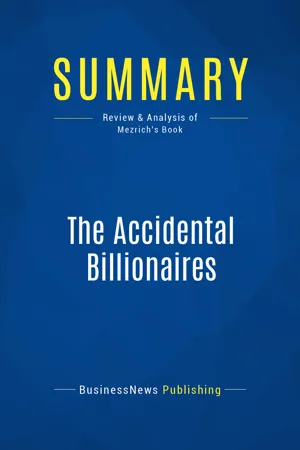
The must-read summary of Ben Mezrich's book: "The Accidental Billionaires: The Founding of Facebook"
This complete summary of the ideas from Ben Mezrich's book "The Accidental Billionaires" recounts the story of the world's biggest social network and the world's youngest billionaire, Mark Zuckerberg. Learn how a company that was created to connect people ultimately tore two best friends apart. In 2003, Eduardo Saverin and Mark Zuckerberg, two Harvard undergrads, were looking for a way to stand out among the university's elite student body. The book tells how Mark crashed Harvard's network and created the social networking site that has since revolutionised the way people communicate. "The Accidental Billionaires" is a captivating story of betrayal, sex and money.
Added-value of this summary:
• Save time
• Understand key concepts
• Increase your business knowledge
To learn more, read "The Accidental Billionaires" and discover the juicy stories behind the creation of Facebook.
eBook - ePub
Summary: The Accidental Billionaires
Review and Analysis of Mezrich's Book
- English
- ePUB (mobile friendly)
- Available on iOS & Android
eBook - ePub
About this book
Information
Subtopic
Business BiographiesIndex
BusinessSummary of The Accidental Billionaires (Ben Mezrich)
1. The FaceMash Experiment
Facebook was co-founded by Eduardo Saverin and Mark Zuckerberg who became best friends when they met as Harvard undergraduates in October 2003.
Mark Zuckerberg was a sophomore at Harvard in the fall of 2003. He was a computer science major from New York, the son of a dentist father and a psychiatrist mother. While at high school, Mark created a software program called Synapse. This was a plug-in for MP3 players which allowed the device to learn a user’s preferences and then create tailored information. Mark had posted Synapse as a free download on the Web and this caused a number of major companies to contact him with offers to buy the software. It was rumored that Microsoft had made Mark a two-million dollar offer to go and work for them but impressively Mark had turned them down.
Eduardo Saverin, by contrast, didn’t know much about computers at all. He was a business major. During the summer vacation break, Eduardo had made three hundred thousand dollars by investing in oil futures with his brother utilizing an investment strategy based on meteorology. Eduardo’s family were Jewish and had barely escaped the Holocaust to move to Brazil before being forced to relocate again to Florida, where Eduardo’s father had become very successful in banking.
As Harvard undergraduates, both Mark Zuckerberg and Eduardo Saverin were outside the more popular student groups because they were different. To counter this, Eduardo was working hard to get admitted into the Phoenix – one of Harvard’s eight “Finals Clubs” which formed the university’s exclusive old boys network. In addition to being able to rub shoulders with future billionaires, power brokers and possibly even presidents, if you belonged to a Finals Club you got to spend weekends at the best parties on campus surrounded by the hottest girls. It was this last point in particular – meeting girls – which appealed the most to Eduardo.
On a Tuesday night in the last week of October 2003, Mark and Eduardo went out with a couple of Asian girls Eduardo had met. Mark struck out and went back to his dorm room and opened up his Internet connection. He started browsing his dorm’s online housing facebook – the database of student photos for all the students which stayed in the same dorm as him. Mark was also e-mailing his friends and one of them suggested Mark should code a way of comparing the facebook’s student photos to come up with a list of who’s hot and who’s not. Another friend also suggested as a joke, you could compare someone from the facebook with a farm animal which was also an idea which appealed to Mark’s sense of humor combined with the fact he seemed to be striking out with the opposite sex at that time.
By 11pm that Tuesday night, Mark had realized he would need more pictures than his own dorm’s online database alone could provide if he was going to make this “hot or not” concept work. The solution was simple – he would hack into the Harvard University’s server and access the pictures from all the dorms on the campus. By 4:00 am the next morning, Mark Zuckerberg had downloaded thousands of pictures from Harvard’s dorms online databases to his laptop computer. Mark had even decided on a domain name for his project – he would call the site Facemash.com.
“Perhaps Harvard will squelch it for legal reasons without realizing its value as a venture that could possibly be expanded to other schools (maybe even ones with good-looking people). But one thing is certain, and it’s that I’m a jerk for making this site. Oh well. Someone had to do it eventually. Were we let in for our looks? No. Will we be judged on them? Yes.”
– Mark Zuckerberg
About seventy-two hours later, Mark had Facemash.com up and running. It was an elegant Web site which allowed users to compare pictures of two undergraduate girls, vote for which one was hotter and then watch as algorithms calculated mathematically who were the best looking girls on campus. He e-mailed a few of his buddies to ask what they thought and headed off to his classes. By the time he returned a few hours later, he found word of Facemash.com had rapidly gone viral and in just under two hours, Facemash.com had logged twenty-two thousand votes for the hottest girls on campus.
“This wasn’t good. The link wasn’t supposed to go out like that. Mark had wanted to get some opinions, maybe tweak the thing a bit. He’d wanted to figure out what the legalities were of downloading all those pictures. Maybe he’d never have launched it at all. But now it was too late. The thing about the Internet was, it wasn’t pencil, it was pen. You put something out there, you couldn’t erase it. Facemash was out there. In a matter of minutes, he killed the damn thing, shutting it down. He had a feeling that he was in big trouble.”
– Ben Mezrich
2. The Winklevoss Twins
The results of Facemash.com’s brief existence over one afternoon were genuinely impressive:
- Almost every women’s organization on campus came out against the Web site and expressed their disgust in no uncertain times.
- The university’s computer science department was up in arms because Facemash.com hogged all the university’s bandwidth.
- The legality of someone having access to other people’s pictures to use in this way was questioned.
- The Crimson, the Harvard student newsletter, carried lurid details about Facemash.com and its developer, Mark Zuckerberg.
- Many of the girls who were featured on Facemash sent Mark e-mails of complaint, letters and sometimes boyfriends across campus to get their message across.
Therefore, it was no great surprise when Mark was called to appear befor...
Table of contents
- Title page
- Book Presentation
- Summary of The Accidental Billionaires (Ben Mezrich)
- About the Summary Publisher
- Copyright
Trusted by 375,005 students
Access to over 1.5 million titles for a fair monthly price.
Study more efficiently using our study tools.
Frequently asked questions
Yes, you can cancel anytime from the Subscription tab in your account settings on the Perlego website. Your subscription will stay active until the end of your current billing period. Learn how to cancel your subscription
No, books cannot be downloaded as external files, such as PDFs, for use outside of Perlego. However, you can download books within the Perlego app for offline reading on mobile or tablet. Learn how to download books offline
Perlego offers two plans: Essential and Complete
- Essential is ideal for learners and professionals who enjoy exploring a wide range of subjects. Access the Essential Library with 800,000+ trusted titles and best-sellers across business, personal growth, and the humanities. Includes unlimited reading time and Standard Read Aloud voice.
- Complete: Perfect for advanced learners and researchers needing full, unrestricted access. Unlock 1.5M+ books across hundreds of subjects, including academic and specialized titles. The Complete Plan also includes advanced features like Premium Read Aloud and Research Assistant.
We are an online textbook subscription service, where you can get access to an entire online library for less than the price of a single book per month. With over 1.5 million books across 990+ topics, we’ve got you covered! Learn about our mission
Look out for the read-aloud symbol on your next book to see if you can listen to it. The read-aloud tool reads text aloud for you, highlighting the text as it is being read. You can pause it, speed it up and slow it down. Learn more about Read Aloud
Yes! You can use the Perlego app on both iOS and Android devices to read anytime, anywhere — even offline. Perfect for commutes or when you’re on the go.
Please note we cannot support devices running on iOS 13 and Android 7 or earlier. Learn more about using the app
Please note we cannot support devices running on iOS 13 and Android 7 or earlier. Learn more about using the app
Yes, you can access Summary: The Accidental Billionaires by BusinessNews Publishing in PDF and/or ePUB format, as well as other popular books in Business & Business Biographies. We have over 1.5 million books available in our catalogue for you to explore.