eBook - ePub
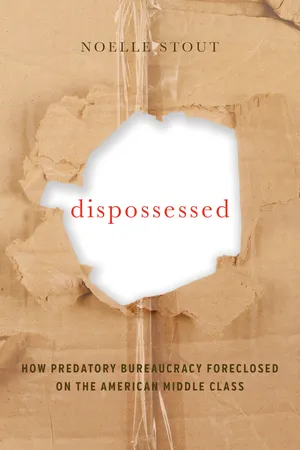
Dispossessed
How Predatory Bureaucracy Foreclosed on the American Middle Class
- 280 pages
- English
- ePUB (mobile friendly)
- Available on iOS & Android
eBook - ePub
About this book
In the aftermath of the 2008 financial crisis, more than 14 million U.S. homeowners filed for foreclosure. Focusing on the hard-hit Sacramento Valley, Noelle Stout uncovers the predacious bureaucracy that organized the largest bank seizure of residential homes in U.S. history. Stout reveals the failure of Wall Street banks' mortgage assistance programs—backed by over $300 billion of federal funds—to deliver on the promise of relief. Unlike the programs of the Great Depression, in which the government took on the toxic mortgage debt of Americans, corporate lenders and loan servicers ultimately denied over 70 percent of homeowner applications. In the voices of bank employees and homeowners, Stout unveils how call center representatives felt about denying appeals and shares the fears of families living on the brink of eviction. Stout discloses the impacts of rising inequality on homeowners—from whites who felt their middle-class life unraveling to communities of color who experienced a more precipitous and dire decline. Trapped in a Kafkaesque maze of mortgage assistance, borrowers began to view debt refusal as a moral response to lenders, as seemingly mundane bureaucratic dramas came to redefine the meaning of debt and dispossession.
Information
Publisher
University of California PressYear
2019Print ISBN
9780520291775
Edition
1eBook ISBN
9780520965423
CHAPTER ONE
Dream It, Own It
Genealogies of Speculation and Dispossession in the Valley
It was a bright spring afternoon, and a deer ran across David Sanchez’s gravel road as I pulled through the gate. Empty horse corrals lined his driveway, where his faded red Ford pickup was parked. Inside, his house was dim and musty, each room cluttered with exotic knickknacks, handmade stone sculptures, and painting supplies. A xylophone, the size of a love seat, dominated the living room. Balding on top, with his curly gray hair pulled into a ponytail, David, a sixty-eight-old veteran, had a charming smile, an easy laugh, and a soft, ironic tone of voice that kept even the most disheartening conversations upbeat.
As David fed his three cats, wiry strays from the surrounding hills, on the kitchen counter, he explained how “a street-smart Chicano from East L.A. ended up in Sacramento.” David told me he had had a good job in Los Angeles as a factory manager, but his first wife had succumbed to drug and alcohol addiction shortly after their daughter was born. His older brother had secured a stable manufacturing job in the Sacramento Valley, and on his advice David, then in his early twenties, moved there so that his young daughter could have a fresh start. In Sacramento, he worked in manufacturing, but after the factories shut down, David reinvented himself as a video tech for a community college, where he landed a job in the 1990s.
Working at the college, David met Karen, a gentle and hardworking white school counselor fifteen years his junior. Karen, originally from Santa Barbara, had traveled north to attend Sacramento State. After graduating, she had taken a position counseling students and coordinating adult night courses; they met when David was hired as a video technician and used his position to develop an arts curriculum for the adult program. After some back-and-forth, the couple settled into a relationship. They traveled, rode horses (Karen was an avid equestrian), and spent time with friends. In their social circle, David said, the couple developed a reputation for lighting up a room whenever they walked in together.
After five years, in 2001, they married. David described his outdoor wedding to “the love of my life” as he led me to a parade of photographs hanging in his hallway. In my favorite photo, Karen smiled straight into the camera, her mouth caught wide in mid-laugh, while David stood with his gaze fixed adoringly on his bride and his hands awkwardly angling toward her trim waist. The sun setting over the foothills cast shadows over their guests standing in the background.
Soon after, Karen was diagnosed with an aggressive ovarian cancer. They were living in what David called their “safety home,” a two-bedroom house they bought after the wedding. It was nothing like the house they had imagined living in. “My wife had survived the first operation and chemo,” David explained, “and she was looking dazed.” On a mission to return some of the vitality cancer had stolen, David found their dream home four blocks away, a four-bedroom California ranch-style house nestled in the woods back from a country road. “It was a fixer-upper; it needed some TLC. And it had room for Karen’s horses.” David secured a loan through Countrywide Financial, and they borrowed $15,000 from a friend for the down payment. The couple signed a contract in 2004.
When the payments ballooned, their new mortgage stretched the couple financially. Karen had stopped working when she started chemotherapy, and they were barely scraping by on David’s income. When they bought the house, they agreed, David joked, that they wouldn’t eat for ten years, but if they qualified for the mortgage, they qualified. The market had been going up for years; property was a sound investment. Besides, Karen had fallen in love with the place, declaring it her dream home, and David was desperate “to give her something to live for.”
For David and Karen, a home purchase was much more than a commodity or a sound investment; it represented a second chance at a life that seemed suddenly all too fragile. David described the purchase as emotionally driven, one that would give them a place where they could be together “with room to breathe.” Like David and Karen, most homeowners I came to know in the Sacramento Valley described their motivation for homeownership as a combination of emotion and finances: a graduation into adulthood, a place to grow a family, a stable ground to live out the golden years. An empty structure, a dwelling, became the scaffolding that would support tremendous psychic weight and was infused with a magical power to give a child solid footing or to save a life. These visions of homeownership, enabled by a financial exchange but not determined by it, would later encourage people to rethink the moral valence of debt repayment as foreclosures overtook the Sacramento Valley.
POSTWAR AMERICAN DREAMS
Lenders and loan servicers consistently perpetuated the idea that homeownership could cure the tragedies of modern life. Advertising campaigns selling mortgages promised familial bliss, personal belonging, and financial stability. In the Sacramento Valley, this sentiment imbued the marketing tag lines of mortgage lenders: “Dream it, own it.” “Impossible.” “Move up.” “You’re too smart to rent.” Kinship references abounded; in these advertisements, babies, young children, and women either holding newborns or about to give birth were familiar tropes. Another advertising angle emphasized a link between homeownership and unlimited possibility. One Wells Fargo television spot from 2013 intercut scenes of the Wright brothers, Rosa Parks, a NASA control room erupting into cheers as a rover lands on Mars, and a newborn baby as a way to link, in the space of sixty seconds, mortgage lending with a broader dream of American possibility.
If the American Dream was grounded in the ideology that hard work guarantees opportunities for the good life, possession of a house was the post–World War II embodiment of that ideal. This imagined role of the home as a respite from the cold, hard calculations of the public sphere was already rooted in nineteenth-century notions of public and private divides under industrial capitalism, but it took on a new sheen as the suburbs expanded after World War II. After the war, the federal government fueled the growth of the suburbs by using tax policies to encourage developers to build large-scale suburban neighborhoods on farmland.1 To help Americans to buy these homes, the government insured mortgages and built highways connecting commuters with the city centers where they worked. The new houses in these sprawling suburbs needed to be filled, in turn promoting a consumer culture of goods and appliances, the domestic manufacturing of which helped the United States transition out of a wartime economy. Rosie the Riveter had built bombs during the war, but once peace was declared, she and her sisters handed their manufacturing jobs back to their husbands and brothers coming home from Europe and the Pacific. Soon American factories were churning out washing machines instead of bombs, appliances that made housework more efficient for now-homebound Rosie and kept the men in her life employed.
The postwar suburban housing boom was part of a larger project of economic redistribution that sought to secure blue-collar livelihoods and ease workers’ entry into the American middle class. In the Sacramento Valley, New Deal policies supported not only mortgaging but also massive employment and educational ventures. Federal programs funded projects including infrastructure developments that hired local labor to produce city murals and sculptures, expand city parks and the Sacramento airport, build public schools, and install sidewalks and water tanks. These policies paved the way for significant public works after World War II. Sacramento State University was founded in 1947 to meet the increased demand for higher education from veterans taking advantage of the GI Bill. For generations, public-sector jobs in the Sacramento Valley would offer residents secure employment with moderate but certain possibilities for advancement and with decent health and retirement benefits.
This growth of the American suburbs and mortgaging coincided with the expansion of a consumer credit market that would transform the social meaning of debt. Before the 1920s, Americans had considered it shameful to owe money. As historian Louis Hyman describes, U.S. lenders were prohibited from charging profitable interest rates, reselling debts, or borrowing against debts before 1917.2 Some Americans did secure loans, but the stigma of debt meant that they borrowed primarily in a subterranean world of loan sharks and pawnbrokers.3 However, the expansion of consumer credit, along with federal mortgaging, allowed long-term borrowing and debt repayment to become central to middle-class notions of stability. In the 1920s, consumer credit entered mainstream middle-class American social life, as business and government collaborated to enable Americans to purchase the goods of the developing manufacturing economy. Those who carried so-called good debt were considered good citizens.4 Mortgaging and other forms of consumer credit, as Hyman points out, became an entitlement rather than a privilege for middle-class Americans, tightly woven into the spending habits of homeowners who took out mortgages, financed cars, and bought clothes with charge cards. “To be denied credit went beyond an economic inconvenience,” he explains; “credit access cut to the core of what it meant to be an affluent responsible adult in postwar America.”5 This pervasive sense of entitlement among middle-class homeowners would fuel expectations of financial reciprocity and mutuality from mortgage lenders decades later in the aftermath of the mortgage crash.
Conversely, residents in Sacramento Valley’s lower-income neighborhoods were less likely to anticipate help from lenders as the housing bubble imploded in 2008. The absence of feelings of entitlement to assistance and attention reflects residents’ long-standing exclusion from mortgage lending and credit markets. Consumer credit and home loans became available beginning in the 1930s, democratizing credit and mortgage lending, but both were riddled with racial covenants. “It was not a boon for everyone,” UC Davis sociologist and veteran Sacramento real estate agent Jesus Hernandez told me. An expert on the racist practices of American mortgaging, Hernandez showed me a slide of a local appraisal manual he had unearthed from a Sacramento archive from the 1930s that listed races in hierarchical order of the supposed risk that neighborhoods posed to mortgage lenders; housing officials had relegated “South Italians,” “Negroes,” and “Mexicans” to the bottom of the list. At a property in Sacramento, an appraiser’s notes justified low property values because “goats, rabbits, and black babies” had been found on the property. “Fannie Mae,” Hernandez said bluntly of the Federal National Mortgage Association, “would only do loans with white people.” Military bases attracted African American and Latino service members and their families to the Sacramento Valley, forging among them a fragile middle class, but rampant redlining and de facto segregation kept them from enjoying access to many neighborhoods in the region.
The same types of discrimination existed in other forms of credit lending. Hyman shows how middle-class consumers, particularly white men, had easy access to consumer credit, but low-income people of color and women of all classes and races were denied loans. Divorced and married white women, for example, could not take out a loan without the signature of a husband or father. The organization of postwar suburban houses similarly helped to solidify the advantages of white middle-class masculinity. Cultural campaigns to relegate women’s work to the domestic sphere proliferated. Whereas women had broken gender segregation during the war, working in factory jobs previously forbidden to them, these posts were now reserved for men returning from war, which put women of color and working-class white women who had always worked and had relied on these higher-paying factory jobs to support their families during the war at a particular disadvantage. The architecture, material culture, and spatial arrangements of postwar suburbanization generated and exacerbated inequalities of class, race, and gender.6
Federally sponsored educational and employment opportunities likewise failed to benefit Sacramento Valley residents equally. Most prominently, during World War II, Japanese American residents in Sacramento had been detained and imprisoned in internment camps, suffering innumerable injustices and losing substantial amounts of family wealth in the process. Racial inequalities also plagued the farming industry, as large-scale farms took advantage of a largely Latino workforce. These inequities persisted into the 1960s, as Cesar Chavez led the most famous United Farm Workers civil rights march to Sacramento.
Without a doubt, the expansion of consumer credit consolidated white male privilege, but, ironically, the Keynesian philosophies driving these financial policies often celebrated credit markets as a tool of liberation. In the 1930s, policy makers often suggested that the best way to address social problems such as income inequality and discrimination was a massive expansion of consumer credit, making credit available to those previously excluded, such as nonwhite borrowers and white women.7 In the 1960s, a second-wave feminist movement of credit activists emerged, in which women advocated for a fuller integration into capitalist economies as a way to secure equal rights, resulting in the passage of the Equal Credit Opportunity Act in 1974. Similarly, credit scoring was touted as a way to remove personal bias from the credit decisions made about consumers by outsourcing the human component of these decisions to a seemingly impartial mathematical system. That said, most often the rise of credit scoring merely concealed racism and classism behind a façade of formalized objectivity.
Postwar American consumer credit markets, especially mortgaging, endemic with forms of discrimination, were deeply flawed but still aimed to grease the wheels of manufacturing, supporting blue-collar and middle-class families with wages and benefits that allowed them to purchase manufactured goods. But 1980s neoliberal economic policies began dismantling those industries and sending fac...
Table of contents
- Imprint
- Subvention
- Title
- Copyright
- Dedication
- Epigraph
- Contents
- List of Illustrations
- Introduction. Once Sold, Twice Taken: A Life Undone
- 1. Dream It, Own It: Genealogies of Speculation and Dispossession in the Valley
- Landscapes
- 2. Put Out: Bank Seizure at the Poverty Line
- 3. Robbing Peter to Pay Paul: Relocating the Middle Class
- Documents
- 4. Can’t Work the System: The Troubled Sympathies of Corporate Bureaucrats
- 5. We Shall Not Be Moved: The Shifting Moral Economies of Debt Refusal
- Drawings
- Conclusion. You Can’t Go Home Again
- Acknowledgments
- Glossary
- Notes
- References
- Index
Trusted by 375,005 students
Access to over 1.5 million titles for a fair monthly price.
Study more efficiently using our study tools.
Frequently asked questions
Yes, you can cancel anytime from the Subscription tab in your account settings on the Perlego website. Your subscription will stay active until the end of your current billing period. Learn how to cancel your subscription
No, books cannot be downloaded as external files, such as PDFs, for use outside of Perlego. However, you can download books within the Perlego app for offline reading on mobile or tablet. Learn how to download books offline
Perlego offers two plans: Essential and Complete
- Essential is ideal for learners and professionals who enjoy exploring a wide range of subjects. Access the Essential Library with 800,000+ trusted titles and best-sellers across business, personal growth, and the humanities. Includes unlimited reading time and Standard Read Aloud voice.
- Complete: Perfect for advanced learners and researchers needing full, unrestricted access. Unlock 1.5M+ books across hundreds of subjects, including academic and specialized titles. The Complete Plan also includes advanced features like Premium Read Aloud and Research Assistant.
We are an online textbook subscription service, where you can get access to an entire online library for less than the price of a single book per month. With over 1.5 million books across 990+ topics, we’ve got you covered! Learn about our mission
Look out for the read-aloud symbol on your next book to see if you can listen to it. The read-aloud tool reads text aloud for you, highlighting the text as it is being read. You can pause it, speed it up and slow it down. Learn more about Read Aloud
Yes! You can use the Perlego app on both iOS and Android devices to read anytime, anywhere — even offline. Perfect for commutes or when you’re on the go.
Please note we cannot support devices running on iOS 13 and Android 7 or earlier. Learn more about using the app
Please note we cannot support devices running on iOS 13 and Android 7 or earlier. Learn more about using the app
Yes, you can access Dispossessed by Noelle Stout in PDF and/or ePUB format, as well as other popular books in Social Sciences & Real Estate. We have over 1.5 million books available in our catalogue for you to explore.