The historian and author of
The Great Trek recounts the devastating period of violence among indigenous peoples in early 19th century southern Africa.
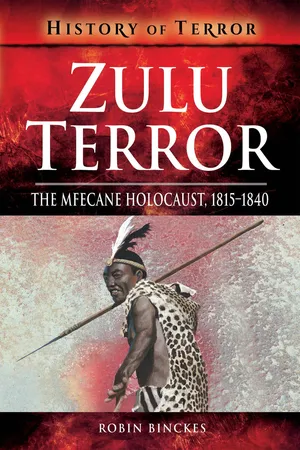
From 1815 to 1840, southeastern Africa experienced a devastating period of warfare between the Zulus, the Matabele, and other indigenous peoples. Though the causes of the unrest—which the Zulu called the Mfecane—are still debated by historians, we know that hundreds of thousands of lives lost. Some estimate the total number of deaths to be near two million.
At the center of the turmoil was the Zulu Kingdom and its King Shaka, whose wars of expansion sparked mass migrations among smaller tribes. One of Shaka's lieutenants, Mzilikazi Khumalo, escaped execution and began a trail of destruction from Zululand north to the Highveld. Refugees from Mzilikazi's warpath then formed their own alliance—including with the Dutch-speaking Voortrekkers, arriving on their own "Great Trek" to escape British control. Finally defeated in 1836 by the Voortrekkers in a nine-day battle, Mzilikazi and his followers crossed the Limpopo River and founded the kingdom of the Matabele in what is now Zimbabwe.
- 128 pages
- English
- ePUB (mobile friendly)
- Available on iOS & Android
eBook - ePub
About this book
Information
Subtopic
19th Century HistoryIndex
History1. THE ARRIVAL OF THE SETTLERS
On 3 December 2017 Chief Khoisan SA accompanied by fellow marchers Brendon Billings and Shane Plaatjies set up camp on the lawns of the Union Buildings in Pretoria after having walked for three weeks from Port Elizabeth to Pretoria, a distance of 700 miles, to demand recognition of their language and culture from Jacob Zuma, the president of South Africa. Five hundred additional marchers joined the three men that day to add their voices to those of the three Khoisan marchers.
South Africa boasts the Cradle of Humankind, the site of the first controlled use of fire, the fossils of Australopithecus Africanis, Mrs Ples (2.6—2.8 million years old), Naledi (over 3 million years old) and Little Foot (3.67 million years old). It also boasts the oldest living people on the planet: the Khoisan. Indisputably the Khoisan are the indigenous people of southern Africa with their origins dating back to the early mists of time.

Sebastian Munster’s map of Africa, c. 1535. (Cosmographiae Universalis, Basle, 1640)

Southourn Africa, Blaeu’s 1665 map.
Consisting of five major groups—the KhoeKhoen, San, Nama, Korana and later, after the arrival of the white man, the Griqua—all of these groups speak the language of Khoekhoegowab, which consists mainly of ‘clicks’ and sounds made by the use of the tongue with very few guttural sounds.1 The KhoeKhoen and San in turn each broke down into many subclans, nineteen for the KhoeKhoen including the Cochoqua, Chainouqua, Hessequa, Inqua, Gona, Hoengeyqua. The KhoeKhoen were pastoralists, owned cattle and were nomadic to a certain extent while the San were hunter-gatherers and also nomadic.
The early European settlers referred to the Khoekoen as Hottentots (also known as Khoikhoi), naming them after the clicking sounds they made when conversing and the San as Bushman. Over the years wars, genocide, smallpox and other diseases brought by the Europeans have all but totally annihilitaed these peoples.

Location of the Khoikhoi before contact with the Europeans.
In neighbouring South West Africa (now Nambia), which was administered by South Africa as a League of Nations mandate from 1918 until 1990 it was legal to hunt a Bushman up until 1936.
These groups lived in relative harmony until, from about 300 AD, when like a stone being thrown into a pool of still water; this harmony was disturbed by the arrival of the first black people, the Bantu, who originated in the Niger basin of West Africa. Over a period of centuries these people moved down Africa in two distinct streams. Into the interior of southern Africa came the Sotho-speaking people and down the east coast of southern Africa, the Nguni-speaking people.
Seeking better pastures for their cattle the Nguni people reached a river beyond which the grazing was not suitable (today named the Fish river), causing them to stop their wanderings, and it was here, east of the Fish river in the land bounded by the sea and the great Drakensberg mountains that the Nguni people settled. Prior to becoming separate nations Nguni society was comprised of a myriad of clans, or subtribes, ruled by chiefs and subchiefs (indunas).
By the beginning of the nineteenth century there were at least forty-six different clans living between the Pongola river in the east and the Umzimkulu river in the west and bounded by the Drakensberg mountains. The largest of these clans were the emaHlutshini (8,208), Ngcobo (8,208) Qwabe (7,182), Ndwandwe (4,104), Mtetwa (4,104). The Zulu were a relatively small clan of 2,0522
There were three major tribes occupying the areas now known as Nquthu, Babanango, Empangeni, Mtubatuba, Hlabisa, Nongama, Pongola, Vryheid Melmoth, and Mahlabathini. These were the Ngwane, the Ndwandwe and the Mtetwa. West of the Umzimkulu river more Nguni clans existed who later molded themselves into the Pondo, Thembu and Xhosa.
It was here, around 1670, east of the Umzikulu river near the Mhlatuse valley that we first meet Malandela, an Nguni, son of Luzulmane. It is believed that he was from the now non-extant Ntsele clan, which had settled in the eBabanango hills.3 At this time Malandela took his family and trekked west to the coast. In pouring rain Malandela and his family marched down the left bank of the Mfule river until a suitable place was found to cross the raging torrent. Some of the family, slower to move, stayed behind despite the cold and hungry members of the party who had crossed with Malandela shouting back across the river that they had found a field of delicious fat plants, izimBece (wild melons). Those that remained behind chose to settle where they had stopped and built huts and in time became a separate clan, aba-s-emaNgadini (‘Those among the watermelons’) ruled by Yabana, son of Ngema.
Malandela’s party pushed on. Some ten miles farther near the iNkwenkwe hill they crossed the Mhlatuze river and there, under the emaNdawe hill at the end of the valley Malandela built his hut. It was here that Malandela died, leaving his wife Nozinja (Mrs Dogs) and two sons, Qwabe, the eldest, and Zulu. Legend has it that Qwabe coveted the cattle that Nozinja had accumulated by her hard work and shrewdness. When Qwabe attempted to wheedle the cattle from his mother her response was “Hawu! And you the heir to all your father’s cattle? What then is my child Zulu to receive?” She then abandoned Qwabe and returned inland, accompanied by Zulu and a servant, Mpungose, a man of the Gwabini clan.
After leaving the Mhlatuze valley the small party crossed the river, climbed the hills and headed for the mid-Mfule valley, following a stream and ascending the Mtonjaneni heights. They looked down on the landscape below: stony veld sprinkled with candelabra euphorbias and thorny mimosa scrub, which teemed with wild game of all sorts: elephant, lion, giraffe, buffalo, and thousands of buck. This was to be the home of the aba-kwa Zulu clan. While Zulu settled at Mkumbane, the abandoned brother, Qwabe, lived some thirty miles away, on the lower Mhlatuze river4 closer to the sea. Here he founded the Qwabe clan. As Nozinja and her small party were seeking a new home so were other smaller groups splitting away and establishing new residences, which would grow into separate clans over time. The two most important clans in the area were the Amangwane and the Mtetwa led by Jama. After the death of Jama two of his sons, Godongwana and Mawewe, vied for the chieftainship resulting in Godongwana fleeing to the Phate stream below Mthonjaneni mountains in the southwest. Here, assisted by Ndlovu of the Mphungose people, they killed Mawewe, cutting him down on the slopes of Sihlungo hill, near Banango.5 Godongwana came to power as chief of the Mtetwa in 1780. He immediately changed his name to Dingiswayo, or ‘One in distress’. Dingiswayo had, as a young man, been forced to flee from his people for a period of time due to jealousy of his right to take over as chief. During this time it is believed that he travelled far to the west and experienced firsthand the military tactics being applied by the British against the Xhosa on the Fish river. Gifted with a superior intellect, Dingiswayo proved to be an enlightened leader, opening up trade in ivory with the Portuguese in Delagoa Bay. He also became the first of the chiefs to introduce the system of regiments, or impis, by dividing his followers into battle groups, distinguishing each by name and colour of their shields.6 He appointed officers of various grades to command them and introduced war dresses to distinguish the officers from the rank and file. It was he who introduced the stabbing spear. He began declaring war on all his neighbouring clans on the pretext that he wished to do away with the constant rivalry and bickering between them. The first to be defeated were the Amakwadini. He directed that the cattle of the Amakwadini be brought to his place of residence. He distributed the oxen to his warriors as a reward for their victory and gave the cows back to the defeated Amakwadini after they had khonza’d, accepting his authority over them. In this same way he defeated the Kwabi, AmaLanga, AmaKwadini, AmaZulu, AmaTyaleni, Telayiza, Kuyivane, AmaThembu, AmaSwazi, and Amakose. The only tribe he had not defeated was the Ndwandwe under Chief Zwide. The Mfecane, or crushings, had begun.

Clans inhabiting Zululand about 1816, from A. T. Bryant’s Olden Times in Zululand and Natal (1929). The precision is staggering.
Of these early Zulu rulers very little is known. Zulu became the first king of the Zulus until 1709, followed by Punga and then Mageba.7 Mageba was succeeded by Ndaba and he by Jama who died in 1781. Jama had a number of children including daughters Mnkabayi, Mawa, Mthembase and Mmama, and sons Sojisa, Khekhe, Magunza, Nomaphikela, Nobongoza, Nkwelo and Senzangakhona.
Having been defeated by Dingiswayo, the Zulu under Senzakhona became Dingiswayo’s subjects and had to abide by his laws. One of these laws—the custom of circumcision prevalent among the Nguni people—was ceased until Dingiswayo had conquered all around him. It was customary that no intercourse was permitted until after circumcision. Senzakhona had to toe the line. One of the women of the Langeni8 tribe, Nandi, was selected by Senzakhona as one of the women whom he would one day bed, when he was allowed to, after being circumcised. But Senzakhona became impatient and could not wait for Dingiswayo’s go-ahead and had intercourse with Nandi. He impregnated her and Dingiswayo, when noticing the change in Nandi’s figure, thought she was suffering from a stomach disease known as cheka. The son who was born a few months later, around 1787, became known as Shaka. When the boy was seven years old, Nandi returned to her people, the Langeni. Shaka’s maternal grandmother played a large role in raising the boy. He experienced great unhappiness as a child, the young boys in the Langeni tribe continuing to taunt and bully him in exactly the same manner as the young Zulu boys had done in his earlier years. This physical and mental abuse no doubt left its mark, turning a proud and confident young boy into one who was withdrawn, angry and vindictive.

A Hottentot couple, from a 1745 engraving by N. Parr.
After being involved in a fight with the family of a boy who had angered him, Nandi and Shaka left the Langeni and settled briefly among the Qwabe before joining the Mtetwa people. Shaka placed himself under the watchful eye of Chief Jobe of the Mtetwa. When Jobe died in about 1807 his successor, Dingiswayo— Shaka’s conception long since forgotten—took over responsibility for raising the boy and placed Shaka under the special care and protection of Ngomane kaMqoboli, one of his chief military commanders and advisors.9 Nandi returned to her own people, the Langeni, leaving Shaka behind. She later married a commoner and had a son, Engwade. Dingiswayo, having himself been an outcast, had taken pity on the young Shaka and adopted him as his foster son. Shaka grew up very much influenced by Dingiswayo and at an early age served in Dingiswayo’s army and participated in many of his campaigns against his neighbours. Shaka became conspicuous by his bravery in battle and soon earned the name of Sigiti, ‘We do not dance’.
2. SHAKA: THE QUEST FOR POWER
When Senzakhona, Shaka’s father, died in 1816,1 Shaka approached Dingiswayo and requested that he be appointed chief of the Zulus who were now part of Dingiswayo’s growing empire. Dingiswayo refused and informed him that the rightful heir to the Zulu chieftainship was Shaka’s half-brother, Umfogazi. Undeterre...
Table of contents
- Cover
- Title
- Copyright
- Contents
- Maps
- Introduction
- 1. The Arrival of the Settlers
- 2. Shaka: The Quest for Power
- 3. Matiwane’s Path of Terror
- 4. The British Arrive
- 5. Mzilikazi: The Bloodiest of All
- 6. Dingane: Who Rules by Fear
- 7. Mzilikazi’s Rivers of Blood
- 8. Enter the Boers
- 9. The Great Trek Begins
- 10. Defeat of the Matabele
- 11. Intrusion onto the Land of the Zulu
- 12. Weenen and Italeni
- 13. Blood River
- 14. The End Game
- Notes
- Bibliography
Trusted by 375,005 students
Access to over 1.5 million titles for a fair monthly price.
Study more efficiently using our study tools.
Frequently asked questions
Yes, you can cancel anytime from the Subscription tab in your account settings on the Perlego website. Your subscription will stay active until the end of your current billing period. Learn how to cancel your subscription
No, books cannot be downloaded as external files, such as PDFs, for use outside of Perlego. However, you can download books within the Perlego app for offline reading on mobile or tablet. Learn how to download books offline
Perlego offers two plans: Essential and Complete
- Essential is ideal for learners and professionals who enjoy exploring a wide range of subjects. Access the Essential Library with 800,000+ trusted titles and best-sellers across business, personal growth, and the humanities. Includes unlimited reading time and Standard Read Aloud voice.
- Complete: Perfect for advanced learners and researchers needing full, unrestricted access. Unlock 1.5M+ books across hundreds of subjects, including academic and specialized titles. The Complete Plan also includes advanced features like Premium Read Aloud and Research Assistant.
We are an online textbook subscription service, where you can get access to an entire online library for less than the price of a single book per month. With over 1.5 million books across 990+ topics, we’ve got you covered! Learn about our mission
Look out for the read-aloud symbol on your next book to see if you can listen to it. The read-aloud tool reads text aloud for you, highlighting the text as it is being read. You can pause it, speed it up and slow it down. Learn more about Read Aloud
Yes! You can use the Perlego app on both iOS and Android devices to read anytime, anywhere — even offline. Perfect for commutes or when you’re on the go.
Please note we cannot support devices running on iOS 13 and Android 7 or earlier. Learn more about using the app
Please note we cannot support devices running on iOS 13 and Android 7 or earlier. Learn more about using the app
Yes, you can access Zulu Terror by Robin Binckes in PDF and/or ePUB format, as well as other popular books in History & 19th Century History. We have over 1.5 million books available in our catalogue for you to explore.