The author of
The Charge of the Light Brigade examines the history behind a treasure of military gold that disappeared during the Peninsula War.
History abounds with unresolved puzzles and unanswered questions, none more so than that of the loss of the British Army's military chest during the retreat to Corunna in 1809. Now, with a group of fellow historians, the author set off to search the archives and the mountains of Galicia in a bid to find Moore's gold.
Sir John Moore's small force had dared to attack Marshal Soult's II Corps isolated in the north of Spain. But before Moore could pounce on the unsuspecting French corps, he learned that the Emperor Napoleon, at the head of an overwhelming body of troops, was bearing down on the British force, hoping to cut it off from the sea and its only avenue of escape.
A desperate race for the coast then began, with the French hard on Moore's heels. In subzero temperatures, the troops were driven on through the snow-clad Galician mountains at a punishing pace. As the men trudged on in deteriorating conditions, the bullocks pulling the army's military chest could no longer keep up. So, in order to prevent the money from falling into enemy hands, the entire military chest was thrown down a deep ravine.
What then happened to all those dollars and doubloons? Some were snatched up by the pursuing French cavalry. Some, also, were retrieved by British soldiers who intentionally lagged behind, though their greed cost them their lives on the end of a French bayonet. But what of the rest of the money?
eBook - ePub
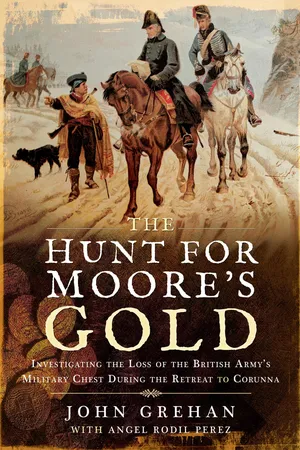
The Hunt for Moore's Gold
Investigating the Loss of the British Army's Military Chest During the Retreat to Corunna
- 248 pages
- English
- ePUB (mobile friendly)
- Available on iOS & Android
eBook - ePub
The Hunt for Moore's Gold
Investigating the Loss of the British Army's Military Chest During the Retreat to Corunna
About this book
Trusted by 375,005 students
Access to over 1.5 million titles for a fair monthly price.
Study more efficiently using our study tools.
Information
Chapter 1
Cintra Shame
The raft swayed gently on the slow-running waters of the Niemen. Napoleon’s boat was the first to arrive, the Marines of the Guard proving swifter oarsmen than their Russian counterparts. Upon the raft had been built a magnificent apartment, the imperial eagles of both countries proudly adorning the doors and the roof. A few moments later, Alexander I, Czar of All the Russias, stepped onto the elaborately decorated craft. Napoleon courteously opened the door flap for the young Russian autocrat and, for the first time, the two most powerful men in the world stood face to face.
They were there, anchored in the middle of a neutral river, to formulate a treaty of peace after years of antagonism. But one obstacle still stood in their way – Britain, Russia’s ally and financial backer, France’s implacable enemy.
Acutely conscious of Napoleon’s growing strength and Britain’s increasingly isolated position, the Czar made the first move: ‘I hate the English as much as you do yourself,’ he declared. ‘If that is the case,’ replied Napoleon, ‘then peace is already made.’1
For more than an hour the two emperors bargained over the fate of Europe as a host of dignitaries and the massed ranks of the French and Russian armies lined the banks of the river. Twenty-three days earlier, on 14 June 1807, Napoleon’s seemingly invincible horde had crushed the Russian Army at the Battle of Friedland and the despondent Czar had begged for an armistice. After ten months of almost continuous warfare the last two major continental powers in arms against France, Prussia and Russia, had been beaten and humiliated. Only that small nation of shopkeepers, sitting remote and secure behind the ‘wooden walls’ of the Royal Navy, refused to pay homage to the new Charlemagne.
Now, with almost all of Western Europe under his control, Napoleon could turn the full weight of his empire’s vast resources upon those ‘Perfidious Islanders’. A direct assault upon Britain, however, was beyond even Napoleon’s means, for although France dominated the land, Britannia still ruled the waves, and the frigates of the Royal Navy cruised the Channel with an unrelenting vigilance. Unable, therefore, to come to grips with his enemy, Napoleon had resolved upon warfare of a different kind. On 21 November 1806, five weeks after defeating the once-mighty army of Prussia, Napoleon issued a decree from the captured Prussian capital, Berlin, in which he outlawed all trade and correspondence between Britain and the French-controlled areas of Europe.
Britain then, as now, relied upon international commerce to maintain the expansion of its manufacturing industries. The restriction upon its trade caused by Napoleon’s ‘Continental System’ caused some discomfort throughout the United Kingdom and export figures fell. Many countries in Europe, including alleged allies of France, nevertheless, disregarded the decrees and openly, or secretly, continued to trade with the ‘Workshop of the World’. Napoleon was determined to stamp out this illicit trade and close off every Continental port to English shipping. So, when the two emperors met in the middle of the River Niemen at Tilsit, Napoleon was prepared to use every possible expedient to persuade Russia to participate in his embargo of British goods. Alexander, though, did not need much persuading. Anxious to achieve an honourable settlement, he readily agreed to ban English goods from his domains. Napoleon had no wish to humiliate Russia. His real enemy was to be found in London not in St Petersburg, and he needed the support of this huge northern state to bring the few wayward countries into line. Denmark, Sweden and Portugal still trafficked in British merchandise, the first as a neutral, the latter two as allies of King George.
Publicly, the Treaty of Tilsit proclaimed the advantages of harmonious relations between the two countries, the new opportunities for enterprise that this would bring, and the now mutual affection of the two emperors. The treaty, however, contained a number of secret clauses. Europe was to be split into two spheres of influence. Russia was to add Finland to its growing list of conquests and exert pressure upon King Gustavus of Sweden to sever his links with Britain. France agreed to abandon its traditionally friendly relations with Constantinople and allow Alexander to seize parts of the European provinces of the Ottoman Empire. In return, Russia would stand aside while France took possession of the Ionian Islands, the Dalmatian coast of what is now Croatia, and ‘The Bourbon dynasty in Spain and the House of Braganza in Portugal shall cease to reign; a prince of the Bonaparte family to succeed to each throne.’2
News of the Russian defeat at Friedland and the diplomatic manoeuvring at Tilsit reached Westminster by mid-July. Although the content of the secret clauses was unknown to the British Government, dark intrigues were immediately suspected. Considerable suspicion also surrounded the motives of ‘neutral’ Denmark and its ability (and determination) to withstand the mounting pressure from France to close its ports to British vessels. Fearing that the Danes might soon be overwhelmed and their valuable navy fall into the hands of Napoleon, the British cabinet decided upon an audacious scheme to capture the entire Danish battle-fleet.
With uncharacteristic speed the government assembled a force of 30,000 men and seventeen battleships, under Lord Cathcart, and despatched them to Copenhagen. This armada was preceded by an English diplomat, Mr Francis Jackson, who demanded the surrender of the Danish fleet in return for an annual payment of £100,000, with the ships to be returned to their owners upon the cessation of hostilities.
The crown prince naturally rejected Jackson’s offer, and on 16 August 1807, British troops landed at Vedboek and marched upon Copenhagen. Powerful batteries were erected and, after four nights of devastating bombardment, the city was surrendered and with it forty-five warships.
However piratical this act may have appeared, it was in fact a brilliant piece of anticipation. The combined naval strength of France, and her Dutch, Spanish, and now Russian allies, stood at 129 ships-of-the-line. The Royal Navy had, at the most, 113. Despite this slight numerical advantage, the French and Spanish fleets had spent much of the war blockaded within their own harbours. Man-for-man the inexperienced French sailor was no match for Jack Tar, as Nelson had so emphatically proved at Trafalgar two years earlier. If Napoleon still nurtured any hope of driving his old enemy from the seas he would have to considerably increase the size of his navy. It would take years to build such a fleet, but what Napoleon could not manage by construction he might yet achieve by force. Only days before Cathcart’s men began their advance upon Copenhagen, Napoleon had told the Danish Emissary that his country must ally itself with France or face war, and that a large force under Marshal Bernadotte was concentrating in Holland for the invasion of Denmark.
When the French Emperor heard of the British coup his rage was uncontrollable. Yet there was once last chance. Lying idle in Lisbon harbour was the powerful Portuguese battle-fleet. At a diplomatic reception a few days later, Napoleon threatened the Portuguese Ambassador: ‘If Portugal does not do what I wish, the House of Braganza will not be reining in Europe in two months! I will no longer tolerate an English Ambassador in Europe. I will declare war on any power that receives one two months from this time! I have 300,000 Russians at my disposal, and with that powerful ally I can do everything.’
On the last day of November 1807, two months after Napoleon’s prophetic tirade, General Junot marched through the crowded, cobbled streets of Lisbon. Behind him trailed 1,500 ragged and exhausted men, the remnant of a magnificent force of 25,000 seasoned French troops who had crossed the Pyrenees only a few weeks before. They had encountered no organised resistance from the Portuguese but the invaders had suffered terribly from the ravages of the weather in the barren and inhospitable countryside. Many had died through exposure, others simply starved, the rest staggered on at whatever pace they could. Nevertheless, Junot had crossed the northern Iberian Peninsula at astonishing speed, covering the last 300 miles in fourteen days. His objective was to seize the Portuguese fleet before the British could once again intervene. Unfortunately for Junot, only forty-eight hours earlier a terrified and confused Prince John had submitted to the entreaties of the British Ambassador and, in the company of a Royal Navy squadron, he had sailed to set up court in the Portuguese colony of Brazil. With him went the Portuguese fleet and Napoleon’s last hope of naval supremacy.3
Over the course of the next few days the stragglers hobbled into the Portuguese capital and soon Junot had more than 24,000 men under arms. Dispatching strong columns to occupy the principle fortresses, Junot quickly and bloodlessly subdued the population. The subjugation of Portugal was, however, only part of a far grander design. Napoleon was under no illusions as to the efficacy of the Continental System, for while large parts of the old world were denied to the British traders, the UK’s unrivalled naval strength allowed those traders to open unlimited new markets in the developing countries of Asia and America. Napoleon, consequently, planned a series of massive assaults upon British-held posts throughout the globe.
The first of these attacks, aimed at India, was to consist of ‘50,000 men, Russians, French and perhaps Austrians,’ Napoleon announced, ‘marching into Asia by way of Constantinople [who] would no sooner reach the Euphrates than England would tremble and go down on her knees’. The second part of the scheme was designed to drive the Royal Navy from the Mediterranean, thus depriving the ships of their vital supply bases and compelling them to lift their blockade of the southern European ports. This would enable the combined fleets of France and Spain to execute the third phase of Napoleon’s master plan, and sail against the British colonies in South Africa and the West Indies.
By far the most important of these measures was the one directed at securing control of the Mediterranean. Gibraltar, Sicily and Malta, all garrisoned with British troops, provided the Royal Navy’s Mediterranean Fleet with food, shelter, and essential stores. So Napoleon’s brother Joseph, King of Naples, was to be ordered to seize Sicily, while a second army marched through Spain, besieged Gibraltar, and took possession of the free ports along the North African coast.
This last task could not be safely entrusted to the Spaniards. Although nominally an ally of France, and at war with Britain, Spain had shown herself to be a fair-weather friend. In October of the previous year, when the Grande Armée was about to face the feared Prussian Army, Godoy, the Spanish Prime Minister, believing that Napoleon had finally met his match, issued a proclamation evidently designed to raise an army against the French.
Godoy, as it transpired, had backed the wrong horse. When news of the sensational French victories at Jena and Auerstadt reached Madrid, he rushed off a letter to Napoleon in which he promised unending allegiance to ‘the most perfect model of a hero that History has to show.’ With such a fickle neighbour as this, Napoleon’s southern flank would always be in danger. The Spanish authorities had also proven to be unable, or unwilling, to stem the regular flow of British goods into the country and the once-proud and formidable Spanish fleet lay idle and rotting in its blockaded harbours. Much, then, could be gained by the military occupation of Spain, particularly if this could be achieved without great loss or expense. Already thousands of French troops were pouring into Spain under the pretext of reinforcing Junot in Portugal. By the Treaty of Fontainbleau, signed on 27 October 1807, Spain had agreed to the passage of Junot’s army across its northern provinces and to the occupation of some of the key towns along the route to secure the French line of communication. A further 40,000 men were to be held in readiness at Bayonne close to the Spanish border, to support Junot in the event of British military intervention. The Spaniards themselves were to provide a strong force to garrison many of the Portuguese towns and to assist Junot if the Portuguese offered any resistance.
Napoleon had manipulated the situation extremely skilfully and Spain lay open at his feet. But Napoleon wanted to avoid another costly war and, if possible, add an air of respectability to his actions. The political situation in Spain at the time offered him every prospect of accomplishing both those aims, as the royal family was bitterly divided. The regal disputes were brought to a head when French troops marched into Madrid.
King Carlos sought Napoleon’s help to adjudicate in the family squabble, giving the Emperor the opportunity to intervene in Spanish affairs with all the appearance of legitimacy. He managed to persuade Carlos, his son and heir Ferdinand, Prince of Asturias, and most of the leading royals, to travel to Bayonne to settle the dispute. Once in France, the Spanish royal family was removed into the heart of France.
While the attention of the Spanish authorities was distracted by the regal wrangling, French armies had taken control of most of the northern provinces. The fortresses of Pamplona, San Sebastian, Barcelona and Figueros were treacherously seized, and before the Spanish Government could react, the troops of generals Moncey, Duhesme and Mouton were in possession of all the towns guarding the Pyrenean passes. Tens of thousands of reinforcements poured over the mountains and soon no less than 118,000 French soldiers were spreading all over northern Spain.
The Spanish army was in no condition to oppose the invaders. It was hopelessly disorganised, badly led and seriously ill-equipped. Of the infantry, not a single line regiment was up to strength, whilst of nearly 15,000 cavalry only 9,000 actually possessed horses. Spain’s finest body of men, over 15,000 strong, was at that time serving with the French occupation forces in northern Germany. These troops had been despatched to the Baltic on the insistence of Napoleon after Godoy’s act of infidelity the year before. This move not only ensured continued Spanish cooperation with France it also deprived Spain of its only effective armed force.
There was nothing it seemed to stand in Napoleon’s way and in a few short weeks the entire Iberian Peninsula had been conquered with barely a shot fired in anger. The thrones of both Portugal and Spain had been vacated and Napoleon was at liberty to choose their next occupants. In Madrid, however, events were no longer running quite so smoothly. The mob, already on the verge of insurrection due to the disappearance of the senior royals, particularly the popular young Ferdinand, rioted upon the news that the remainder of the royal family was to be rounded up and deported to France. The wild crowd rushed into the streets, slaughtering every Frenchman it could find.
Three hours later the blood-drenched streets were silent. Hundreds of French and Spaniards alike lay dead and mutilated in the alleyways and gutters. At every street corner a French cannon kept the peace. Martial law was imposed, and scores of supposed ringleaders were shot. But rather than quench the spreading fire of insurrection, these brutal reprisals merely fanned the flames. All over the country local councils, or ‘juntas’ were formed, and provincial armies were raised. The Peninsular War had begun.4
The suddenness of the French invasion had left the Spaniards totally unprepared. No amount of patriotic fervour could make up for the lack of weapons and ammunition. So it was, that in the first week of June, the patriots turned to their old enemy, Britain, for assistance. Lieutenant General Sir Hew Dalrymple, the Governor of Gibraltar, was approached by the Junta of Seville and, at the same time, a delegation from the Asturias sailed to London to beg for arms and money.
The long conflict between Britain and Spain was ended, and on 4 July 1808, peace was officially declared. Yet, despite the Spaniards’ desperate appeal for help, the British cabinet was soon to find increasing difficulty in assisting the rebels. Although Royal Navy cruisers, in anticipation of instructions from the Admiralty, were rousing the Spanish patriots along the coasts of Biscay and Valencia, the arrogant and self-interested regional juntas refused to permit British troops to land in their territories and they accepted the first shipments of gold bullion without allowing the British any real say in its distribution. There were, however, reports reaching London of outbreaks of violence in Portugal. The naturally indolent Portuguese had been stirred into revolt by Junot’s barbaric rule and indiscriminate plundering by his troops. Junot now only controlled the area around Lisbon and a number of vital fortresses. These disturbances in Portugal offered the British army the opportunity it needed to gain a foothold in the Peninsula. A landing in Portugal would divert French pressure without insulting Spanish pride.
Lord Castlereagh, the Secretary of State for War, was hurriedly marshalling all the available British forces. Although the British Army in 1808 numbered around 200,000 men, most of these troops were dispersed around the world garrisoning the far-flung outposts of the empire. Of the remainder, a number were always retained at home for reasons of national security, leaving only a fraction of the total manpower disposable for field operations.
The largest force under arms was that of Lieutenant General Sir John Moore stationed off the coast of Sweden. Moore’s mission to Scandinavia was to assist the Swedes in repelling the anticipated invasion from Russia. The Swedish king, Gustav, however, wanted to throw Moore’s 10,000 men at the entire Russian army in a ridiculous offensive operation. Sir John refused to co-operate in such a suicidal venture and was placed under house-arrest by the mad king.
At Cork in southern Ireland, a further 9,500 troops under Sir Arthur Wellesley had assembled for an amphibious operation against Spanish possessions in South America. With the declaration of peace between Britain and Spain, Wellesley’s men were temporarily redundant. Another 5,000 men were in transports at Gibraltar, whilst Major General Beresford commanded 3,000 soldiers in Madeira. Lastly, Sir Brent Spencer was in Sicily with around 4,500 men. With favourable winds ...
Table of contents
- Cover
- Title
- Copyright
- Contents
- Acknowledgements
- List of Maps
- Introduction: The Quest for the Chest
- Chapter 1 Cintra Shame
- Chapter 2 Blind Confidence
- Chapter 3 Portugal Adieu
- Chapter 4 The Fate of Spain
- Chapter 5 In Fortune’s Way
- Chapter 6 Risking too Much
- Chapter 7 Retreat
- Chapter 8 The Loss of the Military Chest
- Chapter 9 At Bay: The Battle of Lugo
- Chapter 10 A Melancholy Aspect of Affairs
- Chapter 11 ‘I Hope the People of England will be Satisfied!’
- Chapter 12 Consequences
- Chapter 13 The Hunt
- Notes
- Appendix I Reasons for the loss of equipment during the Corunna Campaign
- Appendix II British Losses in the Corunna Campaign
- Source Information
- Plates
Frequently asked questions
Yes, you can cancel anytime from the Subscription tab in your account settings on the Perlego website. Your subscription will stay active until the end of your current billing period. Learn how to cancel your subscription
No, books cannot be downloaded as external files, such as PDFs, for use outside of Perlego. However, you can download books within the Perlego app for offline reading on mobile or tablet. Learn how to download books offline
Perlego offers two plans: Essential and Complete
- Essential is ideal for learners and professionals who enjoy exploring a wide range of subjects. Access the Essential Library with 800,000+ trusted titles and best-sellers across business, personal growth, and the humanities. Includes unlimited reading time and Standard Read Aloud voice.
- Complete: Perfect for advanced learners and researchers needing full, unrestricted access. Unlock 1.5M+ books across hundreds of subjects, including academic and specialized titles. The Complete Plan also includes advanced features like Premium Read Aloud and Research Assistant.
We are an online textbook subscription service, where you can get access to an entire online library for less than the price of a single book per month. With over 1.5 million books across 990+ topics, we’ve got you covered! Learn about our mission
Look out for the read-aloud symbol on your next book to see if you can listen to it. The read-aloud tool reads text aloud for you, highlighting the text as it is being read. You can pause it, speed it up and slow it down. Learn more about Read Aloud
Yes! You can use the Perlego app on both iOS and Android devices to read anytime, anywhere — even offline. Perfect for commutes or when you’re on the go.
Please note we cannot support devices running on iOS 13 and Android 7 or earlier. Learn more about using the app
Please note we cannot support devices running on iOS 13 and Android 7 or earlier. Learn more about using the app
Yes, you can access The Hunt for Moore's Gold by John Grehan,Angel Rodil Perez in PDF and/or ePUB format, as well as other popular books in History & 19th Century History. We have over 1.5 million books available in our catalogue for you to explore.