Best known for powerful 1950s melodramas like All That Heaven Allows, Written on the Wind, The Tarnished Angels, and Imitation of Life, Douglas Sirk (1897–1987) brought to all his work a distinctive style that led to his reputation as one of twentieth-century film's great directors. Sirk worked in Europe during the 1930s, mainly for Germany's UFA studios, and then in America in the 1940s and '50s. The Films of Douglas Sirk: Exquisite Ironies and Magnificent Obsessions provides an overview of his entire career, including Sirk's work on musicals, comedies, thrillers, war movies, and westerns. One of the great ironists of the cinema, Sirk believed rules were there to be broken. Whether defying the decrees of Nazi authorities trying to turn film into propaganda or arguing with studios that insisted characters' problems should always be solved and that endings should always restore order, what Sirk called "emergency exits" for audiences, Sirk always fought for his vision. Offering fresh insights into all of the director's films and situating them in the culture of their times, critic Tom Ryan also incorporates extensive interview material drawn from a variety of sources, including his own conversations with the director. Furthermore, his enlightening study undertakes a detailed reconsideration of the generally overlooked novels and plays that served as sources for Sirk's films, as well as providing a critical survey of previous Sirk commentary, from the time of the director's "rediscovery" in the late 1960s up to the present day.

- 320 pages
- English
- ePUB (mobile friendly)
- Available on iOS & Android
eBook - ePub
About this book
Information
Publisher
University Press of MississippiYear
2019Print ISBN
9781496822376
9781496817983
eBook ISBN
9781496822383
CHAPTER ONE
Detlef Sierck in Europe
“I didn’t expect the Nazis to last. I was wrong about that. First of all, like a lot of people, I didn’t ever expect them to get power—and then, when they did get in, I didn’t believe they could hold on to it.”
—DOUGLAS SIRK, 19701
IN 1934, AFTER TWO UFA (UNIVERSUM FILM-AKTIEN GESELLSCHAFT) executives attended a performance of Sirk’s stage production of Twelfth Night in Berlin, the director was invited to work for the Berlin-based film company. It had been established in 1917 as a corporation run by a consortium whose business was making films and money. In 1927, it was bought by Alfred Hugenberg, an extreme right-wing financier with close ties to the Nazi Party. In 1933, Hitler came to power and appointed Joseph Goebbels as minister of propaganda; his goal was to assume control of the media in all forms, and that included UFA. Public book burnings began soon afterwards, although the types of films coming out of UFA remained relatively constant.
There are several reasons for this, including the fact that the company was not only an established part of the business landscape but was also prosperous. As Marc Silberman puts it, “except for the exclusion of ‘undesirables’ [notably Jews and Leftists], there was a remarkable continuity in the personnel on the management level of the film industry before and after January 1933 … In other words, the main social function of National Socialism in the film industry was to sustain the capitalist industrial structure to the advantage of big business and at the expense of small and midsized operations.”2
While Sirk, whose work in the theatre had made him a well-known figure of the left, became one of numerous “undesirables” to find or maintain a place at UFA, others departed the scene, many in fear for their lives. Although little detailed biographical information is available about this period of Sirk’s career, it appears that he managed to do things his own way not only because his films were successful but because, despite the oppressive circumstances, he found himself working with like-minded individuals.
In fact, even after UFA had been nationalized in 1937, bringing it formally under the control of the government’s propaganda ministry, Goebbels regarded it as a problem. As historian Klaus Kreimeier points out, despite official policy, not only was it “still employing unreliable types capable of equivocation,” but “the contingent of National Socialist Party adherents (working there) was small, and even in their presence criticism was repeatedly voiced.”3
In his interview with Jon Halliday, Sirk confirmed this, recalling that, during his time at UFA, “the workers and technicians were mainly anti-Nazi, much more so than the intellectuals.”4 He also went on to explain that, just as he later found ways to deal with Hollywood on his own terms, he also managed to negotiate his way past prohibitions at UFA: “You could still get away with extraordinary things under the Nazis. It took time for everything to seize up, and at UFA there was still a certain amount of room to manoeuvre.”5
Part of the reason for this was that Goebbels was concerned that the films being made at UFA should, for the most part at least, adhere to the principles of popular entertainment rather than pitching hard-line propaganda. The problem created by his attempt to, in the words of historian Eric Rentschler, “aestheticize the political in order to anaesthetize the public”6 was that he was inadvertently giving filmmakers license to inflect “the political” in ways that he hadn’t anticipated. In other words, to tell stories their own way. The critical question for those exploring Sirk’s work, and for this chapter, is the kind of use the director made of the prevailing circumstances at UFA during his short time there.
Between 1935 and 1937, he made seven feature films under the company banner, five about female characters colliding with hostile circumstances. Three travel across oceans—in Schlussakord (1936) and Zu neuen Ufern and La Habanera (both 1937)—but they and their soul-sisters are all on metaphorical journeys. In Das Madchen vom Moorhof (1935), Helga (Hansi Knoteck) is an unwed mother confronted by social prejudice and hypocrisy. But, although she is the title character, the protagonist is the man who, eventually, stands by her. The tone is lighter in Das Hofkonzert (1936), an operetta, but Christine (Martha Eggerth), a singer, is equally subject to a fraught situation in which she’s cast as an unwelcome outsider.
While this might seem to confirm the notion that the character focus of the films that Sirk made in Germany was sustained into his career in Hollywood, it doesn’t. In fact, although he’s long been best known for his films about women, only nine of the twenty-nine films he made after leaving Europe have females as their central characters. But even if the connections between the two phases of his career lie elsewhere, in these films it’s the woman’s plight that drives the plot.
Although all five are distinguished by compelling performances from their female leads, Sirk’s two collaborations with Zarah Leander—in Zu neuen Ufern and La Habanera—are what stand out. Despite her reputation as being generally troublesome,7 and Goebbels’s famous dislike for her—he is reputed to have described her as an “enemy of Germany”—the Swedish-born actress became a star in Nazi Germany. Only after she returned to Sweden in 1943 did the press turn on her.
In an interview with Eckhardt Schmidt,8 Sirk recounted visiting her backstage in Vienna in 1936 while she was performing in the musical, Axel an der Himmelstur. During the casting for Zu neuen Ufern, he’d been sent there by UFA production boss, Ernst Hugo Correll, and was immediately taken by what he describes as “the whole strange Nordic landscape of her face”: “It was as if she was covered by a blanket of ice,” he continues. “Rarely was there any movement in her face, but she had wonderful eyes and exuded a great calm.” He knew almost at once that she was right for the role of the tormented chanteuse in Zu neuen Ufern, although, after three days of screen tests, UFA executives became troubled by her “strange blend of femininity and masculinity.” “Everything about her was in a minor key,” Sirk says, “even her voice.”
As in much of the rest of the world at the time, the prevailing wisdom in Nazi Germany was that a woman’s place was in the home looking after her children. In his commentary on La Habanera, Bruce Babington identifies “National Socialism’s perverse ability to colonise themes and language not in themselves Nazi.”9 So, like the German cinema’s wider roster of female stars, Leander represented a problem for the authorities. As critic Antje Ascheid observes, “The very presence and immense popularity of a star like Leander exemplify the ideological inconsistencies that existed in everyday life under Nazi rule.”10 Further evidence that, despite the strict measures that Goebbels put into place, the film business was a very difficult one to control.
For Sirk, Leander was perfect casting, and he constantly draws on the tensions between her public persona as a woman very much in control of her life and the traumas encountered by the characters she played for him. Her exterior might have signified a magisterial stillness, but violent storms raged within. And, in both Zu neuen Ufern and La Habanera, despite the ostensible “happy endings,” those tensions remain unresolved.
Sirk made two other features for UFA, both directly linked to his time in the theatre. The first was the Moliere-inspired April! April!; the second, the Ibsen adaptation, Stutzen der Gesellschaft. Both deal loosely with the workings of class and capitalism, never far away throughout Sirk’s career. His stylistic range is further illustrated by the neorealist Boefje, which he made in Holland after leaving Germany and shortly before his departure from Europe for the US.
APRIL! APRIL! (1935)
“If he does not assert a system of virtues, he identifies the reverse of them, pretentiousness, insincerity, hypocrisy; finds amusement in the contrasts between what men are and what they think themselves, what they endeavour to do and what is in their nature to be: he reveals things which deform men, separate them from their fellows, and magnify their differences.”
—JOHN WOOD ON MOLIERE, 195311
A deliciously funny screwball farce, Sirk’s feature debut is very much in the mode of Le Bourgeois Gentilhomme/The Would-Be Gentleman. And theatre producer John Wood’s above observations about the seventeenth-century playwright are equally applicable to April! April! In fact, they also encapsulate a general view of the world akin to Sirk’s, even though much of the director’s work was in the realm of melodrama rather than comedy.
The film’s title sets the tone for what is to follow. “April! April!” is the exclamation you’ll hear in Germany after someone has made you the butt of an April Fools’ Day hoax. In most countries, citizens could expect to find themselves free of pranksters by midday, since custom has it that the joke rebounds on the joker after then. However, in Sirk’s film, written by H. W. Litschke and Rudo Ritter (best known for the opera, Penthesilea), the games go on long after the appropriate hour has passed and the ricocheting chaos can even continue into the following day.
The central character is Julius Lampe (Erhard Siedel), an endearing buffoon with upwardly mobile aspirations who, nominally at least, is in charge of Lampe’s Nudelfabrik, a noodle-making factory. I’m not entirely sure why, but “noodle,” or “nudel,” is an automatically funny word, the humor only enhanced when it’s spoken in German. Lampe’s wife, Mathilde (Lina Carstens), appears to be the one who really cares about climbing the social ladder—like Harriet Blaisdell (Lynn Bari) in Sirk’s later Has Anybody Seen My Gal—although her husband seems willing enough to push aside his discomfort with the required airs and graces and go along for the ride. He used to be a humble baker, she a cook, and they have now, somehow, managed to hit the jackpot.
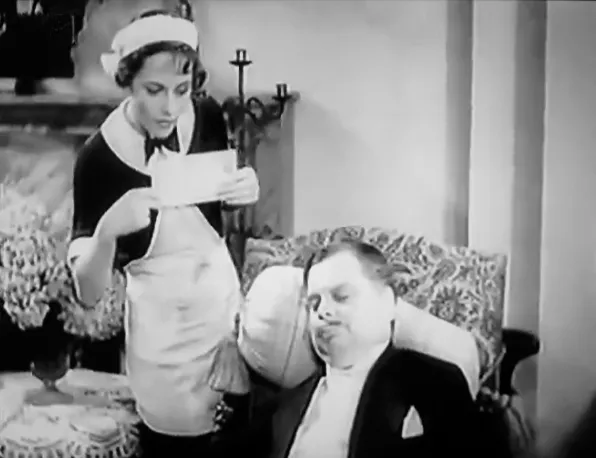
The family maid (Hilde Schneider) delivers the letter to befuddled noodle-maker Julius Lampe (Erhard Siedel) that sets the plot of April! April! in motion.
We first find him sleeping his way through a Sunday-morning recital by his daughter, Mirna (Charlott Daudert), and her goofy beau, Reinhold Leisegang (Werner Finck). The finely attired guests, anticipating the snooty attendees at the country club party in All That Heaven Allows, politely applaud their performance, while turning down their noses at the family’s ambitious affectations. One of them, Finke (Paul Westermeier), sardonically asides, “Thank God, I’m not musical.”
While all this is happening, the family maid (Hilde Schneider) is scurrying across the room towards the slumbering man of the house, carrying the letter that is to set the loopy plot in motion. It is from Prince von Hosten-Bohlau (Albrecht Schoenhals), containing an order for noodles, and it leads a very excited Mathilde to see opportunity knocking, call the recital to a halt, announce the family’s very close relationship to local royalty, and regard poor Leisegang as no longer a suitable marriage prospect for Mirna.
For Finke and his friend (Herbert Weissbach), the Lampes’ pomposity is “intolerable,” so, given that it’s April 1, they conspire to put them in their place. Pretending to be the prince, Finke phones Julius and announces an imminent visit. The guests are dispensed with, the newspapers are contacted, the Lampes’ mansion is prepared, and bedlam ensues.
It should have been avoided when Leisegang discovers the prank that is being played and tells Julius … actually, he has to persuade him because Julius is not especially quick on the uptake. But instead of immediately calling the preparations for the visit to a halt, Julius decides that they need someone to play the part of the illustrious visitor. Given the public humiliation if the prince doesn’t appear, he sees no alternative. The force of social expectations is just too great.
Thus, Mueller (Hubert von Meyerinck), a traveling salesman who just happens to be passing through, is cast in the role. Meanwhile, after the prince reads about his forthcoming visit in the newspaper, he assumes that his secretary (Annemarie Korff) has forgotten to tell him and decides to make his own way to the Lampes’. And then … never mind: I’m sure you get the general idea.
What follows is a crescendo of mistaken identities, verbal misunderstandings, and false rumors, with characters forever pretending to be somebody they’re not or to have done something they didn’t. The interlocking misjudgements and deceptions are as hilarious as they are seemingly endless. And driving them all are the ways in which the characters’ sense of their place in the world is determined by an insidious social hierarchy.
While the film’s ending might seem to restore a semblance of order, the mindsets of most of those involved suggest that their place in that order is far from fixed. With a very raised eyebrow at the proposed outcomes—Mirna settles for Leisegang because all other options seem exhausted; her parents go back to business as usual—Sirk is simply placing the mayhem in pause mode and suggesting that it’s very likely to continue indefinitely.
At the same time, however, the possibility of rising above such divisions and confusions is embodied in the romantic relationship that develops between the prince and Julius’s secretary, Friedl Bild (Carola Hohn). A godsend for her employer—she is smart and down-to-earth, and knows how to write letters to princes—she’s also the film’s Cinderella. When she and her prince fall in love, she’s unaware that he’s actually a prince—in the film’s ongoing network of intrigues, she believes he’s the traveling-salesman impostor rather than the real thing—and he’s happy to go along with her mistake. That they’re made for each other is clear from the start in the actors’ easygoing, naturalistic performances, in sharp contrast to the bombast on display elsewhere.
Despite the Lampes’ pomposity, Sirk depicts them as dolts rather than devils. Julius, in fact, is the heart and soul of the film. If April! April! were a Hollywood screwball comedy, he might be played by Edward Everett Horton or, perhaps, Eugene Pallette. But Siedel is a joy to watch, fluttering to and fro as his character tries to do the right thing, as he sees it, but forever missing the point. In appearance, his Julius could easily be one of George Grosz’s allegorical caricatures of the bourgeoisie.12 But whereas Grosz’s art was driven by his anger at the plight of Germany between the World Wars, Sirk’s approach in April! April! is much gentler, even affectionate, the equivalent of a wry smile rather than a savage snarl.
During his time in the theatre, Sirk had directed Moliere,13 and his pursuit of the cinematic potential in Moliere’s experimental fusions of music, dance, and drama—in particular in Le Bourgeois Gentilhomme—is clear in the approach he took to April! April! The musical rhythms underpinning the play are evident in some of Moliere’s stage directions: for example, “Four tailor boys dance up to Mr. Jourdain [Moliere’s equivalent to t...
Table of contents
- Cover
- Title Page
- Copyright
- Dedication
- Contents
- Acknowledgments
- Introduction
- Chapter One. Detlef Sierck in Europe
- Chapter Two. American Beginnings: The European Legacy
- Chapter Three. In the Shadows: Sirk and the Noir Inclination
- Chapter Four. The Uncomfortable Comedies
- Chapter Five. Sirk and God: “The Pure Ambiguity of Experience”
- Chapter Six. Pastoral Yearnings: Sirk and the Musical
- Chapter Seven. Hollywood, Rock Hudson, and the Idea of the Hero
- Chapter Eight. Sirk, the Family Melodrama, and the Production Code
- Chapter Nine. Sirk and John M. Stahl: Adaptations and Remakes
- Chapter Ten. Out of the Past
- Chapter Eleven. Into the Future: Sirk’s Legacy
- Filmography
- Notes
- Bibliography
Trusted by 375,005 students
Access to over 1.5 million titles for a fair monthly price.
Study more efficiently using our study tools.
Frequently asked questions
Yes, you can cancel anytime from the Subscription tab in your account settings on the Perlego website. Your subscription will stay active until the end of your current billing period. Learn how to cancel your subscription
No, books cannot be downloaded as external files, such as PDFs, for use outside of Perlego. However, you can download books within the Perlego app for offline reading on mobile or tablet. Learn how to download books offline
Perlego offers two plans: Essential and Complete
- Essential is ideal for learners and professionals who enjoy exploring a wide range of subjects. Access the Essential Library with 800,000+ trusted titles and best-sellers across business, personal growth, and the humanities. Includes unlimited reading time and Standard Read Aloud voice.
- Complete: Perfect for advanced learners and researchers needing full, unrestricted access. Unlock 1.5M+ books across hundreds of subjects, including academic and specialized titles. The Complete Plan also includes advanced features like Premium Read Aloud and Research Assistant.
We are an online textbook subscription service, where you can get access to an entire online library for less than the price of a single book per month. With over 1.5 million books across 990+ topics, we’ve got you covered! Learn about our mission
Look out for the read-aloud symbol on your next book to see if you can listen to it. The read-aloud tool reads text aloud for you, highlighting the text as it is being read. You can pause it, speed it up and slow it down. Learn more about Read Aloud
Yes! You can use the Perlego app on both iOS and Android devices to read anytime, anywhere — even offline. Perfect for commutes or when you’re on the go.
Please note we cannot support devices running on iOS 13 and Android 7 or earlier. Learn more about using the app
Please note we cannot support devices running on iOS 13 and Android 7 or earlier. Learn more about using the app
Yes, you can access The Films of Douglas Sirk by Tom Ryan in PDF and/or ePUB format, as well as other popular books in Medien & darstellende Kunst & Filmregie & Filmproduktion. We have over 1.5 million books available in our catalogue for you to explore.