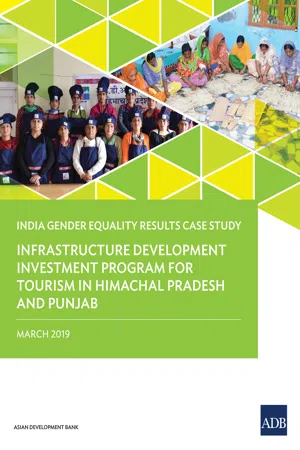
This case study examines the gender aspects of the Infrastructure Development Investment Program for Tourism in Himachal Pradesh and Punjab. The program has contributed to economic growth, and provides evidence of the capacity of gender-responsive tourism development to promote community participation in tourism and enhance the status of women. This report looks at results in three areas: human capital and economic empowerment, the creation of spaces for women's voices to be heard, and the promotion of equal rights. The case study affirms that a gender-inclusive design, coupled with effective implementation, gives women and men equal access to project benefits.
- 42 pages
- English
- ePUB (mobile friendly)
- Available on iOS & Android
eBook - ePub
About this book
Trusted by 375,005 students
Access to over 1.5 million titles for a fair monthly price.
Study more efficiently using our study tools.
Information
Gender Equality Results: Key Achievements
Reports on the implementation of IDIPT in Himachal Pradesh and Punjab showed the following major outputs (see Appendix 1 for details):20
• Integration of gender-related community needs in management plan-based investments for natural and cultural heritage sites. All management plans developed in Himachal Pradesh and Punjab under IDIPT include gender considerations wherever applicable (e.g., separate toilets for men and women, illumination for the safety of tourists especially women and children, CCTV cameras for safety measures, etc.).
• Establishment of community-based societies and organizations for the management of natural and cultural heritage sites with women’s participation. In Himachal Pradesh, there were 35 SHGs with 360 members, of whom 307 or 85% are women, and 96 CBT units, of which 66 or 69% are women-led. The Panchayat Tourism Development Committee (PTDC) and the Town Tourism Development Committee (TTDC) have 102 members with 34 or 33% women. In Punjab, there were 15 SHGs with 172 members, of whom 164 or 95% are women, and 46 bed-and-breakfast and 4 farm stay units, of which 10 or 20% are headed by women.
• Training in heritage management and tourism-related skills. In Himachal Pradesh, the total number of participants of 41 trainings held was 3,771, of whom 1,789 or 47% were women; and in Punjab, the total number of participants of 19 trainings was 586, of whom 227 or 39% were women.
• Gender-responsive value chain analysis to establish stronger links between tourism and local economies and development of tourism-based livelihood schemes. In Himachal Pradesh, value chain analysis was conducted in all the CBT clusters. The analysis focused on the identification of livelihood activities for women micro-entrepreneurs in tourism-related skills such as pine needles, knitting, pickle making, crochet, paper bag making, and homestay management. This resulted in 5,371 individuals, of whom 2,774 (52%) were women, trained in tourism-related skills. In Punjab, the value chain analysis was designed to identify different products of women’s livelihood such as water hyacinth, craft, knitting, crochet, processed food, and washing powder. Tourism-based livelihood schemes designed and implemented for women were (i) bed-and-breakfast, (ii) farm stay, and (iv) Pure Dhaba (roadside food stall) Scheme. The implementing agency also created the Punjab Heritage & Tourism Promotion Board for water hyacinth craft products marketing through interlinkage between Krishi Vigyan Kendra (an agricultural extension center created by the Indian Council of Agricultural Research), Department of Agriculture Cooperation and Farmers Welfare, and panchayat (village council).
• Equal employment opportunities for women and men. In Himachal Pradesh, women make up 24.5% of total employed by the project (245 or 25.0% of 980 workers in the construction site and 30 or 23.3% of 129 project staff). In Punjab, women composed 25.8% of total employed (25.6% at support staff level and 27.0% at executive level, 74.6% in unskilled category and 25.4% in skilled category). The following job opportunities were created: (i) building of four bus shelters in four villages—Keshopur, Magarmudian, Maini, and Dala; (ii) construction of watch towers, bird hides, pause points, and interpretation center; (iii) connectivity improvement in Matwan roads; and (iv) development of the drain structure of Magar Mudian and cremation ground in Keshopur, Maini, and Dala.21
To assess the intermediate outcomes of IDIPT in the two states, human impact stories were collected through focus group discussions, in-depth interviews, and key informant interviews with the beneficiaries, project staff, and other stakeholders (see Appendix 2 for the instrument used). These stories were grouped in this section into three results areas—human capital and economic empowerment, creation of spaces for women’s voice to be heard, and promotion of equal rights).22 In Punjab, the stories were collected from Chandigarh, Amritsar, and Gurdaspur districts in October 2016. Detailed interviews and group discussions were also conducted with project staff in Chandigarh and Amritsar and with the Punjab Forest Department officials in Gurdaspur. Women beneficiaries, both in the skilled and unskilled categories, were interviewed. Discussions were conducted with contractors at construction and renovation sites. Focus group discussions, in-depth interviews, and interactions were conducted with women members of six SHGs in Gurdaspur. In Himachal Pradesh, the stories were gathered in the project sites of Shimla, Pragpur, Naina Devi, Chintpurni, and Pong Dam from November to December 2016. Two state-specific reports were prepared and presented to executing and implementing agencies in a validation workshop in March 2017. The findings were validated, firmed up based on the suggestions of, and feedback from, the executing and implementing agencies, and updated based on their reports in March 2018.
Achievements in Human Capital and Economic Empowerment
Human capital refers to the stock of knowledge, skills, and personal attributes (e.g., health, motivation, values) needed to enable an individual to produce and earn.23 It is a key ingredient of economic empowerment as well as of greater political participation and social inclusion. The tourism infrastructure development in Himachal Pradesh and Punjab under IDIPT was considered a good opportunity to boost women’s human capital and economic empowerment opportunities.
In Punjab, the various types of training were on tailoring and embroidery, washing powder making, water hyacinth handicraft work, interior decoration, food processing, dairy farming, poultry farming, and mushroom cultivation. Seven types of handicrafts were identified for skill upgrade and marketing support under the skill development outreach cell. Other trainings were on heritage conservation and tour guide skills (nature and bird-watching and tour of cluster sites) for women. SHGs in Keshopur have already used their acquired skills and started earning from selling their products in local fairs.
The skills-based trainings in Himachal Pradesh were tailor-made given the huge tourist inflows in the state. Like those in Punjab, the CBT activities provided opportunities for local communities to participate in the management of tourism activities through organized groups. The SHGs in each cluster received specialized trainings such as basic communication and marketing skills in areas as diverse as traditional local cuisine. Trainings include bird-watching, advanced-level boating and water-based activity, organic farming and WWOOFing (organic farming and volunteer farming through World Wide Opportunities on Organic Farms [WWOOF]), ancillary service provider trainings for taxi drivers, and basic-level residential campsite management training.
Women members of SHGs interviewed during field visits in both states were optimistic about having regular sources of income with their learned skills (Boxes 4 and 5). The project has succeeded in building confidence and creating a thirst for entrepreneurial aspirations. However, there is still a long way to go to sustain the impetus. Means of packaging and labeling are yet to be institutionalized. There are no regular accessible markets. SHGs are dependent totally on occasional and seasonal fairs for the sale of their produce. Members of several SHGs expressed their need for help in finding more regular and accessible markets.
Box 4: Women’s Economic Empowerment Stories from Punjab
Skilling for Economic Independence
After the death of her husband, Rani Devi and her daughter Savita were dependent entirely on the remittances sent by her two sons who worked in Pune. When the Infrastructure Development Investment Program for Tourism (IDIPT) formed the self-help group (SHG), Shrichand Magarmodian, in Gurdaspur district, Punjab, to which ...
Table of contents
- Front Cover
- Title Page
- Copyright Page
- Contents
- Abbreviations
- Executive Summary
- Introduction
- Project Aims and Expected Outcomes
- Opportunities and Challenges of Gender-Inclusive Tourism Development
- Practical Approaches to Gender-Inclusive Tourism Development
- Gender Equality Results: Key Achievements
- Project Features Contributing to the Achievement of Gender Equality Results
- Lessons and Ways Forward
- Appendixes
- Footnotes
- Back Cover
Frequently asked questions
Yes, you can cancel anytime from the Subscription tab in your account settings on the Perlego website. Your subscription will stay active until the end of your current billing period. Learn how to cancel your subscription
No, books cannot be downloaded as external files, such as PDFs, for use outside of Perlego. However, you can download books within the Perlego app for offline reading on mobile or tablet. Learn how to download books offline
Perlego offers two plans: Essential and Complete
- Essential is ideal for learners and professionals who enjoy exploring a wide range of subjects. Access the Essential Library with 800,000+ trusted titles and best-sellers across business, personal growth, and the humanities. Includes unlimited reading time and Standard Read Aloud voice.
- Complete: Perfect for advanced learners and researchers needing full, unrestricted access. Unlock 1.5M+ books across hundreds of subjects, including academic and specialized titles. The Complete Plan also includes advanced features like Premium Read Aloud and Research Assistant.
We are an online textbook subscription service, where you can get access to an entire online library for less than the price of a single book per month. With over 1.5 million books across 990+ topics, we’ve got you covered! Learn about our mission
Look out for the read-aloud symbol on your next book to see if you can listen to it. The read-aloud tool reads text aloud for you, highlighting the text as it is being read. You can pause it, speed it up and slow it down. Learn more about Read Aloud
Yes! You can use the Perlego app on both iOS and Android devices to read anytime, anywhere — even offline. Perfect for commutes or when you’re on the go.
Please note we cannot support devices running on iOS 13 and Android 7 or earlier. Learn more about using the app
Please note we cannot support devices running on iOS 13 and Android 7 or earlier. Learn more about using the app
Yes, you can access Infrastructure Development Investment Program for Tourism in Himachal Pradesh and Punjab by in PDF and/or ePUB format, as well as other popular books in Business & Hospitality, Travel & Tourism Industry. We have over 1.5 million books available in our catalogue for you to explore.