Peter Hall (1930–2017) is one of the most influential directors of Shakespeare's plays in the modern age. Under his direction, the Royal Shakespeare Company and the National Theatre rediscovered Shakespeare as a writer who could comment incisively on the modern world. Productions such as Coriolanus, The Wars of the Roses and Hamlet established his reputation as a director able to bring Shakespeare to the heart of contemporary politics. He later cemented his reputation with epic productions of Coriolanus and Antony and Cleopatra at the National. With the Peter Hall Company, Hall continued to work intensively on Shakespeare, directing plays in the UK and America.
Reviewing Hall's work in its cultural and creative context, this study explores his approach to directing and rehearsal. This is the first book to analyse all of Hall's professional Shakespeare productions in a historical context, from the Suez crisis to the 9/11 attacks and beyond.
- 224 pages
- English
- ePUB (mobile friendly)
- Available on iOS & Android
eBook - ePub
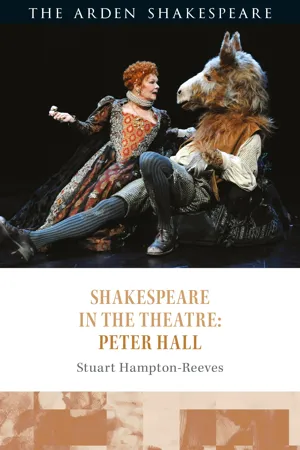
Shakespeare in the Theatre: Peter Hall
About this book
Information
1
Nostalgia and Politics at the Shakespeare Memorial Theatre
Peter Hall’s years at the Shakespeare Memorial Theatre (SMT) in Stratford-upon-Avon cover a period of tremendous cultural change as Britain and the world emerged from the long shadow of war and austerity. The year that Hall joined the SMT, 1956, is often memorialized as a watershed in post-war culture. It was the year that Elvis Presley released Heartbreak Hotel to a young audience listening to Bill Hailey and watching James Dean at the cinema; it was also the year that the Berliner Ensemble visited Britain, inspiring a new generation of theatre-makers to think about the political potential of theatre. John Osborne’s Look Back in Anger opened at the Royal Court, heralding a new wave of realism in British playwriting. There was, then, both optimism and rebellion in the air. Cities destroyed by the Luftwaffe were being rebuilt, food rationing had ended in 1954, and new technologies such as television, which had been suspended during the war and went mainstream in Britain after the coronation of Elizabeth II in 1953, were quietly transforming cultural lives. There was full employment in England for the first time in a generation and, with past generations decimated by war, it was the younger generation who set the pace of this new cultural revolution. Britain’s military intervention in Suez that year, which triggered a brief reintroduction of petrol rationing, marked the difference between the generations. The investment in the British Empire as a concept was withering along with its territories: the tradition of playing the National Anthem before a theatrical performance was something that Hall and his generation eventually ended. It was the year of the angry young man, of rebels without a cause. Hall was at the heart of this cultural moment and contributed directly to it, in 1955, by introducing Samuel Beckett’s Waiting for Godot to British audiences. By moving to Stratford, Hall distanced himself from these cultural currents. He went from directing hard-edged existential plays to surprisingly romantic Shakespeare comedies. As the modern world emerged around him, he embraced a provincial nostalgia for a pastoral world, a pre-war idyll.
Hall was twenty-six and had not directed a professional production of Shakespeare outside the Marlowe Dramatic Society and its offshoot, the Elizabethan Theatre Company (for more on Hall’s undergraduate productions see Cribb 2007). After graduating from Cambridge, he had worked as an assistant to John Fernald at the Arts Theatre in the West End and took over from Fernald when he left the post (Rosenthal 2013: 40). It was here that he directed Beckett as well as Anouilh, Whiting and many other modern playwrights. The theatre was small and not lucrative, but with productions like Godot Hall could make an immediate impact and the post led to more lucrative commissions, such as the opportunity to direct the West End hit Gigi. He had big ideas about theatre and its place in the modern world. His choice of playwrights shows him looking to Europe and the avant-garde for inspiration. Television, which had become mainstream in British life following the televising of the queen’s coronation in 1953, was quickly eroding theatre’s traditional role. Hall thought British theatre too ‘pre-war, safe and easy going’: he ambitiously called for ‘the stimulation that will attract fresh audiences’ (Rosenthal 2013: 40).
Stratford was, on the face of it, an unpromising place for Hall to achieve such stimulation. Poorly connected to London, or anywhere, Stratford was sustained mainly by tourism and education. The SMT was nearly a century old and had grown from a summer festival to an endeavour that more closely resembled that of a repertory theatre. The theatre received no public subsidy and was proud of its independence. It still managed to attract stars – and make stars. Laurence Olivier, John Gielgud, Vivien Leigh and Peggy Ashcroft were all regular actors. Along with the Old Vic, Stratford was unquestionably one of the twin pillars of British Shakespeare performance, but its ability to attract high-calibre actors was under threat. A project to build the National Theatre was already underway, the first stone of the building that now stands on the South Bank laid in 1951 by Queen Mary as part of the Festival of Britain. The threat to the SMT was existential, something Hall grasped immediately. So did Glen Byam Shaw, who seems to have recruited Hall with the explicit intention of making the young director his successor.
The standard narrative of Hall’s time in Stratford is shaped by the story of his efforts to shift the SMT into the space of public subsidy, to bring modern drama into its repertory, establish an ensemble company and stake a claim in London: in short, to change the SMT into the Royal Shakespeare Company, a second subsidized national theatre. Hall’s work in the theatre tends to take a back seat in this story, but it was in the rehearsal room that Hall explored Shakespeare differently, sometimes chafing at modernity, at other times revelling in the spirit of youth in a way that seemed calculated to send up the Shakespeare performance style of the 1940s and early 1950s. He brought into the theatre artists, designers, directors, and composers who were not run-of-the-mill but well-regarded artists, including the Italian artist Lila De Nobili and the composer Raymond Leppard (now better known as a conductor). He maintained his interest in new writing, only devoting some of his time to Stratford before he took over as its director: of the seventeen plays he directed between 1956 and 1959, only five were for Stratford (Hall 1993: 435–436).
His Shakespeare productions were not, then, a retreat from modernity: on the contrary, Hall was using nostalgia and romanticism as a strategy for rethinking Shakespeare’s role in post-war Britain. In her classic study of the performance of nostalgia in contemporary Shakespeare performance, Susan Bennett cautions against simplistically treating nostalgia as a paean to a lost world designed to support traditional worldviews: nostalgia, Bennett writes, ‘might be best considered as the inflicted territory where claims for authenticity (and thus a displacement of the articulation of power) are staged’. This, Bennett argues, can ‘enable re-memberings which don’t, by virtue of the categorization, conjure up a regressively conservative and singular History’ (Bennett 1996: 7). The exploration of the authenticity on the stage was, perhaps, a displacement of the battle for authenticity that Hall faced in his battles to protect the SMT’s future against the rise of the National Theatre. He was simultaneously claiming Shakespeare and the past as a way of also claiming Shakespeare in the present. Hall’s early work at the SMT stuck close to the romantic comedies: his productions of Love’s Labour’s Lost, Cymbeline, Twelfth Night, A Midsummer Night’s Dream and The Two Gentlemen of Verona set out a stall that told a story about Shakespeare and modern England collectively. They are all primarily ensemble plays, allowing Hall the opportunity to explore Shakespeare as a dramatist who was both past and present. He also directed Coriolanus and co-directed Troilus and Cressida, with both discovering a sardonic and political edge that would re-emerge in the following decade as the political theatre of the Royal Shakespeare Company.
Love’s Labour’s Lost 1956 and Cymbeline 1957
The sense of nostalgia and youthful spirit which Hall created in his first SMT Shakespeare productions was at least in part personal. A decade before, just after the end of the war, Hall was soaking himself in the repertoire of the SMT. For three summers, from 1946 to 1949, he saw every play produced for the summer season multiple times. In his autobiography, Hall wistfully remembers cycling 100 miles to Stratford with a friend, camping in the rain and living off fish and chips (Hall 1993: 70). Two productions from 1946 made a particular impression on him: Peter Brook’s beautiful Love’s Labour’s Lost, which was the big hit of the season, and Nugent Monck’s Cymbeline, whose ‘tangled complexities’ entranced him (Hall 1993: 70). Paul Scofield also made his Stratford debut in 1946 and was in both productions. Brook and Scofield between them created a new energy in Shakespeare performance, inspiring not just the young Hall but a new generation of theatre practitioners, among them the director Tony Richardson, who felt ‘stimulated and spurred on’ by their work. Gary O’Connor argues that ‘the impact and influence’ of the season ‘on future theatre and film people was inestimable’ (O’Connor 2002: 58–59).
By looking backward, Hall was also looking forwards and setting out his vision for his career and Shakespeare’s place in the modern world. It is surely no coincidence that Hall’s first productions at the SMT were Love’s Labour’s Lost and Cymbeline, as if he were recalling that formative experience of seeing Scofield in 1946. Brook had a significant impact on the teenage Hall: his Love’s Labour’s Lost was both his first SMT production and the breakthrough work which established his reputation. Brook was twenty-one in 1946, only five years older than Hall, and already enjoying the career and reputation to which Hall aspired. Hall was following in Brook’s footsteps when he chose Love’s Labour’s Lost as his first Shakespeare play to direct as an undergraduate at Cambridge and then again when he joined the SMT ten years after Brook’s production.
However, he had other reasons for choosing his debut play. John Barton, still very much one of Hall’s mentors, believed that Shakespeare performance could only be made meaningful for modern audiences by returning to the early comedies. At a debate in 1956 called ‘Shakespeare and the Dramatic Critics’, Barton, a scholar who identified himself more as an actor, instead lambasted the current state of Shakespearean acting and proposed a new era of acting based on a solid foundation of Shakespeare’s early comedies – with Love’s Labour’s Lost singled out. Recent revivals of the comedies, he argued, had highlighted the deficiencies in modern acting. The theatre was too reliant on plays with great roles and underestimated the extent to which those roles carried the performer. With the comedies, he insisted, Shakespeare had written material ‘for performers of consummate skill in speech, timing, and movement’. They were ensemble plays, which demanded a high level of acting ability. Having castigated the work of the directors also in attendance, Barton finished by proposing that the early comedies are the right plays ‘in which to train and develop a new generation of Shakespearean players’ (quotes are from The Times 24 August 1956).
Whether Hall was in the audience or not, he would undoubtedly have known Barton’s views and probably would have shared them. At this point in his career, Hall was still in awe of Barton and tended to agree with his trenchant opinions of Shakespearean performance and its future, even when Hall was himself the target. With hindsight, Barton was laying out a manifesto for what would become the Royal Shakespeare Company. Hall’s first years at the SMT, and then the RSC, follow this blueprint almost exactly: of the seven plays he directed at the SMT, six were comedies. When Hall took over as Director of the SMT for the 1960 season, he announced a themed season of comedies with Barton as one of the directors. Although Hall worked with star actors at the SMT, including Charles Laughton and Laurence Olivier, most of his casts were young; a point remarked on in many of the reviews of his early work. Hall was putting Barton’s vision into action: even as early as 1956, when he had only just arrived in Stratford, Hall was using his new celebrity status to push through their upstart version of a Shakespearean ensemble of new actors skilled in verse-speaking and the technical demands of Shakespeare’s early comedies and histories.
Yet it is a measure of the complexity of the relationship between Barton and Hall that the production of Love’s Labour’s Lost which Barton probably had in mind when he castigated ‘recent’ revivals for the shortcomings of their actors was almost certainly Hall’s, which had debuted a few weeks before. The production had attracted modest reviews, but Barton damned the production as a ‘disgrace’. Hall agreed with Barton’s assessment, and although the run attracted good audiences, he worried that he would not be asked back to Stratford (Fay 1995: 86). Hall’s first professional Shakespeare production at Stratford should have been a momentous occasion, but he was still embarrassed enough by it thirty years later when writing his autobiography to dismiss the production in a few lines (Hall 1993: 145).
Barton was particularly critical of the stage design, which he thought ‘camp and sugar-like’ (Fay 1995: 86). Hall had been paired with James Bailey, a minor aristocrat with an undistinguished and soon-forgotten career as a costume and set designer. The set itself was a cramped collection of steps, towers and a semi-circular balcony which looked attractive but choked the playing space. The effect reminded the unnamed Times reviewer of a ‘Grand Hotel terrace’ (4 July 1956) which, as W.A. Darlington pointed out, jarred with those scenes set in the country (Telegraph 4 July 1956). The lighting plan helped neither Hall nor Bailey, a ‘steady noontide light’ which hardly changed throughout the production and made the stage look dull (Times 4 July 1956). Bailey’s costumes (doublet and hose for the men, patterned dresses for the women) were colourful and varied, impressing Peter Forster, who remarked that they were ‘sumptuous’ and ‘bright’ (Financial Times 4 July 1956). Philip Hope-Wallace thought they suggested a ‘full pack of Tudor playing cards’ (Guardian 4 July 1956). But they were not practical. The female actors were lumbered with over-sized panniers under their dresses, giving their medieval looks an anachronistic eighteenth-century flamboyance. With all the main cast onstage, there was little room left for them to move. Judging by surviving photographs, the set design was very much of its time, a decent and competent example of mid-1950s British Shakespeare but lacking the freshness and modern eye of the director of Waiting for Godot. Hall learnt his lesson. He did not work with Bailey again (Fay 1995: 86), but more importantly, Hall grasped how crucial it was that he work with a designer who shared his vision. After Love’s Labour’s Lost, Hall’s most important artistic relationship in every subsequent Shakespeare production was with his designer.
The production did not fulfil Barton’s idea of a young cast learning their craft through an intense engagement with Love’s Labour’s Lost either. The members of the cast were mainly young actors, appropriate for a play that the SMT first announced as ‘particularly youthful in spirit’ with Peter Hall billed as ‘the young director of the London Arts Theatre’ who would be ‘producing a Shakespeare play for the first time’ (Times 26 June 1956). Yet they were a long way from the skilled actors Barton had in mind for his revolution in Shakespearean performance. Forster gave the most generous assessment when he wrote that they were ‘a company of good young players who are not yet all good Shakespearean players’ (Financial Times 4 July 1956). The performances were uneven. Harry Andrews, as Don Adriano, was roundly criticized in the press for missing the jokes, and Hope-Wallace thought that Alan Badel overdid Berowne’s physical gestures such as his ‘swan-prince walk’ and ‘unnecessarily rueful faces’ (Guardian 4 July 1956). Clive Revill, as Costard, attracted more praise for his cheerful indifference (Telegraph 4 July 1956) but the actor who attracted most attention was Geraldine McEwan, who was only twenty-four and making her debut at the SMT as the Princess of France. The Times admired her voice which, despite a ‘sublimated squeak,’ ‘royally dignifies her teasing mischievousness’ (4 July 1956); Darlington wrote that she played the part with ‘dignity and a touch of individuality’ and for Hope-Wallace she was a ‘pert and husky princess’. McEwan was the most significant actor from Hall’s point of view: she was his first major discovery and the only one in the cast who went on to have a major role in the Royal Shakespeare Company, although she rarely worked directly with Hall again. In fact, he worked with only a few of the cast again throughout his long career: this was not the nucleus of a new Shakespeare company, although Hall may have taken some satisfaction from Darlington’s praise for the ‘quality of the speaking’ which, if a little too careful at times, was ‘occasionally impressive’ (Telegraph 4 July 1956).
Hall had not emulated Brook’s success on his first outing, but he stuck close to the memory of the 1946 season for his next production, Cymbeline, in 1957. Hall was still finding his feet as a director and he did not need a second failure. Shaw took the trouble to write Hall a note of praise after Cymbeline’s opening night, praising it as ‘a most skillful and beautiful production full of imagination, sensitivity and true romantic feeling’ (Fay 1995: 92). For all its enthusiasm, Shaw’s note hints that Hall found the production difficult. ‘I realize you have suffered some agonies with this production,’ he wrote, ‘but I sincerely believe the best work is often the outcome of such tortures’ (Fay 1995: 92). One of the agonies Hall faced was working with Peggy Ashcroft, one of his heroes. According to Fay, Hall had blocked out the entire play, determining every single movement for the cast (Fay 1995: 90) – a rookie mistake that was the result of over-enthusiasm and lack of professional experience. For all his fame and his already exhausting work schedule, Hall was still a young Cambridge graduate whose theatrical experience was broad rather than deep, semi-amateur rather than professional. Working with Ashcroft was a formative experience, as bruising as it was revelatory. Hall could not impose his directorial authority on her. He would instruct her to make a pre-scripted movement and she would refuse, insisting ‘that move’s wrong’. Eventually, Hall had little choice but to abandon his plans and work with the cast. ‘I never give moves any more,’ Hall told Billington, ‘ … the actors must always feel they’ve invented it. She taught me to have the confidence to use their responses. It started a whole new method for me’ (Billington 1988: 173). Judging by Shaw’s note, Hall’s experience of working with Ashcroft was more trying than Hall implies here, but it was a valuable lesson that he would not forget.
Hall had at least exercised more control over the design. Not content with being attached to an SMT stalwart, Hall used his wife’s bohemian connections to bring the reclusive artist Lila De Nobili over from Paris to create the stage set. De Nobili was an artist rather than a set designer, and she approached the set for Hall in that spirit. She did not come into the theatre to oversee the painting of the backdrops: instead, she had the cloths laid out in a nearby village hall and painted every one herself. Hall observed her working, splashing paint everywhere and walking over the fabric as she did so. Her chaotic methods may have been another one of Hall’s agonies, but he was reassured when the cloths were hung and the set assembled, De Nobili’s random, formless painting magically transformed into a brilliant, dark and mysterious setting. Hall wanted an environment which brought together the different worlds of the play, fusing classical and renaissance, interiors and exteriors, into a single permanent set (Warren 1989: 27). Hall did not want the set to interfere with the play’s pace as it m...
Table of contents
- Cover
- Halftitle Page
- Title Page
- Contents
- Acknowledgements
- Series Preface
- Introduction: Speaking Shakespeare
- 1. Nostalgia and Politics at the Shakespeare Memorial Theatre
- 2. Nation, Culture and Authority at the Royal Shakespeare Company
- 3. Authority in Crisis at the National Theatre
- 4. Protest and Politics at the National Theatre
- 5. Death and Sexuality after the National Theatre
- 6. Playing Shakespeare in America
- 7. National Stages
- List of Productions
- References
- Index
- Imprint
Trusted by 375,005 students
Access to over 1.5 million titles for a fair monthly price.
Study more efficiently using our study tools.
Frequently asked questions
Yes, you can cancel anytime from the Subscription tab in your account settings on the Perlego website. Your subscription will stay active until the end of your current billing period. Learn how to cancel your subscription
No, books cannot be downloaded as external files, such as PDFs, for use outside of Perlego. However, you can download books within the Perlego app for offline reading on mobile or tablet. Learn how to download books offline
Perlego offers two plans: Essential and Complete
- Essential is ideal for learners and professionals who enjoy exploring a wide range of subjects. Access the Essential Library with 800,000+ trusted titles and best-sellers across business, personal growth, and the humanities. Includes unlimited reading time and Standard Read Aloud voice.
- Complete: Perfect for advanced learners and researchers needing full, unrestricted access. Unlock 1.5M+ books across hundreds of subjects, including academic and specialized titles. The Complete Plan also includes advanced features like Premium Read Aloud and Research Assistant.
We are an online textbook subscription service, where you can get access to an entire online library for less than the price of a single book per month. With over 1.5 million books across 990+ topics, we’ve got you covered! Learn about our mission
Look out for the read-aloud symbol on your next book to see if you can listen to it. The read-aloud tool reads text aloud for you, highlighting the text as it is being read. You can pause it, speed it up and slow it down. Learn more about Read Aloud
Yes! You can use the Perlego app on both iOS and Android devices to read anytime, anywhere — even offline. Perfect for commutes or when you’re on the go.
Please note we cannot support devices running on iOS 13 and Android 7 or earlier. Learn more about using the app
Please note we cannot support devices running on iOS 13 and Android 7 or earlier. Learn more about using the app
Yes, you can access Shakespeare in the Theatre: Peter Hall by Stuart Hampton-Reeves in PDF and/or ePUB format, as well as other popular books in Literatura & Arte dramático shakespeariano. We have over 1.5 million books available in our catalogue for you to explore.