Teaching 101
eBook - ePub

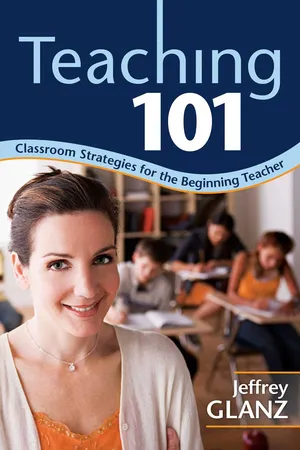
Teaching 101

Classroom Strategies for the Beginning Teacher

  1. 328 pages
  2. English
  3. ePUB (mobile friendly)
  4. Available on iOS & Android
eBook - ePub

Teaching 101

Classroom Strategies for the Beginning Teacher

About this book

The noble profession of teaching plays a vital role in inspiring students to achieve excellence. This new edition of one of the most comprehensive introductions to teaching available provides essential knowledge and actively engages new teachers in practice to become an exceptional teacher.Easy to understand and practical, this wide-ranging guide provides tools such as questions and activities at the end of each chapter, Web sites and vital readings for further study, and a self-assessment instrument to help readers succeed in their first year. The second edition includes more information on curriculum development and technology, more sample lesson plans, a new section on bullying, new activity sheets, and many checklists with immediate application procedures. The book is packed with helpful suggestions on topics such as: Lesson planning
Classroom management
Differentiating instruction
Standards
Assessment and grading
Literacy
Cooperative learning
Inclusion
National Board certificationTeaching 101 is an invaluable resource that teachers can reference throughout their careers to expand their skills and perspectives.
Frequently asked questions

Yes, you can cancel anytime from the Subscription tab in your account settings on the Perlego website. Your subscription will stay active until the end of your current billing period. Learn how to cancel your subscription.
No, books cannot be downloaded as external files, such as PDFs, for use outside of Perlego. However, you can download books within the Perlego app for offline reading on mobile or tablet. Learn more here.
Perlego offers two plans: Essential and Complete
  • Essential is ideal for learners and professionals who enjoy exploring a wide range of subjects. Access the Essential Library with 800,000+ trusted titles and best-sellers across business, personal growth, and the humanities. Includes unlimited reading time and Standard Read Aloud voice.
  • Complete: Perfect for advanced learners and researchers needing full, unrestricted access. Unlock 1.4M+ books across hundreds of subjects, including academic and specialized titles. The Complete Plan also includes advanced features like Premium Read Aloud and Research Assistant.
Both plans are available with monthly, semester, or annual billing cycles.
We are an online textbook subscription service, where you can get access to an entire online library for less than the price of a single book per month. With over 1 million books across 1000+ topics, we’ve got you covered! Learn more here.
Look out for the read-aloud symbol on your next book to see if you can listen to it. The read-aloud tool reads text aloud for you, highlighting the text as it is being read. You can pause it, speed it up and slow it down. Learn more here.
Yes! You can use the Perlego app on both iOS or Android devices to read anytime, anywhere — even offline. Perfect for commutes or when you’re on the go.
Please note we cannot support devices running on iOS 13 and Android 7 or earlier. Learn more about using the app.
Yes, you can access Teaching 101 by Jeffrey Glanz in PDF and/or ePUB format, as well as other popular books in Education & Education Teaching Methods. We have over one million books available in our catalogue for you to explore.

Information

ACTIVITY 1
image
1. Think of the best teachers you’ve ever had. What did they do or say that made them so effective? Record your response below and share your thoughts with a colleague.
2. Think of the worst teachers you’ve ever had. What did they do or say that made them so ineffective? Record your response below and share your thoughts with a colleague.
1
Why Does Teaching Matter?
A teacher affects eternity; he can never tell where his influence stops.
—Henry Brooks Adams
A conversation between Sir Thomas More and Richard Rich, a younger associate, regarding Richard’s future plans: More: ā€œWhy not be a teacher? You’d be a fine teacher. Perhaps even a great one.ā€ Rich: ā€œAnd if I was, who would know it?ā€ More: ā€œYou, your pupils, your friends, God. Not a bad public at that . . .ā€
—Bolt (A Man for All Seasons, 1962)
Focus Questions
1. What comes to mind when you think of the word teacher?
2. When did you first know you wanted to become a teacher?
3. What impact can a teacher have on the life of a student?
4. Why do you think teachers are undervalued members of society? Justify a position in which teaching is as noble as law or medicine.
5. How can teaching serve as a spiritual endeavor or a calling?
Life is a ceaseless journey. Who we are, what we decide to do, and how we do it are influenced by a multitude of factors. We are a composite of our genetic makeup, the influence of our parents, our environment, our experiences, and even social and political forces. Our personal strengths and weaknesses, likes and dislikes, educational decisions, opportunities presented to us, help we receive from others along the way, and the many personal choices we all make influence our thoughts, speech, and actions. Why does someone go into teaching? Dan Lortie (1977), in a classic sociological study of American teachers, examined several primary reasons why people he interviewed became teachers. Aside from the more mundane explanations relating to material benefits and the desire to interact with people, Lortie and other researchers who came after him discovered that more fundamental and profound influences included the desire to engage in work that is personally and socially meaningful.
Teaching is personally and socially meaningful.
Recollection
I always wanted to become a teacher. I recall how I used to force my sister, four years my junior, to sit and take a test I prepared for her. Despite her protestations, I made her sit to take the exams. I’m not proud of what I did, but I do recall the intense joy I felt using my red pen to mark her answers wrong and to award a grade. The sense of power and authority I felt was uplifting. I regret, of course, coercing my sister in those days (happily, she has forgiven me). I’ve matured since then, fortunately, to realize that teaching is not a matter of serving as an authority figure but, rather, helping another human being to achieve new insights and potential. I’ve come to realize that helping someone else is both personally and socially important.
What are your first recollections about considering teaching as your career? Why have you decided to teach? Why does teaching matter?
Form 1.1 RESPOND—Is teaching for you?
image
ANALYZING YOUR RESPONSES
Note that the items are drawn from one of my previous books (Glanz, 2002) Finding Your Leadership Style: A Guide for Educators, published by the Association for Supervision and Curriculum Development. For a more detailed analysis, please refer to that work. Suffice it to say here that if you answered SA or A to the items in Form 1.1, you are well suited to teaching as a career. Don’t allow any one survey to sway you one way or another, but effective teachers, generally, are naturally inclined to help others; are caring, sensitive individuals; and possess a strong desire to make a difference.
Education is much more than transmitting some set of prescribed cultural, societal, or institutional values or ideas. Education is an ongoing, spirited engagement of self-understanding and discovery. Etymologically, the word education comes from its Latin root educare, meaning to draw out or to lead. That is, in fact, our goal as educators—to draw out that unique latent potential within each student. As Smith (cited in Slattery, 1995, p. 73) poignantly explains, ā€œeducation cannot simply tell us what we are, but what we hope to become.ā€ When we teach our students, regardless of the subject, we serve as a catalyst for them to reach their potential. A fundamental human quest is the search for meaning. The process of education becomes a lifelong journey of self-exploration, discovery, and empowerment. Teachers play a vital role in helping students attain deep understanding. As Rachel Kessler (2000) concludes in her The Soul of Education,
Perhaps most important, as teachers, we can honor our students’ search for what they believe gives meaning and integrity to their lives, and how they can connect to what is most precious for them. In the search itself, in loving the questions, in the deep yearning they let themselves feel, young people can discover what is essential in their own lives and in life itself, and what allows them to bring their own gifts to the world. (p. 171)
As educators, we affirm the possibilities for human growth and understanding. Education embodies growth and possibility, while teachers translate these ideals into action by inspiring young minds, developing capacities to wonder and become, and facilitating an environment conducive for exploring the depths of one’s being. The capacity for heightened consciousness, the emphasis on human value and responsibility, and the quest of becoming are quintessential goals. Teaching thus becomes not only meaningful and important, but also exciting.
Extraordinary times call for extraordinary teachers. We need teachers who can challenge others to excellence, and teachers who love what they do. We need teachers who help students achieve their potential, and teachers who help students understand why and how to treat others with respect, dignity, and compassion.
Teachers
• Challenge others to excellence
• Love what they do
• Help students achieve their potential
• Help students understand why and how to treat others with respect, dignity, and compassion
Haim Ginott (1993) made the point that education is more than teaching knowledge and skills in dramatic fashion when he related a message sent by a principal to his teachers on the first day of school:
Dear Teacher:
I am a survivor of a concentration camp. My eyes saw what no man should witness:
Gas chambers built by learned engineers.
Children poisoned by educated physicians.
Infants killed by trained nurses.
Women and babies shot and burned by high school and college graduates.
So, I am suspicious of education.
My request is: Help your students become human. Your efforts must never produce learned monsters, skilled psychopaths, educated Eichmanns.
Reading, writing, arithmetic are important only if they serve to make our children more humane. (p. 317)
The challenges of teaching are certainly awesome. Overcrowded classrooms, lack of student interest, absenteeism, lack of preparedness, high incidence of misbehavior, and lack of parental support, compounded by social problems such as drugs, unstable family life, teenage pregnancy, poverty, child abuse, violence, and crime, give pause to think. But think again. If not for these challenges, the rewards of teaching would not be so great. Our work matters. We make a difference. Listen to the words of praise this fourth grader has for her teacher:
Cherished Memories of Mrs. Siblo
As the flowers blossom
The weather gets warmer
And time is still passing.
June has approached quicker than ever.
Another school year is coming to an end;
And I won’t have Mrs. Siblo as my teacher ever again.
I feel kind of sad to say goodbye
To the greatest teacher that once was mine.
Before I go to achieve...

Table of contents

  1. Cover
  2. Dedication
  3. Title Page
  4. Copyright
  5. Contents
  6. Preface
  7. Acknowledgments
  8. About the Author
  9. Activity 1
  10. Activity 2
  11. Activity 3
  12. Activity 4
  13. Activity 5
  14. Activity 6
  15. Activity 7
  16. Activity 8
  17. Activity 9
  18. Closing Comments
  19. Appendix A: Annotated Bibliography
  20. Appendix B: Some of the Best Web Sites for Teachers
  21. Appendix C: Self-Assessment Instrument
  22. Appendix D: Teacher’s Suggestions Exchange Forum
  23. References
  24. Index