The Fall of the Dynasties
eBook - ePub

The Fall of the Dynasties

The Collapse of the Old Order: 1905-1922

  1. 432 pages
  2. English
  3. ePUB (mobile friendly)
  4. Available on iOS & Android
eBook - ePub

The Fall of the Dynasties

The Collapse of the Old Order: 1905-1922

About this book

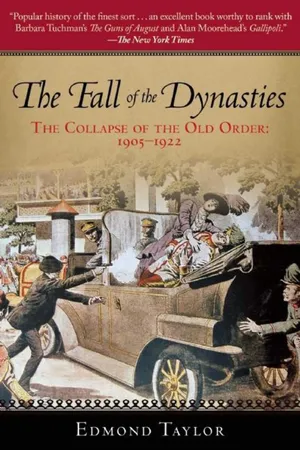
"Popular history of the finest sort... an excellent book worthy to rank with Barbara Tuchman's The Guns of August and Alan Moorehead's Gallipoli." —The New York Times On June 28, 1914, in the dusty Balkan town of Sarajevo, an assassin fired two shots. In the next five minutes, as the stout middle-aged Archduke Franz Ferdinand of Habsburg, heir to the Austro-Hungarian throne, and his wife bled to death, a dynasty—and with it, a whole way of life—began to topple.In the ages before World War I, four dynasties—the Habsburg, Hohenzollern, Ottoman, and Romanov—dominated much of civilization. Outwardly different, they were at bottom somewhat alike: opulent, grandiose, suffocating in tradition, ostentatiously gilded on the surface and rotting at the core. Worse still, they were tragically out of step with the forces shaping the modern world. The Fall of the Dynasties covers the period from 1905 to 1922, when these four ruling houses crumbled and fell, destroying old alliances and obliterating old boundaries. World War I was precipitated by their decay and their splintered baroque rubble proved to be a treacherous base for the new nations that emerged from the war. "All convulsions of the last half-century, " Taylor writes, "stem back to Sarajevo: the two World Wars, the Bolshevik revolution, the rise and fall of Hitler, and the ongoing turmoil in the Middle East. Millions upon millions of deaths can be traced to one or another of these upheavals; all of us who survive have been scarred at least emotionally by them."In this classic volume, Taylor traces the origins of the dynasties whose collapse brought the old order crashing down and the events leading to their astonishingly swift downfall.Skyhorse Publishing, as well as our Arcade imprint, are proud to publish a broad range of books for readers interested in history--books about World War II, the Third Reich, Hitler and his henchmen, the JFK assassination, conspiracies, the American Civil War, the American Revolution, gladiators, Vikings, ancient Rome, medieval times, the old West, and much more. While not every title we publish becomes a New York Times bestseller or a national bestseller, we are committed to books on subjects that are sometimes overlooked and to authors whose work might not otherwise find a home.
Frequently asked questions

Yes, you can cancel anytime from the Subscription tab in your account settings on the Perlego website. Your subscription will stay active until the end of your current billing period. Learn how to cancel your subscription.
No, books cannot be downloaded as external files, such as PDFs, for use outside of Perlego. However, you can download books within the Perlego app for offline reading on mobile or tablet. Learn more here.
Perlego offers two plans: Essential and Complete
  • Essential is ideal for learners and professionals who enjoy exploring a wide range of subjects. Access the Essential Library with 800,000+ trusted titles and best-sellers across business, personal growth, and the humanities. Includes unlimited reading time and Standard Read Aloud voice.
  • Complete: Perfect for advanced learners and researchers needing full, unrestricted access. Unlock 1.4M+ books across hundreds of subjects, including academic and specialized titles. The Complete Plan also includes advanced features like Premium Read Aloud and Research Assistant.
Both plans are available with monthly, semester, or annual billing cycles.
We are an online textbook subscription service, where you can get access to an entire online library for less than the price of a single book per month. With over 1 million books across 1000+ topics, we’ve got you covered! Learn more here.
Look out for the read-aloud symbol on your next book to see if you can listen to it. The read-aloud tool reads text aloud for you, highlighting the text as it is being read. You can pause it, speed it up and slow it down. Learn more here.
Yes! You can use the Perlego app on both iOS or Android devices to read anytime, anywhere — even offline. Perfect for commutes or when you’re on the go.
Please note we cannot support devices running on iOS 13 and Android 7 or earlier. Learn more about using the app.
Yes, you can access The Fall of the Dynasties by Edmond Taylor in PDF and/or ePUB format, as well as other popular books in History & German History. We have over one million books available in our catalogue for you to explore.

Information

Publisher
Skyhorse
Year
2015
Print ISBN
9781634506014
eBook ISBN
9781510700512
CHAPTER 1
Sarajevo: The Shots That Still Ring Round the World
ONE of the last known photographs of the Archduke Francis Ferdinand of Habsburg, heir to the throne of his uncle, the octogenarian Emperor Francis Joseph of Austria-Hungary, shows him coming down the steps of the city hall in Sarajevo a few minutes after eleven on the morning of Sunday, June 28, 1914. Under the refulgent uniform topped with a plumed hat his stout body is rigid; his heavy features seem congested and his neck swollen above the tight-fitting collar; his thick, curling mustaches bristle like a wild boar’s. Beside him walks his morganatic wife Sophie, the Duchess of Hohenberg, her plump face looking pinched and taut. They are just about to step into a waiting car. Both are clearly uneasy, but not yet really frightened. The local Bosnian dignitaries who line the steps, framing the doomed couple, are not frightened either; many of them are Moslems—paradoxically the only friends the Catholic Habsburgs have in this seething, semi-Oriental province, only recently freed from the Turkish yoke, but already clamoring for a Yugoslavia which has not yet been born—and they know that man does not evade his fate. The knowledge is written on their faces; the photograph catches them with their gloved hands raised to their flower-pot hats in a gesture of awe and resignation, as one salutes a funeral.
The whole scene, captured for posterity by some anonymous cameraman, stands out so vividly across the years that in looking at it one almost has the impression of reliving a personal nightmare. As in certain nightmares, incredulity wrestles with the sense of doom. Surely someone will cry out a warning before it is too late, surely someone will try to do something. In fact, someone does, but it is the wrong thing, and already it is too late. In five minutes Francis Ferdinand and Sophie will be lying unconscious in their speeding car bleeding to death from an assassin’s bullets: an ancient dynasty—and with it a whole way of life—will start to topple; then another and another and another. Close to nine million men fell in World War I as a direct result of those two shots fired in a dusty Balkan town roughly half a century ago; then 15,000,000 more in a second, greater conflict implicit in the ending of the first one. The visit that the Habsburg heir and his wife paid to Sarajevo lasted only a little more than an hour—not quite the length of a normal feature film—but the drama of those 60 or 70 minutes has literally revolutionized the whole course of modern history; reconstructing it helps to understand many of the tragic dramas that humanity has witnessed since.
The view of Sarajevo as one approaches from the southwest is a lovely one. High but gently sloping mountains almost encircle it. The valley of the Miljacka, a shallow torrent that cuts the town in two, narrows at its eastern outskirts to a rugged gorge commanded by the ruined Turkish fort (serai) from which it takes its name. The old Moslem quarters crown the upper slopes of the natural amphitheater that rises nearly six hundred feet on both banks of the stream; the slender minarets of their hundred mosques soar like rhythmed prayer above whitewashed villas in walled, tangled gardens. The raw modern town below merely serves as a foil to their enchantment. This is Sarajevo today, and this—save for the faint scars left by Allied bombing in World War II—is how it appeared to Francis Ferdinand in the clear morning sunlight, as his open-topped car, with the gold and black fanion of the Habsburgs fluttering in the fresh mountain air, drove into town from the railroad station.
Though not a man normally sensitive to beauty, the archduke no doubt was gladdened by the scene. He demonstrated no more enthusiasm than he habitually displayed at the opera or at Court balls—a constant complaint of the artistic and pleasure-loving Viennese—but as he leaned stiffly against the leather-upholstered seat condescending to the view, his arrogant, morose face, with the sagging middle-aged jowls—he was fifty-one—seemed unusually cheerful. Francis Ferdinand had in fact every reason to be satisfied with life, and even to feel a little mellow that June morning. The ostentatious, almost provocative, military maneuvers along the Serbian border that had been the official pretext for his visit to Bosnia—he was Inspector General of the armed forces—had gone off well, at least from the Austro-Hungarian viewpoint. For once there had been no slackness—nothing like that disgraceful incident a couple of months earlier near Trieste when he had personally caught one of the sailors from his naval guard sneaking a cigarette behind a hedge (he had had the fellow put in the brig for a fortnight). Francis Ferdinand was a humorless, taciturn martinet with a mania for spit-and-polish who also took seriously the serious side of soldiering and administration; he had an almost Prussian phobia about schlamperei,1 the Austrian genius for insouciant inefficiency. The royal suite in the hotel of the little spa, Ilidze, where he had spent the previous night had been quite comfortable—no schlamperei there, either—and Sophie, whom he had brought along with him, in violation of all protocol, had enjoyed the respectful attentions of his young staff officers. The ceremonial visit to Sarajevo, promised, for all its tedium, to be even more satisfying; its timing had a private significance that in the Archduke’s mind may possibly have overshadowed the political one. June 28 was the anniversary of the most important date in his life.
Fourteen years ago on that day, Archduke Francis Ferdinand of Austria-Este (as he preferred to call himself) had married Countess Sophie Chotek, a member of a noble but comparatively obscure Czech family, and a lady-in-waiting to his cousin, the Archduchess Isabella. From the Habsburg viewpoint she might as well have been a chambermaid. ā€œLove makes people lose all sense of dignity,ā€ Francis Joseph exclaimed when he heard the news. The old Emperor had never quite forgiven his heir for this misalliance; it had taken a whole year of stubborn negotiations to win his consent to the marriage. But even Francis Joseph could not have softened the iron writ of Habsburg House Law, the supreme code of the dynasty. At a solemn assembly of the Court and the Privy Council in the ancient Hofburg Palace in Vienna, Francis Ferdinand had been obliged to renounce all rights of rank and succession for his children before taking Sophie as his morganatic wife. He had never forgotten the humiliation. He loved Sophie enough to swallow it, but it rankled all the same. The Archduke was no royal iconoclast or bohemian; he was a snob and a pedant obsessed—despite his marriage to a commoner—with the privileges of royalty generally and with his own dynastic rights in particular.
Oddly enough, the marriage had turned out happy. When Francis Ferdinand developed tuberculosis and was written off for dead by his uncle’s court—another slight he never forgave—Sophie with tireless devotion nursed him back to health. They had three children, Ernst, Max and Sophie, the last two known in the family as Maxl and Sopherl—whom the Archduke adored. Momentarily oblivious to all protocol, he enjoyed sitting on the floor to play with them, often receiving important visitors in this position—and woe to any visitor who did not instantly follow the royal example. The conjugal union of the Habsburg autocrat-to-be with the daughter of the empire’s despised Slav minority seemed a model of bourgeois felicity; actually it was in all probability something more than that: the day they took their last ride together it was still a love match.
In fact, this graceless couple—Francis Ferdinand looking more like the typical Prussian boor of the epoch than like a Viennese gentleman; Sophie a square-faced matron well past her prime, in no way improved by the overdecorated hat and the high, tight collar of her dress—sitting side by side on the back seat of their ungainly antebellum vehicle, en route to keep their rendezvous with death, were united by an undying tenderness as romantic in its way perhaps as any in history. The smiles they exchanged as the royal cortege approached the center of town and the first scattered cries of ā€œZivioā€ rang out were warm and intimate. It was in part for Sophie’s sake that the Archduke had organized the trip to Sarajevo, and she knew it.
In the stylized ballet of Vienna Court life, strictly regulated by an etiquette going back to the days of Maria Theresa, there was no place for Sophie. In 1906 the Emperor had given her the title of Duchess of Hohenberg and thereafter she was allowed to attend Court at the Schoenbrunn Palace, but never on the same footing as her husband. The Archduke’s numerous enemies exploited every weapon in the armory of protocol to vex and humiliate her. At Court galas, for example, when etiquette called for a ā€œceremonial entrance,ā€ orders were issued that only half the folding door should be opened for her. Eventually Francis Ferdinand, a brooding, vindictive man, burning with ill-concealed impatience for his uncle to die and given to black fits of depression and rages so violent that Sophie sometimes feared he was going insane, set up a kind of rival Court at his Belvedere Palace on a hilltop overlooking Vienna. The great German and Magyar feudal families were but perfunctorily represented there; the Archduke particularly loathed the haughty Magyar nobles because of their independence, and surrounded himself with a paradoxical mixture of Slavs, reactionary clerics, and German Christian Socialists. This tended to split the aristocracy and officialdom of the empire into two factions without wholely solving the problem of the Duchess’s rank.
Unlikely as it sounds today, this tiresome and anachronistic imbroglio played a real part in setting the stage for a world disaster. It was to punish his detractors and to atone to Sophie for all the times she had been forced to walk at the tail of some court procession while he had headed it with an Archduchess on his arm, that Francis Ferdinand in 1914 hatched up a kind of protocol-putsch. He would take advantage of his new office as Inspector General of the armed forces—he was appointed in 1913—to attend the forthcoming maneuvers in the recently annexed province of Bosnia-Herzegovina. While there he would pay an official visit to its capital, Sarajevo, in his military capacity rather than as heir to the throne. But of course he would have to be treated like royalty. And he would take Sophie with him—on their wedding anniversary. She would be received like the wife of an Inspector General who happened to be the royal heir—that is to say, like a queen.
The political motivations back of the Archduke’s visit to Sarajevo were no less convoluted than his private ones. They were rooted both in Habsburg family history and in the complex human geography of the Danubian Basin. While these two subjects deserve fuller exploration, it is enough at this point to recall a few of their salient features. To begin with, there is the key fact that Austria-Hungary was called the Dual Monarchy because it was not a nation but two separate and theoretically sovereign nations ruled by a common King-Emperor and linked by rather sketchy joint, or imperial, administrative services (including the army). This, however, is a gross oversimplification; in many respects Austria and Hungary were less like nations than like two associated empires. In each a master race—in Austria, the Germans; in Hungary the Magyars—ruled more or less oppressively over a number of subject peoples. (Being a master race at home did not prevent the Magyars from complaining that they themselves were oppressed, or at least exploited, by the Germans throughout the Empire.) Most of the submerged nationalities belonged to the Slavic race, (though there were also many Italians and Rumanians) but they stemmed from several different branches of it, and instead of being grouped in one area they were scattered throughout Austria-Hungary along with various ethnic minorities, like the addled limps and features of the subjects in certain surrealist portraits. The Czechs lived in the part of northern Austria that had once been the independent Slavic Kingdom of Bohemia; their close kinsmen, the Slovaks, lived more to the east and therefore under the much harsher Hungarian yoke. Hungary also owned large parts of what is today Yugoslavia, and thus had an important South Slav—Serb and Croat—minority as well as the Slovak one. The Slovenes, another South Slavic people, were partly under Austrian dominion, however. The Habsburgs, as the feudal overlords of this anachronistic hodge-podge of peoples naturally, had the most trouble with their biggest and proudest vassals, the Magyars; therefore, they tended to favor certain of their Slav subjects as a sort of counterweight to Magyar ambition or stubbornness. Francis Ferdinand pushed this family tradition to extreme limits; he detested the Magyars, and whether to annoy them or for more statesmanlike reasons, constantly sought to appear as the champion of the Empire’s Slavs. (The fact that he had married a Czech noblewoman naturally facilitated, and perhaps inspired, this role.) Francis Ferdinand was undoubtedly more clearsighted than most high-ranking Austrian officials in recognizing the ominously growing strength of the nationalist movement among the empire’s Slav minorities, particularly among its South Slavs. At one time the Archduke apparently hoped to combat the separatist lure of the Yugoslav dream—which was being actively promoted by expansionist elements in the adjacent Kingdom of Serbia—through offering the South Slavs home rule in a separate state of their own within the Empire.
images
Bosnia had a significant, if ambivalent, relationship to all such schemes, and it was a major factor in the general Balkan imbroglio. Vienna had administered the provinces—together with its sister province of Herzegovina—since 1877 when the native Christians (mostly Serb or Croat by race) had driven out their Turkish masters. The original legal basis for the arrangement had been a general European treaty, aimed precisely at preventing the freshly liberated territory from becoming a bone of contention among the powers, which had put it under Austro-Hungarian administration in a sort of mandate. (Juridically, Bosnia-Herzogovina remained part of the Ottoman Empire.) Then in 1908 the old Emperor’s ministers had persuaded him to sign a decree formally annexing the provinces to his empire. This irresponsible act had disturbed the great powers, enraged the pepper-patriots in free Serbia—who had hoped some day to annex Bosnia-Herzegovina themselves—and inflamed the pro-Serbian or Pan-Slav nationalism of the local population. In deciding his official visit to the Bosnian capital, the Archduke no doubt felt that it would have a soothing effect locally while attracting the favorable attention of Slav nationalists elsewhere in the empire. On the one hand the visit—together with the maneuvers near the frontier—demonstrated that the empire would tolerate no nonsense either from the Serbian irredentists in Belgrade or from the South Slav secessionists within its own borders. On the other hand, it would demonstrate—somewhat more cryptically it would seem—the future Emperor’s sympathy with the legitimate aspirations of loyal Slav nationalism, and his well-known love for his Slav subjects. By the same token, it would once more infuriate the Magyars.
This was how Francis Ferdinand and his wife happened to be riding together in a slow-moving open car in the heart of what was practically a zone of military occupation on the fatal Sunday. The regal-looking motorcade, the flaunting flags, the curious if rather silent crowds lining the wide avenue along the right bank of the Miljacka as the cortege turned into it—these were the Archduke’s anniversary presents to Sophie.
To most of the Bosnians who turned out to greet—or simply to stare at—their presumptive future monarch and his wife, the date marked a quite different sort of anniversary. June 28—actually June 15 by the Serbian Orthodox calendar—is the Vidovdan, the Feast of St. Vitus. To the Slav peoples of the Balkan Peninsula it is a holiday unlike any other. For centuries it was a national day of mourning because it commemorates the battle of Kossovo in 1389 when the Turks destroyed the medieval kingdom of Serbia and enslaved its Christian subjects. Since 1912 it has been the symbol of a glorious resurrection—the defeat of the Turks in the first Balkan War that led to their virtual expulsion from Europe.
Like all historic anniversaries that pluck men’s heartstrings with contradictory fingers, the Vidovdan looses deep, confused emotions among those who observe it: it is a day when good friends drink too much and fall to brawling, when even the stranger’s most tactful word grates as if on a nerve laid bare.
Francis Ferdinand, the least tactful of men and the most intrusive of all possible strangers, knew that the date he had picked for his first visit to Sarajevo was the Vidovdan. He was also aware that Bosnia and the Bosnian capital had remained under the Austro-Hungarian yoke what they had been under the Turkish—hotbeds of nationalist conspiracy and terrorism (the revolutionary tradition was gloriously revived against the Nazis in World War II). Perhaps he counted on his reputation as a champion of the Slavs within the Empire to disarm hostility. Its real effect was to make him seem dangerous as well as hateful to the fanatics of Slavdom; extremists always fear a moderate adversary.
ā€œSuicide while of unsound mind,ā€ would seem the most likely verdict on the visit to Sarajevo if Francis Ferdinand had not taken along with him the being whom he loved most in the world: his wife. Certainly he would not have exposed her if he had really believed there was danger. His fatal insensitivity to the public temper in Bosnia demonstrates how little human contact there was between the Habsburgs and their subjects. In the expressive Chinese phrase, the dynasty after ruling for six hundred years had lost the Mandate of Heaven (as the reader will see later, most of the other surviving twentieth-century dynasties had lost, or were about to lose it, too). Not only were the Habsburgs out of touch with their subjects, but communication had partly broken down between different organs of their state.
The civil authorities both in Sarajevo and in Vienna had picked up warnings of a plot against the Archduke. For a while one school of history believed that certain of these authorities, particularly those with Magyar connections, had deliberately allowed the heir to the throne to walk into a trap—perhaps had even encouraged the assassination plot. Today, with much hitherto secret evidence now available, the expert consensus is less dramatic but in one way stranger. The civ...

Table of contents

  1. Front Cover
  2. Title Page
  3. Copyright Page
  4. Acknowledgments
  5. Contents
  6. 1 Sarajevo: The Shots That Still Ring Round the World
  7. 2 Flashbacks to a Sunset World
  8. 3 Dynasts and Diplomats
  9. 4 The Year of the Red Cock
  10. 5 The Fossile Monarchy
  11. 6 Sick Man’s Legacy
  12. 7 Rehearsal for Doom
  13. 8 The Unlucky Brinkmanship of Wilhelm II
  14. 9 The Gravediggers of Autocracy
  15. 10 Murder, Muddle, and Machiavelli
  16. 11 The Failure of Diplomacy
  17. 12 The Failure of Arms
  18. 13 The Suicide of the Russian Monarchy
  19. 14 The Lost Revolution
  20. 15 The Age of the Witch Doctor
  21. 16 To the Bitter End
  22. 17 Exit the Hohenzollerns
  23. 18 The Fall of the House of Habsburg
  24. 19 The Time of Troubles
  25. 20 The Doomed Peace
  26. Bibliography