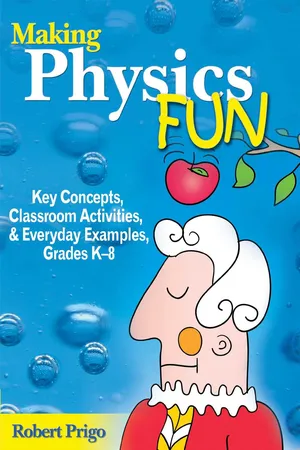
Making Physics Fun
eBook - ePub

Making Physics Fun

Key Concepts, Classroom Activities, and Everyday Examples, Grades K?8

  1. 240 pages
  2. English
  3. ePUB (mobile friendly)
  4. Available on iOS & Android
eBook - ePub

Making Physics Fun

Key Concepts, Classroom Activities, and Everyday Examples, Grades K?8

About this book

Boost student interest and understanding in the physical sciences! Teaching physical science in the elementary and middle grades can be challenging for busy teachers faced with growing demands and limited resources. Robert Prigo provides fun and engaging activities using safe, available materials that educators can easily incorporate into lesson plans. Extensive examples, sample inquiry questions, and ideas for initiating units are readily available for teachers to pick and choose from to meet student needs.The result of more than two decades of professional development work with hundreds of teachers and administrators, this resource addresses specific areas of physical science, including motion and force, waves and sound, light and electromagnetic waves, and more. Dozens of activities demonstrating physics in action help students of all ages relate physics principles to their everyday experiences.This practitioner-friendly resource helps teachers: • Address the "big ideas" in K–8 science education
• Promote student understanding with ready-to-use learning experiences
• Use hands-on activities to help students make larger, real-world connections
• Assemble classroom learning centers to facilitate deeper understanding of basic physics principlesWith conceptual summaries to support teachers' proficiency and understanding of the content, this guidebook is ideal for bringing physics to life for students in the classroom and in their lives!
Frequently asked questions

Yes, you can cancel anytime from the Subscription tab in your account settings on the Perlego website. Your subscription will stay active until the end of your current billing period. Learn how to cancel your subscription.
At the moment all of our mobile-responsive ePub books are available to download via the app. Most of our PDFs are also available to download and we're working on making the final remaining ones downloadable now. Learn more here.
Perlego offers two plans: Essential and Complete
  • Essential is ideal for learners and professionals who enjoy exploring a wide range of subjects. Access the Essential Library with 800,000+ trusted titles and best-sellers across business, personal growth, and the humanities. Includes unlimited reading time and Standard Read Aloud voice.
  • Complete: Perfect for advanced learners and researchers needing full, unrestricted access. Unlock 1.4M+ books across hundreds of subjects, including academic and specialized titles. The Complete Plan also includes advanced features like Premium Read Aloud and Research Assistant.
Both plans are available with monthly, semester, or annual billing cycles.
We are an online textbook subscription service, where you can get access to an entire online library for less than the price of a single book per month. With over 1 million books across 1000+ topics, we’ve got you covered! Learn more here.
Look out for the read-aloud symbol on your next book to see if you can listen to it. The read-aloud tool reads text aloud for you, highlighting the text as it is being read. You can pause it, speed it up and slow it down. Learn more here.
Yes! You can use the Perlego app on both iOS or Android devices to read anytime, anywhere — even offline. Perfect for commutes or when you’re on the go.
Please note we cannot support devices running on iOS 13 and Android 7 or earlier. Learn more about using the app.
Yes, you can access Making Physics Fun by Robert Prigo in PDF and/or ePUB format, as well as other popular books in Education & Education Teaching Methods. We have over one million books available in our catalogue for you to explore.

Information

1
Motion and Force
images
INERTIA AND NEWTON’S FIRST LAW OF MOTION
Concepts
All material objects are stubborn in two senses of the word. On the one hand, an object at rest (not moving at all) tends to remain at rest. Examples of this aspect of the concept of inertia are all around us—a book resting on a table, a house resting on the ground. On the other hand, an object moving in a straight line with constant speed (not increasing or decreasing its speed and/or turning) tends to remain moving in the same straight line with the same constant speed. Examples of this aspect of the concept of inertia are a little harder to identify—a spaceship drifting in interstellar space far from gravitating objects, a hockey puck moving freely across the ice. These two tendencies make up the concept of inertia. Historically, recognizing this duality was a key to unlocking our present understanding of motion. The scientists most responsible for its discovery and clarification, respectively, were Galileo (1564–1642) and Newton (1642–1727).
An object with a larger quantity of matter (say, a jumbo jet) possesses more of these tendencies—that is, possesses more inertia than an object with a lesser quantity of matter (say, a Ping-Pong ball or other table-tennis ball). In other words, both a jumbo jet and a Ping-Pong ball at rest tend to stay a rest, and both a jumbo jet and a Ping-Pong ball moving in a straight line with constant speed tend to remain doing that, but the jumbo jet has much more of these two tendencies than the Ping-Pong ball. The jumbo jet is said to have more mass, mass being the quantitative (numerical) measure of inertia.
Mass is also a measure of the amount of “stuff” (matter) that makes up an object. In other words, the mass value for an object gives a numerical value for the quantity of matter as well as for the tendency an object has to remain at rest and for the tendency an object has, if moving in a straight line with constant speed, to remain doing that. In the metric system of units (International System of Units), mass is measured in kilograms (kg).
Mass is a distinct concept from and more fundamental than weight. Weight is a measure used to quantify the strength of the gravitational force of attraction an object experiences when in the vicinity of the earth, moon, or any other astrophysical body. In other words, weight is a gravitational force and not a measure of inertia. For example, out in interstellar space, far away from any gravitating astrophysical body, a jumbo jet and a Ping-Pong ball would both be weightless (would have the same weight of zero) but would still possess greatly different amounts of inertia. In fact, each would have the same amount of inertia (each would have the same mass value) they had on earth or anywhere else, for that matter. Weight (gravitational pull) depends on locality; mass (inertia, stuff) does not. In the metric system (International System of Units), weight is measured in newtons (N). Near the surface of the earth, a 1.0-kg object weighs about 9.8 N or about 2.2 lbs.
The concept of inertia sets the default for motion. When there is no force on an object, or the net force on an object is zero (the concepts of force and net force will be examined later), the object will be moving in a straight line with constant speed (the speed could be zero and the object not moving). In other word, objects do not need any cause to keep moving in a straight line with constant speed. That is just the way it is. This is the default of nature. As we will see later, forces are responsible for changing motion (speeding up, slowing down, and/or turning) but are not needed for straight-line, constant-speed motion. If you could snap your fingers and turn off all the forces in the universe, you would see all the fundamental particles that are the building blocks of matter moving in straight lines with constant speeds.
Indeed, the concept of inertia is the backdrop against which all motion is played out. It is absolutely fundamental to our understanding of motion. Unfortunately, we live in a world dominated by electrical and gravitational forces, so it is natural that children possess the misconception that forces are needed for motion. Indeed, many children hold the misconceptions that constant motion requires a constant force, and that if an object is moving there is a force on it in the direction of its motion, with the amount of motion being proportional to the amount of force (Gunstone & Watts, 1985).
Forces are not required to maintain motion. Straight-line, constant-speed motion just happens on its own without the need for any external agents. Forces (external pushes and pulls) cause a change in motion. To be discussed later in more detail, forces cause objects to accelerate (speed up, slow down, and/or turn corners).
The concept of inertia is clearly articulated in Newton’s First Law of Motion, often called the Law of Inertia: When there is no force on an object or when the net force on an object is zero, the object will be either at rest or moving in a straight line with constant speed. The law also works in reverse: If an object is at rest or is moving with constant speed in a straight line, you can conclude either that no forces are being exerted on the object or that the net force on the object is zero.
Before closing on this topic, some interesting extensions of Newton’s First Law of Motion must be mentioned, not because they are developmentally appropriate for the student, but only because they should be of philosophical interest to the teacher. The fact that being at rest and being in motion in a straight line with constant speed are equivalent, in the sense that no forces are need for these types of motion, led Einstein to conclude that there is no way to know whether something is actually moving or not. You can feel only acceleration, motion that is changing. In other words, there is nothing you can do and no experiment you could perform to know whether you are absolutely at rest or moving in a straight line with constant speed. Consequently, Einstein argued that the absolute motion of an object through a fixed space is just a false construction of the human mind. There is no such thing as absolute motion and absolute space. This thinking led him to conclude that all motion must be relative. You can reference the motion of an object relative to some other object (e.g., the earth moves relative to the sun or a car moves relative to the road), but the absolute motion of an object in some fixed and absolute space does not exist. These ideas, along with some additional reasoning about the speed of electromagnetic radiation, eventually led to the knowledge that both space and time are also relative concepts and to the equivalence of mass and energy, cornerstones of Einstein’s Special Theory of Relativity.
Activities
images
Bowling Ball Versus Nerf Ball: You will need to obtain a bowling ball (more mass and inertia) and a Nerf ball or beach ball (with much less mass and inertia). Place each ball at rest on the ground in front of you. Hit each with a yardstick like you would hit a golf ball. Observe that the bowling ball does not move or moves very little (more tendency to stay at rest) and that the Nerf ball moves quickly away (less tendency to stay at rest). Next, get each ball rolling across the classroom floor and try to stop each with the yardstick. Observe that it is very easy to stop the Nerf ball (less tendency to keep moving) and very difficult to stopped the bowling ball (more tendency to keep moving).
Pendulums: You will need to obtain a variety of balls of various masses (from Styrofoam to steel) that can be hung from individual strings. You will also need to obtain a rubber-tipped dart gun (from your local toy store) and a drinking straw. With the pendulums hanging side by side, shoot each one in turn with the dart gun. Note the motions. The more massive ball will move the least and the least massive one the most. If you want, you can then weigh the balls on a scale to determine their masses to see if you ordered them properly. Instead of using the dart gun, you can “push” on the balls by blowing air at them through a straw. You can also set the pendulums swinging and try to stop them with a dart gun or by blowing air. The more massive pendulum should be harder to bring to rest. You might investigate other ways of providing a controlled push on the pendulums beside the dart gun and blowing air.
Ball on a Truck: You will need to locate a toy truck (or any flatbed cart), a metal ball (or any ball with a reasonable amount of mass), and a small piece of putty. Rest the ball in the center of the toy truck on a small piece of putty. The putty is used to fix the ball to the bed of the truck in order to keep it from initially rolling around inside the truck. It is important that the putty barely keeps the ball fixed to the truck. Move the truck forward quickly and observe that the ball wants to stay where it was (relative to the ground) and hits the back of the truck. An object at rest tends to stay a rest. Repeat, but now ease the ball and truck into motion, with the ball moving along with the truck and still stuck to the truck. Stop the truck suddenly by running it into some object (say, a wall). Notice that the ball has a tendency to keep moving in a straight line and hits the forward part of the truck. Repeat, but this time, as the truck and ball are moving together, turn the truck in a sharp circle. Notice that the ball still tends to move in a straight line and hits the side of the truck. You might try this activity using a smooth block (no putty needed) in the truck, instead of with a ball. You might also try scaling up these activities by using a push cart, the kind used for moving supplies around the school, and a larger ball (e.g., a basketball).
Marker Pen Person on a Cart: You will need a marker pen (like a Magic Marker) and a flatbed cart. Balance the marker pen vertically in the center of the cart so it simulates a person in a car. In other words, the maker pen is standing straight up, balanced on its bottom. With your hand, thrust the cart forward and watch the maker pen fall backward. Relative to the ground, the marker pen has a tendency to remain at rest and falls backward. Now repeat, but this time ease the cart into motion—making sure that the pen does not fall over—and run it into some object (like a wall). Observe now that the maker pen falls forward. A marker pen in motion tends to stay in motion. Like the previous activity, this activity is very useful for illustrating the role of seat belts, air bags, padded dashboards, headrests, and child safety seats in automobiles and other vehicles.
Ramp and Slider Investigation: You will need to collect a set of small balls of approximately the same diameter but with different masses. You will also need to construct a ramp (say, from a Hot Wheels track or with a grooved ruler) that runs down to the floor. Position a catcher-slider (anything, like a paper cup, that can catch a ball and slide across the floor will do) on the floor a few inches from the bottom of the ramp. From the same height on the track, release each ball in turn down the ramp and into the catcher-slider. Observe or measure how far the slider moves in each case. The more massive balls have more inertia and tend to keep on moving more than the less massive balls. Other versions of this activity would change the mass of the catcher-slider and/or change the surface over which the catcher-slider slides. Instead of using the slider, you can set up a row of cards (bent to stand up) in front of the ramp and see how many cards each ball can knock over.
Stack and Pull: You will need to cut a two-by-four into seven or more eight-inch-long blocks or locate some wood blocks of similar size. You will also need to sandpaper these blocks smooth. Attach a screw eyelet to one of the blocks in the middle of one of its narrow ends. Stack the blocks directly on top of each other, with the eyelet block at the bottom. Using a string attached to the lower block’s eyelet, pull that block quickly out from under the others. Be careful; do not pull the block so hard that it flies into your hand or body or something else in the room. As in the previous activity, the stack of blocks will tend to remain at rest and will not fall over and will remain stacked. You might try different arrangements, like standing some of the blocks vertically or inserting the eyelet block at different places in the stack. Blocks at rest tend to stay at rest.
Stack and Shoot: You will need to locate some circular-shaped playing pieces from a backgammon game. The pieces must be smooth and without ridges (ridged checkers will not work). Stack the pieces (10 or so) on top of each other on a smooth table or floor. Take another piece and, with a flick of a finger, send it across the table toward the bottom piece in the stack. A direct hit will flip out the bottom piece in the stack while the others will fall down in place and remained stacked. The stack of pieces tends to stay at rest. Another version of this activity places a small strip of paper under the stack. The paper can be pulled out quickly without toppling the stack.
Dollar Bill Trick: You will need to locate two plastic water bottles, both filled with water and sealed tightly. You can also use empty soda bottles filled with sand and sealed with a smooth cap. Take a dollar bill and place it between the two bottles balanced on each other, cap-to-cap. In other words, the dollar bill is sandwiched between the two bottles, which are precariously balancing cap-to-cap. One edge, not the middle of the dollar bill, should be between the bottles. Try to pull out the dollar bill quickly without upsetting the balance. One technique that works well is to hold the dollar bill straight out from the bottles with one hand and then quickly karate chop downward with the index finger of the other hand in the middle of the dollar. A bottle at rest tends to stay at rest.
Tablecloth Pull: You will need to locate a smooth piece of cloth (a piece of silk works well) to act as your tablecloth. There should be no seams around the edges. You will also need to locate a set of dinnerware (smooth plate, cup, etc.) and a very smooth table with a sharp edge. Place the tablecloth partway on the table, no more than a foot and a half from the table’s edge. Allow the rest of the...

Table of contents

  1. Cover
  2. Dedication
  3. Title Page
  4. Copyright
  5. Contents
  6. Preface
  7. Acknowledgments
  8. About the Author
  9. 1. Motion and Force
  10. 2. Fluids and Buoyancy
  11. 3. Waves and Sound
  12. 4. Light and Electromagnetic Waves
  13. 5. Electricity and Magnetism
  14. References and Resources
  15. Index