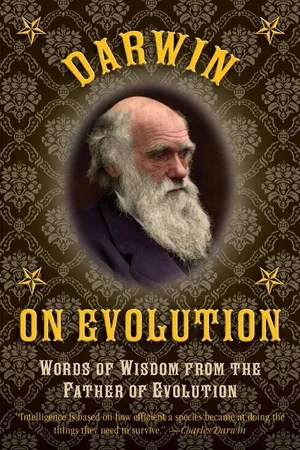
Darwin on Evolution
eBook - ePub

Darwin on Evolution

Words of Wisdom from the Father of Evolution

  1. 144 pages
  2. English
  3. ePUB (mobile friendly)
  4. Available on iOS & Android
eBook - ePub

Darwin on Evolution

Words of Wisdom from the Father of Evolution

About this book

The father of evolution imbibed history with his controversial book On the Origin of Species. As a young scientist studying natural history, Charles Darwin set out on the HMS Beagle for a five-year voyage that would bring him in contact with animal species, plant species, and rock formations all over the world. This voyage established him as an eminent geologist, and his publication of his journal of the voyage established him as a well-known popular author.After continued, careful studying of his findings from his trip around the world, he published one of the most controversial books of history— The Origin of Species —which opposed the church's theory that all species had come into existence at the time of the Creation. Darwin on Evolution contains quotes and wisdom from The Origin of Species, as well as from his other publications, pertaining to his theories of evolution and natural selection. Readers young and old alike will have the opportunity to learn more about his theories while also taking away important life lessons. As Darwin says, "In the long history of humankind (and animal kind, too) those who learned to collaborate and improvise most effectively have prevailed."
Frequently asked questions

Yes, you can cancel anytime from the Subscription tab in your account settings on the Perlego website. Your subscription will stay active until the end of your current billing period. Learn how to cancel your subscription.
No, books cannot be downloaded as external files, such as PDFs, for use outside of Perlego. However, you can download books within the Perlego app for offline reading on mobile or tablet. Learn more here.
Perlego offers two plans: Essential and Complete
  • Essential is ideal for learners and professionals who enjoy exploring a wide range of subjects. Access the Essential Library with 800,000+ trusted titles and best-sellers across business, personal growth, and the humanities. Includes unlimited reading time and Standard Read Aloud voice.
  • Complete: Perfect for advanced learners and researchers needing full, unrestricted access. Unlock 1.4M+ books across hundreds of subjects, including academic and specialized titles. The Complete Plan also includes advanced features like Premium Read Aloud and Research Assistant.
Both plans are available with monthly, semester, or annual billing cycles.
We are an online textbook subscription service, where you can get access to an entire online library for less than the price of a single book per month. With over 1 million books across 1000+ topics, we’ve got you covered! Learn more here.
Look out for the read-aloud symbol on your next book to see if you can listen to it. The read-aloud tool reads text aloud for you, highlighting the text as it is being read. You can pause it, speed it up and slow it down. Learn more here.
Yes! You can use the Perlego app on both iOS or Android devices to read anytime, anywhere — even offline. Perfect for commutes or when you’re on the go.
Please note we cannot support devices running on iOS 13 and Android 7 or earlier. Learn more about using the app.
Yes, you can access Darwin on Evolution by Charles Darwin in PDF and/or ePUB format, as well as other popular books in Biological Sciences & Evolution. We have over one million books available in our catalogue for you to explore.

Information

EXCERPT FROM THE FOUNDATION OF ON THE ORIGIN OF THE SPECIES: TWO ESSAYS WRITTEN IN 1842 AND 1843
I will now recapitulate the course of this work, more fully with respect to the former parts, and briefly [as to] the latter. In the first chapter we have seen that most, if not all, organic beings, when taken by man out of their natural condition, and bred during several generations, vary; that is variation is partly due to the direct effect of the new external influences, and partly to the indirect effect on the reproductive system rendering the organization of the offspring in some degree plastic. Of the variations thus produced, man when uncivilized naturally preserves the life, and therefore unintentionally breeds from those individuals most useful to him in his different states: when even semi-civilized, he intentionally separates and breeds from such individuals. Every part of the structure seems occasionally to vary in a very slight degree, and the extent to which all kinds of peculiarities in mind and body, when congenital and when slowly acquired either from external influences, from exercise, or from disuse [are inherited], is truly wonderful. When several breeds are once formed, then crossing is the most fertile source of new breeds. Variation must be ruled, of course, by the health of the new race, by the tendency to return to the ancestral forms, and by unknown laws determining the proportional increase and symmetry of the body. The amount of variation, which has been effected under domestication, is quite unknown in the majority of domestic beings.
In the second chapter it was shown that wild organisms undoubtedly vary in some slight degree: and that the kind of variation, though much less in degree, is similar to that of domestic organisms. It is highly probable that every organic being, if subjected during several generations to new and varying conditions, would vary. It is certain that organisms, living in an isolated country which is undergoing geological changes, must in the course of time be so subjected to new conditions; moreover an organism, when by chance transported into a new station, for instance into an island, will often be exposed to new conditions, and be surrounded by a new series of organic beings. If there were no power at work selecting every slight variation, which opened new sources of subsistence to a being thus situated, the effects of crossing, the chance of death and the constant tendency to reversion to the old parent-form, would prevent the production of new races. If there were any selective agency at work, it seems impossible to assign any limit to the complexity and beauty of the adaptive structures, which might thus be produced: for certainly the limit of possible variation of organic beings, either in a wild or domestic state, is not known.
It was then shown, from the geometrically increasing tendency of each species to multiply (as evidenced from what we know of mankind and of other animals when favored by circumstances), and from the means of subsistence of each species on an average remaining constant, that during some part of the life of each, or during every few generations, there must be a severe struggle for existence; and that less than a grain1 in the balance will determine which individuals shall live and which perish. In a country, therefore, undergoing changes, and cut off from the free immigration of species better adapted to the new station and conditions, it cannot be doubted that there is a most powerful means of selection, tending to preserve even the slightest variation, which aided the subsistence or defense of those organic beings, during any part of their whole existence, whose organization had been rendered plastic. Moreover, in animals in which the sexes are distinct, there is a sexual struggle, by which the most vigorous, and consequently the best adapted, will oftener procreate their kind.
A new race thus formed by natural selection would be undistinguishable from a species. For comparing, on the one hand, the several species of a genus, and on the other hand several domestic races from a common stock, we cannot discriminate them by the amount of external difference, but only, first, by domestic races not remaining so constant or being so “true” as species are; and secondly by races always producing fertile offspring when crossed. And it was then shown that a race naturally selected—from the variation being slower—from the selection steadily leading towards the same ends, and from every new slight change in structure being adapted (as is implied by its selection) to the new conditions and being fully exercised, and lastly from the freedom from occasional crosses with other species, would almost necessarily be “truer” than a race selected by ignorant or capricious and short-lived man. With respect to the sterility of species when crossed, it was shown not to be a universal character, and when present to vary in degree: sterility also was shown probably to depend less on external than on constitutional differences. And it was shown that when individual animals and plants are placed under new conditions, they become, without losing their healths, as sterile, in the same manner and to the same degree, as hybrids; and it is therefore conceivable that the cross-bred offspring between two species, having different constitutions, might have its constitution affected in the same peculiar manner as when an individual animal or plant is placed under new conditions. Man in selecting domestic races has little wish and still less power to adapt the whole frame to new conditions; in nature, however, where each species survives by a struggle against other species and external nature, the result must be very different.
Races descending from the same stock were then compared with species of the same genus, and they were found to present some striking analogies. The offspring also of races when crossed, that is mongrels, were compared with the cross-bred offspring of species, that is hybrids, and they were found to resemble each other in all their characters, with the one exception of sterility, and even this, when present, often becomes after some generations variable in degree. The chapter was summed up, and it was shown that no ascertained limit to the amount of variation is known; or could be predicted with due time and changes of condition granted. It was then admitted that although the production of new races, undistinguishable from true species, is probable, we must look to the relations in the past and present geographical distribution of the infinitely numerous beings, by which we are surrounded—to their affinities and to their structure—for any direct evidence.
In the third chapter the inheritable variations in the mental phenomena of domestic and of wild organic beings were considered. It was shown that we are not concerned in this work with the first origin of the leading mental qualities; but that tastes, passions, dispositions, consensual movements, and habits all became, either congenitally or during mature life, modified and were inherited. Several of these modified habits were found to correspond in every essential character with true instincts, and they were found to follow the same laws. Instincts and dispositions &c. are fully as important to the preservation and increase of a species as its corporeal structure; and therefore the natural means of selection would act on and modify them equally with corporeal structures. This being granted, as well as the proposition that mental phenomena are variable, and that the modifications are inheritable, the possibility of the several most complicated instincts being slowly acquired was considered, and it was shown from the very imperfect series in the instincts of the animals now existing, that we are not justified in prima facie rejecting a theory of the common descent of allied organisms from the difficulty of imagining the transitional stages in the various now most complicated and wonderful instincts. We were thus led on to consider the same question with respect both to highly complicated organs, and to the aggregate of several such organs, that is individual organic beings; and it was shown, by the same method of taking the existing most imperfect series, that we ought not at once to reject the theory, because we cannot trace the transitional stages in such organs, or conjecture the transitional habits of such individual species.
In the Second Part the direct evidence of allied forms having descended from the same stock was discussed. It was shown that this theory requires a long series of intermediate forms between the species and groups in the same classes—forms not directly intermediate between existing species, but intermediate with a common parent. It was admitted that if even all the preserved fossils and existing species were collected, such a series would be far from being formed; but it was shown that we have not good evidence that the oldest known deposits are contemporaneous with the first appearance of living beings; or that the several subsequent formations are nearly consecutive; or that any one formation preserves a nearly perfect fauna of even the hard marine organisms, which lived in that quarter of the world. Consequently, we have no reason to suppose that more than a small fraction of the organisms which have lived at any one period have ever been preserved; and hence that we ought not to expect to discover the fossilized sub-varieties between any two species. On the other hand, the evidence, though extremely imperfect, drawn from fossil remains, as far as it does go, is in favor of such a series of organisms having existed as that required. This want of evidence of the past existence of almost infinitely numerous intermediate forms, is, I conceive, much the weightiest difficulty on the theory of common descent; but I must think that this is due to ignorance necessarily resulting from the imperfection of all geological records.
In the fifth chapter it was shown that new species gradually appear, and that the old ones gradually disappear, from the earth; and this strictly accords with our theory. The extinction of species seems to be prec...

Table of contents

  1. Cover
  2. Title Page
  3. Copyright
  4. Contents
  5. On The Theory and Concerns of Evolution
  6. On Nature
  7. On Humanity and the Struggle for Existence
  8. On Religion
  9. On Science
  10. A Mixed Reception: Letters Concerning the Release of On The Origin of the Species
  11. Excerpt from The Foundation of the Origin of the Species: Two Essays Written in 1842 and 1843