
eBook - ePub
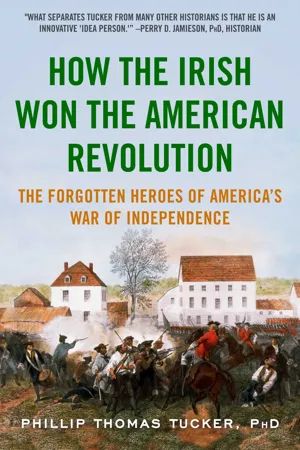
How the Irish Won the American Revolution
A New Look at the Forgotten Heroes of America's War of Independence
- 408 pages
- English
- ePUB (mobile friendly)
- Available on iOS & Android
eBook - ePub
How the Irish Won the American Revolution
A New Look at the Forgotten Heroes of America's War of Independence
About this book
When the Continental Congress decided to declare independence from the British empire in 1776, ten percent of the population of their fledgling country were from Ireland. By 1790, close to 500,000 Irish citizens had immigrated to America. They were was very active in the American Revolution, both on the battlefields and off, and yet their stories are not well known. The important contributions of the Irish on military, political, and economic levels have been long overlooked and ignored by generations of historians. However, new evidence has revealed that Washington’s Continental Army consisted of a far larger percentage of Irish soldiers than previously thoughtbetween 40 and 50 percentwho fought during some of the most important battles of the American Revolution.
Romanticized versions of this historical period tend to focus on the upper class figures that had the biggest roles in America’s struggle for liberty. But these adaptations neglect the impact of European and Irish ideals as well as citizens on the formation of the revolution. Irish contributors such as John Barry, the colonies’ foremost naval officer; Henry Knox, an artillery officer and future Secretary of War; Richard Montgomery, America’s first war hero and martyr; and Charles Thomson, a radical organizer and Secretary to the Continental Congress were all instrumental in carrying out the vision for a free country. Without their timely and disproportionate assistance, America almost certainly would have lost the desperate fight for its existence.
Skyhorse Publishing, as well as our Arcade imprint, are proud to publish a broad range of books for readers interested in history--books about World War II, the Third Reich, Hitler and his henchmen, the JFK assassination, conspiracies, the American Civil War, the American Revolution, gladiators, Vikings, ancient Rome, medieval times, the old West, and much more. While not every title we publish becomes a New York Times bestseller or a national bestseller, we are committed to books on subjects that are sometimes overlooked and to authors whose work might not otherwise find a home.
Romanticized versions of this historical period tend to focus on the upper class figures that had the biggest roles in America’s struggle for liberty. But these adaptations neglect the impact of European and Irish ideals as well as citizens on the formation of the revolution. Irish contributors such as John Barry, the colonies’ foremost naval officer; Henry Knox, an artillery officer and future Secretary of War; Richard Montgomery, America’s first war hero and martyr; and Charles Thomson, a radical organizer and Secretary to the Continental Congress were all instrumental in carrying out the vision for a free country. Without their timely and disproportionate assistance, America almost certainly would have lost the desperate fight for its existence.
Skyhorse Publishing, as well as our Arcade imprint, are proud to publish a broad range of books for readers interested in history--books about World War II, the Third Reich, Hitler and his henchmen, the JFK assassination, conspiracies, the American Civil War, the American Revolution, gladiators, Vikings, ancient Rome, medieval times, the old West, and much more. While not every title we publish becomes a New York Times bestseller or a national bestseller, we are committed to books on subjects that are sometimes overlooked and to authors whose work might not otherwise find a home.
Frequently asked questions
Yes, you can cancel anytime from the Subscription tab in your account settings on the Perlego website. Your subscription will stay active until the end of your current billing period. Learn how to cancel your subscription.
No, books cannot be downloaded as external files, such as PDFs, for use outside of Perlego. However, you can download books within the Perlego app for offline reading on mobile or tablet. Learn more here.
Perlego offers two plans: Essential and Complete
- Essential is ideal for learners and professionals who enjoy exploring a wide range of subjects. Access the Essential Library with 800,000+ trusted titles and best-sellers across business, personal growth, and the humanities. Includes unlimited reading time and Standard Read Aloud voice.
- Complete: Perfect for advanced learners and researchers needing full, unrestricted access. Unlock 1.4M+ books across hundreds of subjects, including academic and specialized titles. The Complete Plan also includes advanced features like Premium Read Aloud and Research Assistant.
We are an online textbook subscription service, where you can get access to an entire online library for less than the price of a single book per month. With over 1 million books across 1000+ topics, weâve got you covered! Learn more here.
Look out for the read-aloud symbol on your next book to see if you can listen to it. The read-aloud tool reads text aloud for you, highlighting the text as it is being read. You can pause it, speed it up and slow it down. Learn more here.
Yes! You can use the Perlego app on both iOS or Android devices to read anytime, anywhere â even offline. Perfect for commutes or when youâre on the go.
Please note we cannot support devices running on iOS 13 and Android 7 or earlier. Learn more about using the app.
Yes, you can access How the Irish Won the American Revolution by Phillip Thomas Tucker in PDF and/or ePUB format, as well as other popular books in History & Early American History. We have over one million books available in our catalogue for you to explore.
Information
Chapter I
âYou Have Lost America by the Irish:â Americaâs Forgotten Revolutionaries
America lost its first general officer when a British cannon unleashed a blast of canister at point-blank range into Major General Richard Montgomery, who was inspiring his troops onward in Americaâs most desperate offensive effort to date. Montgomery was cut down while encouraging his ill-clad men through a driving snowstorm in a determined attempt to capture the mighty fortress-city of Quebec, the key to Canada, against the odds. He led the way against a well-prepared British and Canadian opponent in the time-honored tradition of generations of Irish revolutionaries, who had fought in vain to free the Emerald Isle from British rule.
Montgomery, who was born as a member of the Irish Protestant gentry near Swords, County Dublin, Ireland and had attended prestigious Trinity College in Dublin, died along with Americaâs ambitious dream of making Canada the fourteenth colony and conquering an empire. When the Irishman fell into the snow on a cold, windswept Quebec street far from his beloved Emerald Isle on the last day of December 1775, he became Americaâs first authentic war hero and martyr to the cause of liberty.1 Upon receiving the sad news, a shocked General George Washington lamented how âAmerica has sustained a heavy Lossâ in the fall of the gifted Montgomery, whom the Virginian described in a letter as âthe Gallant Chiefâ of Americaâs first invading army on foreign soil.2
However, in the subsequent glorification of Americaâs first general to fall in battle, something significant was lost, shrouded in a romantic cloak of nationalism. In late January 1776, the Continental Congress appointed a committee, which included Benjamin Franklin, to take the necessary steps to preserve the memory of one of Americaâs first martyrs to the cause of liberty. The committee determined that a stone marker, made by only the finest artists in Paris, France, should be erected in General Montgomeryâs honor. Therefore, while Montgomeryâs body remained on Canadian soil, the first monument ever dedicated to a United States war hero was erected at St. Paulâs Church on Broadway in New York City in 1787. But nothing was revealed about Montgomeryâs birth in Ireland in the stoneâs inscription: a lasting testament of how an Ireland-born major general became thoroughly Americanized for posterity by the erasing of his Irish antecedents.3
Worst of all, however, not only were Montgomeryâs Irish roots (his father was disinherited because he married an English woman) lost, but also his historical memory. Despite his noble sacrifice and lofty rank, Montgomery became just another one of the forgotten Irishmen of the American Revolution. This development was even more surprising because his death in leading Americaâs first invasion of foreign soil inspired an entire generation of revolutionaries across America to embark upon the perilous road to independence against the worldâs most powerful nation.4
Montgomeryâs contributions and sacrifice at Quebec was only the first of countless examples of the important, but forgotten, Irish heroics and sacrifices throughout the American Revolution. Historian Jay P. Dolan, in his excellent work entitled The Irish Americans: A History, correctly called the first section of his book, which included the American Revolution, âA Forgotten Eraâ in regard to Irish contributions to the making of America.5
John Sullivan was another forgotten major general of Irish immigrant parents. On Washingtonâs orders to reverse the dismal situation in Canada, he led the next offensive effort in still another attempt to capture Quebec in June 1776. Although unsuccessful in Canada for reasons not of his making, Sullivanâs leadership abilities later explained why Washington appointed him a leading role in the attack on Trenton, New Jersey. Sullivan commanded the First Division, the southern arm of Washingtonâs brilliant pincer movement, in the surprise December 26, 1776, attack on Trenton. Without Sullivanâs timely arrival from the northern army to reinforce Washington, the Virginianâs audacious strike upon Trenton might well have proved unsuccessful.6 Clearly, Sullivan (one of five Sullivan brothers who fought for Americaâs liberty) was one of Washingtonâs top lieutenants at an early date. In fact, from the beginning, Washingtonâs well-placed confidence in Sullivan was rewarded. He wrote how Sullivan was an ideal revolutionary leader like Montgomery: âactive, spirited, and zealously attachâd to the causeâ of Americaâs liberty.7
Sullivan was the son of two Irish âredemptionariesâ (indentured servants), John and Margery Browne, who settled on the banks of the Salmon Falls River, just below the Maine border. The generalâs father hailed from a âlong line of Irish warriorsâ who fought and died for Irish liberty. His grandfather, Major Philip Sullivan, battled the English all the way to the surrender of the Limerick garrison in 1690 that led to the fateful Treaty of Limerick. The major then fled to France with many other Irish Jacobite exiles, becoming one of the famous âWild Geeseâ who served France with distinction.8
Unfortunately, even some of the most important aspects of the American Revolution still remain riddles and enigmas to this day, however. Not long after the American Revolution ended, even Washington himself was mystified as to how it had all come about in Americaâs favor. Other than the blessings of âProvidenceâ that he often invoked, Washington was not fully able to explain how the revolution had succeeded, defying the odds and top military experts on both sides of the Atlantic.
Consequently, a prophetic Washington correctly understood that historians of future generations would never quite be able to explain exactly how and why Americaâs rustic revolutionaries had succeeded against the odds. In a rather remarkable letter written not long after the new nationâs independence was won, Washington emphasized how in the future, âit will not be believed that such a force as Great Britain has employed for eight years in Country could be baffled [and] by numbers infinitely less, composed of Men oftentimes half starved; always in Rags, without pay, and experiencing, at times, every species of distress which human nature is capable of undergoing.â9 However, Washington later gave a strong hint in regard to the actual answer. He fully understood and appreciated the importance of the Irish and Scotch-Irish contributions to the winning of Americaâs independence because âIreland [was] thou friend of my country in my countryâs most friendless dayâ during the desperate struggle for liberty.10
George Washington Parke Custis, Washingtonâs adopted son and a careful student of the American Revolution, said it better:
When our friendless standard was first unfurled for resistance, who were the strangers that first mustered âround its staff, and when it reeled in the fight, who more bravely sustained it than Erinâs generous sons? Who led the assault on Quebec [Ireland-born General Richard Montgomery] and shed early luster on our arms, in the dawn of our revolution? Who led the right wing of Libertyâs forlorn hope [General John Sullivan played a leading role in Washingtonâs victory at Trenton] at the passage of the Delaware? Who felt the privations of the camp, the fate of battle, or the horrors of the prison ship more keenly than the Irish? Washington loved them, for they were the companions of his toils, his perils, his glories, in the deliverance of his country.11
This long-overlooked analysis was accurate. In regard to Washingtonâs surprise attack on Trenton that was made possible partly by supplies from Ireland-born merchants such as William Patterson, Sullivan commanded one of the two divisions that struck simultaneously in a closing of two pincer arms, performing magnificently to cement his lofty place as âperhaps Washingtonâs best field commander.â12 Likewise, Washingtonâs enlisted ranks were heavily dominated by Irish and Scotch-Irish soldiers who followed so many Celtic-Gaelic commanders throughout the war. When thousands of Americans were captured in the Long Island fiasco on August 27, 1776, Ambrose Serle, Admiral Richard Howeâs personal secretary, was shocked by the sight of the âvast numbers of Irishâ in Washingtonâs ranks while closely inspecting the lengthy lines of sullen American prisoners who had surrendered.13 And in the South when Charleston, South Carolina, was captured four years later, one British officer was likewise astounded how the âPrisoners [who] have fallen into [our] hands being many of the . . . Irishâ soldiers of the primary American army in the Southern theater.14
Privates Patrick McFarthom and William McCarthy, a Maryland Continental, were among Washingtonâs forgotten Irishmen of the enlisted ranks. Patrick was âa middle sized well looking Irishman, about 26 years of age, red complexion, dark, curled and short hair.â McCarthy hardly fit the romantic image of the Continental soldier. William was described by a comrade as âan Irishman, about forty years old [with] a blanket over-coat, round hat, and his shoes were tied with strings, his feet had been frost-bitten [from service during the Trenton-Princeton Campaign and] he has something of the [Irish] brogue in his language.â15
However, in regard to later-day historians, as opposed to Washington and his contemporaries, even the most fundamental explanations of Americaâs ultimate success that shocked the world have been proven false because Revolutionary War historiography has been dominated by romance and misconceptions. A natural development in the self-serving formulation of a distinguished national history (as seen in all nations), Americaâs creation story has been narrowly interpreted and romantically portrayed as fundamentally having been won primarily by a single group of colonistsânative-born Americans of English stock of the Protestant faith, which led to the yeoman farmer-soldier myth. This one-dimensional and even racially based perspective has led to the popular conception in the American mind and iconic imaginary of the mythical homogenous Anglo-Saxon soldiery, without a hint of ethnicity, especially in regard to Ireland and the Irish people.
Of course, these central myths of Americaâs creation story have been a natural if not inevitable development in the historiography of the United Statesâ birth because the infant nation needed to invent its past into a heroic sagaâAmericaâs Iliad. However, this development resulted in a sanitization and homogenization of not only the American Revolutionâs story but also the very image of the revolutionaries themselves.
The extensive whitewashing of the overall image of Americaâs revolutionaries was faithfully continued by generations of American historians and scholars (almost always Protestant), who have presented the most nationalistic and racially pristine of interpretations that left no room for the contributions of a distinct ethnic and racial group that was considered âforeign.â However, nothing could have been further from the truth. In fact, eight signers of the Declaration of Independence were foreign born, more in Ireland than in any other country. Only one signer was Irish Catholic: Charles Carroll from Carrollton, Maryland, who traced his roots to the OâCarroll family of County Kings in Irelandâs fertile midlands of Leinster Province. He was one of Washingtonâs relatively few die-hard supporters who helped to save the commander in chiefâs position when criticism for the often-defeated Virginian reached its greatest height.
More than any other ethnic group in America, the Celtic-Gaelic people, Americaâs greatest pioneering race, were precisely the right kind of individuals to wage revolution, thanks to the legacies of the searing Irish experience. They first answered the call to arms and continued to faithfully serve year after year in part because as lower-class members they were the most attracted to military service, especially when cash inducements and land bounties were part of the enlistment bargain. In consequence, the poor, disadvantaged, and uneducated people (mostly Irish and Scotch-Irish in America) were the most likely soldiers to serve for extended periodsâan absolutely necessary requirement in what was a lengthy war of attritionâas regulars to sustain the resistance effort, especially in Washingtonâs Army. Patriotism combined with Protestant zeal and a Calvinist work ethic that forbade failure to create a moral and determined Irish soldiery. Therefore, the typical Irish soldier was far from the stereotypical mercenary type. In overall terms, these Celtic-Gaelic soldiers were highly motivated not only because of Americaâs struggle for liberty but also because of the overall Irish experience, especially in regard to the centuries-long quest for independence on Irish soil and the fact that England was the ancient enemy of the Irish people.16
Besides the lower class and immigrant status of the Irish, one fundamental reason why the revolutionary generation and future historians failed to fully acknowledge the disproportionate Irish contributions to Americaâs amazing victory was because they were considered un-American âforeignersâ by colonists and revolutionary leaders of English descent. At this time, the native Irish, or Catholics, who were known as Gaels and Celts, were considered by colonists of English descent as members of a distinct race instead of a nationality because Ireland had been subjugated by England.
The long-elusive answer that explains why the infant republic ultimately won its lengthy struggle for existence actually lies in the key demographic equation; a larger percentage of American colonial society consisted of Ireland-born Irish Catholics (who hailed from most of Ireland) and a far larger number of Scotch-Irish Presbyterians (mostly from Northern Ireland) than at any other time in American history. No American army in United States history ever contained a larger percentage of soldiers, both among leadership (including general officers) and the enlisted ranks, from foreign soil than Washingtonâs Continental Army.17 So many Irish filled the ranks of the disproportionately large Pennsylvania Continental Line that it was known as the Line of Ireland.18 Most importantly, the largely Celtic-Gaelic Pennsylvania regiments âprovided the backbone of the American army.â19
In a letter to his brother John Augustine, whom he affectionately referred to as Jack, Washington understood the difference between so many colonists of British descent who remained either neutral or Loyalist and more worldly but less realistic compared to the lowly Irish: the only realistic choice was to âconquer, or submit to unconditional terms . . . such as confiscations, hanging, etc.â20 For all practical purposes, Washington might as well have been referring specifically to the bitter lessons of Irish history and those Emerald Island colonists who most intimately understood these harsh realities of British imperialism and nationalism far better than any other people in America.
However, in an all-too-common omission, even respected Irish historians, such as Myles Dugan in a popular work, failed to include any mention of Irish participation in the American Revolution. But to be fair, Dugan has only continued the tradition of generations of American historians in ignoring American Revolutionary War contributions, despite the supreme importance of the Irish contribution.21
As mentioned, contemporaries of the time of the American Revolution were actually more on target in regard to th...
Table of contents
- Cover
- Halftitle
- Title Page
- Copyright
- Contents
- Dedication
- Introduction: The Forgotten Irish Contribution to Decisive Victory
- Chapter I: âYou Have Lost America by the Irish:â Americaâs Forgotten Revolutionaries
- Chapter II: Enduring Irish Legacies, Myths, and Popular Modern Memory
- Chapter III: Complexities of Ethnicity and Forgotten History
- Chapter IV: Half of Washingtonâs Continental Army Was Celtic-Gaelic?
- Chapter V: A New Generation of the Most Radical Revolutionaries in America
- Chapter VI: More of Washingtonâs Invaluable Irish Commanders
- Chapter VII: Washingtonâs Close-Knit Irish âFamilyâ and Other Hard-Hitting Irish Leaders
- Conclusion: Irish Odyssey
- Notes
- Index
- Back