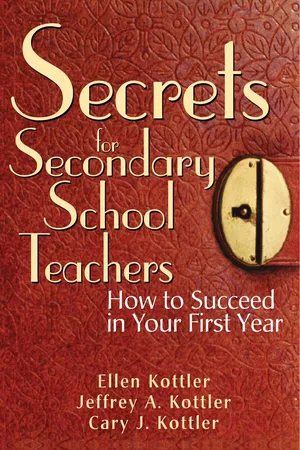
Secrets for Secondary School Teachers
eBook - ePub

Secrets for Secondary School Teachers

How to Succeed in Your First Year

  1. 224 pages
  2. English
  3. ePUB (mobile friendly)
  4. Available on iOS & Android
eBook - ePub

Secrets for Secondary School Teachers

How to Succeed in Your First Year

About this book

Teach like a pro from day one! In this updated version of the successful Secrets for Secondary School Teachers, you will learn tangible ways to supercharge your teaching skills, while avoiding the pitfalls common to beginning teachers. Offering a unique blend of perspectives and "insider" insights into secondary education, a seasoned high school teacher, a long-time educator and counselor, and a recent high school graduate join forces to impart proven tips and tools.This indispensable guide combines practical applications of your preservice coursework with straightforward portrayals of what you can expect during your first days, weeks, semesters, and years in the classroom.Already packed with winning ideas and real-life scenarios, this newest edition has added: • A new chapter on developing plans for instruction and assessment
• Rubrics—both holistic and analytic
• A-to-Z list of assessments
• Expanded information on multiple intelligences and diverse learning populations
• Suggestions for students with attention deficits
• Stress source chart
• Technology tipsReduce your stress, hone your skills, and be "in the know" with this invaluable resource.
Frequently asked questions

Yes, you can cancel anytime from the Subscription tab in your account settings on the Perlego website. Your subscription will stay active until the end of your current billing period. Learn how to cancel your subscription.
No, books cannot be downloaded as external files, such as PDFs, for use outside of Perlego. However, you can download books within the Perlego app for offline reading on mobile or tablet. Learn more here.
Perlego offers two plans: Essential and Complete
  • Essential is ideal for learners and professionals who enjoy exploring a wide range of subjects. Access the Essential Library with 800,000+ trusted titles and best-sellers across business, personal growth, and the humanities. Includes unlimited reading time and Standard Read Aloud voice.
  • Complete: Perfect for advanced learners and researchers needing full, unrestricted access. Unlock 1.4M+ books across hundreds of subjects, including academic and specialized titles. The Complete Plan also includes advanced features like Premium Read Aloud and Research Assistant.
Both plans are available with monthly, semester, or annual billing cycles.
We are an online textbook subscription service, where you can get access to an entire online library for less than the price of a single book per month. With over 1 million books across 1000+ topics, we’ve got you covered! Learn more here.
Look out for the read-aloud symbol on your next book to see if you can listen to it. The read-aloud tool reads text aloud for you, highlighting the text as it is being read. You can pause it, speed it up and slow it down. Learn more here.
Yes! You can use the Perlego app on both iOS or Android devices to read anytime, anywhere — even offline. Perfect for commutes or when you’re on the go.
Please note we cannot support devices running on iOS 13 and Android 7 or earlier. Learn more about using the app.
Yes, you can access Secrets for Secondary School Teachers by Ellen Kottler, Jeffrey A. Kottler, Cary J. Kottler in PDF and/or ePUB format, as well as other popular books in Education & Classroom Management. We have over one million books available in our catalogue for you to explore.

Information

Publisher
Skyhorse
Year
2015
Print ISBN
9781629147468
1
Learning Your Way Around the School
ā€œVisitors please report to the Principal’s Office,ā€ reads the sign at the entrance to the school. Indeed, you are a visitor that first year, with all the appropriate levels of confusion and disorientation that are typical for an intrepid explorer who is operating in unknown territory without a map.
As many times as you may have visited a school previously, during field placements or perhaps even as a parent or relative of a student, you are always struck by how big the place seems. Everyone seems to know just where they are going, always in a hurry, making contact with as many people as they can, rushing to the next class before the bell rings. The place is a maze of offices, rooms, hallways, labs, each connected by a layout that probably once made sense to someone in charge of designing things. To the newcomer, however, whether an entering student or first-year teacher, the school seems hopelessly inhospitable.
ORIENT YOURSELF
Your first job is to learn your way around. We don’t mean just memorizing the quickest route from the entrance to your assigned classroom; rather, we mean orienting yourself completely to every nook and cranny in the building. After you’ve gotten the official tour from the principal and department head, found out where to park and to what room(s) you are assigned, make it a priority to get ā€œunofficialā€ guided tours from an experienced teacher, a secretary, a student, and a custodian (especially the custodian!). This is the place you will be spending most of your life during the coming years, so you will want to orient yourself as quickly and comprehensively as you can.
ā€œI remember one new teacher,ā€ a colleague of ours recalls. ā€œShe never left her classroom during the day except to go to the bathroom down the hall. At first, we thought she was just snooty or unsociable. Only later did we learn she was so afraid of getting lost that she thought it best to just remain in one spot as long as she could.ā€ As you have more interactions with the staff, you will learn your way around and become more comfortable venturing out into other parts of the building.
As you walk around, note how the activities of the building are organized. Do the freshmen and sophomores have classes in one area while the juniors and seniors meet in another? Or, are rooms for specific subject areas grouped together, with science in one area and social studies in another? Where are the offices located? Are the counseling offices separated from the administrative offices? Where is the health office? How far away are the gymnasiums and athletic fields? And of course, most important of all, where do folks eat lunch and hang out?
Later on you will have time to notice where people habitually congregate. We are creatures of habit and take comfort in familiar spaces. Those who come early and those who stay late (students and faculty) tend to gather in the same locations. The same is true with respect to all the other factors that draw people together—their common interests, their age groups, their areas of expertise, their mutual attractions, and their coalitions.
You may be curious about how student lockers are organized—in most high schools, for example, students may be assigned lockers according to class level. You will also want to study where various student groups hang out—whether that is in front of the school, a quad area, or a specific hallway (and eventually you will learn the ā€œsecretā€ places as well). So, if you need to find a senior before school starts, you’ll want to go to the ā€œsenior wingā€ of the building or the place where seniors typically gather as they wait for the first bell to ring. The office staff will have favorite areas as well, from lounges to department offices. You can be sure that most people, regardless of their jobs, personalities, or interests, develop consistent patterns over time.
MAKE FRIENDS WITH THE SCHOOL SECRETARIES
Most people think that the principal is the key person to know in the school. Well, she or he is certainly the designated authority figure and is ultimately responsible for what happens in the school. But the people who control access to the administration, the ones who are connected to all facets of the school’s operation, those who know the most efficient ways to get things done, as well as the most important gossip, are the school secretaries.
In learning your way around the school, the school secretary will likely be your first point of contact. She or he will help you get settled, help you get keys and supplies, introduce you to other people, and guide you through the appropriate paperwork. Even if the principal does this him- or herself, you would be well-advised to spend some time getting to know the secretaries as soon as you’re able. Ultimately, they can be your strongest supporters or biggest obstacles throughout your career. They control access to everyone and everything.
You will probably have a few thousand questions to address with your assigned school guide. Rather than overwhelming the person with the sheer number of inquiries, select the most critical ones, and save the rest to ask others later.
Here is a sampling of the most critical questions that one teacher asked her assigned mentor during the first few minutes of the first day:
• ā€œWhere’s the bathroom?ā€
• ā€œWhat textbook will I be using?ā€
• ā€œWhat’s my schedule?ā€
• ā€œWhen’s lunch?ā€
• ā€œDoes that metal detector really work?ā€
It is a good idea to avoid bombarding one person with all your questions and instead spread them around; that way you have an excuse to meet more people. Also, consider the timing of your questions. While most people are only too happy to help, be respectful of when and how often you approach them. Office staff, in particular, are often swamped at the beginning of each semester.
RULES AND REGULATIONS
The principal or secretary is likely to give you a map of the school, as well as the official Teacher’s Handbook that tells you about the policies, rules, and professional responsibilities of your job. In it you will find the district and school mission statements; organizational charts; duties for teachers; guidelines for teaching about controversial issues; selection of supplementary materials; use of technology; child abuse reporting procedures; and policies related to grading and attendance, student discipline and safe schools, and other issues. Usually you will have an opportunity to go through the handbook during one of the new-teacher orientation sessions. Read the manual carefully when you get the chance, as it will include much useful information.
The handbook may contain the publicly espoused values, but does not necessarily describe how the school operates. To find out the ā€œundergroundā€ version of the school culture, you will need to be aware of the interactions of quite a number of students and staff over time. This is how you will find out what is really expected of you.
You will want to discover answers to the following key questions:
• Who has power and control in the school?
• Who and what influences the principal the most?
• How do decisions get made?
• What are the major conflicts that erupt most consistently?
• What coalitions have formed among staff members, and on what basis do these groups maintain their membership?
These are just a few questions to consider. More will be suggested later.
MEETING YOUR DEPARTMENT
Most secondary schools are organized by department. If you are the single teacher in an area such as music, you may be grouped with other disciplines. If you haven’t met the department chair, it will be important for you to do so as soon as possible. While the authority of department chairs varies from place to place, they all tend to serve as liaison between the administration and the department staff. In some districts, the chairs are responsible for scheduling and budgets; in other districts, this remains the domain of the administration. Your department head most likely will provide you with teacher resource materials and curriculum guides and inform you how to obtain texts for your students, supplementary materials, and supplies for the classroom. Some schools will have the department chair serve as mentors to new teachers; others will not make a formal assignment.
In some districts, the faculty members in each department do all their planning together. They write lesson plans and develop unit and/or quarterly assessments as a group. They meet regularly to review objectives and discuss student progress. You will find much-needed support readily available if this is your situation. If not, you will need to find a mentor in your subject area, preferably someone who has taught your assigned classes before, and who is willing to share his or her expertise and resources with you. If such support is not available in your school, you will be able to network at district-level meetings and professional conferences.
YOUR CLASSROOM
Once you have been escorted to your assigned classroom and left to your own devices, allow yourself sufficient time to revel in the feelings that you are experiencing. This classroom is your room: the place where you will be working your magic. There are bulletin boards to dress up, furniture to rearrange according to your liking, supplies to order and put away. Mostly, though, you just want to get a feel for the space. Begin to personalize it, make it yours, at least to the point where it starts to feel a little familiar.
Sometimes you will be assigned a room or rooms that other teachers use. In that case, you will need to negotiate space with the other teacher(s). Nevertheless, you will be responsible for that room when your classes are scheduled to meet there, and your students will associate that room with you! The next chapter will discuss organizing your room(s) in depth.
CUSTODIANS
Another important person to get to know is the custodian. In the afternoon or evening, your room will be serviced. While a thorough cleaning may take place once a week or less often, wastebaskets will be emptied and a general straightening of the room will likely take place daily. Custodians will appreciate your keeping the room neat and having students clean up the areas where they work. Custodians may also perform minor repairs, help with moving furniture, and take away large boxes after you unpack. They can also provide you with cleaning supplies—paper towels for unexpected spills and all-purpose cleaners for desk tops. Make sure you communicate clearly the status of your chalk- or whiteboards. Clearly marking ā€œDo not eraseā€ on sections you want to keep posted will avoid problems.
BUILDING ORIENTATION
Once you have gotten settled, there are a number of other important places that you will want to locate from your room. These include
• Principal’s office
• Deans’ office
• Counselors’ office
• Attendance office
• Registrar’s office
• Health office
• Custodians’ office
• Teachers’ lounge
• Library/Media Center
• Main gymnasium
• Cafeteria
• School banker
• Graphic arts and copy room
• Restroom facilities
SAFETY CONCERNS
As part of your school orientation, you will also need to familiarize yourself with safety procedures in the event of some emergency: fire for certain, and depending on your location, hurricanes, floods, tornadoes, earthquakes, or volcanic eruptions. (According to a posted sign in a New Zealand school, in the event of such an eruption, you should close all windows and doors.) Schools today also provide for shelter-in-place protection. Your school district may have a system that uses color codes for the following situations that we have seen: (1) evacuation to the athletic field, (2) securing the perimeter with activities continuing, (3) remaining in classrooms with doors locked, and (4) all clear. You may want to note pages in your school handbook with bookmarks or Post-its for quick reference.
Check your handbook for your responsibilities as a teacher. You will probably discover that your responsibility for the students in your care continues should an emergency extend beyond the school day. If you have an elderly parent or young children of your own for whom you care, you will want to have contingency plans in place for them.
In learning your way around the school, make sure to find out where the fire alarm nearest your room is located, where to direct students in the event of fire and fire drills, and where the designated shelters and supplies are for other disasters. Fire drills are usually a surprise, so be prepared. Most schools provide teachers with a small first-aid kit for minor emergencies in the classroom.
SCHOOL TRADITIONS
Every school has its own unique culture and customs, some of them established by the administration, such as dress codes, others emerging from student or staff input, such as school mascots and school colors. Homecoming celebrations, school dances, and other events often have many rituals associated with them. These traditions are as much a part of the school experience as anything to do with the physical building, and you would be well-advised to familiarize yourself with t...

Table of contents

  1. Cover
  2. Title Page
  3. Copyright
  4. Contents
  5. Preface
  6. About the Authors
  7. 1. Learning Your Way Around the School
  8. 2. Organizing Your Room
  9. 3. Knowing Your Students
  10. 4. Dressing for Success
  11. 5. Beginning and Ending Your Class on the First Day
  12. 6. Developing Plans for Instruction and Assessment
  13. 7. Managing Time and Paperwork
  14. 8. Avoiding Boredom—Theirs and Yours
  15. 9. Eating Lunch
  16. 10. Connecting With Students
  17. 11. Communicating With Parents
  18. 12. Dealing With Difficult Students
  19. 13. Getting Involved in Activities
  20. 14. Networking With Professionals
  21. 15. Using a Substitute
  22. 16. Taking Care of Yourself to Minimize Stress
  23. 17. Planning for Your Future
  24. Resources for Further Reading
  25. Index