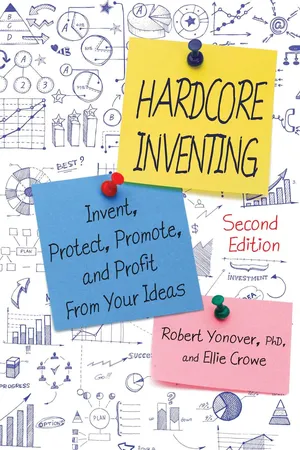
Hardcore Inventing
eBook - ePub

Hardcore Inventing

Invent, Protect, Promote, and Profit from Your Ideas

  1. 288 pages
  2. English
  3. ePUB (mobile friendly)
  4. Available on iOS & Android
eBook - ePub

Hardcore Inventing

Invent, Protect, Promote, and Profit from Your Ideas

About this book

You've come up with a great solution to a persistent problem—an invention that will help thousands of people. But what do you have to do to turn it into a reality? Robert Yonover uses his experiences from the world of inventing and promotion to take you through the invention process step-by-step. Learn how to: Find the problem you can solve
Build a show prototype
Create an attention-grabbing and memorable name
Find investors
Safeguard your intellectual property
Navigate critical crossroads
License and market your inventionFrom your initial idea through a captivating proposal, Hardcore Inventing is an easy-to-use, informational, and inspirational guide on how to turn your idea into a success.
Frequently asked questions

Yes, you can cancel anytime from the Subscription tab in your account settings on the Perlego website. Your subscription will stay active until the end of your current billing period. Learn how to cancel your subscription.
No, books cannot be downloaded as external files, such as PDFs, for use outside of Perlego. However, you can download books within the Perlego app for offline reading on mobile or tablet. Learn more here.
Perlego offers two plans: Essential and Complete
  • Essential is ideal for learners and professionals who enjoy exploring a wide range of subjects. Access the Essential Library with 800,000+ trusted titles and best-sellers across business, personal growth, and the humanities. Includes unlimited reading time and Standard Read Aloud voice.
  • Complete: Perfect for advanced learners and researchers needing full, unrestricted access. Unlock 1.4M+ books across hundreds of subjects, including academic and specialized titles. The Complete Plan also includes advanced features like Premium Read Aloud and Research Assistant.
Both plans are available with monthly, semester, or annual billing cycles.
We are an online textbook subscription service, where you can get access to an entire online library for less than the price of a single book per month. With over 1 million books across 1000+ topics, we’ve got you covered! Learn more here.
Look out for the read-aloud symbol on your next book to see if you can listen to it. The read-aloud tool reads text aloud for you, highlighting the text as it is being read. You can pause it, speed it up and slow it down. Learn more here.
Yes! You can use the Perlego app on both iOS or Android devices to read anytime, anywhere — even offline. Perfect for commutes or when you’re on the go.
Please note we cannot support devices running on iOS 13 and Android 7 or earlier. Learn more about using the app.
Yes, you can access Hardcore Inventing by Robert Yonover, Ellie Crowe in PDF and/or ePUB format, as well as other popular books in Business & Business Skills. We have over one million books available in our catalogue for you to explore.

Information

Publisher
Skyhorse
Year
2014
Print ISBN
9781629144269
eBook ISBN
9781629149783
Section 1
image
INVENT
image
Success Story—The RescueStreamer Technology
Money never starts an idea. It is always the idea that starts the money.
—Owen Laughlin
An invention is one of those super strokes, like discovering a platinum deposit, or a gas field, or writing a novel, through which an individual . . . can transform his life overnight, and light up the sky.
—Tom Wolfe
THE RESCUESTREAMER, AN EMERGENCY SIGNALING device used by all branches of the U.S. military and onboard all U.S. Navy submarines, and the Self-Deploying Infra-Red Streamer (SDIRS) now being placed on fighter-jet aircraft worldwide, were my first really successful inventions. I invented the RescueStreamer technology to solve a tricky problem I hope I’ll never experience—a plane crash at sea.
Living on the edge was a reality for me, a big-wave surfer and scientist who worked on active volcanoes in the middle of the Pacific Ocean. The edge sharpened during an interisland flight on a small airplane that began sputtering like a Volkswagen Beetle. It didn’t help my confidence that the plane was rented.
What if the pilot had to ditch in the ocean below? As usual in precarious situations, my mind started racing with contingency plans. I knew I could get out of the cabin and swim, but the metal plane would sink quickly. Viewed from thousands of feet up in the air, the vast ocean is quite impressive. How would search and rescue parties see us? We’d be, to paraphrase marine biologist Roger Hanlon, yummy hunks of protein swimming in the ocean.
image
How could I somehow signal the search planes that would, hopefully, be looking for us? I brainstormed, but couldn’t solve the problem. We finally landed successfully, despite the engine noises.
But the problem continued to rattle around in my brain until a few weeks later when I flew to Florida. As the commercial jet approached Miami International, I spotted a strange sight in the ocean below: small islands wrapped in bright-pink plastic—the artist Christo’s latest project. That was it—I needed a little piece of that pink plastic and I could solve my visibility problem in an open ocean and on land. It took years to figure out how to put the pink plastic in a form that would be compact when not in use, yet extend to create a large target and stay that way until search parties could visually locate it.
Like all inventors, I’ve been a problem solver my whole life. My first invention, when I was about six years old, was a tiny battery-powered engine that spun a small shaft and performed automatically a bodily function boys especially are fond of (no, it’s not that). I then taped a drinking straw onto the rotating shaft and produced the first mechanized electric nose picker! Inserting the rotating straw into your nose did the job quite effectively. However, if you stuck it in too far, it made you sneeze!
Ideas come and go in my maniacal brain, but that piece of pink plastic never left—that’s how I knew it was a winner. A swathe of this bright plastic would be the ideal shape to see from the air; however, I couldn’t figure out how to make it stay rigid and outstretched. I started looking for things in nature that remained extended. A few examples were striking—the human spine, centipedes, and palm trees. They were made up of segments, with supports at the beginning and end of each segment. I just needed to figure out how to put segments on a piece of plastic.
The next eureka moment came while I was teaching oceanography at the Hawaii Pacific University. I was in a laboratory handing out pipettes (small, semi-rigid plastic straws for measuring liquids) when I realized that the solution to the segmentation problem was literally in my hand.
Then it was off to my laboratory (read ā€œpatio at the back of my houseā€) for research and development. I built the first RescueStreamer device there while my wife yelled at me to stop playing with plastic and get a real job! Those were words she would later gladly eat.
I built the first streamer out of white plastic, because I couldn’t get bright pink as a free sample. As my wife and some friends sailed out on our small boat to watch the sunset, I unfurled the white streamer and it started to bunch up in the waves. I thought I’d again failed to solve the deployment problem. Then, suddenly, the currents stretched the streamer and the pipettes (ā€œstrutsā€) caused it to straighten out like a spinning helix—the most beautiful thing I’d ever seen in the ocean!
The next step was to make it pink. I acquired more free samples: My method was to get free samples from large manufacturers with toll-free numbers, letting them know I was working on something big that could ultimately equal big sales for them. However, I could never make those pink versions work as well as the original white version.
In science, it is best to keep some things constant when creating new versions. I couldn’t figure out the problem and thought it was the composition of the new pink material, as the chemistry of extruded plastics can be very complicated. Another principle I learned as a scientist is to keep good notes and always catalog samples, whether volcanic rocks from the ocean floor or new versions of a device. Finally, after racking my brain, I went back to the original white streamer that I’d fortunately kept in a safe place. It turned out the problem wasn’t the plastic’s composition; it was how I attached the struts. Initially, I was either too cheap with the glue or in too much of a hurry (or both) and didn’t glue down the whole length of the strut against the plastic film. In the newer pink version, I’d taken my time and glued the whole length of the strut. That was the difference. By leaving air space between parts of the strut and the film, water was able to pass through the device without pulling it underwater. I’m glad I kept my original!
I like to bounce ideas off people and gather as many opinions (data) as possible, prior to making a decision. I showed the streamer to a navy captain who lived across the water from me. In the original design, the streamer is stowed in a pouch that unfurls to become a hat for the survivor to prevent sunburn while he is waiting to get rescued. The hat looked a little like a pirate’s hat from a party on Fire Island. The captain liked my idea. However, his first words were ā€œLose the pink and lose the hat and you have something.ā€ I took his advice, and now all RescueStreamer emergency signaling devices are international orange, the color deemed most easily visible in the ocean by the U.S. Coast Guard. And they don’t come with hats, though I still think it was a good idea.
PROTECTING MY INVENTION
The gut-check part of the invention game is getting a patent. Patents done right, and by that I mean by a patent attorney who can write ā€œlegal claimsā€ that are defensible in court, are expensive, about $5,000. You can patent your invention on your own using various books on the market, but the ā€œlegal claimsā€ are worth paying for.
In the case of the streamer, I tried to get a patent on my own the first time, but failed miserably. I tried again a few years later using a patent attorney and with legal claims in hand. The irony of patents is this: ā€œthe simpler the idea, the broader the patent.ā€ If you think about patenting a complex system like a computer, you can see that the next person to come along can just change a few electronic components and the device is different and distinct. In the case of the streamer patent, using struts as support bars across the length of the streamer film, regardless of the composition of the struts, provides for a very broad patent because it is such a simple design.
In choosing a patent attorney, I chose a longstanding firm that was right across from the patent office. Proximity proved invaluable, as it is common for the patent attorney and the examiner to have face-to-face meetings as they debate how strong the patent will be.
PROMOTING MY INVENTION
Now I ran into that point in every inventor’s history that I call a ā€œcritical crossroads.ā€ This is when you run into an obstacle—and I guarantee you will run into them. You have a few paths to choose from, with the easiest being quitting. I think inventors who take on a relentless persevering attitude are the ones who succeed. You will encounter people who laugh at you, make fun of you, blow you off, hang up on you—and these are just your family members! You have to drag yourself off the ground and get up and keep charging ahead.
To keep sane, I found the best approach to keeping the financial pressure off was to keep my day job. I had many day jobs in my quest to become a profitable inventor: teacher, housepainter, environmental scientist.
During my journey, I learned a critical lesson from my brother, who was involved in advertising and marketing: Every day editors of magazines and newspapers are sitting at their desks wondering what to write about. It takes a special type of person to pitch a story to 100 people and get rejected 99 times. In the end, you have to believe that there is one editor out there willing to write about your invention.
Before e-mailing, there was faxing. Late at night, when phone rates were cheaper, I’d send the same fax to 100 people. Finally, I got a sports editor at the Miami Herald to write about the RescueSreamer. Once the Miami Herald article came out, I mass-faxed copies of that article to the 99 other people and alerted them to how the big guys were writing about the streamer. I repeat the process to this day and jokingly refer to myself as a ā€œmedia whore.ā€ The RescueStreamer has now been featured on CNN and the Discovery Channel, and in numerous magazines, including Outside and Playboy.
During my ā€œdon’t quit your day jobā€ period, I continued relentlessly self-promoting to the U.S. military, writing polite but compelling letters to the highest-ranking admirals and generals I could find. A few actually answered, leading to a U.S. Navy trial of my streamer. It passed with flying colors and I used that bit of news to again try to whip editors into a frenzy.
As a result of the publicity, a venture capital group learned about the streamer and invited me to submit a business plan to a panel of experts that included a marketing executive and a patent attorney. I was revved up as usual for any public appearance, particularly one with major players in attendance. The panel came at me from left and right, and I was ready to defend my baby. After I aggressively defended the RescueStreamer, the session ended with applause from everyone. An attractive woman approached me and identified herself as a reporter for a major weekly business publication. The result was an article alluding to massive profits in the streamer’s future and lives to be saved from the newly approved military survival technology! Of course, I made copies and continued to fax them out to more publications.
PROFIT: WHAT ALL INVENTIONS DO IN A PERFECT WORLD
A few days later, a couple of local ā€œangelā€ investors called me and I had what all inventors dream about—a bidding war! One group outbid the other and I had a b...

Table of contents

  1. Cover
  2. Title Page
  3. Copyright
  4. Contents
  5. Foreword by Louis Zamperini
  6. Introduction
  7. Section 1—Invent
  8. Section 2—Protect
  9. Section 3—Promote
  10. Section 4—Profit
  11. Appendixes
  12. Acknowledgments
  13. Selected Sources
  14. Index
  15. Advance Praise for Hardcore Inventing