Preparing Students for Testing and Doing Better in School
eBook - ePub

Preparing Students for Testing and Doing Better in School

  1. 200 pages
  2. English
  3. ePUB (mobile friendly)
  4. Available on iOS & Android
eBook - ePub

Preparing Students for Testing and Doing Better in School

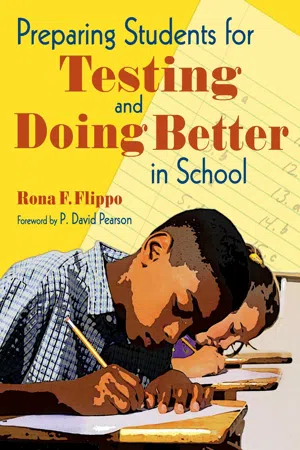
About this book

Help students master test taking through preparation strategies that lead to academic success! As the stakes on high-profile student tests such as the SAT continue to rise, student preparedness is becoming increasingly important. As a result, helping students do well on tests and succeed in school has become a top priority for teachers. This indispensable guide responds to this need by providing resources to promote content learning and test-taking abilities in middle and secondary school students.This practical text provides charts, checklists, Internet resources, and sample exercises for teachers to use with students, plus a final test covering content from each chapter. Using research-based practices, educators will be able to help students develop• Strategies for dealing with test anxiety
• Effective time management and organizational skills
• Note-taking and study techniques applicable across content areas
• Methods for taking essay and objective testsTests are often a source of anxiety for students and teachers alike, but they don't have to be! Use these proven tools and strategies to help your students develop the skills and confidence that lead to positive academic experiences.
Frequently asked questions

Yes, you can cancel anytime from the Subscription tab in your account settings on the Perlego website. Your subscription will stay active until the end of your current billing period. Learn how to cancel your subscription.
No, books cannot be downloaded as external files, such as PDFs, for use outside of Perlego. However, you can download books within the Perlego app for offline reading on mobile or tablet. Learn more here.
Perlego offers two plans: Essential and Complete
  • Essential is ideal for learners and professionals who enjoy exploring a wide range of subjects. Access the Essential Library with 800,000+ trusted titles and best-sellers across business, personal growth, and the humanities. Includes unlimited reading time and Standard Read Aloud voice.
  • Complete: Perfect for advanced learners and researchers needing full, unrestricted access. Unlock 1.4M+ books across hundreds of subjects, including academic and specialized titles. The Complete Plan also includes advanced features like Premium Read Aloud and Research Assistant.
Both plans are available with monthly, semester, or annual billing cycles.
We are an online textbook subscription service, where you can get access to an entire online library for less than the price of a single book per month. With over 1 million books across 1000+ topics, we’ve got you covered! Learn more here.
Look out for the read-aloud symbol on your next book to see if you can listen to it. The read-aloud tool reads text aloud for you, highlighting the text as it is being read. You can pause it, speed it up and slow it down. Learn more here.
Yes! You can use the Perlego app on both iOS or Android devices to read anytime, anywhere — even offline. Perfect for commutes or when you’re on the go.
Please note we cannot support devices running on iOS 13 and Android 7 or earlier. Learn more about using the app.
Yes, you can access Preparing Students for Testing and Doing Better in School by Rona F. Flippo in PDF and/or ePUB format, as well as other popular books in Education & Education Teaching Methods. We have over one million books available in our catalogue for you to explore.

Information

PART ONE
Doing Better in School
Chapter 1. How to Avoid Test Panic
Chapter 2. How to Develop a Game Plan
1
How to Avoid Test Panic
Tests measure students’ knowledge of a subject or their ability to perform a skill. Tests are a means for students to show their teachers that they have mastered the course content, and they are a basis for teachers to assign grades. Granted, some tests are better or fairer than others, but like it or not, the grades based on those tests are the measure of each student’s success in school. Grades can determine whether students will be promoted or obtain a degree, get into an advanced program, and/or even find the job they want.
Because tests can have all these consequences, it is quite understandable that all students at one time or another will be anxious about tests. A certain amount of anxiety is normal—and even desirable—because it motivates students to try to do their best. Just as runners get themselves psyched up before a race, actors before a performance on stage, football players before a game, lawyers before a trial, and business executives before a meeting with important clients, so students need to get themselves psyched up before a big test.
Too much anxiety, however, can spoil a student’s performance. If a student is too tense and too worried about doing well on a test, he or she will find it almost impossible to concentrate (Elliott, DiPerna, Mroch, & Lang, 2004). Check with your students to see if, when they try to read their class notes, the words seem like a meaningless blur. When they sit down to take the test, does their mind go blank? These are the signs of too much anxiety.
In this chapter, teachers will find out how to teach their students to prepare for a test without succumbing to panic. Students will learn how to psych themselves up for a test so they will be motivated to do their best; they will learn how to relax and how to organize the course content so they will be able to do their best. These are the first steps to becoming prepared.
PREPARING MENTALLY AND PHYSICALLY
Psyching Up
For students to do their best on a test, they need to be psyched up for it. Being psyched up helps one to focus all of one’s attention on studying for and taking a test (Gettinger & Seibert, 2002). For most people, neither activity is fun, but when students realize that tests are the way we are evaluated in school and that they have to pass them to succeed, then students can psych up and go!
How do professional athletes and actors and executives psych themselves up? Studies of highly successful people have shown that their ability to keep their ultimate goals in mind is the key to their success (Andriessen, Phalet, & Lens, 2006; Cukras, 2006; Gabriele, 2007; Gettinger & Seibert, 2002; Goodstein, 1999; Klomegah, 2007).
Teachers can help students psych themselves up for a test by helping them visualize their ultimate goal and think about how the test is connected to it. Here are some questions for teachers to ask their students to help them make that connection. Try posing these questions to your students for their reflection when it is time for them to get ready for their next test.
1. What is my ultimate goal in life?
2. Why am I going to school?
3. What relationship does school have with my ultimate goal?
4. What relationship does this class have with my ultimate goal?
5. Is a good grade in this class important to my success in school?
6. Is a good grade in this class important to my being promoted or getting a degree?
7. Is a good grade in this class necessary to my qualifying for the advanced program of my choice?
8. Is a good grade in this class important to further my professional or career interests?
9. Is a good grade on this test important to my final grade in the class?
10. Will it be worthwhile to invest some time studying to get a good test grade?
11. Why is the information covered by this test important to learn?
12. How can the information learned for this test help me in my future pursuits?
13. Do I believe that if I set my mind to something, I can do it?
14. Do I have the ability to perform well on this test if I am prepared?
15. What do I have to do to get myself as prepared as possible for this test?
Relaxing
Once students are psyched up, they are ready to organize a game plan and get to work. But they need to know how to keep themselves from getting too much on edge. Teachers want their students to be psyched up to work but not so strung out that they get nothing accomplished. Remember, it is normal to feel anxious about tests, and anxiety can help students work harder and concentrate better—as long as they keep it under control. Prepared students are aiming for high productivity—consistently high. To do their best, they need to be highly motivated but not panicked.
In this section, students will discover that the best way to do this is to plan their schedules several days before a test so they will be able to get enough sleep, some physical exercise, and some quiet leisure time—and have enough time to study as well. Students will also learn some relaxation techniques and other ways to stay calm on the day of the test. Students who anticipate getting too anxious preparing for a test might want to review the material on relaxation.
Getting in Shape for a Test
Sleep is important. Staying up all night to study is usually not wise. It is more beneficial for students to get their normal eight (or six or ten) hours of sleep each night than to try to make up for an all-nighter by sleeping late the next day. Students need to be alert to study for a test as well as to take one. Regular sleep habits increase their chance of a good night’s rest, and getting up at about the same time every morning means students won’t have to rush to fit everything into the day’s schedule.
It should be noted here, however, that once in a while, staying up all night to complete an important paper is acceptable. It can be an efficient use of a student’s time where it means accomplishing an academic goal. The student will be judged on her performance, which in this case is the paper. Short of missing important class notes or sleeping through a test-preparation day, a student’s degree of alertness following a term paper all-nighter is not so crucial. For a test, however, the performance takes place in school at the time of the test, and doing one’s best requires being alert. This book does not advocate staying up all night for every paper, but if doing an occasional all-nighter is the only way to finish a paper and have prime hours available to study for a test, too, then that is the best use of time.
Apart from regular sleep habits, taking occasional breaks from studying for quiet leisure activities and for physical exercise also helps students to stay alert. Physical activities, such as running, working out, tennis, and handball, are good tension breakers as long as they are part of a normal routine. Students who do not normally engage in strenuous forms of exercise shouldn’t start when they are studying for a test. Instead, a brisk walk or some moderate stretching will help relieve tension.
Students should allow some quiet relaxation time as well to reduce fatigue and tension (Brown & Schiraldi, 2004; Carlson, Hoffman, Gray, & Thompson, 2004). They can use meal times as breaks from studying and then spend a little more time in conversation, reading for pleasure, watching a movie or television show, or listening to music. Relaxing after a meal not only helps to reduce tension: It also improves digestion, which contributes to better health. Moreover, right after a meal, one is not as alert, so studying then will not be as effective as a half hour or an hour later.
A study break—whether involving physical activity or quiet relaxation—should be a reward for a student’s hard work. The student should stop studying at the first sign of excessive fatigue. This does not mean the moment one feels a little tired but instead pushing oneself a little further by thinking of the reward, then stopping for a break when one has pushed oneself to the limit of one’s concentration.
The teacher could ask students to write out a list of the kinds of relaxation breaks they find most appealing. Students could be encouraged to use them as rewards for studying hard.
But a break is only a break, and the teacher can likewise instruct the students that the activities they list must be used only for study breaks, not for distractions from studying. Anything that competes for their attention while they are preparing for a test should be avoided: radios, headsets, stereos, computers, television, the telephone, and other distractions should be reserved for relaxation breaks.
Staying Calm on Exam Day
When students know they are prepared—that they have followed their game plan to study for the test and know all the techniques for taking essay and objective tests—they will naturally feel more confident. But even prepared students can become unduly nervous just before and during a test. If this should happen, students should be able to fall back on some proven ways to offset nervousness before it gets too serious and they lose control.
Relaxation training is often helpful for students who experience frequent test panic. Some school counselors have training materials or programs (usually on cassettes or DVDs) that teach relaxation techniques. The basic concept of all these techniques is that relaxing physically makes it impossible for anyone to feel overly anxious. The training materials teach a person to relax at will, and with a bit of practice, a student can learn to relax while taking exams (Casbarro, 2004; Gates, 2005; Supon, 2004; Viadero, 2004).
Relaxation Techniques
There are a great many relaxation techniques. Here are a few easy ones for teachers to suggest...

Table of contents

  1. Cover
  2. Dedication
  3. Title Page
  4. Copyright
  5. Contents
  6. Foreword
  7. Acknowledgments
  8. About the Author
  9. How to Use This Book
  10. Note to the Teacher
  11. Note to the Student
  12. Introduction
  13. Part One: Doing Better in School
  14. Part Two: Preparing for all Tests
  15. Part Three: Taking Tests and Doing Better
  16. Resources
  17. References
  18. Index