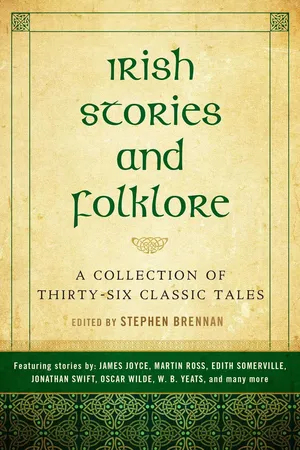
Irish Stories and Folklore
eBook - ePub

Irish Stories and Folklore

A Collection of Thirty-Six Classic Tales

  1. 312 pages
  2. English
  3. ePUB (mobile friendly)
  4. Available on iOS & Android
eBook - ePub

Irish Stories and Folklore

A Collection of Thirty-Six Classic Tales

About this book

For a comparatively small country, Ireland's contributions to the world of literature have been enormous. From the older tradition, Irish writers have inherited a sense of wonder in the face of nature, a narrative style that tends toward the deliberately exaggerated or absurd, a keen sense of the power of satire. These themes carry through the entire canon of Irish literature, up until modern times. Stephen Brennan brings us this collection of classic stories, essays, and fairytales that inform the past and therefore, the present, of our most beloved fiction.
This collection of thirty-six stories includes the influential works of Ireland's most treasured authors, including:
• Oscar Wilde
• Jonathan Swift
• James Joyce
• W. B. Yeats
• And so many more!
In Irish Stories and Folklore, the reader can revisit old favorites like Oscar Wilde's short story, "The Canterville Ghost" and discover lesser known treasures such as, "The Orangeman: Or the Honest Boy and the Thief" by Maria Edgeworth. The imaginative stories contained in this volume are sure to engage the mind and delight readers looking to enhance their knowledge of the rich history of Irish literature and folklore.Skyhorse Publishing, as well as our Arcade, Yucca, and Good Books imprints, are proud to publish a broad range of books for readers interested in fiction—novels, novellas, political and medical thrillers, comedy, satire, historical fiction, romance, erotic and love stories, mystery, classic literature, folklore and mythology, literary classics including Shakespeare, Dumas, Wilde, Cather, and much more. While not every title we publish becomes a New York Times bestseller or a national bestseller, we are committed to books on subjects that are sometimes overlooked and to authors whose work might not otherwise find a home.
Frequently asked questions

Yes, you can cancel anytime from the Subscription tab in your account settings on the Perlego website. Your subscription will stay active until the end of your current billing period. Learn how to cancel your subscription.
No, books cannot be downloaded as external files, such as PDFs, for use outside of Perlego. However, you can download books within the Perlego app for offline reading on mobile or tablet. Learn more here.
Perlego offers two plans: Essential and Complete
  • Essential is ideal for learners and professionals who enjoy exploring a wide range of subjects. Access the Essential Library with 800,000+ trusted titles and best-sellers across business, personal growth, and the humanities. Includes unlimited reading time and Standard Read Aloud voice.
  • Complete: Perfect for advanced learners and researchers needing full, unrestricted access. Unlock 1.4M+ books across hundreds of subjects, including academic and specialized titles. The Complete Plan also includes advanced features like Premium Read Aloud and Research Assistant.
Both plans are available with monthly, semester, or annual billing cycles.
We are an online textbook subscription service, where you can get access to an entire online library for less than the price of a single book per month. With over 1 million books across 1000+ topics, we’ve got you covered! Learn more here.
Look out for the read-aloud symbol on your next book to see if you can listen to it. The read-aloud tool reads text aloud for you, highlighting the text as it is being read. You can pause it, speed it up and slow it down. Learn more here.
Yes! You can use the Perlego app on both iOS or Android devices to read anytime, anywhere — even offline. Perfect for commutes or when you’re on the go.
Please note we cannot support devices running on iOS 13 and Android 7 or earlier. Learn more about using the app.
Yes, you can access Irish Stories and Folklore by Stephen Brennan in PDF and/or ePUB format, as well as other popular books in Literature & Classics. We have over one million books available in our catalogue for you to explore.

Information

Publisher
Skyhorse
Year
2016
Print ISBN
9781510725645
eBook ISBN
9781634507943
GRACE
BY JAMES JOYCE
Two gentlemen who were in the lavatory at the time tried to lift him up: but he was quite helpless. He lay curled up at the foot of the stairs down which he had fallen. They succeeded in turning him over. His hat had rolled a few yards away and his clothes were smeared with the filth and ooze of the floor on which he had lain, face downwards. His eyes were closed and he breathed with a grunting noise. A thin stream of blood trickled from the corner of his mouth.
These two gentlemen and one of the curates carried him up the stairs and laid him down again on the floor of the bar. In two minutes he was surrounded by a ring of men. The manager of the bar asked everyone who he was and who was with him. No one knew who he was but one of the curates said he had served the gentleman with a small rum.
ā€œWas he by himself?ā€ asked the manager.
ā€œNo, sir. There was two gentlemen with him.ā€
ā€œAnd where are they?ā€
No one knew; a voice said:
ā€œGive him air. He’s fainted.ā€
The ring of onlookers distended and closed again elastically. A dark medal of blood had formed itself near the man’s head on the tessellated floor. The manager, alarmed by the grey pallor of the man’s face, sent for a policeman.
His collar was unfastened and his necktie undone. He opened eyes for an instant, sighed and closed them again. One of gentlemen who had carried him upstairs held a dinged silk hat in his hand. The manager asked repeatedly did no one know who the injured man was or where had his friends gone. The door of the bar opened and an immense constable entered. A crowd which had followed him down the laneway collected outside the door, struggling to look in through the glass panels.
The manager at once began to narrate what he knew. The constable, a young man with thick immobile features, listened. He moved his head slowly to right and left and from the manager to the person on the floor, as if he feared to be the victim of some delusion. Then he drew off his glove, produced a small book from his waist, licked the lead of his pencil and made ready to indite. He asked in a suspicious provincial accent:
ā€œWho is the man? What’s his name and address?ā€
A young man in a cycling-suit cleared his way through the ring of bystanders. He knelt down promptly beside the injured man and called for water. The constable knelt down also to help. The young man washed the blood from the injured man’s mouth and then called for some brandy. The constable repeated the order in an authoritative voice until a curate came running with the glass. The brandy was forced down the man’s throat. In a few seconds he opened his eyes and looked about him. He looked at the circle of faces and then, understanding, strove to rise to his feet.
ā€œYou’re all right now?ā€ asked the young man in the cycling-suit.
ā€œSha,’s nothing,ā€ said the injured man, trying to stand up.
He was helped to his feet. The manager said something about a hospital and some of the bystanders gave advice. The battered silk hat was placed on the man’s head. The constable asked:
ā€œWhere do you live?ā€
The man, without answering, began to twirl the ends of his moustache. He made light of his accident. It was nothing, he said: only a little accident. He spoke very thickly.
ā€œWhere do you live?ā€ repeated the constable.
The man said they were to get a cab for him. While the point was being debated a tall agile gentleman of fair complexion, wearing a long yellow ulster, came from the far end of the bar. Seeing the spectacle, he called out:
ā€œHallo, Tom, old man! What’s the trouble?ā€
ā€œSha,’s nothing,ā€ said the man.
The new-comer surveyed the deplorable figure before him and then turned to the constable, saying:
ā€œIt’s all right, constable. I’ll see him home.ā€
The constable touched his helmet and answered:
ā€œAll right, Mr. Power!ā€
ā€œCome now, Tom,ā€ said Mr. Power, taking his friend by the arm. ā€œNo bones broken. What? Can you walk?ā€
The young man in the cycling-suit took the man by the other arm and the crowd divided.
ā€œHow did you get yourself into this mess?ā€ asked Mr. Power.
ā€œThe gentleman fell down the stairs,ā€ said the young man.
ā€œI’ ’ery ’uch o’liged to you, sir,ā€ said the injured man.
ā€œNot at all.ā€
ā€œā€™ant we have a little…?ā€
ā€œNot now. Not now.ā€
The three men left the bar and the crowd sifted through the doors in to the laneway. The manager brought the constable to the stairs to inspect the scene of the accident. They agreed that the gentleman must have missed his footing. The customers returned to the counter and a curate set about removing the traces of blood from the floor.
When they came out into Grafton Street, Mr. Power whistled for an outsider. The injured man said again as well as he could.
ā€œI’ ’ery ’uch o’liged to you, sir. I hope we’ll ’eet again. ’y na’e is Kernan.ā€
The shock and the incipient pain had partly sobered him.
ā€œDon’t mention it,ā€ said the young man.
They shook hands. Mr. Kernan was hoisted on to the car and, while Mr. Power was giving directions to the carman, he expressed his gratitude to the young man and regretted that they could not have a little drink together.
ā€œAnother time,ā€ said the young man.
The car drove off towards Westmoreland Street. As it passed Ballast Office the clock showed half-past nine. A keen east wind hit them, blowing from the mouth of the river. Mr. Kernan was huddled together with cold. His friend asked him to tell how the accident had happened.
ā€œI ’an’t ’an,ā€ he answered, ā€œā€™y ’ongue is hurt.ā€
ā€œShow.ā€
The other leaned over the well of the car and peered into Mr. Kernan’s mouth but he could not see. He struck a match and, sheltering it in the shell of his hands, peered again into the mouth which Mr. Kernan opened obediently. The swaying movement of the car brought the match to and from the opened mouth. The lower teeth and gums were covered with clotted blood and a minute piece of the tongue seemed to have been bitten off. The match was blown out.
ā€œThat’s ugly,ā€ said Mr. Power.
ā€œSha, ’s nothing,ā€ said Mr. Kernan, closing his mouth and pulling the collar of his filthy coat across his neck.
Mr. Kernan was a commercial traveller of the old school which believed in the dignity of its calling. He had never been seen in the city without a silk hat of some decency and a pair of gaiters. By grace of these two articles of clothing, he said, a man could always pass muster. He carried on the tradition of his Napoleon, the great Blackwhite, whose memory he evoked at times by legend and mimicry. Modern business methods had spared him only so far as to allow him a little office in Crowe Street, on the window blind of which was written the name of his firm with the address—London, E. C. On the mantelpiece of this little office a little leaden battalion of canisters was drawn up and on the table before the window stood four or five china bowls which were usually half full of a black liquid. From these bowls Mr. Kernan tasted tea. He took a mouthful, drew it up, saturated his palate with it and then spat it forth into the grate. Then he paused to judge.
Mr. Power, a much younger man, was employed in the Royal Irish Constabulary Office in Dublin Castle. The arc of his social rise intersected the arc of his friend’s decline, but Mr. Kernan’s decline was mitigated by the fact that certain of those friends who had known him at his highest point of success still esteemed him as a character. Mr. Power was one of these friends. His inexplicable debts were a byword in his circle; he was a debonair young man.
The car halted before a small house on the Glasnevin road and Mr. Kernan was helped into the house. His wife put him to bed while Mr. Power sat downstairs in the kitchen asking the children where they went to school and what book they were in. The children—two girls and a boy, conscious of their father’s helplessness and of their mother’s absence, began some horseplay with him. He was surprised at their manners and at their accents, and his brow grew thoughtful. After a while Mrs. Kernan entered the kitchen, exclaiming:
ā€œSuch a sight! O, he’ll do for himself one day and that’s the holy alls of it. He’s been drinking since Friday.ā€
Mr. Power was careful to explain to her that he was not responsible, that he had come on the scene by the merest accident. Mrs. Kernan, remembering Mr. Power’s good offices during domestic quarrels, as well as many small, but opportune loans, said:
ā€œO, you needn’t tell me that, Mr. Power. I know you’re a friend of his, not like some of the others he does be with. They’re all right so long as he has money in his pocket to keep him out from his wife and family. Nice friends! Who was he with tonight, I’d like to know?ā€
Mr. Power shook his head but said nothing.
ā€œI’m so sorry,ā€ she continued, ā€œthat I’ve nothing in the house to offer you. But if you wait a minute I’ll send round to Fogarty’s at the corner.ā€
Mr. Power stood up.
ā€œWe were waiting for him to come home with the money. He never seems to think he has a home at all.ā€
ā€œO, now, Mrs. Kernan,ā€ said Mr. Power, ā€œwe’ll make him turn over a new leaf. I’ll talk to Martin. He’s the man. We’ll come here one of these nights and talk it over.ā€
She saw him to the door. The carman was stamping up and down the footpath, and swinging his arms to warm himself.
ā€œIt’s very kind of you to bring him home,ā€ she said.
ā€œNot at all,ā€ said Mr. Power.
He got up on the car. As it drove off he raised his hat to her gaily.
ā€œWe’ll make a new man of him,ā€ he said. ā€œGood-night, Mrs. Kernan.ā€
Mrs. Kernan’s puzzled eyes watched the car till it was out of sight. Then she withdrew them, went into the house and emptied her husband’s pockets.
She was an active, practical woman of middle age. Not long before she had celebrated her silver wedding and renewed her intimacy with her husband by waltzing with him to Mr. Power’s accompaniment. In her days of courtship, Mr. Kernan had seemed to her a not ungallant figure: and she still hurried to the chapel door whenever a wedding was reported and, seeing the bridal pair, recalled with vivid pleasure how she had passed out of the Star of the Sea Church in Sandymount, leaning on the arm of a jovial well-fed man, who was dressed smartly in a frock-coat and lavender trousers and carried a silk hat gracefully balanced upon his other arm. After three weeks she had found a wife’s life irksome and, later on, when she was beginning to find it unbearable, she had become a mother. The part of mother presented to her no insuperable difficulties and for twenty-five years she had kept house shrewdly for her husband. Her two eldest sons were launched. One was in a draper’s shop in Glasgow and the other was clerk to a tea-merchant in Belfast. They were good sons, wrote regularly and sometimes sent home money. The other children were still at school.
Mr. Kernan sent a letter to his office next day and remained in bed. She made beef-tea for him and scolded him roundly. She accepted his frequent intemperance as part of the climate, healed him dutifully whenever he was sick and always tried to make him eat a breakfast. There were worse husbands. He had never been violent since the boys had grown up, and she knew that he would walk to the end of Thomas Street and back again to book even a small order.
Two nights after, his friends came to see him. She brought them up to his bedroom, the air of which was impregnated with a personal odour, and gave them chairs at the fire. Mr. Kernan’s tongue, the occasional stinging pain of which had made him somewhat irritable during the day, became more polite. He sat propped up in the bed by pillows and the little colour in his puffy cheeks made them resemble warm cinders. He apologised to his guests for the disorder of the room, but at the same time looked at the...

Table of contents

  1. Cover
  2. Title Page
  3. Copyright
  4. Contents
  5. Jamie Freel and the Young Lady Letitia Maclintock
  6. The Nightingale and the Rose Oscar Wilde
  7. A Modest Proposal Jonathan Swift
  8. The Pursuit of the Gilla Daker Patrick Weston Joyce
  9. The Keening Woman Patrick Pearse
  10. Grace James Joyce
  11. King O’Toole and His Goose S. Lover
  12. The Host of the Air William Butler Yeats
  13. Chronicle of the Voyages of Saint Brendan Stephen Vincent Brennan
  14. The Canterville Ghost Oscar Wilde
  15. The Orange-man: Or the Honest Boy and the Thief Maria Edgeworth
  16. The Priest’s Soul Lady Wilde
  17. The Rising of the Moon John Keegan Casey
  18. High Tea at McKeown’s Edith Somerville & Martin Ross
  19. Teig O’Kane and the Corpse Douglas Hyde
  20. Some of Gulliver’s Adventures Jonathan Swift
  21. The Hill-Man and the Housewife Juliana Horatia Ewing
  22. How Thomas Connolly Met the Banshee J. Todhunter
  23. The Coming of Finn Standish James O’Grady
  24. An Essay on the Noble Science of Self-Justification Maria Edgeworth
  25. Sea-Stories Lady Gregory
  26. Devereux’s Dream Joseph Sheridan Le Fanu
  27. The Young King Oscar Wilde
  28. Resolutions When I Come To Be Old Jonathan Swift
  29. The Piper and the PĆŗca Douglas Hyde
  30. ā€˜It Was His First Christmas Dinner’ James Joyce
  31. The Tinker’s Dog Edith Somerville & Martin Ross
  32. Brennan on the Moor Traditional
  33. Murtough and the Witch Woman Eleanor Hull
  34. The Thief Patrick Pearse
  35. The Devil, The Demon Cat Lady Wilde
  36. The Enchanted Cave of Cesh Corran James Stephens
  37. The Star-Child Oscar Wilde
  38. An Encounter James Joyce
  39. Directions to Servants Jonathan Swift
  40. The Ballad of Father Gilligan William Butler Yeats
  41. A Historical Anecdote Thomas Francis Brennan