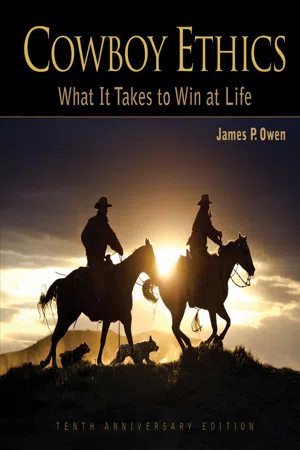
A new approach to business ethics is quietly taking hold in executive suites and corporate boardrooms across America. Frustrated by an epidemic of misbehavior at all employee levels, management teams are getting back to basics—back to the idea that personal character and individual responsibility are the ultimate keys to integrity, just as they were back in the days of the Open Range.A decade ago, the book Cowboy Ethics first inspired businesspeople to look to the Code of the West. Once they did, they discovered that its simple, common-sense principles can be more effective guides to business leadership than a truckload of corporate mission statements, rules, and ethics manuals. "Cowboys are role models because they live by a code, " says author James P. Owen. "They show us what it means to stand for something, and to strive every day to make your actions line up with your beliefs. And isn't that as good a definition of integrity as you can find?" In the years since, the book's "Ten Principles to Live By" have been embraced by scores of companies, universities, and even a state government. This updated Tenth Anniversary hardcover edition traces the evolution of this grassroots business movement in brand-new chapters while preserving the inspirational lessons and stunning photography of the original. It's ideal for corporate gifts, the new graduate, business students, or any career person who cares about doing the right thing.
- 96 pages
- English
- ePUB (mobile friendly)
- Available on iOS & Android
eBook - ePub
About this book
Information
Table of contents
- Cover
- Title Page
- Copyright
- Dedication
- Author’s Note
- Introduction
- Living by the Code
- The Code of the West
- Conclusion
- About the Author
- About the Center
Trusted by 375,005 students
Access to over 1.5 million titles for a fair monthly price.
Study more efficiently using our study tools.
Frequently asked questions
Yes, you can cancel anytime from the Subscription tab in your account settings on the Perlego website. Your subscription will stay active until the end of your current billing period. Learn how to cancel your subscription
No, books cannot be downloaded as external files, such as PDFs, for use outside of Perlego. However, you can download books within the Perlego app for offline reading on mobile or tablet. Learn how to download books offline
Perlego offers two plans: Essential and Complete
- Essential is ideal for learners and professionals who enjoy exploring a wide range of subjects. Access the Essential Library with 800,000+ trusted titles and best-sellers across business, personal growth, and the humanities. Includes unlimited reading time and Standard Read Aloud voice.
- Complete: Perfect for advanced learners and researchers needing full, unrestricted access. Unlock 1.5M+ books across hundreds of subjects, including academic and specialized titles. The Complete Plan also includes advanced features like Premium Read Aloud and Research Assistant.
We are an online textbook subscription service, where you can get access to an entire online library for less than the price of a single book per month. With over 1.5 million books across 990+ topics, we’ve got you covered! Learn about our mission
Look out for the read-aloud symbol on your next book to see if you can listen to it. The read-aloud tool reads text aloud for you, highlighting the text as it is being read. You can pause it, speed it up and slow it down. Learn more about Read Aloud
Yes! You can use the Perlego app on both iOS and Android devices to read anytime, anywhere — even offline. Perfect for commutes or when you’re on the go.
Please note we cannot support devices running on iOS 13 and Android 7 or earlier. Learn more about using the app
Please note we cannot support devices running on iOS 13 and Android 7 or earlier. Learn more about using the app
Yes, you can access Cowboy Ethics by James P. Owen in PDF and/or ePUB format, as well as other popular books in Business & Business Etiquette. We have over 1.5 million books available in our catalogue for you to explore.