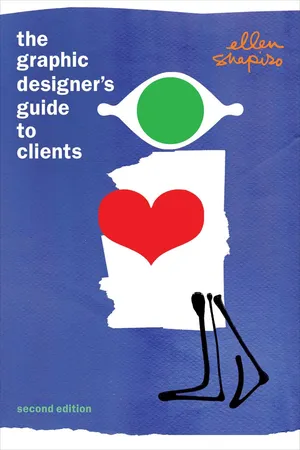
The Graphic Designer's Guide to Clients
eBook - ePub

The Graphic Designer's Guide to Clients

  1. 256 pages
  2. English
  3. ePUB (mobile friendly)
  4. Available on iOS & Android
eBook - ePub

The Graphic Designer's Guide to Clients

About this book

Here is the perfect volume for graphic designers who want real-life advice for long-term success. Renowned designer Ellen Shapiro reveals time-tested tricks of the trade—for making sure the clients you want to work with know about you, become your clients, and work with you productively. Then, in a series of one-on-one interviews, leading designers such as Milton Glaser, April Greiman, Mke Weymouth, Drew Hodges, Marc Gobé, and partners in Pentagram reveal their personal experiences and insights on how to uphold creative standards while fulfilling clients' needs. Their advice will help you:

  • Identify what is distinct about your services
  • Market yourself effectively
  • Meet and court clients
  • Learn the lingo of corporate strategy
  • Make effective presentations
  • Believe in the work you do and sell the work you believe in
  • Obtain referrals from existing clients
  • Keep clients coming back for more


CEOs and design managers from nineteen marketing and design-savvy clients—such as Klein Bikes, The Knoll Group, Barnes & Noble, and Harvard University—offer their own candid perspectives on the challenges solutions, and triumphs of working with designers. Whether you are courting your first clients or seeking fresh insights for achieving even greater success, you cannot afford to be without this crucial resource. Allworth Press, an imprint of Skyhorse Publishing, publishes a broad range of books on the visual and performing arts, with emphasis on the business of art. Our titles cover subjects such as graphic design, theater, branding, fine art, photography, interior design, writing, acting, film, how to start careers, business and legal forms, business practices, and more. While we don't aspire to publish a New York Times bestseller or a national bestseller, we are deeply committed to quality books that help creative professionals succeed and thrive. We often publish in areas overlooked by other publishers and welcome the author whose expertise can help our audience of readers.

Frequently asked questions

Yes, you can cancel anytime from the Subscription tab in your account settings on the Perlego website. Your subscription will stay active until the end of your current billing period. Learn how to cancel your subscription.
No, books cannot be downloaded as external files, such as PDFs, for use outside of Perlego. However, you can download books within the Perlego app for offline reading on mobile or tablet. Learn more here.
Perlego offers two plans: Essential and Complete
  • Essential is ideal for learners and professionals who enjoy exploring a wide range of subjects. Access the Essential Library with 800,000+ trusted titles and best-sellers across business, personal growth, and the humanities. Includes unlimited reading time and Standard Read Aloud voice.
  • Complete: Perfect for advanced learners and researchers needing full, unrestricted access. Unlock 1.4M+ books across hundreds of subjects, including academic and specialized titles. The Complete Plan also includes advanced features like Premium Read Aloud and Research Assistant.
Both plans are available with monthly, semester, or annual billing cycles.
We are an online textbook subscription service, where you can get access to an entire online library for less than the price of a single book per month. With over 1 million books across 1000+ topics, we’ve got you covered! Learn more here.
Look out for the read-aloud symbol on your next book to see if you can listen to it. The read-aloud tool reads text aloud for you, highlighting the text as it is being read. You can pause it, speed it up and slow it down. Learn more here.
Yes! You can use the Perlego app on both iOS or Android devices to read anytime, anywhere — even offline. Perfect for commutes or when you’re on the go.
Please note we cannot support devices running on iOS 13 and Android 7 or earlier. Learn more about using the app.
Yes, you can access The Graphic Designer's Guide to Clients by Ellen M. Shapiro in PDF and/or ePUB format, as well as other popular books in Design & Business Development. We have over one million books available in our catalogue for you to explore.

Information

Publisher
Allworth
Year
2014
Print ISBN
9781621534013
part I
What I’ve Learned about Clients
Financial matters aside, we graphic designers need clients to give our work purpose and structure. If we didn’t have clients, we wouldn’t be making fine art. We’d be out and about looking for clients.
Image
Sometimes clients put their own needs above yours.
1
The Client: Elusive, Difficult, Coveted
graphic designers are fairly predictable. We usually want the same things.
The opportunity to do good work is at the top of our lists.
Yes, there are differences and debates. Over the last decade or two, there have been philosophical rifts about legibility versus memorability, classicism versus innovation. But we are usually in agreement on what constitutes great design. We love to admire the latest expressions of creativity, beauty, wit, insight, and technical wizardry. How did the designer do it?
All of us want to do something of that quality and impact, too. Not just for ourselves or to be admired by our peers.
But for our clients.
A Service Business
In the twentieth century, the art world, as it had functioned since the Middle Ages, was transformed. Church and state no longer dictated appropriate subject matter and style. The artist was freed to make art to please him or herself (and at the very top of the market, to please gallery owners and wealthy art buyers). This paradigm shift not only changed painting, drawing, sculpture, and photography, it changed architecture and even cooking. Celebrity chefs can be temperamental artistes. If you don’t like a dish, choose a different restaurant. Or perhaps something is wrong with you, with your unsophisticated taste buds and lack of appreciation.
Are graphic designers the last remaining vestiges of the old paradigm? Maybe so. Whatever we produce always has to please our patrons, the clients. If it doesn’t, they’ll ask us to change it. In the worst cases, they won’t pay for it—and then hire someone else.
Like it or not, we work in a service business.
The purpose of graphic design is not to express our feelings about the universe (which doesn’t mean we shouldn’t believe in what we’re doing). Our work isn’t created for exhibition in museums and galleries—although if we’re very good, it sometimes ends up there. It is used, to give just a few examples, to brand a product or service, to tell a company story, to give people a positive experience, to unite them behind a cause, to entertain, to announce an event, to raise money, to recruit, to sell, to inform.
Not Just Any Clients. Great Clients
If we didn’t have clients, we wouldn’t all be painting and sculpting and creating nouvelle cuisine. We’d be out and about looking for clients. With a great client, the process is a partnership. We don’t feel like hands for hire. There is no servitude. There is joy and excitement in the process. We work in concert with individuals of vision to bring success to their organizations.
Designer April Greiman, whose work often blurs the boundaries between fine art and graphic design, says that she needs clients to give her projects structure and purpose. “When you work with a visionary,” she says (see chapter 20), “there is a conceptual collaboration, and from that you grow tremendously.” Pentagram partner and AIGA medallist Paula Scher also calls her best clients great collaborators. “The best collaborators in my career have been George C. Wolfe and Oskar Eustis, artistic directors of the Public Theater,” she says. “They’ve allowed me to do fantastic work because they have vision.”
A great client has a vision, a great story, and a great budget. Okay, maybe not a great budget, but an adequate budget, or at least an understanding of what it takes to get things done.
Why Aren’t They All Great Clients?
If all clients were like Wolfe and Eustis, we’d all be doing work as awe-inspiring as Paula’s Public Theater posters. Right?
What’s the matter with the rest of them?
After all, you and I have the talent and the skill to produce work of that caliber, don’t we? The only thing that comes between us and all that great work, all the awards and recognition, is the client.
At first, I was going to say, let’s skip the horror stories. But, alas, there are too few great clients.
There are few great anythings in this world. Just look around. Millions more people shop at Wal-Mart than at that cool boutique you just discovered. Most companies cater to a least-common-denominator mentality. Their marketing managers are folks with jobs to do, office politics to worry about, budgets and sales quotas to meet. Groundbreaking design might not be the number-one priority on their agendas, as you’ve perhaps learned the hard way. One almost-great client said to me, while choosing a safe, plain-vanilla design over two much more interesting options (and, I guess, noticing the look on my face): “Ellen is seeing all her design awards fly out the window.” A perceptive guy. He put the tastes of his future investors, or at least what he envisioned they would respond to, first. Some clients have less noble motivations. A few are far from tactful or respectful.
Yes, there have been the legendary Olivettis, Container Corporations of America, Knolls, and Herman Millers. There have been the legendary CEOs like Thomas Watson, Jr., of IBM, who were, in fact, patrons of the arts—at least of the “commercial” arts of product design and packaging design, exhibition design, and advertising. Contemporary design patrons include some of the same august corporations, as well as companies like Nike, Apple, Nickelodeon, Target, and many entrepreneurs, publishers, and arts organizations. Sometimes a small business, like a bakery or toy store or garage band, becomes a great client, offering a designer creative freedom and the opportunity to do fun, interesting, meaningful work.
The number of organizations that are committed to design as an integral part of their mission or culture is increasing, and that’s encouraging.
Can Your Clients Be Great Clients?
Helping you make that happen is the purpose of this book. With the right tools, ranging from suggested questions to ask potential clients to examples demonstrated in the eighteen case studies of long-term relationships between successful design firm principals and their clients, you can help your clients become, if not great clients, at least clients with whom you can produce successful, satisfying work.
“Knowledge is expanding at an exponential rate,” maintains Jon Esser, coordinator of arts recruitment programs at Purchase College, State University of New York. “There is good reason for designers to be optimistic. Clients are content providers, and content providers are increasingly in need of images and text that excite and compel the reader or user. The overwhelming flow of information must be given shape, and designers are content navigation enablers. That means more opportunities for more designers. The constant need to win market share will motivate clients to take more risks,” he continues. “They will no longer define their needs as, ‘Make us look just like our competition.’ They are taking a bolder position: ‘Make us look better than our competition.’ That means more satisfying work for more designers.”
More opportunities for more designers. More satisfying work. The potential is there, if you take the right approaches to meeting clients, establishing relationships with them, and keeping them happy.
Clients Are Much Less Predictable than Designers. Or Are They?
I can predict that Zevvie, our German shepherd dog, will go ballistic when another dog and owner walk down “her” street. And when company comes, she’ll hide under the table and then emerge to be petted. Our former German shepherd, who had a different temperament, behaved much the same way. A guide to German shepherd dogs could be relatively easy to write.
But a guide to clients? I can’t predict what my own clients will do from one day to the next. Much less yours, whom I’ve never met.
Or can’t I? If your clients are of the old-school variety (and that doesn’t mean they’re old; they could be young and inexperienced), they’ll demand an unreasonable amount of work in a ridiculous amount of time, for a fee that’s much too low. They’ll keep you waiting for half an hour, but if you arrive five minutes late, they’ll be sitting around the conference table looking at their watches. They’ll never have anything organized; won’t take enough time to thoroughly explain their needs; will wait weeks before responding to a proposal, and then call and say, “We need the job tomorrow.” When there’s a tiny typo, they’ll immediately point it out. But when you come up with an excellent solution, they’ll barely acknowledge it or try to change it. They’ll nit-pick and haggle over every detail but ignore the big picture. They’ll insist that you cram enough copy for a well-paced twenty-four pages into half that many, and then make you use a photo that ruins the whole thing. No amount of arguing and pleading and rational demonstrations of superior alternatives will cause them to change their minds. Then they’ll try to get an agreement that stipulates they will own all the rights in perpetuity.
Okay, maybe I’m exaggerating. But it all goes with the territory of being a client. After all, they are the ones paying the bills.
The Competition Is Ever-Growing
If you don’t agree to their requirements, they might take their business somewhere else. And that might not be a bad thing. It will free you up to work for clients whose requirements are a better fit. There will always be someone else willing to do the job. Clients’ inboxes are filled with promise-filled pitch letters and links to their online portfolios. And don’t even let met get started talking about crowdsourcing sites where competitors work on spec for fees so low they could be for a tank of gas, not a brand identity.
No one knows more about the competition than Ed Gold, former executive vice president and creative director of the Barton-Gillet Company, specialists in institutional marketing, and professor at the School of Communication Design at the University of Baltimore. Ed interviewed 300+ designers around the country for his seminal book, The Business of Graphic Design. Every year, he says, 15,000 to 20,000 students graduate from the more than 2,000 graphic design programs in US art schools, colleges, and universities. “The number of new people in the field is impossible to quantify,” he adds, “because people are coming into graphic design from areas like mass communications and media studies, from computer graphics programs, and by creating their own curricula from online offerings. The only sure thing is that the competition is much more intense than ever before.”
Every year, new business plans are written and new partnerships and firms are formed. Public relations and marketing firms and printing companies “cross-sell” design services to their existing clients. Big ad agencies add more and more “design boutiques” to their mix of offerings, and they’re often willing to lowball graphic design services or even provide free work in order to get or hold on to lucrative advertising and PR accounts.
“Fortunately,” says Allen Kay, chairman of the New York ad agency Korey Kay & Partners, “there’s no Home Depot for do-it-yourself advertisers.” There are, though, plenty of Home Depots for do-it-yourself designers. They’re called FedEx Office, AlphaGraphics, VistaPrint. Every year, more and more potential clients, heeding the claims of software makers and template publishers, are trying to figure out how to do it themselves.
Our mission is to keep convincing clients to use us. We have the education, the experience, the talent, the insights. We can see things they can’t, come up with solutions they could never conceive of, use the power of images and words to make their business dreams come true.
Then why can they be so difficult?
Some Great Clients Are Difficult, for Good Reasons
Clients who are difficult can sometimes be the best kind to have. They challenge you to do your finest work. They don’t want anything mundane. They don’t want an imitation or something they’ve seen a million times before. They know that in order to sell their products or services, they must have a unique selling proposition, one that is visualized by a unique, effective design solution. They seek out designers who have distinctive voices and who can give voice to their vision.
Martin Zimmerman of LFC Capital offers the most articulate explanation of this that I’ve ever heard (chapter 9). “Why would I want an imitation of what my competitor already has?” he asks. Zimmerman gives designers creative freedom within the structure of carefully articulated business objectives. “The whole idea is to create a feeling of success and sophistication,” he explains. “There are lots of problems out there, but there are not too many fresh ideas on how to solve them.”
It’s much harder to create an original solution that satisfies requirements like Zimmerman’s than it is to follow explicit directions, to do a formula design, or to merely lay out a client’s text and pictures so they fit on a page.
Sandra Ruch, who for many years was responsible for Mobil Corporation’s brilliant Masterpiece Theater posters, prided herself on being demanding. “I could be very blunt and say, ‘This doesn’t work,’” she said, describing her working relationship with Ivan Chermayeff and with other top designers and illustrators. “There were times when it took us four or five months before we came up with the right image. Four or five months of working it over and over. Ivan went back to the drawing board many times when he didn’t come up with something we felt was what we wanted, and so did Seymour Chwast of Pushpin Studio. There’s nothing wrong with that.”
When the client is knowledgeable—and fair—the designer rises to the occasion.
Bad Clients Are Difficult, Too. How to Tell the Difference
“We do our best work for the clients who understand the most about design,” asserts Marcia Lausen, principal of Chicago’s Studio/lab. “They are the ones who trust us. We’ve also done good work for difficult clients,” she adds, “and those difficulties usu...

Table of contents

  1. Cover
  2. Title Page
  3. Copyright
  4. Dedication
  5. Contents
  6. Part I What I’ve Learned about Clients
  7. Part II Corporate Clients
  8. Part III Retail and Entertainment Clients
  9. Part IV Institutional Clients
  10. Index