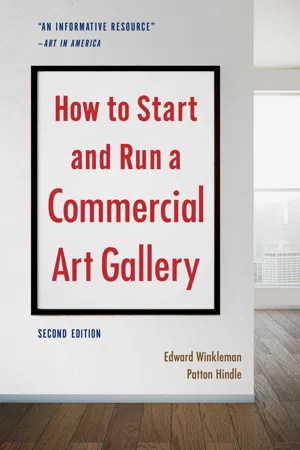
How to Start and Run a Commercial Art Gallery (Second Edition)
eBook - ePub

How to Start and Run a Commercial Art Gallery (Second Edition)

  1. 304 pages
  2. English
  3. ePUB (mobile friendly)
  4. Available on iOS & Android
eBook - ePub

How to Start and Run a Commercial Art Gallery (Second Edition)

About this book

"A comprehensive guide." — Artspace. "Whether you are new to the business or a seasoned gallerist, it is always wise to remember the essentials." —Leigh Conner, director, Conner Contemporary Art Aspiring and new art gallery owners can find everything they need to plan and operate a successful art gallery with How to Start and Run a Commercial Art Gallery. This new edition has been updated to mark the changes in market and technology over the past decade. Edward Winkleman and Patton Hindle draw on their years of experience to explain step by step how to start your new venture. From finding the ideal locale and renovating the space to writing business plans and securing start-up capital, this helpful guide has it all. Chapters detail how to:

  • Manage cash flow
  • Grow your new business
  • Hire and manage staff
  • Attract and retain artists and clients
  • Represent your artists
  • Promote your gallery and artists online
  • Select the right art fair
  • And more


How to Start and Run a Commercial Art Gallery, Second Edition, also includes sample forms, helpful tips from veteran collectors and dealers, a large section on art fairs, and a directory of art dealer associations.

Frequently asked questions

Yes, you can cancel anytime from the Subscription tab in your account settings on the Perlego website. Your subscription will stay active until the end of your current billing period. Learn how to cancel your subscription.
No, books cannot be downloaded as external files, such as PDFs, for use outside of Perlego. However, you can download books within the Perlego app for offline reading on mobile or tablet. Learn more here.
Perlego offers two plans: Essential and Complete
  • Essential is ideal for learners and professionals who enjoy exploring a wide range of subjects. Access the Essential Library with 800,000+ trusted titles and best-sellers across business, personal growth, and the humanities. Includes unlimited reading time and Standard Read Aloud voice.
  • Complete: Perfect for advanced learners and researchers needing full, unrestricted access. Unlock 1.4M+ books across hundreds of subjects, including academic and specialized titles. The Complete Plan also includes advanced features like Premium Read Aloud and Research Assistant.
Both plans are available with monthly, semester, or annual billing cycles.
We are an online textbook subscription service, where you can get access to an entire online library for less than the price of a single book per month. With over 1 million books across 1000+ topics, we’ve got you covered! Learn more here.
Look out for the read-aloud symbol on your next book to see if you can listen to it. The read-aloud tool reads text aloud for you, highlighting the text as it is being read. You can pause it, speed it up and slow it down. Learn more here.
Yes! You can use the Perlego app on both iOS or Android devices to read anytime, anywhere — even offline. Perfect for commutes or when you’re on the go.
Please note we cannot support devices running on iOS 13 and Android 7 or earlier. Learn more about using the app.
Yes, you can access How to Start and Run a Commercial Art Gallery (Second Edition) by Edward Winkleman, Patton Hindle in PDF and/or ePUB format, as well as other popular books in Arte & Arte general. We have over one million books available in our catalogue for you to explore.

Information

Publisher
Allworth
Year
2018
Print ISBN
9781621536567
eBook ISBN
9781621536574
Edition
2
Topic
Arte
Subtopic
Arte general
CHAPTER 1
Education
How to Learn What You Don’t Know before Opening a Commercial Art Gallery
Getting an education specifically designed to prepare you to run an art gallery can require a bit of assembly. Having a PhD in art history is no guarantee you’ll be any good at managing a small business. Just as having an MBA is no guarantee you’ll develop an “eye” for the kind of art that collectors will want to purchase. Attempt to combine two such degrees, and you may end up owing more in student loans than an art gallery is likely to pay you in quite some time. Besides, many of the most successful art dealers of the past 100 years had no advanced degrees in art or business. How much each of them knew about art, or selling it, varied widely before they opened their galleries. Their reasons for starting their spaces ranged from being asked to do so by artists who trusted them, to discovering they had a knack for it through some other avenue, to simply believing they could do it better than anyone else out there. In other words, pretty much for the same range of personal reasons many small businesses are opened. So, don’t be at all daunted if your background is in nursing or computer programming or communications (all real examples of previous careers for flourishing dealers we know).
Even though there is no predominantly held degree for the art gallery business, there are good sources of information for what you probably should know before opening your own space. Likewise, there are excellent examples of the more typical paths to becoming an art dealer worth considering. In this chapter, we’ll look briefly at the history of art dealing and then at how a few successful art dealers got their start. We will also delve into the more formal options for gaining an education, including continuing education courses, “apprenticeships” (put in quotes because it’s often best to keep the fact you’re “apprenticing” at another gallery your little secret), a good mentor, and advanced studies courses tailored toward gallery management, including newly available online courses. Finally, we’ll examine some of the common misperceptions about what a gallery is (or is not) to ensure you’re heading into this world with your eyes as wide open as possible.
A BRIEF HISTORY OF ART DEALING
It behooves any budding art dealer to gain at least a cursory grounding in the giants of the field, if only because other dealers you will do business with may use them as shorthand for certain types of business models or cautionary tales. Exactly who the first person was to serve as the representative for an artist or to buy an artwork with the intention of turning around and reselling it for a profit may not be knowable now, but by the time Western art took that giant leap forward in the form of the Italian Renaissance, there were already vendors acting as middlemen between collectors and artists. Giovanni Battista della Palla was among the first international art dealers to make it into the history books by name. Immortalized in Giorgio Vasari’s marvelous series of biographies, The Lives of the Artists, for having sold work by the greatest artists of his day to the king of France, della Palla undoubtedly falls into the “cautionary tale” category. Called, among other things, a “two-bit merchant” by historians and eventually imprisoned as a traitor, he comes down to us as a somewhat inglorious character. Accounts vary as to whether he was eventually beheaded at Pisa or took his own life in prison, but della Palla is perhaps the basis for many of the negative stereotypes about art dealers that persist today. Things do get better for the profession’s reputation though, we promise.
Throughout much of the history of art dealing, it was apparently not viewed as prudent to try to make a living selling artwork alone. The celebrated eighteenth-century French “luxury merchant” (marchand-mercier) Lazare Duvaux offered a mix of exquisite furniture, jewelry, ceramics, and sculpture to his fashionable and very wealthy clients. (Duvaux’s importance continues to the present day because sales ledgers he kept between 1748 and 1758 still provide contemporary scholars with a treasure trove of provenance information.) Well into the nineteenth century, in fact, art was often still viewed—even by many of its merchants—as parallel to a home furnishing, sold as a sideline in shops offering mirrors, furniture, or even toys. One of the earliest recorded dealers in America, for example, Boston craftsman John Doggett, opened his shop in 1810 to sell both pictures and frames. His shop would go on to become one of most important art galleries in America for a while (Williams and Everett), but selling art alone was not his original business plan. This diversification approach exists even today. Many art galleries continue to mix art and design objects in their inventory. In fact, there’s been an interesting resurgence of exhibiting high-end design in some of the most prestigious “fine art” galleries lately. Where that may lead the profession remains to be seen, but many dealers are keeping an eye on those enterprising souls daring enough to blur the lines after years spent separating out the two genres.
At some point along the line, the relationship between artist and dealer evolved from one based solely on commerce to one that includes sincere advocacy. Even in the face of commercial failure, this new kind of art dealer would champion certain artists because they truly believed in them. For many people, and indeed many artists, the image of the art dealer as an enthusiastic patron (scouring drafty studios, finding that misunderstood genius who’s toiling in obscurity and breaking all the rules, and then working tirelessly to promote this newly discovered modern-day master in the face of even the most scathing of critiques) remains a romantic ideal. A closer look will reveal that among famous dealers even some of the greatest have been known to “let go” of artists whose work they couldn’t sell, but like many legends, this one is at least partially grounded in truth.
The contemporary version of the legend seems to have begun in earnest with the arrival of the French dealer Paul Durand-Ruel. Born in 1831 to a family of picture dealers, Durand-Ruel is considered the first modern art dealer to support his artists with monthly stipends and solo exhibitions. Championing first the painters of the Barbizon school, he eventually would bring widespread attention to the brazen young artists known today as the impressionists. This was no small act of faith on his part. The impressionists were widely ignored or derided for decades, and it took Paul Durand-Ruel years to earn back the money he spent buying up their output. Through his galleries in Paris, London, and New York, as well as a steadfast faith in the importance of this bold new art, however, Paul Durand-Ruel eventually won over the public and helped change art history. The fact that he more than made his money back ultimately should not be overlooked.
From this point forward in our brief historical recap, it is possible to divide art dealers into two camps: those who enjoy working to promote relatively unknown artists and those who prefer to sell work only by established names. There exists considerable overlap in business models, but for a certain breed of art dealer, the thrill of discovering and nurturing new talent seemingly holds little to no interest. They wish to work only with reliably bankable artists. This breed of art dealer found its archetype in the form of Joseph Duveen. Born in 1869 in Hull, England, but expanding his family’s business to include galleries in the toniest districts of London, New York, and Paris, Duveen was a natural salesman. Excessively charming and exuberant, he would notoriously work his clients into a near frenzy of desire for the works in his gallery by dramatically insisting he simply couldn’t part with the old master painting he had recently wrestled away from some duke or count somewhere in Europe. His wife’s reported deep attachment to the piece was frequently the source of the dealer’s dilemma. After several rounds of such theatrics (each seeing the price of the work in question rise), Duveen would reluctantly relent and note that he would just have to figure out how to break the bad news to Mrs. Duveen later. Among Duveen’s clients were some of America’s richest men at the time, including Henry Clay Frick, William Randolph Hearst, J. P. Morgan, Henry E. Huntington, Samuel H. Kress, Andrew Mellon, John D. Rockefeller, and Joseph E. Widener. Much of Duveen’s success is ascribed to his realizing that the one thing eluding these titans, who otherwise had everything money could buy, was the sense of immortality that only art can bestow.
While Duveen was becoming extremely wealthy selling the work of artists long dead, though, two of his contemporaries were working overtime to shift the serious attention, and money, over to the works of the more recent and still living European artists who would usher in the era of modernism. Following in the footsteps of Durand-Ruel, Ambroise Vollard (1866–1939) and Daniel-Henry Kahnweiler (1884–1979) sold between them some of the greatest works of art created by such revolutionaries as Georges Braque, Paul CĂ©zanne, AndrĂ© Derain, Juan Gris, Fernand LĂ©ger, and Pablo Picasso. Vollard’s practice of buying up a large chunk of an artist’s inventory and then reselling the work for a remarkable profit earned him a few detractors, but in addition to making money and publishing biographies on CĂ©zanne, Edgar Degas, and Pierre-Auguste Renoir, he had unquestionably one of the best eyes of any dealer ever. The younger Kahnweiler, while in awe of Vollard, was overall a better art dealer, and by that we mean he was revered by artists, critics, and collectors alike. In addition, Kahnweiler was a respected art historian. As one of the first people to recognize the importance of Picasso’s seminal painting Les Demoiselles D’Avignon, reportedly asking to buy it on the spot, he was recognized as deserving of perhaps the highest of accolades an art dealer can aspire to: he was a connoisseur.
Throughout the twentieth century, the number of notable art galleries increased so dramatically worldwide that a discussion of each would make this brief history anything but. Limiting the following list to those in the United States that you might hear used as examples of how to, or how not to, run your business, therefore is a matter of necessity, not any indication that art dealers in other parts of the world were any less innovative, successful, or unfortunate as these dealers.
Two of the oldest galleries that dominated up until just recently in the United States began as New York branches of Parisian businesses. When Michael Knoedler, who came to America as the director of the French engravers Goupil & Company, opened his own space in 1846, he raised more than a few eyebrows among his competition by forgoing the entry fee (usually about twenty-five cents then) that most other galleries charged. This visitor-friendly policy, a wise choice to mix contemporary European artworks with those by Americans, and a focus on solo exhibitions (pleasing both his artists and the press), eventually led to Knoedler being the first art dealer to be invited to become a member of the Century Association, the distinguished club of artists, writers, and “amateurs of letters and the fine arts.” The gallery he and his family built, Knoedler & Company, remained one of the most respected and flourishing of American art galleries. That is, until 2011, when the gallery closed under a cloud of scandal and multiple lawsuits for fraud. Having perhaps grown complacent about their position in the art world, as well as the trust they had earned as one of New York’s oldest and most important galleries, they ignored experts’ warnings that paintings by Rothko, Pollock, Motherwell, and others they were offered for resale were forgeries and resold them anyway. The lesson here is that an art dealer must be vigilant about due diligence in every transaction. Reputations are built very slowly but can come crashing down in a heartbeat.
Knoedler’s longtime competitor, Wildenstein & Company, has an arguably even more colorful history. Also a family business (now in its fifth generation), the gallery was founded in Paris and opened a New York branch in 1903. Famously secretive about the inner workings of their business, the Wildensteins have nonetheless seen a fair bit of sensationalist press. From a still ambiguous arrangement for selling artwork confiscated from Jewish dealers in Paris reportedly forced out of Georges Wildenstein by the Nazis during World War II to a 1956 suit filed by Knoedler against the Wildenstein company for allegedly hiring a private investigator to wiretap Knoedler’s phones, the history of the gallery is almost as interesting as the sales of acknowledged masterpieces they have placed among the world’s top museums.
The twentieth century also saw the rise of galleries opened by dealers as well known by the art world now, if not more so, than many of the artists they exhibited. Alfred Stieglitz opened Little Galleries of the Photo-Secession in 1905. Eventually it became known simply by its street address, 291. It was among the first spaces to eschew the plush red velvet of most important galleries for a crisp modern look. Julien Levy Gallery was founded in 1931 and is noted for introducing the surrealists to America and with hosting the first cocktail party opening. What Stieglitz and Levy personified, though, was that passion for contemporary art had grown so much in New York, that it became possible to be an influential art dealer without being a very successful businessperson. Steiglitz was notoriously ambivalent about sales, once asking a collector who had sought the gallery out to buy a watercolor what made him think he deserved to own the piece. Levy worked hard but had both the Great Depression and the slowness with which Americans warmed up to surrealism to contend with. After closing his gallery briefly to enter the army in 1942, Levy eventually closed for good in 1949. A lack of funds forced Stieglitz to close 291 in 1917, but he continued to organize exhibitions and eventually opened another gallery, An American Place, in 1929. It lasted until 1946, the year Stieglitz died.
Two illustrious galleries were also opened by women better known for their passion and visions than their ability to make money selling art. After her first failed attempt in London, with Guggenheim Jeune gallery, Peggy Guggenheim opened her second gallery in New York in 1942 to incredible acclaim. Named Art of This Century, her Fifty-Seventh Street space was considered itself a work of art, with highly innovative installation and lighting systems designed by the architect Frederick Kiesler. Art of This Century heralded the dawn of New York’s rise to art capital of the world with the first solo exhibitions of Jackson Pollock, Mark Rothko, Hans Hofmann, and Clyfford Still, to name but a few. Despite her considerable personal wealth, though, Guggenheim insisted that visitors pay an entrance fee and was reportedly upset when she learned her secretary let students and artists in for free when she wasn’t there. By the time she left New York for her new Venetian palazzo when World War II ended, most of her artists had already left her gallery for newer spaces hoping for more sales of their work.
One of those newer spaces was owned by Betty Parsons, who is the first art dealer interviewed in a book we can’t recommend highly enough: The Art Dealers: The Powers behind the Scene Tell How the Art World Really Works by Laura de Coppet and Alan Jones (Cooper Square Press, 1984) and revised by de Coppet in 2002. Edward has given this book to new dealers as a present many times. Although it is now somewhat difficult to find in bookstores, you can get it from online booksellers with ease. It would be indulgent of us to continue in this history of art dealing up to the present day, when nothing we could tell you would be anywhere near as valuable as what you will learn from reading these concise, supremely helpful interviews with the people who are that history.
LEARNING FROM OTHER DEALERS’ EXPERIENCES
Because most successful approaches to running a gallery are as individual as they are innovative, there is much about art dealing you could learn from reading just about any dealer’s biography. Even before you dive into the eye-opening stories found in de Coppet and Jones’s interviews, I would recommend the wonderful overview found in Malcolm Goldstein’s remarkably researched book, Landscape with Figures: A History of Art Dealing in the United States (Oxford University Press, 2000). In addition to more information about many of the dealers I noted in the section above, Goldstein’s history includes a detailed inventory of innovations and changes in business practices.
When you’re ready for even more details, a few must-read full biographies include those of
  • Joseph Duveen: either Duveen: A Life in Art by Meryle Secrest (Univ...

Table of contents

  1. Front Cover
  2. Title Page
  3. Copyright Page
  4. Table of Contents
  5. Acknowledgments
  6. Introduction to the Second Edition
  7. Introduction to the First Edition
  8. Chapter 1: Education: How to Learn What You Don’t Know before Opening a Commercial Art Gallery
  9. Chapter 2: Identity: Defining Your Program and Other Branding Issues
  10. Chapter 3: Business Models and Customary Practices
  11. Chapter 4: Start-Up Capital: How Much You Need and How to Get It
  12. Chapter 5: Writing a Business Plan: Pulling It All Together into an Action Strategy
  13. Chapter 6: Location and Build-Out Issues
  14. Chapter 7: Managing Cash Flow
  15. Chapter 8: Crating, Shipping, Framing, Photographing, Managing, and Insuring Artwork
  16. Chapter 9: Staffing and Management Practices
  17. Chapter 10: Promotional Efforts: Publicity and Advertising
  18. Chapter 11: Getting Expert Advice and Professional Assistance
  19. Chapter 12: Art Fairs
  20. Chapter 13: Artists: Where to Find Them, How to Keep Them
  21. Chapter 14: Collectors: Where to Find Them, How to Keep Them
  22. Chapter 15: Peerage: The Art Gallery Community
  23. Chapter 16: How the Internet Is Rapidly Changing the Art World
  24. Appendix A: The Standard Art Consignment Agreement
  25. Appendix B: Regional Art Dealer Associations
  26. Bibliography
  27. Index