Fleet Fire
eBook - ePub

Fleet Fire

Thomas Edison and the Pioneers of the Electric Revolution

  1. 360 pages
  2. English
  3. ePUB (mobile friendly)
  4. Available on iOS & Android
eBook - ePub

Fleet Fire

Thomas Edison and the Pioneers of the Electric Revolution

About this book

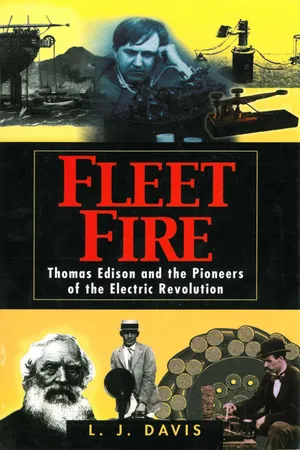
The electric revolution, which eclipsed the Industrial Revolution by the end of the 19th century and continues to this day, changed our world forever. FLEET FIRE tells us how it all began. In an engaging and entertaining narrative, L. J. Davis fields a cast of both prominent and forgotten characters, from dedicated scientists and mischievous rogues to enlightened amateurs who lit the sparks of discovery. Franklin's kite, Davenport's electromagnet, Morse's telegraph, Cyrus Field's transatlantic cable, and Edison's phonograph are but a few of the achievements Davis discusses. Explaining the science in lucid prose, FLEET FIRE conveys the arc of discovery during one of the most creative epochs in the history of mankind.
Frequently asked questions

Yes, you can cancel anytime from the Subscription tab in your account settings on the Perlego website. Your subscription will stay active until the end of your current billing period. Learn how to cancel your subscription.
No, books cannot be downloaded as external files, such as PDFs, for use outside of Perlego. However, you can download books within the Perlego app for offline reading on mobile or tablet. Learn more here.
Perlego offers two plans: Essential and Complete
  • Essential is ideal for learners and professionals who enjoy exploring a wide range of subjects. Access the Essential Library with 800,000+ trusted titles and best-sellers across business, personal growth, and the humanities. Includes unlimited reading time and Standard Read Aloud voice.
  • Complete: Perfect for advanced learners and researchers needing full, unrestricted access. Unlock 1.4M+ books across hundreds of subjects, including academic and specialized titles. The Complete Plan also includes advanced features like Premium Read Aloud and Research Assistant.
Both plans are available with monthly, semester, or annual billing cycles.
We are an online textbook subscription service, where you can get access to an entire online library for less than the price of a single book per month. With over 1 million books across 1000+ topics, we’ve got you covered! Learn more here.
Look out for the read-aloud symbol on your next book to see if you can listen to it. The read-aloud tool reads text aloud for you, highlighting the text as it is being read. You can pause it, speed it up and slow it down. Learn more here.
Yes! You can use the Perlego app on both iOS or Android devices to read anytime, anywhere — even offline. Perfect for commutes or when you’re on the go.
Please note we cannot support devices running on iOS 13 and Android 7 or earlier. Learn more about using the app.
Yes, you can access Fleet Fire by L. J. Davis in PDF and/or ePUB format, as well as other popular books in History & Science History. We have over one million books available in our catalogue for you to explore.

Information

Publisher
Arcade
Year
2012
eBook ISBN
9781611456592

CHAPTER ONE

FRANKLIN, THE ADROIT OLD ADVENTURER

Let the experiment begin.
— Benjamin Franklin
In something resembling a state of pique, Benjamin Franklin, that most well regulated to go fly a kite.
Although the event has become deeply embedded in American folklore, opinion is still divided on whether this, his most famous experiment, actually took place. His own description of the 1752 event in the Autobiography is uncharacteristically vague, an unusual lapse for one of the clearest stylists and sharpest observers in the English language. The full account remained unwritten for fifteen years after the experiment itself, until in 1767 the English chemist and religious philosopher Joseph Priestley published The History and Present State of Electricity, a two-volume work heavily influenced by Franklin (some believe he wrote all or most of it, because Priestley was a chemist) that remained the definitive study of the subject for the balance of the eighteenth century. But to doubt the existence of the experiment is to quibble in the manner of the early twenty-first century. The event took place on a day in June, in a field outside Philadelphia that was equipped with a shed, and it happened as it did because Franklin was angry.
The tale of the actual kite itself begins in 1750, when Franklin wrote the latest in a series of scientific letters to Peter Collinson, a prosperous London mercer, knowing that Collinson would, as he had always done in the past, pass the correspondence on to his colleagues in the Royal Society for comment and discussion. Franklin had not been to London since 1726, when as a young man he had been stranded there in a doomed attempt to buy the presses and type that he needed to set himself up in the printing trade back home in Pennsylvania. Collinson was an amateur naturalist of some note, who had exploded the popular notion that swallows hibernate in streambeds, and his connection with Franklin was fourfold. He was the London agent of the Library Company of Philadelphia, an organization Franklin had founded to establish the first public library in America. In the course of their library correspondence, Collinson had rekindled Franklin’s interest in electricity — some time before, Franklin had bought some apparatus from a traveling electrical showman but had set it aside — by sending him one of the glass rods that, when rubbed, produced sparks and other electrical phenomena in the current London parlor craze for toying with electricity. Because of his scientific bent, Collinson was well informed of new developments in England and on the Continent, and once Franklin began his own series of groundbreaking experiments, he relied on Collinson for word that he was not needlessly duplicating work that had already been done. And because Collinson, a gentleman amateur, was a member of the Royal Society, he was Franklin’s conduit to the admired world of European science. Although Franklin had told Collinson to keep the contents of his first electrical letter to himself, Collinson had ignored Franklin’s instructions and passed it on. Now, passing on the letters describing his electrical experiments was routine. The subject of the latest, in 1750, was lightning.
As always when he was writing on complex matters, Franklin’s text was extremely spare and simple — so simple, in fact, that from the perspective of a later century possessing vastly superior knowledge, to some it might appear comically simple-minded. It was not. Franklin was proposing to go where no one had ventured in the four thousand years of humankind’s recorded history. First, he established his premise: that there were obvious similarities between lightning and the phenomenon he called, following the scientific practice of the time, “the electric fluid,” although he soon realized that it was not, in fact, a fluid, despite the fact that it sometimes seemed to behave like one. But he never discovered what it was. In any event, the similarities he listed between lightning and electricity were:
1. Giving light. 2. Colour of the light. 3. Crooked direction. 4- Swift motion. 5. Being conducted by metals. 6. Crack or noise in exploding. 7. Subsisting in water or ice. 8. Rending bodies it passes through. 9. Destroying animals. 10. Melting metals. 11. Firing inflammable substances. 12. Sulphureous smell.1
This was a series of simple observations of real-world events, and perhaps he was not the first to notice them. Isaac Newton, among others, had surmised that lightning and electricity were one and the same. Franklin was the first, however, to take the next step. “Let the experiment begin” he wrote in the 1750 letter. “On the Top of some high Tower or Steeple place a Kind of Sentry Box big enough to contain a Man and electrical Stand.” An electrical stand, Franklin’s own invention, was an insulating layer of glass or paraffin, the wax commonly used to seal the neck of a jar when preserving food, on which the experimenter stood. Glass or paraffin, he had discovered, did not conduct electricity; neither did silk. He continued:
From the Middle of the Stand let an Iron Rod rise, and pass bending out the Door, and then upright 20 or 30 feet, pointed very sharp at the End. If the Electrical Stand be kept clean and dry, a Man standing on it when such Clouds are passing low, might be electrified and afford Sparks, the Rod drawing Fire to him from the Cloud. If any Danger to the Man should be apprehended (tho’ I think there would be none) let him stand on the Floor of his Box, and now and then bring near to the Rod, the Loop of a Wire, that has one end fastened to the Leads; he holding it by a Wax-Handle. So the Sparks, if the Rod is electrified, will strike from the Rod to the Wire and not affect him.2
It was a long way of saying something very simple: To prevent the lightning from blasting him to his reward, the experimenter would stand on a nonconductive substance while a roof over his head kept off the rain. Lightning would strike the bent metal rod, and Franklin would touch the rod with an insulated device that would have looked to his contemporaries like a rabbit snare. If the task was accomplished, he believed, he would sample the lightning and live. Probably. No one had ever conducted such an experiment, and Franklin had no idea of the gigantic risk he would be running. He could have been electrocuted, and the fact that he never was during his fifteen years of experimentation was a matter of simple luck. He was never hit with a large enough charge to kill him.
Franklin sent his letter to Collinson and awaited the reply. He knew the members of the Royal Society invariably perused his electrical letters with great interest and enthusiasm. But from London came only silence. At a remove of two and a half centuries it is impossible to determine the cause, and it was not very clear at the time. For whatever reason, Franklin’s report of the “thunder gust” (from certain of the letter’s language) and “sameness of lightning with electricity” (words derived from Franklin’s list) seemed to have fallen through the cracks. In a lifetime of careful self-discipline, Franklin had learned to maintain a placid exterior — a quality that infuriated his enemies — but close observers had seen the man go white with anger, and something of the sort happened now. He concluded that he had been “laught at by the Connoisseurs.” But Franklin was a notoriously patient man, another of his infuriating traits. And so, confronted with London’s silence, he waited quietly in Philadelphia for the artisans to complete the steeple on Christ Church. Indeed, he contributed to the building fund, and he designed a lottery to raise more money and finish the job. When the steeple was done, he would build his sentry box somewhere on it. Then he would perform the experiment.
Meanwhile, Franklin’s electrical letters, including the thunder-gust letter, had been published in England in 1751, and a bad translation reached France, where the scientist Thomas François d’Alibard was intrigued by the “sentry box” experiment. Franklin, an ocean away, had no inkling that anything was happening.
In May 1752 d’Alibard set to work in the Paris suburb of Marly. He did away with the steeple-or-tower arrangement and at ground level erected a forty-foot iron mast tipped with brass. Instead of an electrical stand of paraffin, he erected the rod on a slab of wood with three wine bottles for legs. Then, at the crucial moment, he found himself engaged elsewhere, leaving a former dragoon named Coiffer or Coiffier in charge of the apparatus.
At twenty minutes past two on the afternoon of May 10, a clap of thunder sounded, followed by hail. Coiffer tested the mast with an “electric phial” (whatever that was), drew off sparks, and quickly sent a nearby child to fetch the local prior. Hearing the news, the prior began to run through the falling hail. The villagers ran after the prior, convinced that the brave cavalryman had met his maker. It was, all in all, quite a procession that soon found the cavalryman in fine shape. The prior must have been Franklin’s equal in self-possession. With his own hand, the prior drew off the electric fire — apparently he used something to produce a spark — and emerged from the experience unscathed. In other words, he too produced some sparks. Then he quickly scribbled a report and sent it to d’Alibard, who reported complete success to the Royal Academy of Science three days later. All France resounded with praise for Franklin, the man who designed the experiment that drew the fire down from heaven.
In 1752 in Philadelphia, unaware of the French experiment, Franklin was out of patience. More than twenty-four months had passed since the thunder-gust letter, there was still no steeple on Christ Church, the supposed snub from his British colleagues still rankled, and it was time to take matters in hand with an even more elegant, even better designed experiment than the one he had originally planned, A kite, he decided, would give him “better access to the regions of thunder than by any spire whatever,”
According to Priestley, Franklin feared ridicule if he failed, so it would not be a public demonstration. But he planned carefully. For the kite itself, he would use silk, because it was “better able to bear the wind of a thunder-gust without tearing,” From the top of the kite protruded a foot-long, sharply pointed wire that resembled an aerial. It was a flying lightning rod. The wire, Franklin reasoned, would attract the electricity in the cloud cover, either in the form of lightning or as a current passing from drop to drop of water. Then he made his ground connection, “To the end of the twine [that tethers the kite to the ground],” he wrote afterward, “next the hand [of the kite flier], is to be fastened a silk ribbon [for insulation], and where the silk and twine join, a key may be fastened,”3 The metal key was his electricity detector. He would touch it with something and produce a spark.
In June, just a month after d’Alibard had made Franklin the unwitting toast of the ancien rĂ©gime in France, the weather in Philadelphia looked promising for the purposes of electrical phenomena. It was overcast, threatened rain, and hinted at thunder — and thunder usually meant lightning. With his illegitimate son Billy — a young man of twenty-one and not the stripling depicted in the historical prints — Franklin repaired to a distant field with a convenient shed, whereupon everything seemed to go wrong. The kite was sent aloft, but nothing happened. Then Franklin noticed something. The loose threads of the twine were standing erect and away from each other. Franklin’s experiments had taught him that this meant the twine was electrified, although he wouldn’t have used the word because the word wasn’t invented; Franklin would have said “electrised,” He approached the key with his knuckle, A spark leapt across the air between key and knuckle. He had brought a Leyden jar with him. Quickly he attached it to the kite string and, Priestley wrote in his history of electricity, “he collected electric fire very copiously/’ And took it home-Through his usual channel, Franklin reported the experiment to the Royal Society. Collinson’s reply assured him that there had been no snub and that any rift, had there been one, was now a thing of the past. In England, still in that same memorable year of 1752, Franklin’s friend John Canton successfully performed the sentry-box-and-steeple experiment. In Russia, however, a Swedish scientist named Georg Wilhelm Richmann failed to read Franklin’s instructions quite so carefully and became the first fatality of the electrical age when he was struck by what appears to have been ball lightning. Ball lightning is a peculiar phenomenon, a ball of lightning tethered to no cloud, and most experts claim it doesn’t exist, although many thousands of people believe they have seen it. The tsar, who had paid a great deal of money for Richmann’s services, banned all further electrical experiments.
Yale, Harvard, and William and Mary gave Franklin honorary degrees, as later did Oxford and St. Andrews when he was resident in England as the Pennsylvania colony’s emissary to Parliament. He received the Royal Society’s Copley Medal, the highest award of the most distinguished scientific body in the world, and became a member. But although the chorus of praise was deafening, it was not universal. Without explanation King George III ordered his science advisor to declare that Franklin’s science was all wrong. When the advisor told his royal master that the laws of science could not be changed by royal whim, he was fired.
And in France the abbĂ© Nollet, chief royal electrician, was deeply chagrined and, it appears, slightly unhinged by Franklin’s success. Until this provincial buffoon Franklin — who, Nollet believed, might not even exist — had touched the lightning, Nollet had been the foremost electrical scientist in the world. Perhaps Franklin’s subsequent invention of the lightning rod for houses also played a role in the abbé’s discomfort. Nollet wrote patronizing essays belittling Franklin’s science and, when the imperturbable Franklin did not react with anything resembling outrage, chagrin, bluster, or shame and the scientific community did not look with favor on either Nollet or his publications, Nollet set about a public demonstration designed to prove that Franklin was dead wrong about everything. Apparently it was not a very good demonstration — few details survive — for it was unmasked as a hoax, and little more was heard from Nollet on the subject of Franklin, provincial buffoonery, and Franklin’s electrical achievements.
The same could not be said of the rest of the clergy. Thomas Prince, the pastor of Old South Church, laid the blame for the Boston earthquake of 1755 directly at the feet of Franklin’s heretical new lightning rods, which he had invented as a result of the thunder-gust experiment. The metal rods, placed on the tops of houses and other buildings, attracted lightning strikes and conveyed the electricity harmlessly into the ground: a structure with a rod was no longer struck by lightning. In the Reverend Mr. Prince’s view, Franklin had interfered with the heavenly order, and God had gone into a big snit. “In Boston,” thundered the divine, “more [lightning rods] are erected than anywhere else in New England, and Boston seems to be more dreadfully shaken. Oh! There is no getting out of the mighty hand of God.”4
European churchmen saw the matter somewhat differently. For many centuries, the European church — both Catholic and Protestant — had known perfectly well what caused lightning. Demons did it, a view that enjoyed the endorsement of both Thomas Aquinas and Martin Luther. The solution was to ring church bells. The demon theory, unfortunately, revealed a singular disconnection between received wisdom and observable fact: in Germany, for example, within the span of thirty-three years, some four hundred church towers were damaged by lightning and 120 bell ringers were electrocuted, crushed by debris, blown to atoms, or otherwise sent to their maker. Nonetheless, churchly feelings ran high against the installation of Franklin’s lightning rods. In France, Switzerland, and Italy, the pious caused lightning rods to be removed from structures where the enlightened had erected them. This state of affairs persisted until at least 1767, when the Republic of Venice stored a large quantity of gunpowder in the Church of San Nazzaro in Brescia- The rodless church was struck by lightning, the gunpowder went off, one-third of the city was leveled, and three thousand lives were lost, after which little more was heard about the impiety of Mr. Franklin’s invention. Still, the old ways died hard. In 1784 a celebrated French legal case was finally settled in favor of a lightning-rod-owning nobleman, whose attorney argued the case for the rod so persuasively, with such a mastery of the principles of science and such enlightened clarity of thought, that the young man’s reputation was made. His name was Robespierre.
* * *
By his own account, Franklin’s active interest in electricity began in 1743, when he was on a visit to his old home in Boston. There he caught the act of Dr. Archibald Spencer, a traveling lecturer who gave a course, at six pounds a pupil, on the subject of Experimental Philosophy. Among the doctor’s bag of tricks was a glass tube that attracted gold leaf — beaten gold sheets the thinness of paper — and brass when rubbed, and a somewhat shopworn demonstration where he suspended a real live boy from silken cords, rubbed the lad’s bare feet with one of the electricity-producing glass rods, and drew off electric fire from his face and hands in the usual form of sparks. Soon, perhaps at Franklin’s invitation, Spencer was in Philadelphia, where he set up shop in Franklin’s post office. This post office was the nerve center of the royal mail network that Franklin, as deputy postmaster general of the colonies, had improved and made to turn a profit. It was his proudest achievement. Franklin was intrigued but not overly impressed by the man or his abilities. The doctor’s demonstrations, he wrote, “were imperfectly perform’d, as he was not very expert; but being on a Subject quite new to me, they equally surprised and pleas’d me.” Before the doctor departed and shuffled off the pages of history and into his other occupations as Anglican priest and male midwife, Franklin purchased his equipment. And set it aside. Then in 1747, as we’ve seen, Peter Collinson sent the Library Company a glass rod as a scientific curiosity — the Company collected them — and Franklin’s interest was immediately rekindled, to the point that electricity began to consume all his spare time and caused him to execute his planned early retirement from the printing business. He sold half of it to his talented foreman and became a silent partner. For the next ten years, the study of electricity was his business.
At first his new activities seemed little more than an American version of the contemporary craze for electricity among Europe’s science-besotted chattering classes. Franklin attempted the suspended-boy experiment. He also attempted to electrocute a turkey, with unfortunate results when he shocked himself in the process. Reporting “a crack as loud as a pistol shot,” he wrote that “I felt I know not well how to describe, a universal blow throughout my whole body from head to foot, which seemed within as well as without; after which the first thing I took notice of was a violent quick shaking of my body, which gradually remitting, my senses as gradually returned.”5 The turkey survived. Franklin had missed his mark and hit himself, and apparently he didn’t have the heart to continue, but he had discovered that turkeys, unlike chickens, were hard to kill. He had to hit them with a real big jolt. And, inadvertently, he had just discovered that people were even harder to kill than turkeys. Undaunted, he wrote to Collinson in London and requested more electrical devices; Collinson sent him another glass rod, about three feet long and three inches thick. Franklin also began to build devices out of household implements. In one experiment he directed:
Place an Iron Shot of three or four Inches Diameter on the Mouth of a clean dry Glass Bottle. By a fine silken Thread from the Ceiling, right over the Mouth of the Bottle, suspend a small Cork Ball, about the Bigness of a Marble; the Thread of such a Length, as that the Cork Ball may rest against the Side of the Shot. Electrify the Shot, and the Ball will be repelled to the Distance of 4 to 5 Inches, more or less according to the Quantity of Electricity.6
Franklin had demonstrated the mutual repulsion of positive and negative poles of electricity — that is, a positive pole repels a positive and a negative repels a negative — a repulsion that, like its cousin magnetism, occurred invisibly unless a scientist, called in those days a natural philosopher, could make it visible, as Franklin did. Today, it is an experiment performed by children. Then, it was cutting-edge science.
In an age that revered the “new science” of William Gilbert and Francis Baco...

Table of contents

  1. Cover
  2. Title Page
  3. Copyright
  4. Dedication
  5. CONTENTS
  6. ACKNOWLEDGMENTS
  7. INTRODUCTION: WHAT WAS KNOWN
  8. CHAPTER ONE: FRANKLIN, THE ADROIT OLD ADVENTURER
  9. CHAPTER TWO: ERASMUS DARWIN, HUMPHRY DAVY, AND THE SCIENCE OF THEIR TIMES
  10. CHAPTER THREE: THE BLACKSMITH OF BRANDON
  11. CHAPTER FOUR: SAMUEL MOB.SE AND THE INVISIBLE WORLD
  12. CHAPTER FIVE: A RAILROAD TO THE MOON
  13. CHAPTER SIX: MERLIN
  14. CHAPTER SEVEN: LIGHT
  15. CHAPTER EIGHT: THE MANUFACTURER AND THE MAGUS
  16. CHAPTER NINE: MARCONI AND THE LETTER S
  17. CHAPTER TEN: VOX HUMANA
  18. CONCLUSION
  19. ENDNOTES
  20. BIBLIOGRAPHY