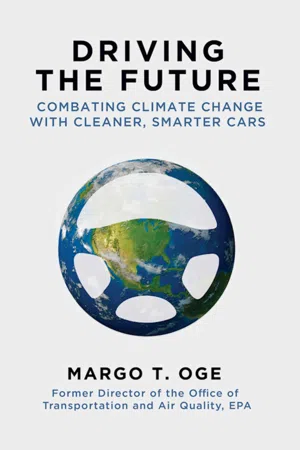
Driving the Future
eBook - ePub

Driving the Future

Combating Climate Change with Cleaner, Smarter Cars

  1. 352 pages
  2. English
  3. ePUB (mobile friendly)
  4. Available on iOS & Android
eBook - ePub

Driving the Future

Combating Climate Change with Cleaner, Smarter Cars

About this book

A distinguished expert offers a dazzling preview of the cars of the future, while exploring the science and politics behind climate change.As the director of the EPA's Office of Transportation and Air Quality, engineer Margo Oge was the chief architect behind the Obama administration's landmark 2012 deal with automakers in the US market to double the fuel efficiency of their fleets to 54.5 mpg and cut greenhouse gas emissions in half by 2025. This was America's first formal climate action using regulation to reduce emissions through innovation in car design. Tom Friedman praised the new rules as the "Big Deal" that redeemed the administration's previous inaction. In Driving the Future, Oge portrays a future where clean, intelligent vehicles with lighter frames and alternative power trains will produce zero emissions and run at 100+ mpg. With electronic architectures more like that of airplanes, cars will be smarter and safer, will park themselves, and will network with other vehicles on the road to drive themselves. Offering an insider account of the partnership between Federal agencies, California, environmental groups, and car manufacturers that led to the historic deal, she discusses the science of climate change, the politics of addressing it, and the lessons learned for policymakers. She also takes the reader through the convergence of macro trends that will drive this innovation over the next forty years and be every bit as transformative as those wrought by Karl Benz and Henry Ford.
Frequently asked questions

Yes, you can cancel anytime from the Subscription tab in your account settings on the Perlego website. Your subscription will stay active until the end of your current billing period. Learn how to cancel your subscription.
At the moment all of our mobile-responsive ePub books are available to download via the app. Most of our PDFs are also available to download and we're working on making the final remaining ones downloadable now. Learn more here.
Perlego offers two plans: Essential and Complete
  • Essential is ideal for learners and professionals who enjoy exploring a wide range of subjects. Access the Essential Library with 800,000+ trusted titles and best-sellers across business, personal growth, and the humanities. Includes unlimited reading time and Standard Read Aloud voice.
  • Complete: Perfect for advanced learners and researchers needing full, unrestricted access. Unlock 1.4M+ books across hundreds of subjects, including academic and specialized titles. The Complete Plan also includes advanced features like Premium Read Aloud and Research Assistant.
Both plans are available with monthly, semester, or annual billing cycles.
We are an online textbook subscription service, where you can get access to an entire online library for less than the price of a single book per month. With over 1 million books across 1000+ topics, we’ve got you covered! Learn more here.
Look out for the read-aloud symbol on your next book to see if you can listen to it. The read-aloud tool reads text aloud for you, highlighting the text as it is being read. You can pause it, speed it up and slow it down. Learn more here.
Yes! You can use the Perlego app on both iOS or Android devices to read anytime, anywhere — even offline. Perfect for commutes or when you’re on the go.
Please note we cannot support devices running on iOS 13 and Android 7 or earlier. Learn more about using the app.
Yes, you can access Driving the Future by Margo T. Oge in PDF and/or ePUB format, as well as other popular books in Technology & Engineering & Sustainability in Business. We have over one million books available in our catalogue for you to explore.
PART ONE
THE CLIMATE JOURNEY
1
THE DAWN OF AUTOMOBILITY
In August of 1888, a thirty-nine-year-old woman named Bertha rolled to a stop in the center of Wieslen, a small town that sat in the rolling green countryside of southwestern Germany. She and her two teenage sons climbed out of their three-wheeled vehicle, made their way into the local apothecary, and purchased all the ligroin he had, about three liters. Ligroin is a petroleum ether commonly used for painting and decorating, but Bertha had neither of these uses in mind. Instead, she walked over to the carriage and poured the liquid into an engine sitting on the front. She then hoisted herself back into a wooden driver’s seat and, to the surprised looks of pedestrians, chugged out of town with her family at the leisurely pace of six miles an hour.
The trip on the curious carriage was hardly trouble free. Along the way Bertha pulled over at a blacksmith’s to fix a chain and a cobbler’s to have him attach some makeshift leather brake pads. She’d had to solve other issues herself, using a hatpin to clean a clogged fuel pipe and a garter to insulate a wire. But, just before dusk, she pulled up outside of her mother’s house in Pforzheim and, after unloading her sons, sent a telegram back to her husband in Mannheim. The message told him that she had stolen his prototype vehicle, had safely completed the sixty-six-mile journey, and would return home the next day.
The trip back was relatively uneventful, but the sight of the engine-powered vehicle still surprised and alarmed observers—exactly the reaction Bertha wanted. The trip’s main purpose was to promote the automobile into which she and her husband, Karl Benz, had invested enormous amounts of money and time.
Or so the story goes. Over time, the legend of Bertha Benz’s inaugural trip has been told and retold, embellished and celebrated by German drivers who retrace her journey every year. What is certain is that Karl Benz invented the first practical gas-powered vehicle, that Bertha’s trip was arguably the most successful automobile promotional campaign to date, and that the Benz’s internal combustion vehicle still faced stiff competition from other propulsion techniques.
At the turn of the twentieth century, popular automobiles were also powered by electricity and steam. Each technology had its own upsides as well as major shortcomings. Electric cars were quiet and easy to operate, but they were heavy, their distance was limited, and their recharge time was unbearably long. One of the most popular vehicles at that time was the Columbia Runabout, which could go forty miles on a single charge and run at speeds of up to 12 mph. Steam-powered cars accelerated fine once you got them going, but they took a long time to harness enough power to start. They also had limited capacity to store energy on long trips and were prone to explosions. Gas-powered vehicles were relatively quick starting and could run for long distances without refueling. But they were noisy, complicated to operate, and often broke down. By the early 1900s, there were nearly four thousand steam, electric, and gas-powered cars traversing America’s roads. Which machinery would win out in the end was still anyone’s guess.
Then, twenty-six years after Bertha’s journey, Henry Ford’s factory took automobile production to the next level. By 1914, his factories were churning out a boxy, black, gas-powered Model T every ninety-three minutes, completing six vehicles in roughly the time it had taken Bertha to go sixty-six miles. By 1918, the assembly-line manufacturing had also brought the car’s cost down to $450, a price even within the reach of Ford’s factory workers—and well below the $2,000 for electric vehicles. The Model T was so popular that Ford didn’t buy any advertising for years. By the 1920s, electric and steam vehicles were left in the petroleum-reeking exhaust of the now-dominant internal combustion engine.
* * *
Of course, the popular availability of cars did much more than make Henry Ford rich. The automobile pushed horse-drawn carriages to the wayside and forced cities to pave roads—if not completely redesign them. It created the sprawling suburbs of 1950s America. It rapidly changed social mores and became one of the most desired consumer goods in the world. It also pushed a century-old revolution in personal mobility to a new zenith.
Over the past two centuries, while the earth’s population has increased seven times and global GDP has increased a hundred times, personal mobility has increased a thousand times.1 In 1800, people primarily got around by walking, riding horses, or using boats. The vast majority never ventured far from their homes or did so rarely. By 1950, millions of people could almost effortlessly travel hundreds of miles in a day. The internal combustion engine was the most important technology in this transformational increase in personal mobility.
Unfortunately, this agent of personal freedom was also a source of an enormous amount of air pollution. Beginning in the 1940s, people in urban areas throughout the United States experienced waves of then-unexplained pollution that caused teary eyes, headaches, nausea, asthma attacks, and other reactions. School children in Los Angeles were kept indoors during high-risk days. The filthy air that factories and power plants emitted was well known, but the smog that enveloped America’s cities was not a sooty black; it had a brownish, yellowish tinge, which was due to the nitrogen oxide in auto emissions. The problem worsened until the popular disgust over pollution rattled American politics and eventually spilled over into one of the nation’s largest grassroots demonstrations.
* * *
In 1959, a newly elected Democratic senator began his journey toward becoming the national political face of the new environmental movement. The former governor of Maine, Edmund Muskie, had grown up the working class son of Polish immigrants in the small town of Rumford. At six feet four inches, with a powerful voice, Muskie was soon known in the Senate for both his flashes of temper and his ability to find consensus.
When Muskie arrived in Washington, DC, what we call environmentalism today didn’t exist. Hunters and fishermen like Muskie promoted conservationism by protecting their recreational areas. Forestry officials managed logging and mining interests in national parks. But there was very little concern over the effects pollution might be having on public health and the environment. Muskie had experienced the ill effects of pollution firsthand. His hometown was dominated by a paper mill that had been spitting enormous amounts of chlorine, nitrogen, phosphorus, and other pollutants into the water, while spewing sulfur dioxide and other toxins into the sky. Dead fish floated in the water, and the air pollution was so bad that it prevented new businesses from opening in Rumford. The new senator recognized the urgent necessity of protecting birds, frogs, humans, and other living things from pollution.
Throughout the 1960s, Muskie’s modern-day environmentalism developed a broad base of support, from scraggly college students to middle-class moms worried about their children’s health. Mainstream media’s coverage of environmental disasters, like Time magazine’s 1969 story of a fire on the surface of Cleveland’s polluted Cuyahoga River, further galvanized concern. As a result, the first nationwide Earth Day events in 1970 attracted attention from across the political spectrum. Senators and congressman from both parties flew back to their districts to speak at local events in city parks and on university campuses. Meanwhile, Muskie was pushing through a bill designed to satisfy the new environmental concerns.
During the 1960s, a series of laws established increased federal monitoring of pollutants, but none had the authority necessary to begin the real work of cleaning up the country. By 1970, Muskie had created legislation designed to transform America’s relationship with its increasingly polluted landscape. His bill also satisfied and incorporated various important political interests. From Tennessee Republican senator Howard Baker he included a commitment to technology-forcing regulations—rules that don’t prescribe specific solutions for industry to follow but stimulate the marketplace by creating a demand for new technologies. Muskie also respected Missouri Democratic senator Tom Eagleton’s demand for solid deadlines. Finally, Muskie wanted certain health standards to be met. These elements all fused in the creation of the most effective environmental law to date, the Clean Air Act of 1970. The bill locked in the regulatory technique of using technologies to achieve a healthier environment by a certain date. No other federal law combined all these elements—most had none.
A well-known example of the Clean Air Act’s application quickly followed its passage. By 1975, new cars were required to meet certain standards for emissions. The regulation would dramatically clean up the air, reducing cases of bronchitis, asthma and more serious health effects including premature death. The requirements had to be met by 1975 model year cars. And it was up to the car companies to figure out what technology would get the job done, prompting a race between multiple companies to supply a device that would win the millions of dollars in contracts from auto companies. That solution, the catalytic converter, is now found in virtually every new car manufactured in the world.
But Muskie wasn’t the only one responding to the new environmentalism. Soon after the Clean Air Act became law, President Richard Nixon created the Environmental Protection Agency. A Republican and no devout environmentalist, Nixon had essentially sat out Earth Day in the 1970s. But he did respect the political importance of the widespread public demand for cleaner land, water, and air. In fact, the EPA may have been strategically created in part to take the environmental card away from Muskie, Nixon’s presumed Democratic challenger in the 1972 presidential election. A few months after the creation of the EPA, the Nixon campaign forged and leaked a letter to the press that called Muskie’s credibility into doubt, essentially ending the environmentalist senator’s presidential ambitions. But whatever Nixon’s motivation was, the new agency he created was too powerful to be considered one more political trick. The EPA soon exercised its authority under the Clean Air Act to begin a massive cleanup of the mess that internal combustion–powered automobiles had created over the past half-century.
The EPA’s success in this effort is clear when comparing modern cars with those from 1970. Just forty years after the EPA went to work, cars produce over 99 percent fewer emissions than they did in 1970. Between 1970 and 2010, the reductions in levels of soot, smog, and other pollutants from cars, trucks, factories, and power plants have prevented hundreds of thousands of premature deaths, nearly a million cases of chronic bronchitis, and over 18 million child respiratory diseases. Lead reductions have prevented the loss of over 10 million IQ points in children.2 Americans breathe much cleaner, healthier air than they did in 1970. While our cities’ skies may not be pristine, they are remarkably cleaner.
* * *
When I joined the EPA in 1980, it was my first professional experience with environmentalism. I had arrived in the United States from Athens, Greece, twelve years earlier, as the environmental movement was becoming a powerful political force. When I got to America my English was limited, but, after a summer-long crash course, I started an engineering program at the University of Massachusetts in Lowell.
At that point my knowledge of environmental issues was also pretty limited. Growing up in Athens, a crowded and polluted city that is home to a third of the entire country’s population, I was constantly surrounded by atmospheric pollution from carbon monoxide, sulfur oxides, nitrous oxides, and dust. I watched Athens’ air pollution coat the 2,500-year-old marble pillars and statues of the Parthenon in soot. I had seen and read about how the beautiful marble underneath the soot was being eroded by pollution, which made the future of the monument questionable.
After receiving my MS degree, I went on to a job at a Connecticut-based consulting firm for the chemical industry. It wasn’t until I started at the EPA’s Office of Toxic Substances that my work as a chemical engineer became exciting. I joined the EPA team evaluating the toxicity level of new chemicals before they entered the marketplace. Now my engineering skills weren’t just academic; they were preventing toxins from harming people and the environment.
In 1985, I secured a one-year detail to work for Senator John Chaffee, a Republican representing Rhode Island. Chaffee, the powerful chairman of the Senate Environment and Public Works Committee, helped me to author a bill that made plastic rings for six-pack beverages biodegradable. At the time, every six-pack of soda or beer was held together by plastic-ring packaging. A lot of these rings found their way into the ocean, where they trapped and killed marine life. The bill I worked on became part of a Superfund amendment in 1986. It was my first experience with the process of lawmaking.
From the Senate, I returned to the Office of Toxic Substances as a deputy director. As a manager, my first project was the toxic release inventory initiative, which became better known as the “Community Right-to-Know Program.” For the first time, the program ensured that public could learn about the type and amount of toxic substance releases from facilities in their community. Several years later, I took on the job of directing the Office of Radiation and Indoor Air. Among my responsibilities was helping to establish the first repository for nuclear waste in Carlsbad, New Mexico. I also worked to make radon gas and other indoor pollutants’ health impacts known to the public. With my team, I also managed the publication of the first scientific study about the health impacts of secondhand smoke, which completely changed the policies for smoking in public places.
Then, after moving from various positions over my first fourteen years at EPA, I found a home leading the Office of Transportation and Air Quality. It was here that I directly confronted the legacy of innovators like Henry Ford and Karl Benz. Starting in 1994, I spent the next eighteen years working with my team to reduce the air pollutants that caused premature death and respiratory illness from cars, commercial trucks, and buses. We reduced cancer-causing substances like benzene in gasoline and sulfur in diesel and gasoline fuels. We also developed rules compelling locomotives and boats to reduce their soot- and smog-forming pollutants that impacted the health of millions of Americans.
But while my team successfully pushed forward our agenda to clean up and reduce conventional air pollutants up to 99 percent since the seventies, a mostly odorless, invisible threat was rapidly building up all around us, greenhouse gases. Throughout the 1980s and ’90s, as Americans became more familiar with this threat, several things became clear. First, human-produced greenhouse gases were causing the planet to heat up rapidly. Second, along with other greenhouse gases, one of the major culprits in this process was carbon dioxide, a byproduct of burning fossil fuels like diesel, gasoline, and coal. Third, greenhouse gases were streaming out of the tailpipe of just about every car and truck in America. In fact, the transportation sector—the sector my office was responsible for cleaning up—was producing almost a third of the greenhouse gas emissions in the United States, second only to the power generation sector.
Despite all of our efforts at EPA, an unregulated, life-threatening gas was still streaming out of vehicles across the country. Over its first forty years, the EPA accomplished much of its original purpose. But it turned out that our greatest challenge still lay ahead: the global threat of greenhouse gas–driven climate change. This phenomenon was a complex beast with a global reach—and a problem so politicized that it had been dangerously ignored by our government for decades.
2
THE DISCOVERY OF EARTH’S CLIMATE
Kiribati, a line of South Pacific islands strung out in turquoise water, has long been a poor nation, subsisting on international aid and the sale of its fishing rights to wealthier countries. But over the past decade, the country has begun to face a more existential threat. Rising sea levels are causing the tropical waters to flood churches and gobble up homes near the coast. Further inland, briny liquid pours out of the ground, collecting in fetid pools. Stands of palm trees are dying from exposure to salt water. The citizens of Kiribati navigate these new challenges on a day-to-day basis, haunted by the realization that th...

Table of contents

  1. Cover
  2. Title Page
  3. Copyright
  4. Dedication
  5. Contents
  6. List of Figures
  7. Introduction
  8. Part One: The Climate Journey
  9. Part Two: The Big Deal
  10. Part Three: Imagining Tomorrow
  11. Afterword
  12. Acknowledgments
  13. Abbreviations
  14. Notes
  15. Index