
- 999 pages
- English
- ePUB (mobile friendly)
- Available on iOS & Android
eBook - ePub
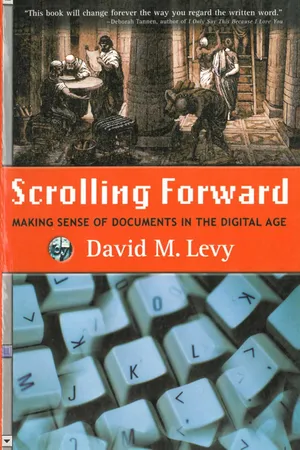
Scrolling Forward: Making Sense of Documents in the Digital Age
About this book
We are surrounded by documents of all kinds, from receipts to letters, business memos to books, yet we rarely stop to reflect on their significance. Now, in this period of digital transition, our written forms as well as out reading and writing habits are being questioned and transformed by new technologies ad practices. What is the future of the book? Is paper about to disappear? With the Internet and World Wide Web, what will happen to libraries, copyright and education? Starting with a simple deli lunch receipt, SCROLLING FORWARD examines documents of all kinds from the perspectives of culture, history, and technology in order to show how they can work and what they say about us and the values we carry into the new age.
Frequently asked questions
Yes, you can cancel anytime from the Subscription tab in your account settings on the Perlego website. Your subscription will stay active until the end of your current billing period. Learn how to cancel your subscription.
No, books cannot be downloaded as external files, such as PDFs, for use outside of Perlego. However, you can download books within the Perlego app for offline reading on mobile or tablet. Learn more here.
Perlego offers two plans: Essential and Complete
- Essential is ideal for learners and professionals who enjoy exploring a wide range of subjects. Access the Essential Library with 800,000+ trusted titles and best-sellers across business, personal growth, and the humanities. Includes unlimited reading time and Standard Read Aloud voice.
- Complete: Perfect for advanced learners and researchers needing full, unrestricted access. Unlock 1.4M+ books across hundreds of subjects, including academic and specialized titles. The Complete Plan also includes advanced features like Premium Read Aloud and Research Assistant.
We are an online textbook subscription service, where you can get access to an entire online library for less than the price of a single book per month. With over 1 million books across 1000+ topics, we’ve got you covered! Learn more here.
Look out for the read-aloud symbol on your next book to see if you can listen to it. The read-aloud tool reads text aloud for you, highlighting the text as it is being read. You can pause it, speed it up and slow it down. Learn more here.
Yes! You can use the Perlego app on both iOS or Android devices to read anytime, anywhere — even offline. Perfect for commutes or when you’re on the go.
Please note we cannot support devices running on iOS 13 and Android 7 or earlier. Learn more about using the app.
Yes, you can access Scrolling Forward: Making Sense of Documents in the Digital Age by David M. Levy in PDF and/or ePUB format, as well as other popular books in Social Sciences & Sociology. We have over one million books available in our catalogue for you to explore.
Information
1
Meditation on a Receipt
WHAT CAN DOCUMENTS TEACH US? Let’s begin by looking at one, close up. The one I have in mind is a cash register receipt, a small strip of paper, 1% inches in width and approximately 4¼ inches in length, marked in light blue ink. At the top it reads “Steve’s Deli & Catering.” Immediately below is a sequence of numbers, 10-29-97, and near the bottom is a decimal value, 5.85. From the look of it, someone bought something from Steves Deli on October 29, 1997, and paid $5.85 for it.
This might seem like an odd place to begin a discussion of documents. Why not begin with a more magnificent specimen, perhaps something beautiful, such as the Book of Kells? Or something more reverently ancient, a Sumerian clay tablet or the Rosetta stone? Or something with an aura of power about it, the U.S. Constitution or an international treaty? This little receipt is so plain and ordinary, so manifestly uninteresting. There are millions and billions of receipts just like it. Every financial transaction at the supermarket, the newsstand, the florist, the drugstore, produces one. You can see people’s attitude toward them in the way they’re handled. They are often left on the counter — refused or even handed back with a vague air of displeasure. (I can’t be bothered with this.) Or they are stuck away in a grocery bag or stuffed in one’s pocket or purse, only to be discarded later. Surely receipts like this are the bottom of the bin.

A receipt for the purchase of a tuna-fish sandwich, a bag of chips, and a bottle of water
But this is exactly the point. If we are going to see into the nature of documents, we would do well to deal directly with the most abundant and ordinary of them. It is easy enough to be transported to heights of ecstasy by the most magnificent specimens. Indeed, we may be spellbound by their beauty and power. The bigger challenge is to look closely and respectfully at the lowest and homeliest of them. And should we find beauty, depth, and power in these, we will surely have accomplished something.
This little receipt is a historical document. Although hardly of the magnitude — or the permanence — of the Rosetta stone, it is a snapshot of something that happened at another time and place. Embedded in it physically, through the absorption of blue dye into processed tree pulp, is the record of a moment when someone (in fact it was me) bought a tuna sandwich, a bag of chips, and a bottle of water in a deli on El Camino Real in Burlingame, California.
The receipt is historical in another sense as well. If it serves as a reminder of a minor transaction in late October 1997, it simultaneously carries within its form the memory of thousands of years of human struggle and development. That receipts like this one are so readily printed and so casually tossed away is due in large measure to the availability of cheap, high-quality paper. This wasn’t always so.
Paper was invented in China in the second century c.e. and made its way to Europe in the twelfth century, carried by Arab traders. We tend to think that brilliant new inventions explode onto the scene and are immediately embraced by all (making fortunes in stock for the founders of companies that produce them). But that isn’t usually the way it works. There is more typically a slow process of diffusion and adaptation, and this is certainly what happened with paper.
People have always made writing surfaces from the natural materials immediately around them. Some, like clay, require little preparation to be usable. Others, most notably papyrus and animal skins, need to be manufactured. Papyrus, from which the word paper is derived, is a rush or grasslike plant that grows in the Nile river delta. To make a writing surface, the plant is sliced lengthwise into long strips. These strips are laid in rows and allowed to dry in the sun, resulting in a highly durable surface that will accept marks on one side.
The process of turning animal skins into writing surfaces is more extensive: it involves raising the animals, skinning them and removing the hair, then stretching and sanding the skins. But the resulting product can be marked on both sides, and while papyrus can only be cultivated in limited regions of the world, livestock is raised in most climates as a source of food and clothing as well. The resulting surface can be remarkably thin, smooth, soft, and pliable. It is also extremely durable: pieces of vellum (from the same Latin root that gives us veal) have survived, with their marks intact, for a thousand years or more.
Medieval monasteries typically had to maintain extensive herds — for food, of course, as well as books. The invention of paper provided a vegetarian alternative that could be made locally Instead of killing and skinning animals, plant fibers could be mashed into a pulp, spread out in thin layers, and dried. With proper treatment the resulting surfaces could accept forms written with a quill or brush.
The main advantage of medieval paper over animal skins was its lower price. Paper was actually more fragile and had a rougher surface than animal skins. It didn’t accept inks and pigments nearly as well, and was harder to correct. It wasn’t until the fourteen or fifteenth century, several hundred years after its introduction into Europe, that paper began to supplant animal skins. Initially this was due to its improved quality and availability. But with the invention of the printing press in the middle of the fifteenth century, which produced better results on paper than on most skins, the demand for paper increased dramatically.1
In those first centuries after the papermaking process was introduced into Europe, and indeed for many centuries afterward, rags provided the primary raw material for the making of paper. We might think of this as an early form of recycling. Once clothing, made of cotton, linen, and hemp, had served its useful lifetime, it was collected by the “ragman” as the first step in the papermaking process. (So important were clothes fibers to papermaking that in seventeenth-century England a law was passed mandating that the dead be buried in wool, which was unsuitable for making paper.)2 The availability of rags placed limits on the quantity of paper that could be produced. Periodic shortages of rags produced crises in book production.
The search began for an alternative to rags. Although the use of wood was first suggested in the eighteenth century,3 it wasn’t until the middle of the nineteenth century — not so very long ago — that techniques for making paper from wood pulp became commercially viable. With the invention of the steam engine as a cheap and reliable source of power, it was finally possible to produce large, continuous rolls of inexpensive paper. It thus became possible to make lots of cheap, expendable documents, like the receipt we’re currently examining. Looking closely, you can indeed see that this receipt was torn from a continuous roll. The ragged upper edge gives evidence of the sudden gesture of the wrist and hand that separated it from the mother roll.
So much for the paper it’s printed on. What makes this a document rather than a mere scrap of paper is its symbolic or representational power. Its little blue marks allow it to tell a story. From the time of the cave paintings at least, human beings have been working out how to depict, name, and describe events and objects in such a way that they could be called to mind — re-called or re-presented — at a later time and place. That this receipt is able to tell its tale so succinctly and efficiently is the result of thousands of years of developments in written forms.
Each of the shapes has its own history, its own story. Let’s start with the capital letters. These come to us most directly from Roman times, adapted from earlier Etruscan and Greek letterforms. Two thousand years ago, the Romans had a twenty-three-letter alphabet (lacking only our J, V, and W), the forms written just as we see them on this receipt. Which means that all the capital letters — A, C, D, E, G, I, L, N, Q, R, S, T— appearing on this receipt would have been immediately recognizable to our Roman ancestors.
Not so the lowercase letters. These didn’t begin to develop until the third century c.e. The Roman capitals had been written slowly; they were often carved in stone — a deliberate and painstaking process. (We call them capitals — from the Latin capitalis for “head” — because they were often incised at the head or top of monumental columns.) But as these forms were written more quickly — with quills on vellum rather than with brushes and chisels on stone — the shapes became rounder and simpler. The uncial alphabet, which made its appearance in the third century c.e., has a very mixed look to our modern eyes. While most of the forms look decidedly uppercase, a small number of others have a distinctly lowercase feel to them, including a, d, h, m, and q.4 It was during Charlemagne’s so-called Carolingian renaissance in the eighth century — an intense period of spiritual and literary exploration during which handwriting was refined and reformed — that the lowercase letters as we know them finally emerged in a clear and beautiful form.
(The terms lowercase and uppercase are actually derived from printing practice. The compositor or typesetter kept his pieces of metal type in bins or “cases.” The small letters were traditionally kept in the case below the one holding the capital letters; thus the small letters were in the lower case, the big letters in the upper case. Strictly speaking, it is anachronistic to call letterforms of the eighth century lowercase. More accurate terms would be minuscule, meaning small, for lowercase and majuscule, meaning big, for uppercase.)
At any rate, by the eighth century, more or less, all the letter shapes needed to make this receipt had come into existence. But they functioned quite differently at that time than they do now. The capitals and the lowercase letters formed essentially separate scripts or “hands.” A text, or portions of a text, would be written in one script or the other. It wasn’t until the Renaissance that the practice of mixing capitals with lowercase letters within a single word (e.g., to begin a sentence or write a proper name) began to emerge. This seems to have been an outgrowth of the use of versals — large illuminated letters — to start a page or a new section of a text. Thus, although the forms of the letters appearing on this receipt are quite old, stretching back a thousand years or more, the manner of combination, as seen in the word “Steve’s,” is much more recent.
Yet letterforms play a fairly minor part in the receipt we’ve been examining. Instead, this receipt is mainly filled with numbers — or numerals to be more exact — and with good reason: it is a financial record, a kind of accounting document, and in this respect it harks back to the earliest days of writing. Archaeological evidence indicates that counting and accounting were some of the first uses of writing. Many of the Mesopotamian cuneiform tablets dug up in Iraq and Iran are administrative records: lists of tribute received, rations distributed, payments made. One scholar, the anthropologist Denise Schmandt-Besserat, even theorizes that writing was a direct out- growth of counting and accounting practices conducted within increasingly complex, urban societies.5
Numerals have at least as long a history as letters. The familiar forms appearing on this receipt are of relatively recent origin. Like paper, they seem to have been brought to Europe through Moslem conquest and settlement. (Whereas paper came originally from China, the numerals originated in India.) Like the adoption of paper in Europe, the diffusion of the numerals was a slow process, lasting centuries. The most radical of the numerals, zero, took a slower course than the others. Although the numerals had made their way to Spain by the tenth century, zero wasn’t in common use until the eleventh or twelfth century There is a certain logic to the delay, since the Arabic numerals were serving as a replacement for the earlier Roman numerals, which lacked a zero. It must have taken quite a while for educational and commercial practices to adjust to this strange new symbol, a mark signifying nothing, a presence signaling an absence. (Still, how strange to think that the use of zero in the West is only a thousand years old.) Decimal notation is even more recent; the decimal point was first used at the end of the fifteenth century.
The decimal point is just one of the nonalphabetic, nonnumeric symbols appearing on the receipt. I count five of them in all — the decimal point or period, the hyphen or dash, the asterisk, the apostrophe, and the ampersand. All but the last of these are punctuation marks (from the Latin punctus or “point”). They are secondary signifies — meta-symbols, you might say — that have been developed over the millennia to make reading easier and to help resolve potential ambiguities. Early writing used few such devices; indeed, in a style called scriptio continua (continuous writing), words were strung together without any visual indication of the divisions between them. At a later stage, dots or points were added to mark the boundaries of words. This was finally replaced by the convention we use today, that of separating words spatially This convention didn’t become the norm until the twelfth century. It took quite a while then for space — the absence of a mark — to come to serve as punctuation. Perhaps it is only accidental that it made its appearance at about the same time as zero, the absence of all quantity.
But space functions as more than punctuation in this sense. It is the single greatest resource for the writer, at once the most blatantly obvious and the most invisible resource on the page. Written marks, after all, are only discernible against an unmarked background. The shape of a single letter, a capital B for example, is equally made up of its negative spaces (the holes that make up its two bowls) and the empty space that forms its outside borders. If we think of the receipt as a planet and the blue marks as its continents, then most of its expanse, like our planet, is ocean.
To see the receipt in this way is to locate it in time. It is to see the receipt as the product of endless developments and innovations, small and large, stretching back over many centuries and reaching across many regions of the globe. As George Kubler has put it in The Shape of Time: “Everything made now is either a replica or a variant of something made a little time ago and so on back without break to the first morning of human time.”6 To see the receipt in this way is therefore to give it a past, but it is also to give it a future, a future that is necessarily uncertain and unknown, at best dimly and imperfectly glimpsed.
This receipt stands at a particularly interesting, and perhaps challenging, moment in time. The paper on which it’s printed has acquired a political and, indeed, even a moral resonance. The seemingly endless availability of cheap paper, which took so many centuries to achieve, has permitted us to be cavalier about its use and mindless about its disposal. In recent decades, the association between the use of paper and the depletion of the planet’s natural resources has come into focus, raising great concerns about sustainability and our collective long-term welfare. It has become increasingly difficult to see little pieces of paper like this one as disposable in the ways we once did.
It is worth noting that not all cultures have been quite so cavalier about their written records. In a book written in 1938, Chiang Yee speaks movingly of the traditional Chinese attitude toward written forms (an attitude that surely cannot have survived the revolution):
Affection for the written word is instilled from childhood in the Chinese heart. We are taught never to tear up a sheet of writing, nor to misuse any paper with writing upon it, even if it is of no further practical use. In every district of a Chinese city, and even in the smallest village, there is a little pagoda built for the burning of waste paper bearing writing. This we call Hsi-Tzu-T’a — Pagoda of Compassionating the Characters. For we respect characters so highly that we cannot bear them to be trampled under foot or thrown away into some distasteful place. It is a common sight to see old men with baskets of plaited bamboo on their backs, gathering up this kind of waste paper from the streets and roads for burning in the Hsi-Tzu-T’a. You may be sure these old men do not act only on an impulse of tidiness! There may be people nowadays who think them foolish; but we cannot bring ourselves to abandon our deep-rooted traditional habits. Newspapers, books, every kind of printed matter are poured out on all sides and in increasing quantity, but still the old reverence for the written word prevails.7
(To this day, Jewish law dictates that all materials on which the Divine Name are written are to be handled respectfully, and they are to be buried when their useful lifetime is over.)
It is likely that future generations of receipts will have a very different look and feel. Digital receipts are already being created, part of a more general movement toward digital commerce. This very receipt may already carry the seeds of change within it: it may actually have a digital component to it, and if so it is something of a hybrid, a hermaphrodite. Although we can’t tell just by looking at it, this receipt was probably produced using a digital cash register, a computer incorporating a printer and a cash drawer. If so, a digital record of my tuna-fish-chips-and-water transaction was being created as the sales clerk punched the cash register keys; and from this the paper version we see before us was printed. Viewed in this light, the receipt is an evolutionary creature like the famed coelacanth, a fish with leglike fins marking the point at which sea creatures first began to venture onto land.
Still, we are missing a crucial perspective on the receipt — perhaps the most crucial. Although we have begun to locate it in the sweep of time, we have yet to see it in its own cultural time and place. We need to see it not so much in relation to events in the distant past or an unknown future, but in relation to its immediate surroundings. Within its local circumstances, what kind of thing is it? What work is it doing, and why is it doing it?
The first thing to notice is that the receipt is telling a story of sorts. It is admittedly a highly selective one, not likely to win any prizes for literature. Why would anyone bother to tell it? The answer is, of course, to be found in the way financial transactions are orchestrated in our culture. The receipt is mea...
Table of contents
- Cover
- Title Page
- Copyright
- Contents
- Preface
- Acknowledgments
- Introduction: The Universe Is Expanding
- 1. Meditation on a Receipt
- 2. What Are Documents?
- 3. Leaves of Grass
- 4. The Dark Side of Documents
- 5. Reach Out and Touch Someone
- 6. Reading and Attention
- 7. Libraries and the Anxiety of Order
- 8. A Bit of Digital History
- 9. An Immense Effort
- 10. The Search for Stable Ground
- 11. Scrolling Forward
- Notes