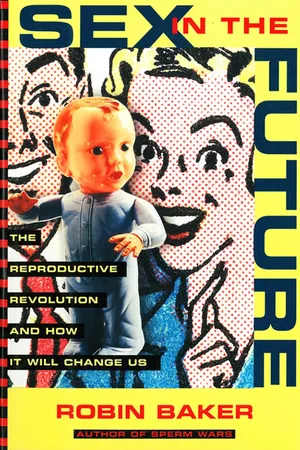
Sex In The Future: The Reproductive Revolution and How it Will Change Us
eBook - ePub

Sex In The Future: The Reproductive Revolution and How it Will Change Us

  1. 999 pages
  2. English
  3. ePUB (mobile friendly)
  4. Available on iOS & Android
eBook - ePub

Sex In The Future: The Reproductive Revolution and How it Will Change Us

About this book

Provocative and often shocking, Sex in the Future examines how advances in reproductive technology will change human behavior. In-vitro fertilization and surrogate motherhood could mean the end not only of infertility but also of the need for men and women to form relationships or for women to interrupt careers for pregnancy. Sperm and egg storage mean people can literally shop for genes, while cloning, egg-egg fertilization, and other techniques will lead to fertility on demand in a Reproduction Restaurant. What will all our choices be, and how far down this road do we want to travel?
Frequently asked questions

Yes, you can cancel anytime from the Subscription tab in your account settings on the Perlego website. Your subscription will stay active until the end of your current billing period. Learn how to cancel your subscription.
No, books cannot be downloaded as external files, such as PDFs, for use outside of Perlego. However, you can download books within the Perlego app for offline reading on mobile or tablet. Learn more here.
Perlego offers two plans: Essential and Complete
  • Essential is ideal for learners and professionals who enjoy exploring a wide range of subjects. Access the Essential Library with 800,000+ trusted titles and best-sellers across business, personal growth, and the humanities. Includes unlimited reading time and Standard Read Aloud voice.
  • Complete: Perfect for advanced learners and researchers needing full, unrestricted access. Unlock 1.4M+ books across hundreds of subjects, including academic and specialized titles. The Complete Plan also includes advanced features like Premium Read Aloud and Research Assistant.
Both plans are available with monthly, semester, or annual billing cycles.
We are an online textbook subscription service, where you can get access to an entire online library for less than the price of a single book per month. With over 1 million books across 1000+ topics, we’ve got you covered! Learn more here.
Look out for the read-aloud symbol on your next book to see if you can listen to it. The read-aloud tool reads text aloud for you, highlighting the text as it is being read. You can pause it, speed it up and slow it down. Learn more here.
Yes! You can use the Perlego app on both iOS or Android devices to read anytime, anywhere — even offline. Perfect for commutes or when you’re on the go.
Please note we cannot support devices running on iOS 13 and Android 7 or earlier. Learn more about using the app.
Yes, you can access Sex In The Future: The Reproductive Revolution and How it Will Change Us by Robin Baker in PDF and/or ePUB format, as well as other popular books in Social Sciences & Social Science Research & Methodology. We have over one million books available in our catalogue for you to explore.

PART ONE

DECLINE of the NUCLEAR FAMILY

CHAPTER ONE

PATERNITY TESTING AND CHILD SUPPORT

SCENE 1 (VERSION 1)

MY SON - PERHAPS?

The phone rang.
Drunk as usual at this time of the evening, Jim tried to ignore the insistent sound. With only minutes to go till the end of the game, he was reluctant to take his eyes off the television set. He didn’t much care about the final score, but he knew that whoever was on the phone would be of even less interest.
The ringing persisted, though. Finally, Jim pulled himself to his feet and with a slight stagger walked into the hall, clutching his nearly empty can of beer. As he picked up the once-white phone to say hello, he cleared his throat and coughed. It had been hours since he had spoken.
The operator asked Jim to pay for the call. Taken aback, he reluctantly agreed.
ā€œHi, Dad,ā€ came the unexpected voice. ā€œYou sound hoarse.ā€
He was genuinely pleased to hear his son’s voice. It was at least two months since they had last talked, and then they’d ended on bad terms. They always ended on bad terms. Between calls, Jim would fret and vow to be more tolerant and amenable next time. But it wasn’t easy, especially since the gaps between conversations were so long. The two of them lived several hundred miles apart, and, although Jim would have liked to make contact more often, there was no phone in the condemned house his son called home — so all he could do was wait.
The caller was Rob, the youngest of Jim’s three children. Dan, his eldest, was nearly thirty, ran a successful business, and now had two children of his own. Sarah was in her mid-twenties, had just finished a Ph.D. and had one child. Then there was Rob, just twenty and sending Jim to an early grave with worry and penury.
There was no doubt of Rob’s innate talent. An aspiring poet, he had shone at school and easily won admission to a good university — but his student career had lasted just one semester. Too lazy and hungover each morning to attend his classes and too misguided to heed his professors, warnings, he had assumed he was an asset that couldn’t be thrown off his course. He was wrong but didn’t admit his dismissal to Jim until the end of the year, when he could hide it no longer. In the meantime he had continued to spend Jim’s money, as well as accumulate overdrafts and small loans. He claimed he was waiting for inspiration.
Nearly a year had passed since the big argument when Jim had told Rob he was on his own, that if he couldn’t take advantage of the opportunities handed to him on a silver platter then he would have to make his own way. Rob continued to live in his university town, spending his nights — and much of his days — sleeping on floors offered by sympathetic friends who were still students. Mainly he tried to live off a succession of menial jobs, ranging from bussing tables to delivering groceries. His latest was stuffing chickens. He had written a few poems, but unimpressed editors had returned them all.
The phone call began reasonably well. Rob said he was happy, more or less. And he was healthy, apart from an outbreak of zits. When Jim asked, Rob eventually admitted he’d lost his job stuffing chickens. He claimed he’d had a couple of girlfriends since they last spoke, but neither had lasted long. After a while, he broached the reason for his call, and to Jim, it had an all-too-familiar ring.
ā€œLook, Dad. The reason I’m phoning … Well, I got this letter from the bank. Well, not really from the bank — from some debt collectors. They say I don’t have a bank account anymore. It’s been handed over to these debt guys or something. Anyway, they say if I don’t pay off my overdraft, I’m going to be blacklisted… and they’re going to start legal proceedings. They wouldn’t do that, would they?ā€
Jim’s heart sank. ā€œRob, I told you never to ask me for money again. I told you to sort yourself out. I haven’t got any money myself, thanks to all of you.
Ask your mother for some money — ask your brother — but don’t ask me. I’ve got enough problems making ends meet myself.ā€
That didn’t end the conversation, but it heralded the end. Rob persisted with his request, eventually pleading tearfully for Jim to pay off his debts. He wouldn’t let it happen again, he said. He promised. He really meant it this time, he said. In the end, Jim angrily agreed to think about it. Then he slammed down the phone, all vows of tolerance and amenability shattered again. Part of the problem was that Rob could only remember the old days, when Jim had part-owned his own business and was well-off and generous to a fault.
Exasperated, Jim downed the remainder of his beer in one gulp and returned to his chair in front of the television. He was disappointed that Rob had not simply wanted to talk but also angry at the clumsy attempt at emotional blackmail and the false promises. Then he felt panic, first at the thought of what not helping might do to Rob, then at the thought of what helping might do to himself — even if he could somehow scratch the money together. More than anything, though, he felt guilty, because the conversation had raised in him the old, old suspicion. Was Rob really his son?
The doubts had been there from the very beginning. Two children were enough, Thelma had said. We’ve got our perfect family, a boy and a girl, let’s concentrate on them. Let’s do everything we can for them. But then, out of the blue one evening, when their marriage was becoming increasingly shaky, Thelma appeared before him, naked from her bath, proclaiming she wanted another baby. A month later, she was in the throes of morning sickness. For Jim, the whole episode had the aura of deception. And although Rob’s birth and infancy kept them together for a further seven years, he could never convince himself that he was the boy’s father. Eventually, he and Thelma separated and divorced.
Jim glanced at the clock:9:50. Time to sober up. Rising from his chair, he stared out the window at the dark, windswept streets. The last thing he felt like doing was to go out, but he had no choice. How on earth had he ended up in this state? he asked himself. It was a rhetorical question, though — he knew the answer.
When they divorced, Thelma kept the marital home, and Jim, beginning what should have been a brief climb back to wealth and home ownership, rented a sizeable, almost flamboyant, apartment. But from then on, he misjudged everything.
Thelma never did cohabit with anyone; nor did she get a job, preferring to live off Jim’s alimony. Dan went to college, spent Jim’s money as if it was limitless, and a year after graduating begged for capital to buy into a friend’s family business. Sarah followed Dan to college, succeeded in being an even greater financial drain, and partied herself into pregnancy. None of the three potential fathers would accept responsibility, so Jim ended up paying for good accommodations and child care while Sarah finished her degree.
Jim raised the money Dan and Sarah needed by selling to his oldest friend, Dave, his half of their joint business. In the years following their graduation, Jim and Dave had built up a successful advertising company. Reluctantly, Jim sold his partner everything on the understanding that his job and privileges would remain secure. He then used the capital he’d raised in two ways. He helped his two eldest children, and he bought a house to placate his new girlfriend.
Susan had been more than happy to visit Jim in his apartment in the early days. But as soon as her place in his life seemed secure she pressured him into buying a property that reflected the status she wanted from the relationship rather than the status Jim could afford. Twenty years younger than Jim, Susan was everything he had been looking for in a second wife, even though deep down he knew she was mainly after his money. They married and bought the house jointly, even though all the capital was his.
It soon became obvious that Jim’s income couldn’t support their lifestyle and before long there were bitter arguments between them. His financial demise was the image in reverse of his son Dan’s financial ascent, as Susan never hesitated to point out. Almost a year to the day after Jim and Susan had moved into their new house, Jim came home unexpectedly from what should have been an overnight business trip to find Susan in bed — with Dan.
The bitter and abusive scene that had followed was the end of his relationship with both of them. Susan moved out to live with Dan and as part of the divorce settlement took half of the equity from their house.
Soon after, to Jim’s amazement and despite his opposition, Dave and Dan merged their businesses and became partners. Dave had always taken an interest in Dan and had helped him out in small ways. ā€œUncle Dave,ā€ Dan had called him when he was young. But for Jim, this was the end. Feeling unable to work for the team of his ex-business partner and his son, Jim left the company, only to find that men over fifty, no matter how successful they had been in their past life, couldn’t find employment that easily. In the end, he had been forced to move into the tiny apartment that was now his home. He could just about make ends meet but had nothing to spare to pay off the debts of idle young poets.
Leaning over the bathroom sink, Jim splashed cold water over his face. He didn’t need to be totally sober for what he had to do, but he needed to be more sober than he was. After studying his face in the mirror, he decided not to shave. Who was going to see him anyway?Who ever saw him?
As he donned his security-guard uniform and went to the tiny kitchen to make a sandwich and a thermos of coffee, he pondered his younger son’s paternity for the thousandth time. None of his children looked particularly like him; they resembled their mother much more closely. But at least the two eldest had his drive and sense of purpose. He didn’t see anything in Rob’s appearance, personality, or demeanor that could convince him he was his son. And Rob’s conception, so unexpected and so deliberate, seemed just one more act of deceit. Had Thelma really wanted them to have a third child, or had she been unfaithful and simply trying to cover her tracks? Yet here Jim was, twenty years later, being asked for what little money he had — and for what? To save a lazy, useless adolescent — who was probably somebody else’s child — from ending up on the streets or in jail.
What irritated him more than anything was that both Rob’s mother and his elder brother were better positioned to help Rob than he was, but both were under the thumb of tightwad partners. As Jim closed his front door and stepped out into the dark street, he made his decision. This time he would not pay off his ā€œson’sā€ overdraft — and as if to emphasize his decision, a train thundered over the nearby railway bridge.
On the other side of the track, both geographically and socially, Jim’s two ex-wives were finishing an expensive meal. Thelma was quite drunk and feeling very affectionate toward her daughter-in-law.
Theirs had been a relationship of two halves. At first Thelma had resented her place as Jim’s wife being taken by a girl young enough to be her daughter. But when Susan metamorphosed from second wife to daughter-in-law, then gave Thelma two beautiful grandchildren, their relationship had blossomed. Even the last tinge of jealousy, because Susan was actually the wealthier of the two, had disappeared when Thelma had finally found somebody suitably well-off and married again.
ā€œThere’s something I’ve always wanted to ask you,ā€ said Susan as they both sipped liqueurs. She knew her mother-in-law was feeling mellow and sensed that tonight might just be the moment to ask. ā€œDo you know the one thing that really gets to him?ā€
They always referred to their mutual ex-husband as ā€œhim.ā€
Thelma laughed, swaying slightly in her seat. Her cheeks were flushed, and she slurred a bit. ā€œI know. You don’t need to tell me. He’d like to think that that lazy good-for-nothing son of ours isn’t his, wouldn’t he? That’s what he’d like — so he doesn’t have to give him any more money. I know just what he’s thinking.ā€
Susan nodded, mildly surprised. ā€œExcept he says he always had his doubts. Even when you were pregnant.ā€
ā€œI know. He used to keep asking me. About once a month he’d ask me. In the end, it was one of the reasons I left him. I kept telling him Rob was his, but he never really believed me. He got totally screwed up about it.ā€
Susan paused a second but couldn’t leave it there. ā€œSo, go on then … Is he? Really, come on, tell me … Is Rob really his son?ā€
Thelma smiled, took another sip of her liqueur, then leaned across to whisper her secret.
ā€œYes, he is,ā€ she said, with emphasis. ā€œHe really is his son … But I will tell you something — if you promise to keep it to yourself.ā€ She paused for agreement and effect. Gaining both, she went on. ā€œThey might not all be his.ā€
This was the sort of revelation Susan wanted. ā€œYou mean … Sarah’s not his daughter?ā€ she said in amazement.
The elder woman shook her head. ā€œNo,ā€ she said. ā€œIt’s not Sarah.ā€
ā€œYou mean ā€¦ā€
Thelma laughed, enjoying the impact of her revelation. ā€œBut for goodness sake don’t tell anyone. I can’t be absolutely certain. Jim could be his father — it’s possible — but if any of them isn’t his … it’s Dan!ā€

TAMING THE FORCES

A divorced ex-businessman is down on his luck. Money-grabbing ex-wives share the secrets of their infidelities, one of which was with his eldest son. A promiscuous daughter falls pregnant. An idle son bleeds his father for every penny he can. Such a depressing scene hardly mirrors the fate of every man, but it is common enough to strike a chord with many an observer at the outset of the twenty-first century. Why was the man in this position? And would he be better or worse off in the future?
Most of the chapters in this book will be concerned with the impact of modern technology on the nuts and bolts of human reproduction — the micro-manipulation of testes and ovaries, sperm and eggs, cell nuclei and the like. The two chapters in Part 1, though, are different. The legacies under review here are subconscious urges that control what is, in effect, the strategic behavior of men and women. Equally as innate as their more anatomical counterparts, these legacies surface as each sex tries to do the best, reproductively, for itself and its children. The impacts of modern developments on our subconscious urges are much less tangible than the more obvious impacts of technology on conception and fertility — but they are no less potent, as we shall see.
In the scene, the main characters were struggling against, or taking advantage of, behavior patterns that have been handed down from distant ancestors. The main forces at work, sculpting the scenes events, were the influence of paternal uncertainty on men's behavior and the problems and opportunities that this generates for women. Soon, though, these forces will be tamed. Indeed, the first faltering steps in two different directions have already been taken.
Originally, paternity testing and child support enforcement were expected to bolster the institution of the nuclear family, which by the end of the twentieth century was in free fall. Ironically, as we shall discuss in Chapter 2, they are likely to have exactly the opposite effect. This is because, socially desirable though both are, they actually erode the cement that binds the nuclear family together — the threat of infidelity.
First, though, this chapter considers the biological background, social birth, and initial influence of both developments.

PATERNAL UNCERTAINTY AND PATERNITY TESTING

PATERNAL UNCERTAINTY

In the realm of reproduction, the psychological difference between men and women is greatly underestimated. A woman can have total confidence that she is the genetic parent of any child to whom she gives birth. A man can never have total confidence in his genetic parenthood. Sex takes only a few minutes, so no matter how much of his time a man spends with a woman — unless it is absolutely every minute — a nagging doubt over paternity can always remain. Trust helps, but can never be total. And the less a man trusts a woman, and the less time he spends with her, the greater that doubt can be.
A survey in the United Kingdom in 1989 showed that if a man spent more than 80 percent of his time with his partner between sexual acts, she was almost never unfaithful to him. Less time than that, though, and the chances of her infidelity increased significantly, rising to over 10 percent if he spent less than 10 perce...

Table of contents

  1. Cover
  2. Also By Robin Baker
  3. Title Page
  4. Copyright
  5. Dedication
  6. Contents
  7. Acknowledgments
  8. Introduction
  9. Part One: Decline of the Nuclehr Family
  10. Part Two: An End to Infertility
  11. Part Three: Choosing A Gamete Partner
  12. Part Four: Relhtionships to Fehr—or not to Fear?
  13. Part Five: Time Warps
  14. Bibliography