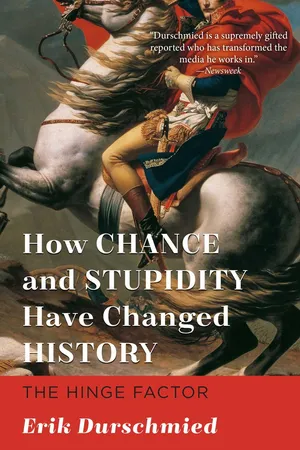
From the Trojan Horse to a photograph snapped in Vietnam, world history has been shaped as much by chance and error as by courage and heroism. Despite impossible odds, invincible armies fall in bitter defeat to weaker opponents. How and why does this happen? What decides the fate of battle? In this fascinating book, Erik Durschmied takes us through the major conflicts of history—from Agincourt to the Civil War, from Crimea to the Gulf War—and reveals how, in war, it is the improbable and the inconceivable that determine events.Writing with the style and flair that made him an award-winning war correspondent, Durschmied explores the fistful of nails that could have won Waterloo for Napoleon; the barrel of schnapps that proved disastrous for an Austrian emperor; and the three cigars that changes the course of Antietam; and many other instances when chance decided history's path. Conflicts are decided by the caprice of weather, erroneous intelligence, unlikely heroism, strange coincidence, or individual incompetence—in short, by the unpredictable "hinge factor."Skyhorse Publishing, as well as our Arcade imprint, are proud to publish a broad range of books for readers interested in history--books about World War II, the Third Reich, Hitler and his henchmen, the JFK assassination, conspiracies, the American Civil War, the American Revolution, gladiators, Vikings, ancient Rome, medieval times, the old West, and much more. While not every title we publish becomes a New York Times bestseller or a national bestseller, we are committed to books on subjects that are sometimes overlooked and to authors whose work might not otherwise find a home.
- 420 pages
- English
- ePUB (mobile friendly)
- Available on iOS & Android
eBook - ePub
About this book
Information
Table of contents
- Front Cover
- Title Page
- Copyright Page
- Contents
- List of Illustrations
- Prologue
- Preface to the 2016 Edition
- 1. A Wooden Horse: Troy, 1184 BC
- 2. The Loss of the True Cross: The Horns of Hattin, 4 July 1187
- 3. A Rabble with Bare Feet: Agincourt, 25 October 1415
- 4. A Barrel of Schnapps: Karansebes, 20 September 1788
- 5. A Fistful of Nails: Waterloo, 18 June 1815
- 6. The Fourth Order: Balaclava, 25 October 1854
- 7. Three Cigars: Antietam, 17 September 1862
- 8. Two Counts and One Prince: Königgrätz, 3 July 1866
- 9. A Fair Fight: Spioen Kop, 24 January 1900
- 10. A Slap on the Face: Tannenberg, 28 August 1914
- 11. The Sting of a Bee: Tanga, 5 November 1914
- 12. Der Halte Befehl: France, 21 May 1940
- 13. A Shark on the Loose: North Atlantic, 27 May 1941
- 14. The Sorge Enigma: Moscow, 6 December 1941
- 15. One Man’s Death: Vietnam, 31 January 1968
- 16. And the Wall Came Tumbling Down: Berlin, 9 November 1989
- 17. The Zero Factor: The Gulf, 17 January 1991
- Epilogue
- Bibliography
Trusted by 375,005 students
Access to over 1.5 million titles for a fair monthly price.
Study more efficiently using our study tools.
Frequently asked questions
Yes, you can cancel anytime from the Subscription tab in your account settings on the Perlego website. Your subscription will stay active until the end of your current billing period. Learn how to cancel your subscription
No, books cannot be downloaded as external files, such as PDFs, for use outside of Perlego. However, you can download books within the Perlego app for offline reading on mobile or tablet. Learn how to download books offline
Perlego offers two plans: Essential and Complete
- Essential is ideal for learners and professionals who enjoy exploring a wide range of subjects. Access the Essential Library with 800,000+ trusted titles and best-sellers across business, personal growth, and the humanities. Includes unlimited reading time and Standard Read Aloud voice.
- Complete: Perfect for advanced learners and researchers needing full, unrestricted access. Unlock 1.5M+ books across hundreds of subjects, including academic and specialized titles. The Complete Plan also includes advanced features like Premium Read Aloud and Research Assistant.
We are an online textbook subscription service, where you can get access to an entire online library for less than the price of a single book per month. With over 1.5 million books across 990+ topics, we’ve got you covered! Learn about our mission
Look out for the read-aloud symbol on your next book to see if you can listen to it. The read-aloud tool reads text aloud for you, highlighting the text as it is being read. You can pause it, speed it up and slow it down. Learn more about Read Aloud
Yes! You can use the Perlego app on both iOS and Android devices to read anytime, anywhere — even offline. Perfect for commutes or when you’re on the go.
Please note we cannot support devices running on iOS 13 and Android 7 or earlier. Learn more about using the app
Please note we cannot support devices running on iOS 13 and Android 7 or earlier. Learn more about using the app
Yes, you can access How Chance and Stupidity Have Changed History by Erik Durschmied in PDF and/or ePUB format, as well as other popular books in History & Military & Maritime History. We have over 1.5 million books available in our catalogue for you to explore.