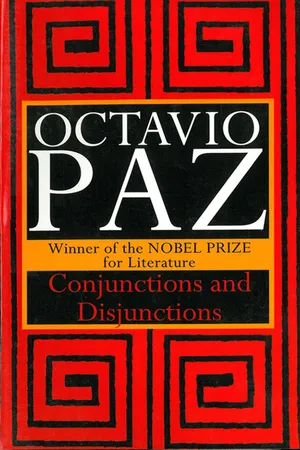
Conjunctions and Disjunctions
eBook - ePub

Conjunctions and Disjunctions

  1. 999 pages
  2. English
  3. ePUB (mobile friendly)
  4. Available on iOS & Android
eBook - ePub

Conjunctions and Disjunctions

About this book

Fascinated by the polarity of being, Paz has boldly attempted to write a "history of man". Unlike countless other histories that simply chronicle civilizations and cultures, Paz's work explores the human heart, the meaning of human nature, and the duality that exists within all beings.
Frequently asked questions

Yes, you can cancel anytime from the Subscription tab in your account settings on the Perlego website. Your subscription will stay active until the end of your current billing period. Learn how to cancel your subscription.
No, books cannot be downloaded as external files, such as PDFs, for use outside of Perlego. However, you can download books within the Perlego app for offline reading on mobile or tablet. Learn more here.
Perlego offers two plans: Essential and Complete
  • Essential is ideal for learners and professionals who enjoy exploring a wide range of subjects. Access the Essential Library with 800,000+ trusted titles and best-sellers across business, personal growth, and the humanities. Includes unlimited reading time and Standard Read Aloud voice.
  • Complete: Perfect for advanced learners and researchers needing full, unrestricted access. Unlock 1.4M+ books across hundreds of subjects, including academic and specialized titles. The Complete Plan also includes advanced features like Premium Read Aloud and Research Assistant.
Both plans are available with monthly, semester, or annual billing cycles.
We are an online textbook subscription service, where you can get access to an entire online library for less than the price of a single book per month. With over 1 million books across 1000+ topics, we’ve got you covered! Learn more here.
Look out for the read-aloud symbol on your next book to see if you can listen to it. The read-aloud tool reads text aloud for you, highlighting the text as it is being read. You can pause it, speed it up and slow it down. Learn more here.
Yes! You can use the Perlego app on both iOS or Android devices to read anytime, anywhere — even offline. Perfect for commutes or when you’re on the go.
Please note we cannot support devices running on iOS 13 and Android 7 or earlier. Learn more about using the app.
Yes, you can access Conjunctions and Disjunctions by Octavio Paz in PDF and/or ePUB format, as well as other popular books in Literature & Literary Essays. We have over one million books available in our catalogue for you to explore.

Information

Publisher
Arcade
Year
2011
Print ISBN
9781628725322
eBook ISBN
9781628721713
Images
ITS TERMS
There is a woodcut by Posada that shows a figure in a circus: a dwarf seen from the back, but with his face turned toward the spectator, and shown with another face down by his buttocks. Quevedo is no less explicit, and one of his juvenile works bears the title Gracias y Desgracias del Ojo del Culo [Graces and Disgraces of the Eye of the Ass]. It is a long comparison between an ass and a face. The superiority of the former lies in its having only one eye, as did the Cyclopes that “descended from the gods of sight.”
Posada’s woodcut and Quevedo’s metaphor seem to say the same thing: that asses and faces are identical. There is a difference nonetheless: the woodcut shows that the ass is a face, whereas Quevedo affirms that the ass is like the face of the Cyclopes. We pass from the human world to the mythological world: if the face is bestial, as is the ass, the bestiality of both is divine or demoniacal. If we want to know what the face of the Cyclopes is like, the best thing is to ask Góngora. Let us listen to Polyphemus as he looks in the water and discovers his face:
miréme y lucir vi un sol en mi frente
cuando en el cielo un ojo se veĂ­a
neutra el agua dudaba a cual fe preste:
o al cielo humano o al cĂ­clope celeste.
[I looked at myself and saw a sun shining in my forehead
while an eye was visible in the sky
the neutral water doubted which was real:
the human sky or the celestial Cyclops.]
Polyphemus sees his deformed face as another firmament. Transformations: the “eye” of the ass—that of the Cyclops—that of the sky. The sun dissolves the face-ass, soul-body dualism in a single dazzling, total image. We regain our former unity, but this unity is neither animal nor human; it is Cyclopean, mythical.
There is not much purpose in repeating here everything that psychoanalysis has taught us about the conflict between the face and the ass, the (repressive) reality principle and the (explosive) pleasure principle. I will merely note here that the metaphor that I mentioned, both as it works upward and as it works downward—the ass as a face and the face as an ass—serves each of these principles alternately. At first, the metaphor uncovers a similarity; then, immediately afterward, it covers it up again, either because the first term absorbs the second, or vice versa. In any case, the similarity disappears and the opposition between ass and face reappears, in a form that is now even stronger than before. Here, too, the similarity at first seems unbearable to us—and therefore we either laugh or cry; in the second step, the opposition also becomes unbearable—and therefore we either laugh or cry. When we say that the ass is like another face, we deny the soul-body dualism; we laugh because we have resolved the discord that we are. But the victory of the pleasure principle does not last long; at the same time that our laughter celebrates the reconciliation of the soul and the body, it dissolves it and makes it laughable once again. As a matter of fact, the ass is sober-sided; the organs of laughter are the same as those of language: the tongue and the lips. When we laugh at our ass—that caricature of our face—we affirm our separation and bring about the total defeat of the pleasure principle. Our face laughs at our ass and thus retraces the dividing line between the body and the spirit.
Neither the phallus nor the ass has a sense of humor. Being sullen, they are aggressive. Their aggressiveness is the result of the smiling repression of the face. As Baudelaire discovered, long before Freud: smiles, and the comic in general, are the stigmata of original sin, or, to put the matter another way, they are the attributes of our humanity, the result of and the witness to our violent separation from the natural world. The smile is the sign of our duality; if at times we make fun of our own selves with the same acrimony with which we laugh at others every day, it is because we are in fact always two: the I and the other. But the violent emissions of the phallus, the convulsions of the vulva, and the explosions of the ass wipe the smile off our face. Our principles totter, shaken by a psychic earthquake no less powerful than earthquakes in the ground beneath our feet. Deeply disturbed by the violence of our sensations and mental images, we pass from seriousness to hearty laughter. The I and the other become one, and what is more, the I is possessed by the other. Hearty laughter is similar to the physical and psychological spasm: we burst out laughing. This explosion is the contrary of the smile, and I am not certain that it can be called comic. The comic spirit implies two persons; the one who is watching and the one who is being watched, whereas when we laugh heartily the distinction is erased or at least diminished. A burst of laughter not only suppresses the duality, it also obliges us to become one with laughter in general, with the great physiological and cosmic turmoil of the ass and the phallus—the volcano and the monsoon.
A burst of laughter is also a metaphor: the face becomes a phallus, a vulva, or an ass. On the psychological level a burst of laughter is the equivalent of what the expressions of poets and satirists are on the verbal level. Its explosion is an exaggeration that is no less extreme than Góngora’s poetic image and Quevedo’s wit. Both are the doubles of physiological and cosmic violence. The result is a transmutation: we leap from the world of duality, ruled by the reality principle, into that of the myth of original unity. A fit of laughter is not merely a response to the pleasure principle, nor its copy or reproduction (even though it is both these things): it is the metaphor of pleasure. Hearty laughter is a (provisional) synthesis between the soul and body, the I and the other. This synthesis is a transformation or symbolic translation: we are like the Cyclopes once again. Once again: hearty laughter is a regression to a former state; we return to the world of our own childhood, either individual or collective, to myth and play. We return to the primordial unity—before there was a you and an I—in the form of a we that embraces every living being and every element.
The other response to carnal violence is seriousness, impassivity. This is the philosophical response, as the burst of laughter is the mythical response. Seriousness is an attribute of ascetics and libertines. Hearty laughter is a relaxation, asceticism a rigidity: it hardens the body so as to preserve the soul. I couple the libertine with the ascetic because libertinage is also a hardening, of the spirit first of all, and then of the senses. An asceticism in reverse. With his usual acuity, Sade states that the libertine philosopher must be imperturbable and aspire to the insensibility of the ancient Stoics, to ataraxia. His erotic archetypes are stones, metals, cooled lava. Equivalences, equations: the phallus and the volcano, the vulva and the crater. Resembling an earthquake in his emotional ardor and fury, the libertine must be hard, as stony as the rocks and crags that cover the plain after an eruption. Freedom, the philosophic state par excellence, is synonymous with hardness.
Strangely enough—or rather, not so strangely—this coincides with Vajrayana Buddhism, which conceives of the wise man and the saint, the adept who has simultaneously attained wisdom and liberation, as a being made in the image and likeness of the diamond. Vajrayana is the “way” or doctrine of the bolt of lightning and the diamond. Vajra refers to a lightning bolt and also to the invulnerable, indestructible diamondlike nature both of the doctrine and of the state of beatitude that the ascetic attains to. At the same time vajra also stands for the male sex organ in Tantric rites and language. The vulva is the “house of vajra” and also wisdom. Series of metaphors composed of terms that now belong to the corporeal world, now to the incorporeal world: the lightning bolt and the phallus, the vulva and wisdom, the diamond and the beatitude of the liberated yogi. The series of material terms culminates in a metaphor that identifies the discharge of celestial fire with the hardness of the diamond—a petrification of the flame; the series of psychic terms ends with another image in which the carnal embrace is indistinguishable from the indifference of the ascetic during meditation—a transfiguration of passion into essence. The two metaphors in the end become one: a fusion of the macrocosm and the microcosm.
Pairs of contrasting concepts such as those I have just mentioned appear in all cultures. What seems significant to me is that in Tantric Buddhism the duality is manifested in this very fire/diamond, eroticism/indifference polarity. The final resolution of this double opposition in terms of the paired concepts diamond/indifference is no less notable. The supreme Buddha is Vajrasattava, the “adamantine essence” in Sanskrit; the Tibetans call him the “Lord of Stones.” The surprising thing is that in its origin vajra (the lightning bolt) was the arm of Indra, the jolly, dissolute Vedic god. There is an arch that unites the two poles of the human spirit through the centuries. An arch which in this case goes from Indra, the god of storms and drunkenness, the god of the terrible burst of laughter that hurls all the elements into primordial confusion, to the impassible, imperturbable, adamantine Buddha, absorbed in the contemplation of his emptiness.
From the Vedic hymn to the manual on meditation, from the bolt of lightning to the diamond, from laughter to philosophy. The path from fire to stone, from passion to hardness, is analogous in the religious tradition of India and in European libertine philosophy. The difference is that the former offers us a total, though dizzying, vision of man and the world while the latter ends in a blind alley. In short, we live between the earthquake and petrification, between myth and philosophy. At one extreme, convulsive laughter pulls down the edifice of our principles and we run the risk of perishing beneath the ruins; at the other extreme, philosophy threatens us with mummification in life, whatever the mask we choose, whether it be that of Calvin or that of Sade. These are ruminations in the shadow of Coatlicue:1 destruction through movement or through immobility. A theme for an Aztec moralist.
1 An Aztec goddess represented with a girdle of skulls.
INCARNATION AND DISSIPATION
Since man has been man, he has been exposed to aggression, either that of others or that of his own instincts. The expression “since man has been man” means, first, since our birth, and second, since the species stood up on its feet and adopted the erect posture. In this sense our condition is not historical: the dialectic of the pleasure principle and the reality principle unfolds in a zone untouched by the social changes of the last eight thousand years. Nevertheless, there is a difference: ancient societies established institutions and used methods that absorbed and transformed the aggressive instincts more easily and with less danger to the species than those of today. On one hand, systems of transformation of obsessions, impulses, and instincts into myths and collective images; on the other hand, rites: the incarnation of these images in ceremonies and festivals. I hardly need add that I believe neither in the superiority of those cultures that have preceded us nor in the superiority of our own culture. I fear that a “healthy society” is a utopia; and, if it is not, it is situated neither in the historical past nor in the future, at least the future such as we see it from the point of view of the present.2 Nonetheless it seems obvious to me that antiquity (or antiquities, for there are several of them) offered a gamut of possibilities for sublimation and incarnation that was richer and more effective than ours.
2 Claude Lévi-Strauss believes that if a golden age ever existed, it must have been in the villages of the Neolithic period. He may be right. The State was still in the embryonic stage, there was almost no division of labor, metals (arms) were unknown, as was writing (a bureaucracy of scribes/a mass of slaves), and religion had not yet produced an organized clergy. Kostas Papaioannou told me almost the same thing a number of years ago, showing me little female fertility figures: happiness personified, a perfect accord with the world.
So-called primitive cultures have created a system of metaphors and symbols which, as LĂ©vi-Strauss has shown, constitute a veritable code of signs that are both physical and intellectual: a language. The function of language is to point to meanings and communicate them, but we modern men have reduced the sign to its meaning, and communication to the transmission of information. We have forgotten that signs are physical things and work on the senses. Perfume transmits information that is inseparable from sensation. The same happens with taste, sound, and other sensory expressions and impressions. The rigor of the “logic of the senses” of primitive peoples amazes us by its intellectual precision, but the richness of their perceptions is no less extraordinary: where a modern nose distinguishes only a vague odor, a savage perceives a precise range of different smells. What is most astonishing is the method, the manner of associating all these signs, so that in the end they are woven into a series of symbolic objects: the world converted into a physical language. This is a double marvel: speaking with the body and converting language into a body.
Cyclic time is another way toward absorption, transformation, and sublimation. The date that recurs is a return of previous time, an immersion in a past which is at once that of each individual and that of the group. As the wheel of time revolves, it allows the society to recover buried, or repressed, psychic structures so as to reincorporate them in a present that is also a past. It is not only the return of the ancients and antiquity: it is the possibility that each individual possesses of recovering his living portion of the past. The purpose of psychoanalysis is to elucidate the forgotten incident, so that to a certain extent the cure is a recovery of memory. In ancient rites it is not memory that remembers the past but the past that returns. This is what I have called, in another context, the incarnation of images.
From this point of view, art is the modern equivalent of rites and festivals: the poet and the novelist construct symbolic objects, organisms that emit images. They do what the savage does: they convert language into a body. Though they do not cease to be signs, the words take on a body. Music also creates bodily languages, perceptible geometries. Unlike the poet and the musician, the painter and the sculptor make the body a language. Things become signs. The celebrated Venus of the Mirror, for example, is a variant of the sex/face metaphor. It is a response to Quevedo’s verbal image and Posada’s graphic metaphor: in Velázquez’s painting, neither the face nor the genitals are humiliated. It is a moment of miraculous concord. The goddess—and there is nothing less celestial than this girl, lying stretched out on her own nudity, so to speak—turning her back on the spectator, as does Posada’s dwarf. In the center of the painting, in the lower half, at the height at which we see dawn break, in the east, at precisely the place where the sun appears, is the perfect sphere of the girl’s hips: a rump that is a celestial body. Above, in the upper horizon, at the zenith, in the center of the sky, is the face of the girl. Is it her face? More likely, as in the case of Góngora’s Polyphemus, it is the reflection of it in the “neutral water” of a mirror. We are dizzied by it: the mirror reflects the face of an image, the reflection of a reflection; the crystallization of a moment which has already vanished in the real world.
Paintings: solitary rites of contemplation. Poems: a feast of phantoms, an invitation to watch reflections. Images take on flesh in art only to have it fall away in the act of reading or contemplating. What is more, the artist believes in art and not, like the primitive, in the reality of his visions. For VelĂĄzquez Venus is an image, for GĂłngora the solar eye of the Cyclops is a metaphor, and for Quevedo the Cyclopean anus is one more witty conceit. In all three cases there is something that does not belong to the realm of reality but to the realm of art. Poetic sublimation becomes more or less completely identical with the death instinct. At the same time, participation with others takes the form of reading. Primitive man also deciphers signs, he also reads, but his signs are a double of his body and the body of the world. The reading of primitive man is corporeal.
However mannered they may seem to us, Quevedo’s conceit and Góngora’s metaphor were still a living language. Though the seventeenth century may have forgotten that the body is a language, its poets managed to create a language that gives us the sensation of a living body—perhaps because it is so complicated. This body is not human: it is the body of Cyclopes and sirens, of centaurs and devils. A language that has suffered martyrdom and been possessed like a bewitched body. To measure the degree of abstraction and sublimation, we need only compare Quevedo’s language with Swift’s. Swift is a writer who is infinitely more free than the Spaniard, but his daring is almost exclusively intellectual. Swift would have been offended at Quevedo’s sensual violence, especially on the scatological level. This is a matter not of morality but of taste: everything is permitted in the sphere of ideas and feelings, but not in that of sensibility. The eighteenth century, the libertine century, was also the inventor of good taste. Repression disappears in one zone only to appear in another, no longer wearing the mask of morality but the veil of aesthetics.
Swift’s horror of female anatomy comes from Saint Augustine and it is echoed by two modern poets: William Butler Yeats and Juan RamĂłn JimĂ©nez. In his best poem, “Espacio” [“Space”], JimĂ©nez writes: “Love, love, love is the place of excrement,” recalling Yeats’s lines: “But Love has pitched his mansion in/The place of excrement.” Although Quevedo probably felt the same sort of repulsion—he was a woman-hater, a whore-chaser, and a Petrarchist—his reaction is more whole-hearted and, his pessimism notwithstanding, more healthy: “It [the eye of the ass as compared to the eyes of the face] is incomparably better, since in both men and women it is a close neighbor of the genital members; and this is a proof that it is better, according to the proverb that says: ‘Tell me what sort of company you keep and I’ll tell you who you are.’” In Quevedo’s day the system of symbolic transformations of Catholicism still offers the possibility of speaking physically of physical things—even at a time when the Counter Reformation is beating a retreat and even though it takes the form of satire and scatology. In spite of the fact that Swift is freer intellectually than Quevedo, his sensuality encounters prohibitions no less powerful than those imposed on the Spanish poet by Neo-Scholasticism, absolute monarchy, and the Inquisition.
As repression becomes less rational, the inhibitions imposed upon sensual language increase. The extreme is Sade. No one has treated such inflammatory subjects in such cold and insipid language. His verbal ideal—when he does not give way to frenzy—i...

Table of contents

  1. Cover
  2. Half Title
  3. Title Page
  4. Copyright
  5. Contents
  6. Chapter 1
  7. Chapter 2
  8. Chapter 3
  9. Chapter 4
  10. Index