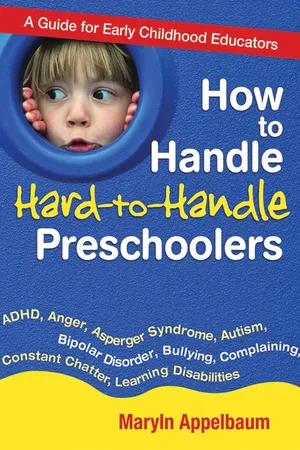
How to Handle Hard-to-Handle Preschoolers
eBook - ePub

How to Handle Hard-to-Handle Preschoolers

A Guide for Early Childhood Educators

  1. 144 pages
  2. English
  3. ePUB (mobile friendly)
  4. Available on iOS & Android
eBook - ePub

How to Handle Hard-to-Handle Preschoolers

A Guide for Early Childhood Educators

About this book

Early childhood educators know all too well how challenging and demanding pre-K children can be. But couple that with learning or behavioral disorders and teaching kids in the classroom can be even more of a challenge. How to Handle Hard-to-Handle Preschoolers is a user-friendly guide that provides early childhood teachers and administrators with a comprehensive overview of the most common kinds of behavioral disorders and learning disabilities in children ages two to five. This handy guide boasts hundreds of easy-to-implement strategies, tips, and techniques for managing behavioral disorders, from ADHD and biopolar disorder to Asperger syndrome and bullying tendencies. Each chapter covers one or more disorders and includes checklists to help educators better understand and manage hard-to-handle children.Maryln Appelbaum, owner of Appelbaum Training Institute—which trains over 50, 000 preschool educators each year in the United States—illustrates ways to help young children learn how to develop the ability to regulate their own behavior, replace negative behaviors with more positive ones, handle their emotions appropriately, succeed in the classroom and everyday life, and problem solve. This book is sure to empower both new and veteran teachers with the tools necessary to transform a negative, disruptive classroom into a positive environment for learning.
Frequently asked questions

Yes, you can cancel anytime from the Subscription tab in your account settings on the Perlego website. Your subscription will stay active until the end of your current billing period. Learn how to cancel your subscription.
No, books cannot be downloaded as external files, such as PDFs, for use outside of Perlego. However, you can download books within the Perlego app for offline reading on mobile or tablet. Learn more here.
Perlego offers two plans: Essential and Complete
  • Essential is ideal for learners and professionals who enjoy exploring a wide range of subjects. Access the Essential Library with 800,000+ trusted titles and best-sellers across business, personal growth, and the humanities. Includes unlimited reading time and Standard Read Aloud voice.
  • Complete: Perfect for advanced learners and researchers needing full, unrestricted access. Unlock 1.4M+ books across hundreds of subjects, including academic and specialized titles. The Complete Plan also includes advanced features like Premium Read Aloud and Research Assistant.
Both plans are available with monthly, semester, or annual billing cycles.
We are an online textbook subscription service, where you can get access to an entire online library for less than the price of a single book per month. With over 1 million books across 1000+ topics, we’ve got you covered! Learn more here.
Look out for the read-aloud symbol on your next book to see if you can listen to it. The read-aloud tool reads text aloud for you, highlighting the text as it is being read. You can pause it, speed it up and slow it down. Learn more here.
Yes! You can use the Perlego app on both iOS or Android devices to read anytime, anywhere — even offline. Perfect for commutes or when you’re on the go.
Please note we cannot support devices running on iOS 13 and Android 7 or earlier. Learn more about using the app.
Yes, you can access How to Handle Hard-to-Handle Preschoolers by Maryln Appelbaum in PDF and/or ePUB format, as well as other popular books in Education & Classroom Management. We have over one million books available in our catalogue for you to explore.

Information

Publisher
Skyhorse
Year
2013
Print ISBN
9781620872215

1

How to Handle Children Who Are Disruptive

Children need encouragement like roses need sunshine.
—Maryln Appelbaum
There are many ways children can disrupt the classroom. They may tattle, complain, blurt out, chatter, get into fights, and insist on having what they want, when they want it. Each type of disruption needs separate strategies and skills. This chapter will give you the skills you need to handle these hard-to-handle children and hard-to-handle situations.

SKILL ONE: HOW TO HANDLE TATTLING

Janette was a brand new preschool teacher. Little Mikey was in her class. He had huge dark eyes, dark curly hair, and a wonderful smile. When he came in each morning, he ran over to Janette and gave her a huge hug. The problem was that he also ran over to her at least once or twice an hour with a tattle about a classmate. Tattling is a very disruptive behavior (Gartrell, 2007). Children who tattle disrupt the routine and the consistency of the classroom. Tattling is detrimental to promoting harmony and cooperation between children.
The origins of tattling are generally in the home. Children learn that when they tattle on a sibling, a friend, or another family member, that person gets in trouble. Children who tattle get sympathy and attention for the tattle. They also learn that when they have problems, adults will step in and solve their problems. They come to preschool and tattle for the same reasons. You cannot help what happens in the home, but you can help what happens in the classroom. Tattling can be stopped.
The first step in stopping tattling is to teach children the difference between tattling and reporting. Tattling is to get someone in trouble. Reporting is when a child gets help for someone. Role-play tattling and reporting and have children tell you which one is being used.
• Jason tells you that Todd is hitting Scott in the playground and that Scott is bleeding. Is this an example of reporting or tattling? This is an example of reporting. Jason appears to be trying to get help for Scott.
• Tonya tells you that Sasha does not want play with her. Is this a report or a tattle?
This is an example of tattling. Tonya appears to be trying to get Sasha into trouble. No one is getting hurt.
Have children give you other examples of reporting and tattling. The more they practice, the better they will get at recognizing the difference between the two.

Strategies for Success for Tattling

Staying Calm
Remain calm when you hear tattles. When children see that you get upset, it actually reinforces the tattling behavior. They think this is a way that they can always get attention and sympathy. The more sympathy they get, the more they will engage in tattling. Take a few deep breaths and stay calm. Remember, the more you react, the more they act!
Tootles Curriculum
Tattling can become contagious. When children see that one child gets attention for tattling, soon they may all start doing it. This may be a sign that children need attention, but in more positive ways. An excellent way to stop tattling in its tracks is to set up a ā€œtootlesā€ curriculum. Tootles are kind statements that children say about others (Skinner, Cashwell, & Skinner, 2000). They are the opposite of tattles. Give children examples of tootles. ā€œKathy helped Kenny when he dropped his backpack and everything fell out.ā€ ā€œAlfie helped Elma put away the blocks.ā€
Have a special tootles time each day. It is a good concluding group activity. Children report all the good things others did. Every time you hear a tootle during circle time or during the day, add a paper clip to a tootles glass jar. It needs to be clear glass jar so the children can see the effects of their tootles as the jar is filled. When the jar is filled with paper clips, the class has a tootles party. Bring in a special treat and encourage them on that day to tell each other lots of tootles so everyone leaves happy.
This is an effective strategy because it teaches children to say nice statements about each other rather than negative ones. The more they get focused on saying positives, the more the negatives fall by the wayside. It creates a different positive climate in the classroom.
Thanks
A simple and effective strategy for handling tattling is to hear the tattle and then calmly say, ā€œThanks.ā€ Display very little emotion. Children learn from this that tattling gets no real sympathy or attention. They learn to handle their own problems and not get attention from trying to get another child into trouble.
ā€œSounds Likeā€
This is an excellent strategy for handling tattling. It acknowledges the emotions children have when they tattle, but does not reinforce the behavior. When you use this technique, you respond to the feeling the child has. You are using empathetic listening without getting actively involved. When Kenny comes to you and says, ā€œJoshie said a bad word,ā€ respond by saying, ā€œSounds like you’re upset.ā€ Kenny feels acknowledged and heard, yet you did not get involved in resolving the issue.
Tattle Sandwich
A sandwich is composed of two slices of bread with something in the middle. A tattle sandwich is composed of two compliments (the slices of bread), and the tattle in the middle. If children want to tattle, they have to first say something nice about the other child. Then they say the tattle. After saying the tattle, they say something else nice about the other child. This forces them to think in a whole new manner about the children that they are trying to get into trouble. They are now looking for good things to say about these children. Here’s an example: Meagan approached Ms. Janie, her teacher, and said, ā€œStephanie has on a pretty dress.ā€ This is the first part of the statement—one of the slices of ā€œbread.ā€ Then she said, ā€œShe won’t share her toys with me.ā€ That was her tattle. She paused and thought about the other ā€œslice of breadā€ that had to be nice. She said, ā€œStephanie gave me one of her crackers yesterday.ā€ The great thing about teaching children to use tattle sandwiches is that it teaches them to focus on the positives about each other, which minimizes tattling.
Tattle Time
If tattling is a real issue in your classroom, set up a special time each day when children get to tell their tattles. They cannot tell them before that time. By the time tattle time rolls around, they typically have forgotten all about the issue that had them upset in the first place. If they do remember the issue, they have to state it in the form of a tattle sandwich, saying two positives as well as the tattle.
Tattle Bucket
Have a special small bucket called the tattle bucket. Make name cards for each child. Use colored index cards for the name cards. Write each child’s name on a separate name card, and then add a unique sticker to each card. The different stickers help children who cannot read their names identify their cards because they recognize their stickers. When children have a tattle, instead of disrupting the class, they get their name card and put it into the tattle bucket. Look in the bucket at varying times during the day. If you see a name card, go to the child and say, ā€œI see you have your name card in the tattle bucket. What would you like to tell me?ā€ Many times, children will have forgotten all about the tattle.
Tattle Ear
There are some children who just like to talk about others. They are not reporting. They are tattling, telling one negative after another. Their goal is to get others in trouble. When children start to tell you tattles like these and are rambling on, have them go tell it to the ā€œear.ā€ Draw an ear and hang the drawing on the wall. Explain that this is the tattle ear, and they are to tell their tattles to the ear. Recently, I went into a preschool and saw one of the children, Maria, walk up to the wall where there was a tattle ear and stand there telling her tattle to the ear. When she finished, she went and rejoined her friends playing in the dramatic play center. She did this all very calmly. It was adorable to watch.
Teach Alternatives to Tattling
Children sometimes do not mean to tattle about someone else. They do it because they are having a problem with another child and just don’t know any other way to handle the problem. Teach them other methods to handle the situation. This is not the same as telling them how to handle the situation. When you tell them exactly how to handle situations, they are not learning to think for themselves or to take responsibility for their choices. Teaching them involves explaining different alternatives for the troublesome situation. For example, Lori approaches her teacher and says, ā€œCindi is taking too long.ā€ Ms. Jenkins says, ā€œYou could say, ā€˜Cindi, I would like a turn now,’ or you could do something else until Cindi is finished. Which do you prefer?ā€

SKILL TWO: HOW TO HANDLE COMPLAINING

Complaining is similar to, but different from, tattling. It is similar in that children have formed a pattern of negative statements to get attention. However, it is different because the complaints may not be about other people, but about situations. It is also different because children who frequently complain may develop victim mentalities. This occurs when children feel powerless about many issues. Children can begin to believe that everything bad happens to them. They complain about everything (Parish & Mahoney, 2006). They say, ā€œI can’t,ā€ and actually stop trying to do things. They say they can’t do a drawing. They can’t play in centers. They can’t do a partner activity. They give constant negative excuses. They complain that their classmates do not like them. It’s important to break this negative pattern of behavior. Children need to develop confidence in themselves. They need to learn their strengths and maximize them.

Strategies for Success for Complaining

ā€œI Can’tā€ to ā€œI Canā€
This is a really powerful strategy to teach children to say ā€œI can,ā€ rather than ā€œI can’t.ā€ Begin by asking children all the things they cannot do. Write separate lists for each child. Read their lists aloud to them individually. Now it is time to have an ā€œI can’tā€ ceremony. Give them their lists and have the children tear them up. Then they toss them into the waste-basket. The goal is to get rid of all the ā€œI can’ts.ā€
Next, get a dictionary. Find the word ā€œimpossible.ā€ Tell the children that impossible means something that they can’t do. Tell them you are going to scratch out the word ā€œimpossibleā€ and then do it.
Tell children stories of people who refused to believe in the word ā€œimpossible.ā€ Tell them your own stories of how you didn’t give up when things got rough. Tell them about others. Beethoven was deaf, yet he composed beautiful music. Einstein could not talk until he was 4 years old and had a very difficult time learning in school, but he went on to become famous for his theories. Tell the children what these brilliant individuals have in common is the fact that they never gave up. They never listened to the word ā€œimpossible.ā€ They believed, instead, that everything was possible. Now the children are ready for the last step, and that is to make lists of all the things they would like to do that they previously thought were impossible. Have them each dictate to you all the things they can do. Put each ā€œI canā€ on a separate sheet of paper. Have the children color each ā€œI canā€ and put them all together so they each have their own individual ā€œI canā€ book. Put the books in the book corner. Label the books with each child’s name and unique sticker.
Connect
One of the most important strategies for all children—those who complain, those who are shy and withdrawn, or those who are disruptive—is to connect (Parish & Mahoney, 2006). Every child needs to feel a sense of belonging. Children do not care how much you know until they know how much you care. When you take time to connect, it totally changes the dynamics of working with even the toughest child. Instead of constant bickering, nagging, and becoming frustrated, you will instead develop a completely new relationship with the children.
One-to-One Meetings This is a great way to connect. It takes some time, but it is so worth it. The truth is that your tough, disruptive children already are taking up precious time in a negative way. This is a positive way to take time that will save time later. Set aside a special time to meet with your toughest child daily for three consecutive weeks. The meeting needs to be for three uninterrupted minutes. Schedule the meeting for a time when you can put your entire focus on the child.
This is not a time for you to do the talking. It is about getting to know the child. Start by explaining that you want this special time together to get to know the child better. Bring up a topic that you think will interest the child. If you are unsure, start with a topic that all children are interested in—a favorite television show, a favorite movie star, or a hobby.
Power Listening When the child begins to talk, use power listening. Power listening is listening in a way so that children want to talk. It is very effective. Sit so that you are both facing each other. It is best to be on the same level. As the child talks, nod your head to indicate that you are listening. Every now and then, say, ā€œReally?ā€ or, ā€œHm...

Table of contents

  1. Front Cover
  2. Dedication
  3. Title
  4. Copyright
  5. Contents
  6. List of Figures
  7. Foreword
  8. Preface
  9. Acknowledgments
  10. About the Author
  11. Chapter 1: How to Handle Children Who Are Disruptive
  12. Chapter 2: How to Handle Children With Attention-Deficit/Hyperactivity Disorder
  13. Chapter 3: How to Handle Children With Learning Disabilities
  14. Chapter 4: How to Handle Anger and Oppositional Defiant Disorder
  15. Chapter 5: How to Handle Bullying
  16. Chapter 6: How to Handle Children With Bipolar Disorder
  17. Chapter 7: How to Handle Children With Autism Spectrum Disorder
  18. Chapter 8: How to Handle Children With Asperger Syndrome
  19. Chapter 9: How to Handle Children With Tourette Syndrome and Obsessive-Compulsive Disorder
  20. Conclusion
  21. References
  22. Index