- 488 pages
- English
- ePUB (mobile friendly)
- Available on iOS & Android
eBook - ePub
About this book
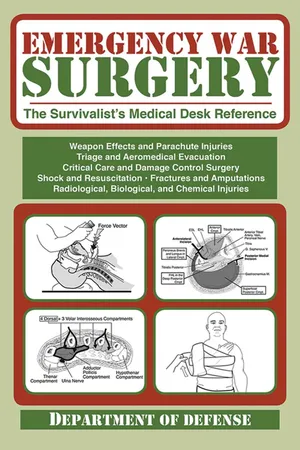
Military surgeons must assume a leadership role in combat casualty care in circumstances that are far less than ideal. This handbook provides much of the information needed to tackle these issues and features state-of-the-art principles and practices of forward trauma surgery as used by military physicians in far flung locations around the globe. Featuring nearly 200 illustrations demonstrating proper techniques, Emergency War Surgery is the most trusted and up-to-date manual offered by the Department of Defense for military medical personnel in the field.
Information
Topic
MedicineTable of contents
- Cover
- Title
- Copyright
- Contents
- Dedication
- List of Tables
- Editorial & Production
- Editorial Board
- Contributors
- Acknowledgments
- Foreword
- Preface
- Prologue
- Envoi
- Chapter 1: Weapons Effects and Parachute Injuries
- Chapter 2: Levels of Medical Care
- Chapter 3: Triage
- Chapter 4: Aeromedical Evacuation
- Chapter 5: Airway/Breathing
- Chapter 6: Hemorrhage Control
- Chapter 7: Shock and Resuscitation
- Chapter 8: Vascular Access
- Chapter 9: Anesthesia
- Chapter 10: Infections
- Chapter 11: Critical Care
- Chapter 12: Damage Control Surgery
- Chapter 13: Face and Neck Injuries
- Chapter 14: Ocular Injuries
- Chapter 15: Head Injuries
- Chapter 16: Thoracic Injuries
- Chapter 17: Abdominal Injuries
- Chapter 18: Genitourinary Tract Injuries
- Chapter 19: Gynecologic Trauma and Emergencies
- Chapter 20: Wounds and Injuries of the Spinal Column and Cord
- Chapter 21: Pelvic Injuries
- Chapter 22: Soft-Tissue Injuries
- Chapter 23: Extremity Fractures
- Chapter 24: Open-Joint Injuries
- Chapter 25: Amputations
- Chapter 26: Injuries to the Hands and Feet
- Chapter 27: Vascular Injuries
- Chapter 28: Burn Injuries
- Chapter 29: Environmental Injuries
- Chapter 30: Radiological Injuries
- Chapter 31: Biological Warfare Agents
- Chapter 32: Chemical Injuries
- Chapter 33: Pediatric Care
- Chapter 34: Care of Enemy Prisoners of War/Internees
- Appendix 1: Principles of Medical Ethics
- Appendix 2: Glasgow Coma Scale
- Appendix 3: Theater Joint Trauma Record
- Index
Trusted by 375,005 students
Access to over 1.5 million titles for a fair monthly price.
Study more efficiently using our study tools.
Frequently asked questions
Yes, you can cancel anytime from the Subscription tab in your account settings on the Perlego website. Your subscription will stay active until the end of your current billing period. Learn how to cancel your subscription
No, books cannot be downloaded as external files, such as PDFs, for use outside of Perlego. However, you can download books within the Perlego app for offline reading on mobile or tablet. Learn how to download books offline
Perlego offers two plans: Essential and Complete
- Essential is ideal for learners and professionals who enjoy exploring a wide range of subjects. Access the Essential Library with 800,000+ trusted titles and best-sellers across business, personal growth, and the humanities. Includes unlimited reading time and Standard Read Aloud voice.
- Complete: Perfect for advanced learners and researchers needing full, unrestricted access. Unlock 1.5M+ books across hundreds of subjects, including academic and specialized titles. The Complete Plan also includes advanced features like Premium Read Aloud and Research Assistant.
We are an online textbook subscription service, where you can get access to an entire online library for less than the price of a single book per month. With over 1.5 million books across 990+ topics, we’ve got you covered! Learn about our mission
Look out for the read-aloud symbol on your next book to see if you can listen to it. The read-aloud tool reads text aloud for you, highlighting the text as it is being read. You can pause it, speed it up and slow it down. Learn more about Read Aloud
Yes! You can use the Perlego app on both iOS and Android devices to read anytime, anywhere — even offline. Perfect for commutes or when you’re on the go.
Please note we cannot support devices running on iOS 13 and Android 7 or earlier. Learn more about using the app
Please note we cannot support devices running on iOS 13 and Android 7 or earlier. Learn more about using the app
Yes, you can access Emergency War Surgery by in PDF and/or ePUB format, as well as other popular books in Medicine & Emergency Medicine & Critical Care. We have over 1.5 million books available in our catalogue for you to explore.