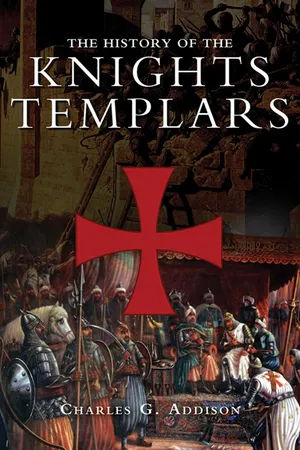
The History of the Knights Templars
eBook - ePub

The History of the Knights Templars

  1. 288 pages
  2. English
  3. ePUB (mobile friendly)
  4. Available on iOS & Android
eBook - ePub

The History of the Knights Templars

About this book

The history of the Knights Templars is a remarkable story of triumphs and defeats, marked with controversies and tragedy. From their rise to their demise, Charles G. Addison captivatingly chronicles the various characters that played a role in shaping this powerful military order that reigned for almost two centuries during the Middle Ages.Having examined scores of documents and texts, and traveled to many of the ruined fortresses and castles of the order, Addison was an expert on the Templars' history. He insightfully details their plight in this volume, first published in 1842. Starting with the origins of the brotherhood, the foundations and ideals of the order, and their chosen symbol of the red cross, the author explains their role in protecting pilgrims traveling to the Holy Land, their feats during the Crusades, the relationships they held with various kings and church leaders, their contributions to protecting Europe from Turkish conquest and preserving Christianity in Europe and Asia, and their tragic end: stripped of their lands, tortured, and burned at the stake. Addison provides a clear and comprehensible account of this great religious and military fraternity of knights and monks that will engross anyone interested in their history and the Middle Ages.
Frequently asked questions

Yes, you can cancel anytime from the Subscription tab in your account settings on the Perlego website. Your subscription will stay active until the end of your current billing period. Learn how to cancel your subscription.
No, books cannot be downloaded as external files, such as PDFs, for use outside of Perlego. However, you can download books within the Perlego app for offline reading on mobile or tablet. Learn more here.
Perlego offers two plans: Essential and Complete
  • Essential is ideal for learners and professionals who enjoy exploring a wide range of subjects. Access the Essential Library with 800,000+ trusted titles and best-sellers across business, personal growth, and the humanities. Includes unlimited reading time and Standard Read Aloud voice.
  • Complete: Perfect for advanced learners and researchers needing full, unrestricted access. Unlock 1.4M+ books across hundreds of subjects, including academic and specialized titles. The Complete Plan also includes advanced features like Premium Read Aloud and Research Assistant.
Both plans are available with monthly, semester, or annual billing cycles.
We are an online textbook subscription service, where you can get access to an entire online library for less than the price of a single book per month. With over 1 million books across 1000+ topics, we’ve got you covered! Learn more here.
Look out for the read-aloud symbol on your next book to see if you can listen to it. The read-aloud tool reads text aloud for you, highlighting the text as it is being read. You can pause it, speed it up and slow it down. Learn more here.
Yes! You can use the Perlego app on both iOS or Android devices to read anytime, anywhere — even offline. Perfect for commutes or when you’re on the go.
Please note we cannot support devices running on iOS 13 and Android 7 or earlier. Learn more about using the app.
Yes, you can access The History of the Knights Templars by Charles G. Addison in PDF and/or ePUB format, as well as other popular books in History & British History. We have over one million books available in our catalogue for you to explore.

Information

Publisher
Skyhorse
Year
2012
Print ISBN
9781616088460
eBook ISBN
9781620878163
THE
KNIGHTS TEMPLARS
image

CHAPTER I.

Origin of the Templars—The pilgrimages to Jerusalem—The dangers to which pilgrims were exposed—The formation of the brotherhood of the poor fellow-soldiers of Jesus Christ to protect them—Their location in the Temple—A description of the Temple—Origin of the name Templars—Hugh de Payens chosen Master of the Temple—Is sent to Europe by King Baldwin—Is introduced to the Pope—The assembling of the Council of Troyes— The formation of a rule for the government of the Templars
image
ā€œYet ā€˜midst her towering fanes in ruin laid,
The pilgrim saint his murmuring vespers paid;
ā€˜Twas his to mount the tufted rocks, and rove
The chequer’d twilight of the olive-grove:
ā€˜Twas his to bend beneath the sacred gloom,
And wear with many a kiss Messiah’s tomb.ā€
THE extraordinary and romantic institution of the Knights Templars, those military friars who so strangely blended the character of the monk with that of the soldier, took its origin in the following manner:—
On the miraculous discovery of the Holy sepulchre by the Empress Helena, the mother of Constantine, about 298 years after the death of Christ, and the consequent erection, by command of the first Christian emperor, of the magnificent church of the Resurrection, or, as it is now called, the Church of the Holy Sepulchre, over the sacred monument, the tide of pilgrimage set in towards Jerusalem, and went on increasing in strength as Christianity gradually spread throughout Europe. On the surrender of the Holy City to the victorious Arabians, (A.D. 637), the privileges and the security of the Christian population were provided for in the following guarantee, given under the hand and seal of the Caliph Omar to Sophronius the Patriarch.
ā€œFrom OMAR EBNO ā€˜L ALCHITAB to the inhabitants of ƆLIA.ā€
ā€œThey shall be protected and secured both in their lives and fortunes, and their churches shall neither be pulled down nor made use of by any but themselves.ā€*
Under the government of the Arabians, the pilgrimages continued steadily to increase; the old and the young, women and children, flocked in crowds to Jerusalem, and in the year 1064 the Holy Sepulchre was visited by an enthusiastic band of seven thousand pilgrims, headed by the Archbishop of Mentz and the Bishops of Utrecht, Bamberg, and Ratisbon.† The year following, however, Jerusalem was conquered by the wild Turcomans. Three thousand of the citizens were indiscriminately massacred, and the hereditary command over the Holy City and territory was confided to the Emir Ortok, the chief of a savage pastoral tribe.
Under the iron yoke of these fierce Northern strangers, the Christians were fearfully oppressed; they were driven from their churches; divine worship was ridiculed and interrupted; and the patriarch of the Holy City was dragged by the hair of his head over the sacred pavement of the church of the Resurrection, and cast into a dungeon, to extort a ransom from the sympathy of his flock. The pilgrims who, through innumerable perils, had reached the gates of the Holy City, were plundered, imprisoned, and frequently massacred; an aureus, or piece of gold, was exacted as the price of admission to the holy sepulchre, and many, unable to pay the tax, were driven by the swords of the Turcomans from the very threshold of the object of all their hopes, the bourne of their long pilgrimage, and were compelled to retrace their weary steps in sorrow and anguish to their distant homes.— The melancholy intelligence of the profanation of the holy places, and of the oppression and cruelty of the Turcomans, aroused the religious chivalry of Christendom; ā€œa nerve was touched of exquisite feeling, and the sensation vibrated to the heart of Europe.ā€
Then arose the wild enthusiasm of the crusades; men of all ranks, and even monks and priests, animated by the exhortations of the pope and the preachings of Peter the Hermit, flew to arms, and enthusiastically undertook ā€œthe pious and glorious enterprizeā€ of rescuing the holy sepulchre of Christ from the foul abominations of the heathen.
When intelligence of the capture of Jerusalem by the Crusaders (A.D. 1099) had been conveyed to Europe, the zeal of pilgrimage blazed forth with increased fierceness; it had gathered intensity from the interval of its suppression by the wild Turcomans, and promiscuous crowds of both sexes, old men and children, virgins and matrons, thinking the road then open and the journey practicable, successively pressed forwards towards the Holy City, with the passionate desire of contemplating the original monuments of the Redemption.* The infidels had indeed been driven out of Jerusalem, but not out of Palestine. The lofty mountains bordering the sea-coast were infested by bold and warlike bands of fugitive Mussulmen, who maintained themselves in various impregnable castles and strongholds, from whence they issued forth upon the highroads, cut off the communication between Jerusalem and the sea-ports, and revenged themselves for the loss of their habitations and property by the indiscriminate pillage of all travellers. The Bedouin horsemen, moreover, making rapid incursions from beyond the Jordan, frequently kept up a desultory and irregular warfare in the plains; and the pilgrims, consequently, whether they approached the Holy City by land or by sea, were alike exposed to almost daily hostility, to plunder, and to death.
* Elmacin, Hist. Saracen. Eutychius.
† Ingulphus, the secretary of William the Conqueror, one of the number, states that he sallied forth from Normandy with thirty companions, all stout and well-appointed horsemen, and that they returned twenty miserable palmers, with the staff in their hand and the wallet at their back—Baronius ad ann. 1064, No. 43, 56.
— Will. Tyr., lib. i. cap. 10, ed. 1564.
To alleviate the dangers and distresses to which these pious enthusiasts were exposed, to guard the honour of the saintly virgins and matrons,† and to protect the gray hairs of the venerable palmer, nine noble knights formed a holy brotherhood in arms, and entered into a solemn compact to aid one another in clearing the highways of infidels, and of robbers, and in protecting the pilgrims through the passes and defiles of the mountains to the Holy City. Warmed with the religious and military fervour of the day, and animated by the sacredness of the cause to which they had devoted their swords, they called themselves the Poor Fellow-soldiers of Jesus Christ. They renounced the world and its pleasures, and in the holy church of the Resurrection, in the presence of the patriarch of Jerusalem, they embraced vows of perpetual chastity, obedience, and poverty, after the manner of monks.— Uniting in themselves the two most popular qualities of the age, devotion and valour, and exercising them in the most popular of all enterprises, the protection of the pilgrims and of the road to the holy sepulchre, they speedily acquired a vast reputation and a splendid renown.
* Omnibus mundi partibus divites et pauperes, juvenes et virgines, senes cum junioribus, loca sancta visitaturi Hierosolymam pergerent.—Jac. de Vitriaco. Hist. Hierosol. cap. Lxv
† ā€œTo kiss the holy monuments,ā€ says William of Tyre, ā€œcame sacred and chaste widows, forgetful of feminine fear, and the multiplicity of dangers that beset their path.ā€ —Lib. xviii. cap. 5.
— Quidam autem Deo amabiles et devoti milites, charitate ferventes, mundo renuntiantes, et Christi se servitio mancipantes in manu PatriarchƦ Hierosolymitani professione et voto solemni sese astrinxerunt, ut a prƦdictis latronibus, et viris sanguinum, defenderent peregrinos, et stratas publicas custodirent, more canonicorum regularium in obedientia et castitiate et sine proprio militaturi summon regi. Jac. De Vitr. Hist. Hierosol. apud Gesta Dei per Francos, cap. lxv. p. 1083.––Will. Tyr. lib. xii. cap.7. There were three kinds of poverty. The first and strictest (altissima) admitted not of the possession of any description of property whatever. The second (media) forbade the possession of individual property, but sanctioned any amount of wealth when shared by a fraternity in common. The lowest was where a separate property in some few things was allowed, such as food and clothing, whilst everything else was shared in common. The second kind of poverty (media) was adopted by the Templars.
At first, we are told, they had no church and no particular place of abode, but in the year of our Lord 1118, (nineteen years after the conquest of Jerusalem by the Crusaders), they had rendered such good and acceptable service to the Christians, that Baldwin the Second, king of Jerusalem, granted them a place of habitation within the sacred inclosure of the Temple on Mount Moriah, amid those holy and magnificent structures, partly erected by the Christian Emperor Justinian, and partly built by the Caliph Omar, which were then exhibited by the monks and priests of Jerusalem, whose restless zeal led them to practise on the credulity of the pilgrims, and to multiply relics and all objects likely to be sacred in their eyes, as the Temple of Solomon, whence the Poor Fellow-soldiers of Jesus Christ came thenceforth to be known by the name of ā€œthe Knighthood of the Temple of Solomon.ā€*
A few remarks in elucidation of the name Templars, or Knights of the Temple, may not be altogether unacceptable.
By the Mussulmen, the site of the great Jewish temple on Mount Moriah has always been regarded with peculiar veneration. Mahomet, in the first year of the publication of the Koran, directed his followers, when at prayer, to turn their faces towards it, and pilgrimages have constantly been made to the holy spot by devout Moslems. On the conquest of Jerusalem by the Arabians, it was the first care of the Caliph Omar to rebuild ā€œthe Temple of the Lord.ā€ Assisted by the principal chieftains of his army, the Commander of the Faithful undertook the pious office of clearing the ground with his own hands, and of tracing out the foundations of the magnificent mosque which now crowns with its dark and swelling dome the elevated summit of Mount Moriah.†
This great house of prayer, the most holy Mussulman Temple in the world after that of Mecca, is erected over the spot where ā€œSolomon began to build the house of the Lord at Jerusalem on Mount Moriah, where the Lord appeared unto David his father, in the place that David had prepared in the threshing-floor of Ornan the Jebusite.ā€ It remains to this day in a state of perfect preservation, and is one of the finest specimens of Saracenic architecture in existence. It is entered by four spacious doorways, each door facing one of the cardinal points; the Bab el D’jannat, or gate of the garden, on the north; the Bab el Kebla, or gate of prayer, on the south; the Bab ib’n el Daoud, or the gate of the son of David, on the east; and the Bab el Garbi, on the west. By the Arabian geographers it is called Beit Allah, the house of God, also Beit Almokaddas, or Beit Almacdes, the holy house. From it Jerusalem derives its Arabic name, el Kods, the holy, el Schereef, the noble, and el Mobarek, the blessed; while the governors of the city, instead of the customary high-sounding titles of sovereignty and dominion, take the simple title of Hami, or protectors.
* Pantaleon, lib. iii. p. 82.
† D ā€˜Herbelot Bib. Orient, p. 270, 687, ed. 1697. William of Tyre, who lived at Jerusalem shortly after the conquest of the city by the Crusaders, tells us that the Caliph Omar required the Patriarch Sophronius to point out to him the site of the temple destroyed by Titus, which being done, the caliph immediately commenced the erection of a fresh temple thereon, ā€œQuo postea infra modicum tempus juxta conceptum mentis suƦ feliciter consummato, quale hodie Hierosolymis esse dinoscitur, multis et infinites ditavit possessionibus.ā€ —Will. Tyr. lib. i. cap. 2.
On the conquest of Jerusalem by the crusaders, the crescent was torn down from the summit of this famous Mussulman Temple, and was replaced by an immense golden cross, and the edifice was then consecrated to the services of the Christian religion, but retained its simple appellation of ā€œThe Temple of the Lord.ā€ William, Archbishop of Tyre and Chancellor of the Kingdom of Jerusalem, gives an interesting account of this famous edifice as it existed in his time, during the Latin dominion. He speaks of the splendid mosaic work, of the Arabic characters setting forth the name of the founder, and the cost of the undertaking, and of the famous rock under the centre of the dome, which is to this day shown by the Moslems as the spot whereon the destroying angel stood, ā€œwith his drawn sword in his hand stretched out over Jerusalem.ā€* This rock he informs us was left exposed and uncovered for the space of fifteen years after the conquest of the Holy City by the crusaders, but was, after that period, cased with a handsome altar of white marble, upon which the priests daily said mass.
To the south of this holy Mussulman temple, on the extreme edge of the summit of Mount Moriah, and resting against the modern walls of the town of Jerusalem, stands the venerable Christian church of the Virgin, erected by the Emperor Justinian, whose stupendous foundations, remaining to this day, fully justify the astonishing description given of the building by Procopius. That writer informs us that in order to get a level surface for the erection of the edifice, it was necessary, on the east and south sides of the hill, to raise up a wall of masonry from the valley below, and to construct a vast foundation, partly composed of solid stone and partly of arches and pillars. The stones were of such magnitude, that each block required to be transported in a truck drawn by forty of the emperor’s strongest oxen; and to admit of the passage of these trucks it was necessary to widen the roads leading to Jerusalem. The forests of Lebanon yielded their choicest cedars for the timbers of the roof, and a quarry of variegated marble, seasonably discovered in the adjoining mountains, furnished the edifice with superb marble columns.* The interior of this interesting structure, which still remains at Jerusalem, after a lapse of more than thirteen centuries, in an excellent state of preservation, is adorned with six rows of columns, from whence spring arches supporting the cedar beams and timbers of the roof; and at the end of the building is a round tower, surmounted by a dome. The vast stones, the walls of masonry, and the subterranean colonnade raised to support the south-east angle of the platform whereon the church is erected, are truly wonderful, and may still be seen by penetrating through a small door, and descending several flights of steps at the south-east corner of the inclosure. Adjoining the sacred edifice, the emperor erected hospitals, or houses of refuge, for travellers, sick people, and mendicants of all nations; the foundations whereof, composed of handsome Roman masonry, are still visible on either side of the southern end of the building.
* Erant porro in eodem Templi Ʀdificio, intus et extra ex opere musaico, Arabici idiomatis literarum vetustissima monimenta, quibus et auctor et impensarum quantitas et quo tempore opus inceptum quodque consummatum fiierit evidenter declaratur… In hujus superioris arƦ medio Templum Ʀdificatum est, forma quidem octogonum et laterum totidem, tectum habens sphericum plumbo artificiose copertum. … Intus vero in medio Templi, infra interiorem columnarum ordinem rupes est, &c.—Will. Tyr. lib. i. cap 2, lib. viii. cap. 3. In hoc loco, supra rupem quƦ adhuc in eodem Templo consistit, dicitur stetisse et apparuisse David exterminator Angel...

Table of contents

  1. Cover
  2. Title
  3. Dedication
  4. Preface
  5. Contents
  6. Chapter I.
  7. Chapter II.
  8. Chapter III.
  9. Chapter IV.
  10. Chapter V.
  11. Chapter VI.
  12. Chapter VII.
  13. Chapter VIII.
  14. Chapter IX.
  15. Chapter X.
  16. Chapter XI. The Temple Church..
  17. Chapter XII. The Temple Church.
  18. Chapter XIII. The Temple.
  19. Chapter XIV. The Temple.