The Book of the Sword
eBook - ePub

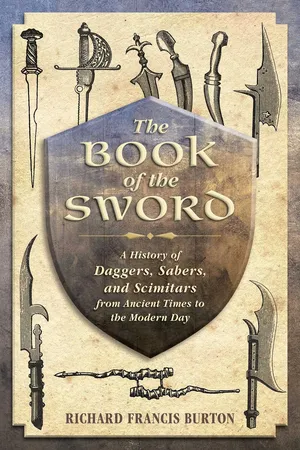
The Book of the Sword

A History of Daggers, Sabers, and Scimitars from Ancient Times to the Modern Day

  1. 336 pages
  2. English
  3. ePUB (mobile friendly)
  4. Available on iOS & Android
eBook - ePub

The Book of the Sword

A History of Daggers, Sabers, and Scimitars from Ancient Times to the Modern Day

About this book

"The history of the sword, " the author writes in his introduction, "is the history of humanity." For centuries, the sword has been a symbol of power, strength, liberty, and courage. In the Middle Ages, the image of a sword was used to signify the word of God. Nearly every culture in history has forged blades from stone or steel to fight in times of battle and protect in times of peace.In this groundbreaking work, Richard Francis Burton, explorer, translator, scholar, and swordsman, draws on a wealth of linguistic, archaeological, and literary sources to trace the millennia-old history of the sword. From its earliest days as a charred, sharpened stick to the height of craftsmanship in the modern era, the sword has been the weapon of choice for warriors of all stripes.In eloquent, captivating prose, Burton describes:
• Dirks
• Daggers
• Knives
• Sabers
• Cutlasses
• The origin of the weapon
• The weapons of the age of wood
• The Copper Age of weapons
• The Iron Age of weapons
• The sword in ancient Egypt
• The sword in ancient Greece
• And moreNearly three hundred line drawings enhance Burton's richly detailed text. Any reader of history or student of weaponry will find this book a fascinating, highly enjoyable read.
Frequently asked questions

Yes, you can cancel anytime from the Subscription tab in your account settings on the Perlego website. Your subscription will stay active until the end of your current billing period. Learn how to cancel your subscription.
No, books cannot be downloaded as external files, such as PDFs, for use outside of Perlego. However, you can download books within the Perlego app for offline reading on mobile or tablet. Learn more here.
Perlego offers two plans: Essential and Complete
  • Essential is ideal for learners and professionals who enjoy exploring a wide range of subjects. Access the Essential Library with 800,000+ trusted titles and best-sellers across business, personal growth, and the humanities. Includes unlimited reading time and Standard Read Aloud voice.
  • Complete: Perfect for advanced learners and researchers needing full, unrestricted access. Unlock 1.4M+ books across hundreds of subjects, including academic and specialized titles. The Complete Plan also includes advanced features like Premium Read Aloud and Research Assistant.
Both plans are available with monthly, semester, or annual billing cycles.
We are an online textbook subscription service, where you can get access to an entire online library for less than the price of a single book per month. With over 1 million books across 1000+ topics, we’ve got you covered! Learn more here.
Look out for the read-aloud symbol on your next book to see if you can listen to it. The read-aloud tool reads text aloud for you, highlighting the text as it is being read. You can pause it, speed it up and slow it down. Learn more here.
Yes! You can use the Perlego app on both iOS or Android devices to read anytime, anywhere — even offline. Perfect for commutes or when you’re on the go.
Please note we cannot support devices running on iOS 13 and Android 7 or earlier. Learn more about using the app.
Yes, you can access The Book of the Sword by Richard Francis Burton in PDF and/or ePUB format, as well as other popular books in History & Ancient History. We have over one million books available in our catalogue for you to explore.

Information

Publisher
Skyhorse
Year
2014
Print ISBN
9781626364011
eBook ISBN
9781628738476

THE BOOK OF THE SWORD.

CHAPTER I.

PREAMBLE: ON THE ORIGIN OF WEAPONS.

MAN’S civilisation began with Fire—how to light it and how to keep it lit. Before he had taken this step, our primal ancestor (or ancestors) evidently led the life of the lower animals. The legend of ‘Iapetus’ bold son’ Prometheus, like many others invented by the Greeks, or rather borrowed from Egypt, contained under the form of fable a deep Truth, a fact, a lesson valuable even in these days. ‘Forethought,’ the elder brother of ‘Afterthought,’ brought down the semina flammœ in a hollow tube from Heaven, or stole it from the chariot of the Sun. Here we have the personification of the Great Unknown, who, finding a cane-brake or a jungle tree fired by lightning or flamed by wind-friction, conceived the idea of feeding the
images
with fuel. Thus Hermes or Mercury was ‘Pteropédilos’ or ‘Alipes;’ and his ankles were fitted with ‘Pedila’ or ‘Talaria,’ winged sandals, to show that the soldier fights with his legs as well as with his arms.1
I will not enlarge upon the imperious interest of Hoplology: the history of arms and armour, their connection and their transitions, plays the most important part in the annals of the world.
The first effort of human technology was probably weapon-making. History and travel tell us of no race so rude as to lack artificial means of offence and defence.1 To these, indeed, man’s ingenuity and artistic efforts must, in his simple youthtide, have been confined. I do not allude to the complete man, created full-grown in body and mind by the priestly castes of Egypt, Phœnicia, Judaea, Assyria, Persia, and India. The Homo sapiens whom we have to consider is the ‘Adam Kadmon,’2 not of the Cabbalist, but of the anthropologist, as soon as he raised himself above the beasts of the field by superiority of brains and hands.
The lower animals are born armed, but not weaponed. The arm, indeed, is rather bestial than human: the weapon is, speaking generally, human, not bestial. Naturalists have doubted, and still doubt, whether in the so-called natural state the lower animals use weapons properly so termed. Colonel A. Lane Fox, a diligent student of primitive warfare, and a distinguished anthropologist,3 distinctly holds the hand-stone to be the prehistoric weapon. He quotes (Cat. pp. 156–59) the ape using the hand-stone to crack nutshells; the gorillas defending themselves against the Carthaginians of Hanno; and Pedro de Cieza (Cieça) de Leon4 telling us that’ when the Spaniards [in Peru] pass under the trees where the monkeys are, these creatures break off branches and throw them down, making faces all the time.’ Even in the days of Strabo (xv. 1) it was asserted that Indian monkeys climb precipices, and roll down stones upon their pursuers—a favourite tactic with savages. Nor, indeed, is it hard to believe that the Simiads, whose quasi-human hand has prehensile powers, bombard their assailants with cocoa-nuts and other missiles. Major Denham (1821–24), a trustworthy traveller, when exploring about Lake Chad, says of the quadrumans of the Yeou country: ‘The monkeys, or, as the Arabs say, men enchanted (Beny Adam meshood),5 were so numerous that I saw upwards of a hundred and fifty assembled at one place in the evening. They did not appear at all inclined to give up their ground, but, perched on the top of a bank some twenty feet high, made a terrible noise, and, rather gently than otherwise, pelted us as we approached within a certain distance.’ Herr Holub,6 also, was ‘designedly aimed at by a herd of African baboons perched among the trees; ‘and on another occasion he and his men had to beat an ignominious retreat from ‘our cousins.’ ‘Hence,’ suggests Colonel A. Lane Fox, ‘our “poor relation” conserves, even when bred abroad and in captivity, the habit of violently shaking the branch by jumping upon it with all its weight, in order that the detached fruit may fall upon the assailant’s head.’ In Egypt, as we see from the tomb-pictures, monkeys (baboons or cynocephali) were taught to assist in gathering fruit, and in acting as torch-bearers. While doing this last duty, their innate petulance caused many a merry scene.1
I never witnessed this bombardment by monkeys. But when my regiment was stationed at Baroda in Gujarát, several of my brother officers and myself saw an elephant use a weapon. The intelligent animal, which the natives call Háthi (‘the handed’2), was chained to a post during the dangerous season of the wet forehead, and was swaying itself in ill-temper from side to side. Probably offended by the sudden appearance of white faces, it seized with its trunk a heavy billet, and threw it at our heads with a force and a good will that proved the worst intention.
According to Captain Hall—who, however, derived the tale from the Eskimos,3 the sole living representatives of the palaeolithic age in Europe—the polar dear, traditionally reported to throw stones, rolls down, with its quasi-human forepaws, rocks and boulders upon the walrus when found sleeping at the foot of some overhanging cliff. ‘Meister Petz’ aims at the head, and finally brains the stunned prey with the same weapon. Perhaps the account belongs to the category of the ostrich throwing stones, told by many naturalists, including Pliny (x. 1), when, as Father Lobo explained in his ‘Abyssinia,’ the bird only kicks them up during its scouring flight Similar, too, is the exploded shooting-out of the porcupine’s quills, whereby, according to mediaeval ‘Shoe-tyes ‘4 men have been badly hurt and even killed. On the other hand, the Emu kicks like an Onager1 and will drive a man from one side of a quarter-deck to the other.
But though Man’s first work was to weapon himself, we must not believe with the Cynics and the Humanitarians that his late appearance in creation, or rather on the stage of life, initiated an unvarying and monotonous course of destructiveness. The great tertiary mammals which preceded him, the hoplotherium, the deino-therium, and other-theria, made earth a vast scene of bloodshed to which his feeble powers could add only a few poor horrors. And even in our day the predatory fishes, that have learned absolutely nothing from man’s inhumanity to man, habitually display as much ferocity as ever disgraced savage human nature.
Primitive man—the post-tertiary animal—was doomed by the very conditions of his being and his media to a life of warfare; a course of offence to obtain his food, and of defence to retain his life. Ulysses2 says pathetically:
No thing frailer of force than Man earth breedeth and feedeth;
Man ever feeblest of all on th’ Earth’s face creeping and crawling.
The same sentiment occurs in the ‘Iliad’; and Pliny, the pessimist, writes—‘the only tearful animal, Man.’
The career of these wretches, who had neither ‘minds’ nor ‘souls,’ was one long campaign against ravenous beasts and their ‘brother’ man-brutes. Peace was never anything to them but a fitful interval of repose. The golden age of the poets was a dream; as Videlou remarked, ‘Peace means death for all barbarian races.’ The existence of our earliest ancestors was literally the Battle of Life. Then, as now, the Great Gaster was the first Master of Arts, and War was the natural condition of humanity upon which depends the greater part of its progress, its rising from the lower to the higher grade. Hobbism, after all, is partly right: ‘Men were by nature equal, and their only social relation was a state of war.’ Like the children of our modern day, helpless and speechless, primaeval Homo possessed, in common with his fellow-creatures, only the instincts necessary for self-support under conditions the most facile. Uncultivated thought is not rich in the productive faculty; the brain does not create ideas: it only combines them and evolves the novelty of deduction, and the development of what is found existing. Similarly in language, onomatopoeia, the imitation of natural sounds, the speech of Man’s babyhood, still endures; and to it we owe our more picturesque and life-life expressions. But, despite their feeble powers, compulsory instruction, the Instructor being Need, was continually urging the Savage and the Barbarian to evolve safety out of danger, comfort out of its contrary.
For man, compelled by necessity of his nature to weapon himself, bears within him the two great principles of Imitation and Progress. Both are, after a fashion, his peculiar attributes, being rudimentary amongst the lower animals, though by no means wholly wanting. His capacity of language, together with secular development of letters and literature, enabled him to accumulate for himself, and to transmit to others, a store of experience acquired through the medium of the senses; and this, once gained, was never wholly los...

Table of contents

  1. Front Cover
  2. Title Page
  3. Copyright Page
  4. Contents
  5. List of Illustrations
  6. Foreword
  7. Introduction
  8. Chapter I. Preamble: on the Origin of Weapons
  9. Chapter II. Man’s First Weapons—the Stone and the Stick. the Earliest Ages of Weapons. the Ages of Wood, of Bone, and of Horn
  10. Chapter III. The Weapons of the Age of Wood: the Boomerang and the Sword of Wood; of Stone, and of Wood and Stone Combined
  11. Chapter IV. The Proto-chalcitic or Copper Age of Weapons
  12. Chapter V. The Second Chalcitic Age of Alloys—bronze, Brass, Etc.: the Axe and the Sword
  13. Chapter VI. The Proto-sideric or Early Iron Age of Weapons
  14. Chapter VII. The Sword: What is It?
  15. Chapter VIII. The Sword in Ancient Egypt and in Modern Africa
  16. Chapter IX. The Sword in Khita-land, Palestine and Canaan; Phœnicia and Carthage; Jewry, Cyprus, Troy, and Etruria
  17. Chapter X. The Sword in Babylonia, Assyria and Persia, and Ancient India
  18. Chapter XI. The Sword in Ancient Greece: Homer; Hesiod and Herodotus: MycenĂŚ
  19. Chapter XII. The Sword in Ancient Rome; the Legion and the Gladiator
  20. Chapter XIII. The Sword Amongst the Barbarians (early Roman Empire)
  21. Conclusion
  22. List of Authorities
  23. Footnotes