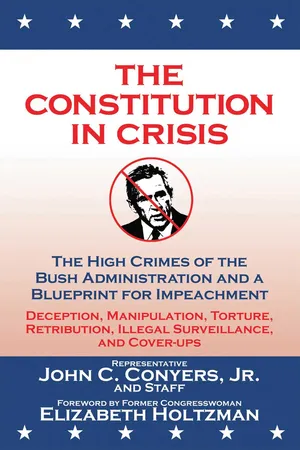
The Republican-led Congress has been notoriously slow to investigate the current Republican administration. For that reason, Representative Conyers of Michigan commissioned his staff to put together the report that became The Constitution in Crisis. It chronicles the deceptions, manipulations, and retributions of President George W. Bush and his administration. Did the President mislead the country in order to invade Iraq? Have suspected "evil-doers" been tortured in violation of U.S. and international laws? Has the National Security Agency eaves-dropped on American citizens in violation of wire tapping laws? This report is a must-read for anyone concerned about the direction of our nation!Skyhorse Publishing, as well as our Arcade imprint, are proud to publish a broad range of books for readers interested in history--books about World War II, the Third Reich, Hitler and his henchmen, the JFK assassination, conspiracies, the American Civil War, the American Revolution, gladiators, Vikings, ancient Rome, medieval times, the old West, and much more. While not every title we publish becomes a New York Times bestseller or a national bestseller, we are committed to books on subjects that are sometimes overlooked and to authors whose work might not otherwise find a home.
- 320 pages
- English
- ePUB (mobile friendly)
- Available on iOS & Android
eBook - ePub
About this book
Information
Table of contents
- Title Page
- Copyright Page
- Table of Contents
- Foreword
- Introduction
- Summary
- I - The Downing Street Minutes and Deception, Manipulation, Torture, Retribution, and Coverups in the Iraq War
- II - Unlawful Domestic Surveillance and the Decline of Civil Liberties Under the Administration of George W. Bush
- Addendum
- Analysis
- Recommendations
- Conclusion
- Endnotes
- Legal Standards and Authorities
- Major Reports
Trusted by 375,005 students
Access to over 1.5 million titles for a fair monthly price.
Study more efficiently using our study tools.
Frequently asked questions
Yes, you can cancel anytime from the Subscription tab in your account settings on the Perlego website. Your subscription will stay active until the end of your current billing period. Learn how to cancel your subscription
No, books cannot be downloaded as external files, such as PDFs, for use outside of Perlego. However, you can download books within the Perlego app for offline reading on mobile or tablet. Learn how to download books offline
Perlego offers two plans: Essential and Complete
- Essential is ideal for learners and professionals who enjoy exploring a wide range of subjects. Access the Essential Library with 800,000+ trusted titles and best-sellers across business, personal growth, and the humanities. Includes unlimited reading time and Standard Read Aloud voice.
- Complete: Perfect for advanced learners and researchers needing full, unrestricted access. Unlock 1.5M+ books across hundreds of subjects, including academic and specialized titles. The Complete Plan also includes advanced features like Premium Read Aloud and Research Assistant.
We are an online textbook subscription service, where you can get access to an entire online library for less than the price of a single book per month. With over 1.5 million books across 990+ topics, we’ve got you covered! Learn about our mission
Look out for the read-aloud symbol on your next book to see if you can listen to it. The read-aloud tool reads text aloud for you, highlighting the text as it is being read. You can pause it, speed it up and slow it down. Learn more about Read Aloud
Yes! You can use the Perlego app on both iOS and Android devices to read anytime, anywhere — even offline. Perfect for commutes or when you’re on the go.
Please note we cannot support devices running on iOS 13 and Android 7 or earlier. Learn more about using the app
Please note we cannot support devices running on iOS 13 and Android 7 or earlier. Learn more about using the app
Yes, you can access The Constitution in Crisis by in PDF and/or ePUB format, as well as other popular books in History & Teaching History. We have over 1.5 million books available in our catalogue for you to explore.