The WOW Factor
eBook - ePub

The WOW Factor

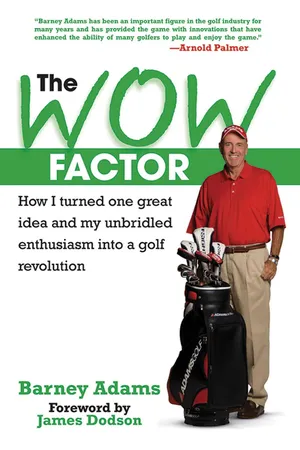
How I Turned One Idea and My Unbridled Enthusiasm into a Golf Revolution

  1. 320 pages
  2. English
  3. ePUB (mobile friendly)
  4. Available on iOS & Android
eBook - ePub

The WOW Factor

How I Turned One Idea and My Unbridled Enthusiasm into a Golf Revolution

About this book

The founder of Adams Golf and the inventor of Tight Lies, the most popular fairway wood of all time, tells his rags-to-riches story. In the early years of Adams Golf, entrepreneur Barney Adams labored in obscurity. He collected six patents for his golf products, manufacturing fine equipment but enjoying no sales. Everything changed for him and his company in 1996, though, when he invented the Tight Lies fairway wood. Working as a custom fitter, his customers repeatedly asked for a club they could play from "long iron" distance, from 180 to 220 yards to the green. Adams knew the technical secret was to lower the club's center of gravity. He did this by designing the traditional head shape upside down, which not only lowered the center of gravity, but also increased the hitting surface. The result was a club that was easier to hit, and suddenly Adams and his club, after years of diligent work, became overnight sensations. As lean as those early years of Adams Golf were, the amazing success of Tight Lies more than made up for them. Sales skyrocketed beyond Adams's wildest expectations, and earned Adams Golf two placements on the Inc. 500 Fastest Growing Small Companies list, an Industry Week Top 25 Award for Growing Manufacturing Companies, several golf industry awards, and led to the largest IPO in the history of the golf industry in 1998. This is Barney's unvarnished story of how he made this happen, and how you, too, can make your entrepreneurial dreams come true.
Frequently asked questions

Yes, you can cancel anytime from the Subscription tab in your account settings on the Perlego website. Your subscription will stay active until the end of your current billing period. Learn how to cancel your subscription.
No, books cannot be downloaded as external files, such as PDFs, for use outside of Perlego. However, you can download books within the Perlego app for offline reading on mobile or tablet. Learn more here.
Perlego offers two plans: Essential and Complete
  • Essential is ideal for learners and professionals who enjoy exploring a wide range of subjects. Access the Essential Library with 800,000+ trusted titles and best-sellers across business, personal growth, and the humanities. Includes unlimited reading time and Standard Read Aloud voice.
  • Complete: Perfect for advanced learners and researchers needing full, unrestricted access. Unlock 1.4M+ books across hundreds of subjects, including academic and specialized titles. The Complete Plan also includes advanced features like Premium Read Aloud and Research Assistant.
Both plans are available with monthly, semester, or annual billing cycles.
We are an online textbook subscription service, where you can get access to an entire online library for less than the price of a single book per month. With over 1 million books across 1000+ topics, we’ve got you covered! Learn more here.
Look out for the read-aloud symbol on your next book to see if you can listen to it. The read-aloud tool reads text aloud for you, highlighting the text as it is being read. You can pause it, speed it up and slow it down. Learn more here.
Yes! You can use the Perlego app on both iOS or Android devices to read anytime, anywhere — even offline. Perfect for commutes or when you’re on the go.
Please note we cannot support devices running on iOS 13 and Android 7 or earlier. Learn more about using the app.
Yes, you can access The WOW Factor by Barney Adams in PDF and/or ePUB format, as well as other popular books in Business & Entrepreneurship. We have over one million books available in our catalogue for you to explore.

Information

Publisher
Skyhorse
Year
2008
Print ISBN
9781602392489
eBook ISBN
9781626369634

PART ONE

THE STORY OF ADAMS GOLF

ONE

DISCOVERING THE
INNER ENTREPRENEUR

I didn't want this book to be the Barney Adams life story, but instead the Adams Golf life story. In order to accurately portray the latter, however, the former requires a brief illumination. I am a product of the 1950s, and was fortunate to receive some financial assistance for attending college. In those days my alma mater, Clarkson University, was known as Clarkson College of Technology. It was primarily an engineering school noted for a high degree of academic excellence. One might surmise that the chance to become an engineer with a degree from a fine school would have influenced my decision to attend this school, but in truth it didn't.
With zero money and no access to any significant funding, my selection of Clarkson was simply a case of least-cost analysis. I'd go where the financial aid made it affordable. For me, going to college wasn't about some esoteric wish for education. It was about seeking the best vehicle toward getting a better job, something I had in common with many from my generation.
The financial aid came with assorted jobs and added to work I found locally. I managed to play sports, attend school, and graduate more with a sigh of relief than with any type of honors. Summers and holidays simply meant a chance for some gainful employment.
In 1956 I was fortunate enough to receive a scholarship from Crouse Hinds Company in Syracuse, New York, where my father worked. Crouse Hinds's offices were located twenty miles from Marcellus, a small town of about 750, where we lived. The scholarship was nice, but what really excited me was that it came with a summer job.
This job meant no more hiring myself out to dairy farms, spending the summers behind a hay baler or shoveling fresh manure from cows vigilantly checking to see if I was within kicking range. It was a real job paying $0.85 an hour, big-time pocket money in those days. The only downside was that I had to work in a factory—actually a black sand iron foundry seemingly designed and choreographed by Dante. But I was seventeen and very smart; after all, I had a scholarship. I figured the reason people worked there full time was that they were unlucky at birth and just not equipped with the mental faculties to handle greater challenges.
I resolved to be one of the guys, and not to show my intellectual advantage. Immediately, however, I learned a lesson that has driven me for the rest of my life more than any other one thing. As it turned out, a significant number of my fellow employees were smarter than I'll ever be. Not just street smart; I mean intellectually. I can still remember one guy who liked to spend his breaks reading books in French or German, two of the several languages he spoke and read fluently.
These men chose to work in that bleak environment for a variety of reasons. Some had to drop out of school to support aging or sick parents, or a young wife and child. Some had a fondness for the shot and beer offered by the corner saloon. Some had a lack of ambition. There were a million reasons why men ended up there, but it wasn't necessarily a lack of mental ability. My naĂŻve little world started with a jolt.
In fact, it was much more than a jolt. It was like getting hit in the face by virtual lightning when I realized that I, too, could end up here with the flames from the furnace, breathing in the thick, black smoke that filled the air. I knew in that moment that unless I decided otherwise, this would be my life. The choice was mine. I had no family business waiting or fortune to inherit. If I'd gotten a little, shall we say, “casual” with my girlfriend, this was the place where I'd have to work to support my new family. It was as if, standing in that smoke-filled factory, there was a light shining on me. I was given a glimpse of what could be my future and the chilling knowledge that at seventeen I was at a crossroads. Quite honestly, it scared me, and motivated me. And to this day I still live with the fear that if I don't give my all, failure is just a step away.
As I relive that memory, it is as real now as it was then, virtually palpable, and I've seen the theme repeated at many different levels throughout my life. Think the corporate executive suites are filled with superior intellects, and the support workers are a capability notch down? To quote the rental car ad, “not exactly.”
Over the years I have read many books on small business entrepreneurialism. To be sure I wasn't missing any new revelations, I returned to my favorite bookstore when getting ready to write this book. I perused the self-help and small-business sections looking for ideas and approaches to glean. In my own research and speaking to others I've learned that there is no one book that can serve as a guide for entrepreneurs. But the more you read, the more you pick up a paragraph here, an idea there.
I will admit to an idiosyncrasy—I love bookstores. They fascinate me. The knowledge of the world resides therein, and besides, you can buy mystery stories there. And one of the books I came across that day was Jack, the bestselling memoir of Jack Welch, CEO of General Electric. For many years I'd always harbored a long range envy of Jack. Who in business wouldn't? He's been called America's greatest CEO. He's loved by Wall Street. He sports a three handicap (for any non-golfer readers, that's in the upper 0.1 percent of those who play). He's a former champion at his club. He's phenomenally rich. He belongs to Augusta. What's not to envy? As I was reading his memoir a nagging feeling persisted, and then I remembered that he and I could have been working side by side. I, too, could have been loved by Wall Street. GE would have performed even better. And then, as my memory improved, the phrase returned: “Not exactly.” The story takes a bit of telling.
My first job out of college was with Corning Glass (1962 to 1969), and in the style of the day I was transferred among branch plants ostensibly on my way up the proverbial management ladder. In those days “IBM” meant, “I've been moved” among us members of the working class. You went to work for a company, accepted their challenges, and understood that the inconveniences of moving were ultimately in your best interest. Now, looking back, I'm struck by the realization that my personal moves, while thinly veiled as promotions, actually had a different intent. I was systematically being removed from the corporate mainstream. If Corning could have opened a facility on the moon, I would have been issued a space suit immediately. Today, accompanied by a little wisdom from age, I can understand why.
I was a lousy corporate employee. Not incompetent, just lousy. Yes, I did my job and performed well, but doing my job was a diversion from my real goal in life, which was to run the entire corporation. Somehow I felt I had been given the gift of great leadership and could never understand why, with this gift, I hadn't ascended to my preordained position. It certainly was not a case of poor communication. I often provided top management with plans, objectives, and strategies, all designed to move the company forward and me upward.
In late 1969 I found myself in Shawnee, Oklahoma, in one of those “do well here and the next step is big time” moves. Shawnee was physically and maybe culturally one of the most distant branch plant postings, but I liked the area and the folks who lived there. I still do.
The product line, a ceramic-based, fire-retardant roofing shingle, was struggling. It was brittle, and tended to break under the weight of roofers. Essentially, Corning had built a facility to manufacture a product line that should still have been in development. Within months of my arrival, Corning decided to do more R&D and moved the technology into a fully-staffed facility in Kentucky, which meant all of us in Shawnee were out of work. As I look back now with better understanding of the corporate decision-making process, it occurs to me that someone had decided to move the facility before my “promotion.” The time gap was attributable to logistical issues. Most of the salaried employees in Shawnee were transferred to other plants, but wise heads understood this was a perfect time to gracefully remove a problem: Me.
They were quite nice and exposed me to several job offerings they knew I wouldn't take, and I found myself unemployed with eight weeks’ severance pay (normally it would have been four, but they told me they felt so bad and loved me so much, they doubled it). A new chapter in my life unfolded before me. I was married with three children; I had no savings, modest skills (I'd spent most of my career as a field engineer and quality manager), and only the want ads for new career prospects. Spending years in one company in a series of manufacturing-related positions does not build up the proverbial network, and this was well before the outsourced staffing systems used today. I only worked in Oklahoma a few months and never moved my family from Pennsylvania, my previous posting with Corning. After my official separation, handled by the corporate office in Corning, New York, I returned to Pennsylvania, bought a newspaper, and turned to the employment ads.
Opening to the want ads, I came across an opening for a quality manager at a local GE facility, certainly something within my purview. So I answered. I made it to the interview stage and was informed that as part of the process they were sending me to Manhattan to interview with a psychologist. Upon learning this, I immediately decided that it would be one of the first things I'd eliminate when I took over GE. But for the time being I figured I should go for the job first. So I was off to New York. I didn't know what to expect, and what I found was a second-story office smelling badly of newsprint and cheap pipe tobacco. Its inhabitant, a man of indeterminate age behind a bushy beard, smelled worse than the office. Suffice it to say that he observed my negative reaction and quickly dispatched me to a nearby table, where I was given the first half of a two-part test.
The entire first half of the test consisted of a single essay question. It asked, roughly, “If you knew the end of the world was five days away, and you had absolute information, what would you do with your time?” I figured that since they knew I was married, the question was really aimed at finding out how well I was grounded. Five days represented precious time to spend with those I loved the most. So I invented a fellow employee, who I called Jackie, and on a scale of one to ten I thoroughly described her as an eleven. In my essay, which took the form of a story, I somehow convinced Jackie of the impending disaster and persuaded her to overlook the ocean with me. Of course, that wasn't all we did, and I carefully omitted no detail. On top of that, I didn't include a single a word about my family, peace of mind, the greater good, or ice cream. Just Jackie and me.
To this day I have no idea what brain synapse brought on this response. One might say immaturity, and I'd have no defense but to say I think it was something more. Somehow, though I really needed a job, the entrepreneur in me was screaming out: “You are an individual, not a classification!” Whatever I was, I wasn't the model of a good corporate citizen.
The second half of the exam consisted of true-or-false and multiple-choice questions, which I attempted to answer as if I were one of the psychopaths found in my mystery books. Later, when I returned to GE, I spoke to the man who would have been my boss had I been hired. I confessed that I couldn't handle the process, and told him what I had done on the test. He cracked up, and told me he agreed with my analysis of that part of their system, but added that GE truly was a great place to work and that he would go to bat to get me the job. He was successful. I received an offer, and even though I had a family to feed and only five weeks more severance coming, I turned it down flat.
I'm sure had I accepted the job it would have only been a matter of time before Jack Welch plucked me out of the organization and installed me in my rightful place in top management. I really liked the guy who would have been my boss, but in a moment of rational thought I knew that I didn't belong in a big company. I'd already proven that at Corning, which was a really good place to work, and accepting this job would take me out of the frying pan and back into the fire, where I didn't belong.
While it was nice that I was reacting to some kind of inner drive to be independent, that independence wouldn't give me much solace while waiting in line for an unemployment check. Returning to Oklahoma to pick up my things, I bought the local newspaper and as was my habit, turned to the employment ads. There, I saw advertised a position selling equipment to supermarkets, which I figured was perfect for me. I had no sales experience, no industry or product knowledge, and the ad said the territory would be Southern California. I had never even been west of Oklahoma. Still, I replied, they interviewed me, and for reasons I'll never fully understand, I got the job.
Despite my incompetence for the position, the interviewing process took no time, and the training even less. It was the business equivalent of a “letter to Garcia.” I was given a territory (Southern California), samples, a price sheet, and a partial customer list, and was wished good luck.
I left for a section of the United States I'd never seen before. Upon my arrival at LAX I learned that part of the airport was restricted because a movie was being filmed. When I got on the bus to our motel, the driver announced that he was really a comedian making meal money between gigs, and proceeded to rehearse his routine over the bus speaker system. Here I was, just in from Shawnee, Oklahoma. Talk about a message that things were going to change. All I had to do was figure out where to live, start earning enough to move my family, learn the business, and learn how to sell—not just my product but how to sell, period. You can attend forty-one seminars on entrepreneurship and never get a crash course like this. Oh yes—in the interview one thing had been “overlooked.” I learned I was working on a draw against commission. In other words, I had about six months to produce or it would be back to the want ads.
When you make a sales call as a representative from Corning or GE, you are accorded a certain amount of respect. But make the same call as the janitor/sales VP of US Start Up, and after driving an hour through traffic you may find your contact has decided to take a long lunch, have a root canal, or reorganize his sock drawer. Whatever the plan, appointment or no, you weren't featured; in fact, you might have been erased. My supermarket job was only slightly better than being at US Start Up.
The company had neglected to tell me a few things in my non-training, most notably that that our number-one competitor was based in Southern California and they had about an 80 percent market share. Further, my predecessor had a bit of an alcohol problem; my potential customers hadn't seen anyone from our company for years and were frankly quite happy with the arrangement.
One of my early sales calls was a classic. The customer was the largest in my territory, the buyer infamous for being nasty to sales reps. Undaunted, I made an appointment and showed up the prescribed ten minutes early. Mr. Charm saw me waiting from his office some hundred feet away, and without standing up yelled to me to come over. When I got to his desk he said, at full volume, “Who the hell are you and why are you here?” I stammered out some kind of response, lapsing into my product pitch. Interrupting, he said (still at full volume), “Get the hell out of here. I have a vendor. Your stuff isn't any better and you're wasting my time.” He wasn't kidding, and by this time the entire office was watching and enjoying the show. I made it back to the exit, which was a Herculean effort considering that I felt about two feet tall by the time I arrived.
I don't remember how I got to my car or where I was able to stop and relive the experience. I do remember thinking I could wait till the S.O.B. was heading for his car after work and accidentally brush up against him, but my corporate training kicked in. I decided to review the situation and see what I could learn. First, despite his nasty act, the buyer was right. He had capable vendors. I wasn't prepared to offer him anything he couldn't get from them, so I was, effectively, wasting his time. Further, this condition wasn't his alone. It would be the case with every call, so if I were going to be successful I had to become more than a body in the waiting room. He did me a favor that day, and later became my biggest account as the territory developed. But the lessons learned were invaluable, and completely different from any formal training I had received. This book isn't about my supermarket selling experience, however. It's about how I survived at Adams Golf facing odds that seemed impossible. A bit of insight gained from my early experiences ...

Table of contents

  1. Cover
  2. Title Page
  3. Dedication
  4. Copyright
  5. Contents
  6. Foreword
  7. Introduction
  8. Part One: The Story of Adams Golf
  9. Part Two: Inside the Golf Equipment Industry
  10. Epilogue
  11. Acknowledgments
  12. Index