U.S. Army Ranger Handbook
eBook - ePub

U.S. Army Ranger Handbook

,
  1. 240 pages
  2. English
  3. ePUB (mobile friendly)
  4. Available on iOS & Android
eBook - ePub

U.S. Army Ranger Handbook

,

About this book

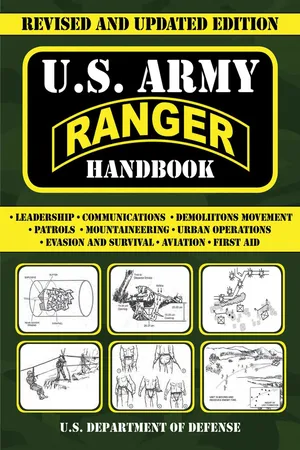
This handbook offers the techniques and tactics that make Army Rangers the best soldiers in the world. These highly-trained, easily-deployable, and widely-skilled infantrymen specialize in airborne assault, raids, recovery of personnel and equipment, and airfield seizure, among other difficult and dangerous missions. Drawing from over two centuries of bloody lessons learned in special operations combat, this guide gives modern soldiers the best advice possible. In straightforward language and a no-frills style, it covers deception, stealth, communications, escape and evasion, ambush operations, perimeter defense, counterintelligence, and much more. Handy and concise, this manual was designed so Rangers could easily carry it into the field. Now it is the ultimate resource for anyone who wants to know how Rangers think and work.
Frequently asked questions

Yes, you can cancel anytime from the Subscription tab in your account settings on the Perlego website. Your subscription will stay active until the end of your current billing period. Learn how to cancel your subscription.
No, books cannot be downloaded as external files, such as PDFs, for use outside of Perlego. However, you can download books within the Perlego app for offline reading on mobile or tablet. Learn more here.
Perlego offers two plans: Essential and Complete
  • Essential is ideal for learners and professionals who enjoy exploring a wide range of subjects. Access the Essential Library with 800,000+ trusted titles and best-sellers across business, personal growth, and the humanities. Includes unlimited reading time and Standard Read Aloud voice.
  • Complete: Perfect for advanced learners and researchers needing full, unrestricted access. Unlock 1.4M+ books across hundreds of subjects, including academic and specialized titles. The Complete Plan also includes advanced features like Premium Read Aloud and Research Assistant.
Both plans are available with monthly, semester, or annual billing cycles.
We are an online textbook subscription service, where you can get access to an entire online library for less than the price of a single book per month. With over 1 million books across 1000+ topics, we’ve got you covered! Learn more here.
Look out for the read-aloud symbol on your next book to see if you can listen to it. The read-aloud tool reads text aloud for you, highlighting the text as it is being read. You can pause it, speed it up and slow it down. Learn more here.
Yes! You can use the Perlego app on both iOS or Android devices to read anytime, anywhere — even offline. Perfect for commutes or when you’re on the go.
Please note we cannot support devices running on iOS 13 and Android 7 or earlier. Learn more about using the app.
Yes, you can access U.S. Army Ranger Handbook by in PDF and/or ePUB format, as well as other popular books in History & Military & Maritime History. We have over one million books available in our catalogue for you to explore.

Information

CHAPTER ONE

PRINCIPLES OF LEADERSHIP

1-1. GENERAL. Leadership is the most essential element of combat power. Leadership provides purpose, direction, and motivation in combat. The leader determines the degree to which maneuver, firepower, and protection are maximized, ensures these elements are effectively balanced, and decides how to bring them to bear against the enemy.
  1. PRINCIPLES OF LEADERSHIP.
    1. BE -
      1. Technically and tactically proficient: Can accomplish all tasks to standard that are required to accomplish the wartime mission.
      2. Possess professional character traits: Courage, Commitment, Candor, Competence and Integrity.
    2. KNOW -
      1. Four major factors of leadership and how they affect each other: The Led, The Leader, The Situation, and Communications.
      2. Yourself and seek self-improvement: Strengths and weaknesses of your character, knowledge, and skills. Continually develop your strengths and work on overcoming your weaknesses.
      3. Your soldiers and lookout for their well-being. Train them for the rigors of combat, take care of their physical/safety needs, and discipline/reward them.
    3. DO -
      1. SEEK RESPONSIBILITY and TAKE RESPONSIBILITY FOR YOUR ACTIONS: Leaders must exercise initiative, be resourceful, and take advantage of opportunities on the battlefield that will lead to victory. Accept just criticism and take corrective actions for mistakes.
      2. MAKE SOUND AND TIMELY DECISIONS: Rapidly assess the situation and make sound decisions. Gather essential information, announce decisions in time for soldiers to react, and consider short/long-term effects of your decision.
      3. SET THE EXAMPLE: Be a role model for your soldiers. Set high, but attainable standards, be willing to do what you require of your soldiers, and share dangers and hardships with your soldiers.
      4. KEEP YOUR SUBORDINATES INFORMED: Keeping your subordinates informed helps them make decisions and execute plans within your intent, encourage initiative, improve teamwork, and enhance morale.
      5. DEVELOP A SENSE OF RESPONSIBILITY IN SUBORDINATES: Teach, challenge, and develop subordinates. Delegation indicates you trust your subordinates and will make them want even more responsibility.
      6. ENSURE THE TASK IS UNDERSTOOD, SUPERVISED, AND ACCOMPLISHED: Soldiers need to now what you expect from them: What you want done, what the standard is, and when you want it.
      7. BUILD THE TEAM: Train and cross train your soldiers until they are confident in the team’s technical/tactical abilities. Develop a team spirit that motivates them to go willingly and confidently into combat.
      8. EMPLOY YOUR UNIT IN ACCORDANCE WITH ITS CAPABILITIES: Know the capabilities and limitations of your unit. As a leader you are responsible to recognize both of these factors and employ your patrol accordingly.
1-2. DUTIES AND RESPONSIBILITIES. To complete all assigned tasks, every soldier in the patrol must do his job. Each soldier must accomplish his specific duties and responsibilities and be a part of the team.
  1. PLATOON LEADER (PL): Responsible for what the patrol does or fails to do. This includes tactical employment, training, administration, personnel management, and logistics. He does this by planning, making timely decisions, issuing orders, assigning tasks, and supervising patrol activities. He must know his men and how to employ the patrol’s weapons. He is responsible for positioning and employing all assigned or attached crew-served weapons and employment of supporting weapons. The platoon leader:
    1. Establishes time schedule using backwards planning. Consider time for execution, movement to the objective, and the planning and preparation phase of the operation.
    2. Takes the initiative to accomplish the mission in the absence of orders. Keeps higher informed by using periodic situation reports (SITREP).
    3. Plans with the help of the Platoon Sergeant (PSG), Squad leaders, and other key personnel (Team Leaders, FO, attachment leaders).
    4. Stays abreast of the situation through coordination with adjacent patrols and higher HQ, supervise, issue FRAGOs, and accomplish the mission.
    5. If needed to perform the mission, requests more support for his patrol from higher headquarters.
    6. Directs and assists the Platoon Sergeant in planning and coordinating the patrol’s CSS effort and casualty evacuation (CASEVAC) plan.
    7. During planning, receives on-hand status reports from the Platoon Sergeant, and squad leaders.
    8. Reviews patrol requirements based on the tactical plan.
    9. Checks security, corrects unsatisfactory actions, and spot checks.
    10. During execution, positions himself where he can influence the most critical task for mission accomplishment; usually with the main effort.
    11. Commands through his squad leaders using the intent of the two levels higher commanders.
    12. Conducts rehearsals.
  2. PLATOON SERGEANT (PSG): Senior NCO in the patrol and second in succession of command. Helps and advises the patrol leader, and leads the patrol in the patrol leader’s absence. Supervises the patrol’s administration, logistics, and maintenance. Prepares and issues paragraph 4 of the patrol OPORD.
    1. Duties of the Platoon Sergeant:
      1. Organizes and controls the patrol CP IAW the unit SOP, patrol leader’s guidance, and METT-TC factors.
      2. Receives squad leader’s requests for rations, water, and ammunition. Work with the company first sergeant or XO to request resupply. Directs the routing of supplies and mail.
      3. Directs the patrol medic and patrol aid-litter teams in moving casualties to the rear.
      4. Maintains patrol personnel status, consolidate and forward the patrol’s casualty reports (DA Forms 1155 and 1156), and receive and orient replacements.
      5. Monitors the morale, discipline, and health of patrol members.
      6. Supervises task-organized elements of patrol:
      7. Quartering parties.
      8. Security forces during withdrawals.
      9. Support elements during raids or attacks.
      10. Security patrols during night attacks.
      11. Coordinates and supervises company-directed patrol resupply operations.
      12. Ensures that supplies are distributed IAW the patrol leader’s guidance and direction.
      13. Ensures that ammunition, supplies, and loads are properly and evenly distributed (a critical task during consolidation and reorganization).
      14. Ensures the casualty evacuation plan is complete and executed properly.
      15. Ensures that the patrol adheres to the Platoon Leader’s time schedule.
      16. The following checklist outlines the Platoon Sergeant’s duties and responsibilities during specific actions:
    2. Actions of the Platoon Sergeant during movement and halts:
      1. Takes action necessary to facilitate movement.
      2. Supervises rear security during movement.
      3. Supervises, establishes, and maintains security during halts.
      4. Knows unit location.
      5. Performs additional tasks as required by the patrol leader and assists in every way possible. Focuses on security and control of patrol.
    3. Actions by Platoon Sergeant at Danger Areas:
      1. Directs positioning of near-side security (usually conducted by the trail squad or team).
      2. Maintains accountability of personnel.
    4. Actions by Platoon Sergeant on the Objective Area:
      1. Assists with ORP occupation.
      2. Supervises, establishes, and maintains security at the ORP.
      3. Supervises the final preparation of weapons and equipment in the ORP per patrol leader’s guidance.
      4. Assists the patrol leader in control and security.
      5. Supervises the reorganization and redistribution of ammo and equipment. Ensures accountability and status of personnel is maintained, to include WlAs and KlAs.
      6. Performs additional tasks assigned by the patrol leader and reports status to Platoon Leader.
    5. Action by the Platoon Sergeant in the Patrol Base:
      1. Assists in patrol base occupation.
      2. Assists in establishing and adjusting perimeter.
      3. Enforces security in the patrol base.
      4. Keeps movement and noise to a minimum.
      5. Supervises and enforces camouflage.
      6. Assigns sectors of fire.
      7. Ensures designated personnel remain alert and equipment is maintained in a high state of readiness.
      8. Requisitions supplies, water, ammo and supervises their distribution.
      9. Supervises the priority of work and ensures its accomplishment.
        1. Security plan. Ensures crew served weapons tied in according to platoon sector sketch.
        2. Maintenance plan.
        3. Hygiene plan.
        4. Messing plan.
        5. Water plan.
        6. Rest plan.
      10. Performs additional tasks assigned by the patrol leader and assists him in every way possible.
  3. SQUAD LEADER (SL). Responsible for what the squad does or fails to do. He is a tactical leader that leads by example.
    1. Duties of the Squad Leader :
      1. Controls the maneuver of his squad and its rate and distribution of fire.
      2. Manages the logistical and administrative needs of his squad. Requests and issues ammunition, water, rations, and special equipment.
      3. Maintains equipment accountability.
      4. Completes casualty feeder reports and review the casualty reports completed by squad members.
      5. Directs the maintenance of the squad’s weapons and equipment.
      6. Inspects the condition of soldiers’ weapons, clothing and equipment.
      7. Keeps the Platoon Leader/Platoon Sergeant informed on status of squad.
      8. Submits ACE report to Platoon Sergeant.
    2. Actions by Squad Leader throughout the mission:
      1. Obtains status report from team leaders and submits reports to PL/PSG.
      2. Makes a recommendation to the PL/PSG when problems are observed.
      3. Ensures tasks are accomplished by delegating tasks to team leaders by establishing a priority of tasks in accordance with orders received from the PL.
      4. Uses initiative in the absence of orders.
      5. Follows the PL’s plan and makes recommendations.
    3. Actions by Squad Leader during movement and halts:
      1. Rotates heavy equipment and difficult duties.
      2. Ensures PL is notified when rest halts and water replenishment are required.
      3. Maintains proper movement techniques while monitoring route, pace, and azimuth.
      4. Prevents breaks in contact.
      5. Ensures subordinate leaders are disseminating information, assigning sectors of fire, and checks personnel.
    4. Action by Squad Leader in the objective area:
      1. Ensures special equipment has been prepared for actions at the objective.
      2. Maintains security and control during conduct of the assault.
      3. Obtains status reports from team leaders and ensures ammunition is redistributed and reports status to PL.
    5. Actions by Squad Leader in the patrol base:.
      1. Ensures patrol base is occupied according to the plan.
      2. Ensures that his sector of the patrol base is covered by interlocking fires; makes final adjustments, if necessary.
      3. LP/OP’s sent out in front of assigned sector. (METT-TC Dependent).
      4. Ensures priorities of work are being accomplished and reports accomplished priorities to the PL/PSG.
      5. Adheres to time schedule.
      6. Ensures personnel know the alert and evacuation plan the locations of key leaders, OPs and the location of the alternate patrol base.
  4. WEAPONS SQUAD LEADER (When designated). Responsible for all that the weapons squad does or fails to do. His duties are the same as the squad leader. Additionally, he controls the machine guns and MAWs in support of the patrol’s mission. He advises the PL on employment of his squad.
    1. Supervises machine gun teams to ensure they follow priority of work.
    2. Inspects machine gun teams for correct range cards, fighting positions, and understanding of fire plan.
    3. Supervises maintenance of machine guns (done correctly, deficiencies corrected, reported and does not violate security plan).
    4. Assists PL in planning.
    5. Positions machine g...

Table of contents

  1. Title Page
  2. Copyright Page
  3. PREFACE
  4. Table of Contents
  5. RANGER CREED
  6. STANDING ORDERS ROGERS RANGERS
  7. RANGER HISTORY
  8. HISTORY OF THE RANGER DEPARTMENT / RANGER TRAINING BRIGADE
  9. CHAPTER ONE - PRINCIPLES OF LEADERSHIP
  10. CHAPTER TWO - OPERATIONS
  11. CHAPTER THREE - FIRE SUPPORT
  12. CHAPTER FOUR - MOVEMENT
  13. CHAPTER FIVE - PATROLLING
  14. CHAPTER SIX - BATTLE DRILLS
  15. CHAPTER SEVEN - COMMUNICATIONS
  16. CHAPTER EIGHT - ARMY AVIATION
  17. CHAPTER NINE - WATERBORNE OPERATIONS
  18. CHAPTER TEN - MILITARY MOUNTAINEERING
  19. CHAPTER ELEVEN - EVASION/SURVIVAL
  20. CHAPTER TWELVE - FIRST AID
  21. CHAPTER THIRTEEN - DEMOLITIONS
  22. CHAPTER FOURTEEN - RANGER URBAN OPERATIONS