No Job? No Prob!
eBook - ePub

No Job? No Prob!

How to Pay Your Bills, Feed Your Mind, and Have a Blast When You're Out of Work

  1. 304 pages
  2. English
  3. ePUB (mobile friendly)
  4. Available on iOS & Android
eBook - ePub

No Job? No Prob!

How to Pay Your Bills, Feed Your Mind, and Have a Blast When You're Out of Work

About this book

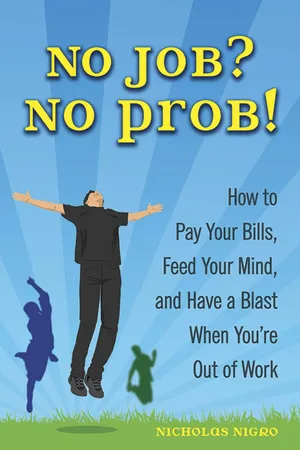
In No Job? No Prob!, business writer Nicholas Nigro shows readers how to convert unemployment lemons into refreshing lemonade. Offering advice that is at once motivational ("when unemployment comes calling, start walking and don't look back"), practical ("20 ways to make yourself leave the house at least once a day"), and fun ("20 things you can do with your retired briefcase"), No Job? No Prob! is the most well-rounded and optimistic unemployment guide available. It also includes useful quizzes that will help you take stock of what you have, decide what you want, and figure out the best way to get there. Learn how to look forward and still live in the moment—after all, as Orson Scott Card says, "unemployment is capitalism's way of getting you to plant a garden."
Frequently asked questions

Yes, you can cancel anytime from the Subscription tab in your account settings on the Perlego website. Your subscription will stay active until the end of your current billing period. Learn how to cancel your subscription.
No, books cannot be downloaded as external files, such as PDFs, for use outside of Perlego. However, you can download books within the Perlego app for offline reading on mobile or tablet. Learn more here.
Perlego offers two plans: Essential and Complete
  • Essential is ideal for learners and professionals who enjoy exploring a wide range of subjects. Access the Essential Library with 800,000+ trusted titles and best-sellers across business, personal growth, and the humanities. Includes unlimited reading time and Standard Read Aloud voice.
  • Complete: Perfect for advanced learners and researchers needing full, unrestricted access. Unlock 1.4M+ books across hundreds of subjects, including academic and specialized titles. The Complete Plan also includes advanced features like Premium Read Aloud and Research Assistant.
Both plans are available with monthly, semester, or annual billing cycles.
We are an online textbook subscription service, where you can get access to an entire online library for less than the price of a single book per month. With over 1 million books across 1000+ topics, we’ve got you covered! Learn more here.
Look out for the read-aloud symbol on your next book to see if you can listen to it. The read-aloud tool reads text aloud for you, highlighting the text as it is being read. You can pause it, speed it up and slow it down. Learn more here.
Yes! You can use the Perlego app on both iOS or Android devices to read anytime, anywhere — even offline. Perfect for commutes or when you’re on the go.
Please note we cannot support devices running on iOS 13 and Android 7 or earlier. Learn more about using the app.
Yes, you can access No Job? No Prob! by Nicholas Nigro in PDF and/or ePUB format, as well as other popular books in Personal Development & Careers. We have over one million books available in our catalogue for you to explore.

Information

Publisher
Skyhorse
Year
2008
Print ISBN
9781602393509

PART ONE

TAKING CONTROL

e9781602393509_i0034.webp

CHAPTER ONE

Getting the Unpleasant Stuff Out of the Way

The trouble with unemployment is that the minute you wake up in the morning, you’re on the job.
—Slappy White, comedian


If you’ve already taken care of the laborious jobless minutiae—applying for unemployment benefits, resolving severance issues, and so on—then by all means leap ahead in the book to the sunny side of the street. The heart and soul of the pages to follow are all about converting unemployment lemons into refreshing and enjoyable lemonade. In other words, in addition to searching for another line of work, you can savor a full glass of fun and frolic as well. If, on the other hand, you need an unemployment roadmap, we’ve got that too.
So, if you need a little assistance in getting your jobless ducks in a row, start by submitting a claim for unemployment insurance. Granted, not everyone qualifies for these state-administered benefits, but if you’ve been fired, laid off, downsized, outsourced—or whatever particular euphemism applies to your involuntary loss of a paying job—you more than likely meet the criteria for unemployment compensation.
However, keep in mind that not everyone is created equal in the eyes of this bureaucratic lifeline. In other words, the generosity or lack thereof of jobless benefits varies from state to state. In addition, the paycheck that you will ultimately receive—if, of course, you meet your state’s myriad eligibility requirements—is effectively linked to what you’ve most recently earned in paying jobs throughout the past year. This is known as the base period in unemployment jargon.
So, to put unemployment compensation into a broader perspective: If you were taking home $450 a week and your neighbor, who just lost her job, pulled down $1,200 a week, it’s a safe bet that the size of your two unemployment checks would differ. In fact, your check would more than likely be a Mini Me version of your neighbor’s. But there are rather low ceilings on the upper limits of jobless benefits paid out, regardless of where you live. Each of the fifty states has a maximum figure threshold for its unemployment compensation. And let’s just say that some of these maximum numbers are rather minimum. In other words, even if you were making $2,000 a week and apply for an unemployment check, there’s only so much you can get.
Now, before we venture any further in this subject matter, it’s time to disabuse those of you who have never before waded into unemployment insurance waters. Your jobless benefits will not equal—or even come reasonably close—to what you earned on a weekly basis in your last job, or the weekly average of the multiple jobs you have held in the past year. It’s just not how the system works. As previously indicated, the individual states have ceilings on the top dollar amount that you can receive—and they vary considerably. Depending on where you call home, as well as your past income numbers, it is not unusual to see unemployment benefits tally up to approximately half of your recent earnings.
With this necessary disclaimer out of the way, it is nevertheless a fact of life that unemployment checks are big—really big—for most recipients of them. Very often receipt of jobless benefits is the difference between you subsisting on a daily repast of no-frills canned soups and hamburger helper versus eating the occasional piece of chicken and Dunkin’ Donuts for dessert—not to mention being able to pay your utility bills, the monthly car payment, and, of course, the rent or mortgage. So, while an unemployment check is not—by any stretch of the imagination—comparable to a full-time job paycheck, it’s often substantial in light of your out-of-work financial straits. When your income is at ground zero, jobless benefits—at whatever level—are very welcome indeed.

Unemployment Insurance: Are You a Candidate?

For openers, there are two websites worth checking out: the U.S. Department of Labor at dol.gov (1-877-US-2JOBS) and CareerOne Stop.org (1-877-348-0502), which is sponsored by the former. These cyber portals furnish links to the fifty states and their respective labor departments. They are also replete with information on employment services and other job-related issues that you might find useful, including comprehensive job banks that can aid and abet your work safari. Of course, if you are from the old school, you could directly contact your local unemployment claims office by opening up the yellow pages and letting your fingers do the walking.
It makes little difference what methodology brings you to your state’s unemployment insurance division. Once there—via a website, telephone call, or in-person visit—you’ll be outfitted with all of the rules and regulations that you must abide by to qualify for a regular unemployment check. Federal guidelines exist that mandate all fifty states do certain prescribed things vis-à-vis unemployment insurance—like having a program to begin with—but it’s the individual state governments that determine most of the particulars, including:
  • Eligibility requirements
  • Duration of the benefits paid out
  • Amount of benefits formulae
  • Maximum benefits paid out
  • Job search reporting requirements.

The Filing Process

Courtesy of the highly advanced technological and super-automated age that we live in, filing for—and indeed collecting—unemployment benefits has gotten a whole lot simpler. Ordinarily, unemployment insurance claims can be applied for over the telephone or online. In the not too distant past, applications were completed and submitted in-person at unemployment claims offices near you, which often entailed long waits in even longer lines and, worse yet, interaction with beleaguered bureaucrats who always seemed like they’d rather be in another line of work—or, perhaps, jobless themselves. And, here’s the kicker: you had to repeat this process week after week after week to continue qualifying for your checks. This grueling system added an unnecessarily demeaning layer to already rough roads.
Consider yourself extremely fortunate then that you can keep visits to the unemployment claims office to a bare minimum. (As a recipient of jobless benefits, you may at some point have to make a personal appearance at a physical location and speak to a flesh-and-blood human being. You might have to furnish proof of your past income sources, or clarify something else on your initial application. It could be that, after you’re approved, you’ll have to update the powers that be on your job search progress. But most of these matters can be handled over the telephone or online.)
In any event, your state unemployment insurance division will fill you in on exactly what you need to do along the way—from filing for the initial benefits to maintaining your weekly or, in some cases, biweekly checks. More or less, the filing process unfolds this way in all quarters of the country:
  1. You submit an application through the proper channels, either by phone, the Internet, or in-person at a local unemployment claims office.
  2. You furnish proof that you are who you say you are; your social security number will suffice.
  3. You provide a home address with a zip code and a telephone number where you can be reached.
  4. You furnish proof of your past employer or employers over the past year, including names, addresses, and dates of employment. What you earned during this time frame will fundamentally determine the amount of your unemployment check.
  5. You begin actively looking for a job.

Frequently Asked Questions about Unemployment Insurance

When should I file for unemployment benefits?

You should file for unemployment compensation the moment you find yourself a jobless statistic. The stark reality is that even if your claim is approved lickety-split, you won’t receive your first check for at least two weeks and probably longer than that.

Do I have to look for work while receiving jobless benefits?

Yes, but of course it’s in your best interests to be proactive in your job or career search anyway. Many states require that recipients of unemployment benefits register with a state job service, or at least avail themselves of its resources. In some instances—depending on your previous line of work and past income—you may be required to apply for certain jobs and submit rĂ©sumĂ©s to specified employers, or risk having your benefits discontinued. There are circumstances that occasionally arise when you are asked to take a particular job. That is, your choice is to take the position, or turn it down and lose your unemployment compensation.

Will I have to show proof that I’ve been actively looking for another job?

Most states require that the unemployed minions who receive jobless benefits reveal the fruits of their labors, as it were, regarding looking for work. This may entail you furnishing the unemployment claims office with lists of places you’ve submitted your rĂ©sumĂ©s, as well as any job interviews you attended. In addition, you are expected to report any job offers that come your way, even if you pass on them.

How long can I expect to receive unemployment insurance?

Assuming that you cannot find suitable work that pays you a living wage, the maximum time allowed for receiving standard unemployment benefits is twenty-six weeks—approximately six months. In certain instances, there are extensions of up to thirteen weeks, and even thirteen weeks after that. Check with your unemployment insurance division to see if extended benefits are an option for your particular circumstances in your particular state. (Areas of the country with high unemployment are more likely to have provisions for extended benefits than areas enjoying low unemployment.)

Do I have to pay income taxes on my jobless benefits?

Sad to be the bearer of bad news here, but the answer is yes. Uncle Sam treats your unemployment check like any other earned income. So, be prepared to ante up to the taxman. When filing your unemployment benefits claim, you are given the option—upon approval—to have the government withhold the taxes at the time you receive your check, or you can defer the tax bite until you file your income taxes at the beginning of the next calendar year. The latter...

Table of contents

  1. Title Page
  2. Dedication
  3. Copyright Page
  4. Table of Contents
  5. ACKNOWLEDGMENTS
  6. INTRODUCTION - Unemployed and Proud
  7. PART ONE - TAKING CONTROL
  8. PART TWO - HAVING A BLAST
  9. PART THREE - KICKING BACK
  10. PART FOUR - FEELING GOOD
  11. AFTERWORD - Just Say No: No Job? No Prob!