The World Is Our Classroom
eBook - ePub

The World Is Our Classroom

How One Family Used Nature and Travel to Shape an Extraordinary Education

  1. 264 pages
  2. English
  3. ePUB (mobile friendly)
  4. Available on iOS & Android
eBook - ePub

The World Is Our Classroom

How One Family Used Nature and Travel to Shape an Extraordinary Education

About this book

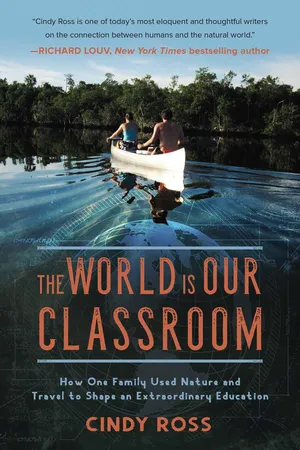
Bronze Medal, Lowell Thomas Travel Journalism Competition, Society of American Travel Writers "Cindy Ross is one of today's most eloquent and thoughtful writers on the connection between humans and the natural world." — Richard Louv, New York Times bestselling author Cindy's story begins in the Rocky Mountain wilderness on a unique and extraordinary journey: two parents leading their young children 3, 100 miles on the backs of llamas. This Canada-Mexico trek illustrated to Cindy and her husband what experiential education can do. Inspired by the experience, they went on to create a new way of supplementing their children's education, focusing on two arenas for learning: the natural world and travel. In this age of world connection, it is important to raise broad-minded and empathetic children who are knowledgeable about other cultures. To accomplish this goal, Cindy chose an unorthodox approach: she orchestrated learning opportunities for her children, Sierra and Bryce, in twelve countries. The family traveled the world, moving about on foot and bicycle, living simply and intimately. But just as important, and more accessible for many parents, were the opportunities for learning closer to home. These adventures brought intangible gifts: values--such as compassion, empathy, resilience, self-reliance, and gratitude, among others--not always fostered in a traditional curriculum but crucially important to raising children. By sharing her story, along with honest insights from her children about the importance of their unusual education, Cindy aims to empower parents to believe they can be their children's best and most important educators. It is for parents who are seeking inspiration, who love a good story, and who are looking for an unorthodox way to raise the happiest, healthiest, and brightest children they can.
Frequently asked questions

Yes, you can cancel anytime from the Subscription tab in your account settings on the Perlego website. Your subscription will stay active until the end of your current billing period. Learn how to cancel your subscription.
No, books cannot be downloaded as external files, such as PDFs, for use outside of Perlego. However, you can download books within the Perlego app for offline reading on mobile or tablet. Learn more here.
Perlego offers two plans: Essential and Complete
  • Essential is ideal for learners and professionals who enjoy exploring a wide range of subjects. Access the Essential Library with 800,000+ trusted titles and best-sellers across business, personal growth, and the humanities. Includes unlimited reading time and Standard Read Aloud voice.
  • Complete: Perfect for advanced learners and researchers needing full, unrestricted access. Unlock 1.4M+ books across hundreds of subjects, including academic and specialized titles. The Complete Plan also includes advanced features like Premium Read Aloud and Research Assistant.
Both plans are available with monthly, semester, or annual billing cycles.
We are an online textbook subscription service, where you can get access to an entire online library for less than the price of a single book per month. With over 1 million books across 1000+ topics, we’ve got you covered! Learn more here.
Look out for the read-aloud symbol on your next book to see if you can listen to it. The read-aloud tool reads text aloud for you, highlighting the text as it is being read. You can pause it, speed it up and slow it down. Learn more here.
Yes! You can use the Perlego app on both iOS or Android devices to read anytime, anywhere — even offline. Perfect for commutes or when you’re on the go.
Please note we cannot support devices running on iOS 13 and Android 7 or earlier. Learn more about using the app.
Yes, you can access The World Is Our Classroom by Cindy Ross in PDF and/or ePUB format, as well as other popular books in Education & Inclusive Education. We have over one million books available in our catalogue for you to explore.

Information

Publisher
Skyhorse
Year
2018
Print ISBN
9781510729568
CHAPTER 1
Learning from Play
“Front yards are boring. Backyards tell stories.”
James Stevenson, “Backyards,” Popcorn
image
As I rummaged through the drawer of hats and gloves looking for matching pairs, I heard the teakettle whistle in the kitchen, reminding me to make hot chocolate for our thermos. We were dressing Sierra and Bryce in multiple layers of clothing. Todd and I wanted a fast getaway, for tonight we were going out to play under the full moon.
We first started going on full moon walks for ourselves, because we loved them and we needed these little doses of moonlight in order to stay happy and function in society. But after we became parents, we went for our children. We wanted Sierra and Bryce to see that there is much magic in the natural world and most of it is accessible to anyone. We also wanted to show them it was not necessary to travel far from our log home in order to have an adventure, learn, experience something new. Our long-distance hikes on the Continental Divide Trail set the bar high in our children’s eyes. In between adventures, our base was our rural log home, the planning center. Every morning, when young Sierra woke up, she would ask, “What adventures are we having today?” I’d tell her of an outing—visit a museum, see a play, watch a documentary film, hear a concert, etc. If it was only a half-day excursion, she questioned, “What are we doing exciting for the second half of the day?” The answer was playing, or merely discovering the big world right where we lived.
Some parents might be nervous about relying on what is right outside the door to entertain, occupy and teach their children many of life’s lessons. But given the right formula of free time, open space, a few materials, and a tiny bit of guidance, a whole universe of lesson plans is amazingly close by. Kids also learn to entertain themselves and not constantly rely on outside stimulation. Our family would go on many more adventures during the course of Sierra and Bryce’s upbringing, both domestic and abroad, but for the most part, our home and their big backyard would be their primary source for learning. Much of it would be on their own, especially while they were young, and much of that learning would look, to the undiscerning eye, like play.
Fred Rogers (of Mister Rogers’ Neighborhood, the hugely famous and influential educational preschool television show) once said, “Play is often talked about as if it were a relief from serious learning. But for children, play is serious learning. Play is really the work of childhood.” Children learn while they play and they actually play to learn, without any help from adults. It is unsupervised play where they stand to gain the most. The American Academy of Pediatrics is of the opinion that play, especially outdoor play, is “essential to development as it contributes to the cognitive, physical, social, and emotional well-being of children and youth.” Nearly every month, our family went into the night to “play” by the full moon.
We have walked under balmy summer moons in T-shirts, with katydids singing and lightning bugs flashing in a multi-sensory display. We have walked under autumn moons and watched migrating geese as they became silhouettes against the silvery disk. We have walked under spring moons and felt the warming breeze on our skin and smelled the rich earth waking up, and we have walked under winter moons, when the wind blew the ice-coated tree limbs that sparkled like jewels and tinkled like musical instruments.
Once we arrived at our location that evening, Sierra and I stood holding hands, thanking the sun out loud for its warmth and light all day long. We then turned and faced the opposite direction in the sky and waited to cheer the full moon in its rising. A thin sliver of the apricot moon poked above the hulking shape of the Blue Mountain Ridge. Everyone stood up and witnessed its rising. More of the moon materialized until it turned into a brilliant orange sphere. Todd explained to Sierra and Bryce that the moon makes no light of its own, but simply acts like a mirror, reflecting the sunlight back to us long after the sun has sunk below the horizon.
“Does the moon’s face change?” Bryce asked. I told him that the moon rotates with the earth, but it does not spin on its axis like the earth does. The same side of the moon is always facing earth. We never see the other side, the far side of the moon. Sierra remarked that the moon looked larger and closer when it was rising. I explained that it is an optical illusion because it is so close to the horizon that the moon tricks our eyes into comparing it with nearby objects to create the impression of increased size. Through our binoculars, the kids got a close-up look at the craters and valleys and mountains on the moon, the dark patches that astronomers call plains and seas.
Much of the knowledge that Todd and I shared with the kids, we had gleaned from our past life experiences. If we did not possess the knowledge to explain and educate, we looked it up, either beforehand to enhance the experience, or afterwards, together, after we wondered and came up with a list of questions. The process of educating our children emerged naturally through our encounters with the world. It never felt forced nor boring; we were all curious and wanted to dig deeper and learn more about the topic.
When Bryce pulled out a red handkerchief on that moonlit walk, he was amazed that he could see color. Todd told him that without light, there is no color. It does not have to be sunlight or light bulbs; it can be from the light of the moon, which is technically reflected sunlight. These are the kinds of simple yet profound experiences that can ignite a spark in us, propel us down a certain path in life, without even realizing it, for it did to me when I was a child. It can be as humble a fact as learning about light.
I remember the first time I realized as a child that without light there was no color—the discovery that inspired me to want to become an artist. I was awake before dawn one morning, yet it was light enough to see the outline of the flowers on the curtains in my bedroom. I thought it unusual that the flowers looked grey, as I knew the fabric had orchid-hued flowers scattered all over it. Then, as if by magic, the faintest tint of color appeared. The color grew in intensity as the sun rose, until at last, the flowers were the color that I knew them to be. I was shocked to realize this direct connection between light and color.
As a parent, I made a conscious effort to teach Sierra and Bryce how to see and appreciate light and color in the natural world. These are the kinds of things Todd and I found just as important as teaching simple math and balancing a checkbook.
As we stared up at the constellations, a brilliant shooting star raced across the sky. We knew it was special to see a shooting star in full moonlight because the sky is so bright. Right afterwards, a great horned owl called in a nearby conifer forest. We cupped our hands and called back. All these events made the night feel magical.
Encouraging our children to view the natural world as magical was important to us as parents. Seeing through this lens evokes a feeling of awe, a sense of wonder. The wonder state often occurs when you don’t quite understand what or why something is. It appears to be mysterious, until you learn the reason, the explanation, but the magical feeling often remains. It is a wonderful way to view the world and it ensures that you will always have the ability to be surprised and amazed.
I held Bryce’s hand on the return hike. “Look at the moon shadows, Mama!” He lifted up his arms like a monster and yelled back to his sister, “I’m taking a moonbeam bath!” and ran down the moonlit trail playing monster. What fun we had on those moonlit walks. Some months we’d take drums that Todd made from deerskin that he tanned and stretched, and assist the full moon in its rising. We pretended we were Native Americans, filling the night air with our drum playing, until the orange orb surfaced on the horizon. Contrary to what much of the media and society would have us believe, families do not have to spend a ton of money on entertainment in order to have fun and learn. Opportunities to seek magical experiences and learning is right in your neighborhood. Sometimes all it takes is going outdoors and gazing up at the heavens.
Todd and I put considerable thought into the kind of neighborhood we wanted to raise our children in long before we even conceived. It was that important to us. Owning land was a number one priority. We built our log home on a low-lying ridge called Red Mountain. It sits in the shadow of the larger Blue Mountain, which is part of the Appalachian Mountain chain. The Blue Mountain seems to go on forever, as it rises in Maryland, crosses Pennsylvania on a west-east angle, then peters out in New Jersey. The Lenape tribe of the Delaware named this ridge Kittatinny, meaning “endless.” Migratory birds follow the ridge and so do Appalachian Trail hikers, for the historic trail cuts a pathway along its ridgeline. The trail stands as the ultimate symbol of freedom for Todd and me, for we both fell in love with hiking and the natural world while traversing its 2,100-mile length.
In the central part of the ridge, the mountain makes a singular jog—1,500-foot Hawk Mountain sits atop this curve in the ridge. It is the focal point for the 2,500-acre mountaintop preserve known as Hawk Mountain Sanctuary, the first wildlife sanctuary in the world offering protection to birds of prey. Lenape chiefs were drawn to the point known as the North Lookout, an outcropping where they went to worship the Great Spirit. The Little Schuylkill, a designated Wild & Scenic River, runs through the valley at the base of the mountain. With the additional Pennsylvania State Game Lands and state forest lands, this area of the Commonwealth seemed like the perfect place to raise children, because it had an abundance of wild public land where we were free to recreate. The river and the mountain became Sierra and Bryce’s playground.
To house and raise our children, Todd and I attended a ten-day log building school in northern Minnesota to learn to build our own log home from scratch. The class took us through every step of construction from felling trees, to chainsaw carving notches, to putting on the roof. We used a lot of salvage in its construction; my uncle had a demolition company, so our handcrafted home cost only $20,000. The bricks in our chimney were once street pavers; the slate roof was taken off a building scheduled for demotion that we hand scalloped, and most of our windows are recycled. We taught ourselves how to do every job—laying the block foundation, roofing, wiring, plumbing, building a chimney, and tiling the floors. Todd picked up the skills from books and helpful friends. With a background in fine furniture making, Todd hand-crafted all of our furniture, including our Victorian screen doors and the oak bed that I delivered Bryce in. Before we even became parents, Todd and I believed in lifelong learning.
Todd and I brought Sierra and Bryce into this beautiful log home built on twelve acres of open space. This unique haven would serve as the home base/planning center for our schooling. Inside, we are surrounded by art and crafts from paintings on the walls, sculpture on the shelves, stained glass in the windows, handmade braided wool rugs on the floors, a huge library of books, but not a single television. Even though all children are innately creative, our modern society has a way of suppressing this instinct. Many adults lose this ability and reserve the act of playing and creating (and much of the fun in life) for the elitist few actors, authors, and dancers. Picasso said, “All children are born artists. The challenge is to remain an artist as you grow up.” Todd and I wanted to design a home that would encourage the creative act.
In the comfort of our home, we would research ideas, make contacts and network, and conduct the ground work for our adventures. Afterwards, we’d return home to record, build portfolios, and craft projects. Our library was massive. Supplies and materials for making things were unlimited.
The majority of Sierra and Bryce’s “play dates” occurred on our homestead where they had a large organic garden, orchard, a surrounding forest, and pet cats, goats, and llamas to play with. They read books in the hammock and followed deer trails in the woods. When a summer shower occurred, they stripped down naked and danced in the rain. They slept out in their tree house, played in a large canvas tipi, and caught frogs with a net in our pond. On summer nights, they took showers out in the orchard in the solar shower, with the stars and the fireflies as their audience. In the winter, we fired up our Finnish log sauna and sweated with our friends. We built campfires and enjoyed every meal outdoors at our picnic table that the weather allowed.
Many of these things sound like childhood playing, but understand, something bigger was occurring in the underlying shadows. Sierra and Bryce were learning about biology, weather, astronomy, and natural history right alongside their play.
A parent has no idea what individual interest will grow into a lifelong satisfying occupation. Take, for example, our kids fascination with a place they created called “Bottletown.” Sierra and Bryce found an old dump in the woods on our property from a long-gone, historic farmhouse. They played archeologist, excavating the antique bottles and pottery and using them to create the perimeter of an outdoor village in the woods—Bottletown. They each had their own space as well as other community areas. These were separated by unique borders of stones and bottles, strung-together flower-and-vine walls, and little pools of water they built. After they discovered an interesting rock or a different pattern in a leaf, the kids would change and redecorate, constantly searching for ways to improve and create more beauty. This play also taught them about boundaries, property lines, personal space and how to create it. Bottletown was like an ever-changing artistic portfolio where they could reinvent, be creative. If one of our children had an innate desire to be an architect, this imaginary town would have planted that seed. Regardless of what occupation they chose, Bottletown impacted their minds and stimulated their creativity, which would prove to be beneficial no matter who or what they grew to be as adults.
In our tiny backyard pond, which is merely a wide, lined puddle that collects water from our home’s massive slate roof, our kids found salamanders. Watching and netting them, as well as North American toads, piqued their interest in amphibians. We purchased books on them and learned more. Todd found an old aquarium from his childhood home and had fun creating a habitat with layered gravel, a slope to help them crawl up out of the pool of water and appropriate hiding places. The kids collected earthworms from the garden and learned to feed their new pets.
As children, Todd and I played outdoors as did most of the children raised in our generation. If we did not live in a wild place, we managed to find a corner, an edge, a space left open, to explore and discover. Our parents made us play outdoors. We were called home for dinner and then afterwards, went right back out to play a game of flashlight tag, remaining outdoors until bedtime.
The value of play is not always immediately obvious to today’s parents. To some adults, play looks like a waste of time. In his book Play: How it Shapes the Brain, Opens the Imagination, and Invigorates the Soul, Stuart Brown informs that play is critical to brain development. This physician, psychiatrist, clinical researcher and the founder of the National Institute for Play has made a career of studying the effects of play on people and animals. He writes: “Play stimulates genes for nerve growth in the executive portion of the brain, the frontal cortex. It fosters maturation of the very centers of the brain that allows kids to exert control over attention, to regulate emotions, to control their own behavior, all of which allows them to learn.”
Through play, kids learn that they can solve problems for themselves. They gain confidence in their ability to negotiate life on their own. They develop coping skills and the ability to problem solve.
When Todd was young and growing up in a new suburb of West York, Pennsylvania, he and his friends visited the latest construction site with their wagon. From the trash pile, they loaded up with long, ungainly pieces of lumber, and pulled them for many blocks to the edge of the development, where their backyards ended and the woods began. There they built a fort. It taught them how to work together and think creatively as they designed their dwelling and discussed the most efficient way to build it; it taught them how to apply their math skills as they measured and sawed; and it taught them problem solving as they figured how to move lumber with fulcrums and levers. This all resulted from the play of young boys.
Today, there are far fewer kids playing outside. Drive nearly anywhere in the country, and you will find that yards are vacant of children. The average American child spends more than seven hours in front of a screen and as few as thirty minutes playing outside. There are many culprits: the overuse of television, computers, and video games are much to blame. The more involved in passive entertainment a child becomes, the less he or she is able to focus, sustain attention and manage boredom and unstructured time.
Much of our philosophy using the natural world to raise and educate Sierra and Bryce sprung from our own personal experiences, but I was heartened to learn of author Richard Louv’s groundbreaking book Last Child in the Woods—Saving Our Children from Nature-Deficit Disorder which reinforced what we already believed and practiced. The book focuses on the human-nature disconnect, highlighting the latest research findings. It connects the rapid increase in childhood depression and attention deficit disorders to this lack of communing with nature. As a result, a worldwide movement to get children and their families reconnected with the natural world was spurred. Louv began the Children and Nature Network (C&NN), a wellspring of information and knowledge (over five hundred studies) to inform and educate. To help alleviate the problem, a program of worldwide nature clubs for families was developed. If one is not located near you, the Families Nature Club Tool Kit was designed to guide parents into starting their own. Louv’s book inspired Todd and I to continue on the path we had chosen using the natural world as a classroom as much as possible.
GARDENING AS A TEACHER
Long before I became a mother, I learned that a teacher friend of mine took her students on a field trip to the grocery store (although an actual a farm would have been better) so they could learn where food came from. On one excursion, a child admitted that she thought cows’ milk was their pee. From that day onward, Todd and I vowed that our children would not only know where their food came from; they would have a hand in growing it.
Gardening holds immense opportunities for learning and food is essential for life no matter where a family lives or how they educate their children. Being knowledgeable about what you put into your mouth is fundamental information that Todd and I felt necessary to pass onto our kids. Sierra and Bryce should know what a genetically modified food is, why organic is healthier, what colony collapse disorder is, and how incredibly valuable bees are to our food. Knowledge is power and an uninformed consumer is a victim. Our garden was right outside our door and it was also a great stage for creative play.
In the orchard, Todd planted berry patches, a grape arbor, and twenty fruit trees. We grew most of our vegetables, and preserved our food by freezing and canning. We occasionally raised turkeys for meat and chickens for eggs. The kids helped Todd start seeds, and then misted the tiny plants with the spray water bottle. They helped push beans into the dirt trough with their index fingers and placed onion sets with the tiny, hairy roots down. When we harvested sweet corn and cut the kernels off the c...

Table of contents

  1. Cover
  2. Title Page
  3. Copyright
  4. Dedication
  5. Contents
  6. Foreword
  7. Preface
  8. Introduction: The Trail—Where the Learning Begins
  9. Chapter 1: Learning from Play
  10. Chapter 2: Learning from History
  11. Chapter 3: Learning from International Travel
  12. Chapter 4: Learning about Values and Priorities
  13. Chapter 5: Learning from Wild Animals
  14. Chapter 6: Learning from Other Faith Cultures
  15. Chapter 7: Learning from Independent Travel
  16. Chapter 8: Learning from Our Ancestors
  17. Chapter 9: Learning from Self-Propelled Travel
  18. Chapter 10: Learning from Pushing past Your Comfort Zone
  19. Chapter 11: Learning to Blaze Your Own Trail
  20. Epilogue
  21. Reflections from Sierra and Bryce
  22. Acknowledgements
  23. Photos