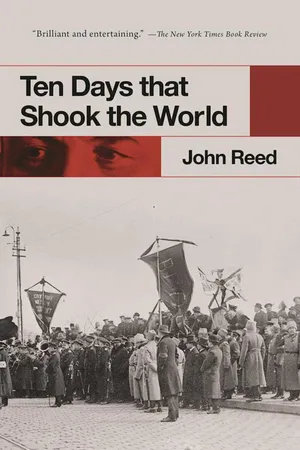
Ten Days that Shook the World
eBook - ePub

Ten Days that Shook the World

  1. 424 pages
  2. English
  3. ePUB (mobile friendly)
  4. Available on iOS & Android
eBook - ePub

Ten Days that Shook the World

About this book

"This book is a slice of intensified history—history as I saw it." So begins John Reed's first-hand account of the Bolshevik Revolution of 1917. Much anticipated when it was published in 1919, Reed's narrative remains as riveting today as when the events he describes were still reverberating throughout the world. Reed was hardly a disinterested observer, and his involvement in the Communist labor movement lends urgency and passion to his classic account. He vividly describes events in Petrograd in November 1917, when Vladimir Lenin and the Bolsheviks stormed the Winter Palace and seized the reins of power. Despite Reed's personal leanings, which he made no attempt to hide, the book garnered praise from luminaries across the political spectrum. George F. Kennan, the American diplomat, and father of the policy of Soviet containment, said that "Reed's account of the events of that time rises above every other contemporary record for its literary power, its penetration, its command of detail. It will be remembered when all others are forgotten."Reed was committed to telling the story of the Russian revolution as truthfully as possible. That the book was banned by Russian premier Josef Stalin is a testament to the author's success in carrying out his mission. One hundred years after Russia and the world trembled, Ten Days that Shook the World brings alive the momentous events of 1917.
Frequently asked questions

Yes, you can cancel anytime from the Subscription tab in your account settings on the Perlego website. Your subscription will stay active until the end of your current billing period. Learn how to cancel your subscription.
No, books cannot be downloaded as external files, such as PDFs, for use outside of Perlego. However, you can download books within the Perlego app for offline reading on mobile or tablet. Learn more here.
Perlego offers two plans: Essential and Complete
  • Essential is ideal for learners and professionals who enjoy exploring a wide range of subjects. Access the Essential Library with 800,000+ trusted titles and best-sellers across business, personal growth, and the humanities. Includes unlimited reading time and Standard Read Aloud voice.
  • Complete: Perfect for advanced learners and researchers needing full, unrestricted access. Unlock 1.4M+ books across hundreds of subjects, including academic and specialized titles. The Complete Plan also includes advanced features like Premium Read Aloud and Research Assistant.
Both plans are available with monthly, semester, or annual billing cycles.
We are an online textbook subscription service, where you can get access to an entire online library for less than the price of a single book per month. With over 1 million books across 1000+ topics, we’ve got you covered! Learn more here.
Look out for the read-aloud symbol on your next book to see if you can listen to it. The read-aloud tool reads text aloud for you, highlighting the text as it is being read. You can pause it, speed it up and slow it down. Learn more here.
Yes! You can use the Perlego app on both iOS or Android devices to read anytime, anywhere — even offline. Perfect for commutes or when you’re on the go.
Please note we cannot support devices running on iOS 13 and Android 7 or earlier. Learn more about using the app.
Yes, you can access Ten Days that Shook the World by John Reed in PDF and/or ePUB format, as well as other popular books in History & Military & Maritime History. We have over one million books available in our catalogue for you to explore.

Information

APPENDIX

CHAPTER I
1.
Oborontsiā€”ā€Defenders.ā€ All the ā€œmoderateā€ Socialist groups adopted or were given this name, because they consented, to the continuation of the war under Allied leadership, on the ground that it was a war of National Defence. The Bolsheviki, the Left Socialist Revolutionaries, the Mensheviki Internationalists (Martov’s faction), and the Social Democrats Internationalists (Gorky’s group) were in favour of forcing the Allies to declare democratic war-aims, and to offer peace to Germany on those terms. . . .
2.
WAGES AND COST OF LIVING BEFORE AND DURING THE REVOLUTION
The following tables of wages and costs were compiled, in October, 1917, by a joint Committee from the Moscow Chamber of Commerce and the Moscow section of the Ministry of Labour, and published in Novaya Zhizn, October 26th, 1917:
Wages Per Day—(Rubles and kopeks)
In spite of numerous stories of gigantic advances in wages immediately following the Revolution of March, 1917, these figures, which were published by the Ministry of Labour as characteristic of conditions all over Russia, show that wages did not rise immediately after the Revolution, but little by little. On an average, wages increased slightly more than 500 per cent. . . .
But at the same time the value of the ruble fell to less than one-third its former purchasing power, and the cost of the necessities of life increased enormously.
The following table was compiled by the Municipal Duma of Moscow, where food was cheaper and more plentiful than in Petrograd:
Cost of Food—(Rubles and kopeks)
On an average, food increased in price 556 per cent, or 51 per cent more than wages.
As for the other necessities, the price of these increased tremendously.
The following table was compiled by the Economic section of the Moscow Soviet of Workers’ Deputies, and accepted, as correct by the Ministry of Supplies of the Provisional Government.
Cost of Other Necessities—(Rubles and kopeks)
On an average, the above categories of necessities increased about 1,109 per cent in price, more than twice the increase of salaries. The difference, of course, went into the pockets of speculators and merchants.
In September, 1917, when I arrived in Petrograd, the average daily wage of a skilled industrial worker—for example, a steel-worker in the Putilov Factory—was about 8 rubles. At the same time, profits were enormous. . . . I was told by one of the owners of the Thornton Woollen Mills, an English concern on the outskirts of Petrograd, that while wages had increased about 300 per cent in his factory, his profits had gone up 900 per cent.
3.
THE SOCIALIST MINISTERS
The history of the efforts of the Socialists in the Provisional Government of July to realise their programme in coalition with the bourgeois Ministers, is an illuminating example of class struggle in politics. Says Lenin, in explanation of this phenomenon:
The capitalists, . . . seeing that the position of the Government was untenable, resorted to a method which since 1848 has been for decades practised by the capitalists in order to befog, divide, and finally overpower the working-class. This method is the so-called ā€˜Coalition Ministry,’ composed of bourgeois and of renegades from the Socialist camp.
ā€œIn those countries where political freedom and democracy have existed side by side with the revolutionary movement of the workers—for example in England and France—the capitalists make use of this subterfuge, and very successfully too. The ā€˜Socialist’ leaders, upon entering the Ministries, invariably prove mere figure-heads, puppets, simply a shield for the capitalists, a tool with which to defraud the workers. The ā€˜democratic’ and ā€˜republican’ capitalists in Russia set in motion this very same scheme. The Socialist Revolutionaries and Mensheviki fell victim to it, and on June 1st a ā€˜Coalition’ Ministry, with the participation of Tchernov, Tseretelli, Skobeliev, Avksentiev, Savinkov, Zarudny and Nikitin became an accomplished fact. . . .ā€ā€”Problems of the Revolution.
4.
SEPTEMBER MUNICIPAL ELECTIONS IN MOSCOW
In the first week of October, 1917, Novaya Zhizn published the following comparative table of election results, pointing out that this meant the bankruptcy of the policy of Coalition with the propertied classes. ā€œIf civil war can yet be avoided, it can only be done by a united front of all the revolutionary democracy. . . .ā€
Elections for the Moscow Central and Ward Dumas
5.
GROWING ARROGANCE OF THE REACTIONARIES
September 18th. The Cadet Shulgin, writing in a Kiev newspaper, said that the Provisional Government’s declaration that Russia was a Republic constituted a gross abuse of its powers. ā€œWe cannot admit either a Republic, or the present Republican Government. . . . And we are not sure that we want a Republic in Russia. . . .ā€
October 23rd. At a meeting of the Cadet party held at Riazan, M. Dukhonin declared, ā€œOn March 1st we must establish a Constitutional Monarchy. We must not reject the legitimate heir to the throne, Mikhail Alexandrovitch. . . .ā€
October 27th. Resolution passed by the Conference of Business Men at Moscow:
ā€œThe Conference . . . insists that the Provisional Government take the following immediate measures in the Army:
ā€œ1. Forbidding of all political propaganda; the Army must be out of politics.
ā€œ2. Propaganda of antinational and international ideas and theories deny the necessity for armies, and hurt discipline; it should be forbidden, and all propagandists punished. . . .
ā€œ3. The function of the Army Committees must be limited to economic questions exclusively. All their decisions should be confirmed by their superior officers, who have the right to dissolve the Committees at any time. . . .
ā€œ4. The salute to be reestablished, and made obligatory. Full reestablishment of disciplinary power in the hands of officers, with right of review of sentence. . . .
ā€œ5. Expulsion from the Corps of Officers of those who dishonour it by participating in the movement of the soldier-masses, which teaches them disobedience. . . . Reestablishment for this purpose of the Courts of Honor. . . .
ā€œ6. The Provisional Government should take the necessary measures to make possible the return to the army of Generals and other officers unjustly discharged under the influence of Committees, and other irresponsible organisations. . . .ā€
CHAPTER II
1.
The Kornilov revolt is treated in detail in my forthcoming volume, ā€œKornilov to Brest-Litovsk.ā€ The responsibility of Kerensky for the situation which gave rise to Kornilov’s attempt is now pretty clearly established. Many apologists for Kerensky say that he knew of Kornilov’s plans. and by a trick drew him out prematurely, and then crushed him. Even Mr. A. J. Sack, in his book, ā€œThe Birth of the Russian Democracy,ā€ says:
ā€œSeveral things . . . are almost certain. The first is that Kerensky knew about the movement of several detachments from the Front toward Petrograd, and it is possible that as Prime Minister and Minister of War, realising the growing Bolshevist danger, he called for them. . . .ā€
The only flaw in that argument is that there was no ā€œBolshevist dangerā€ at that time, the Bolsheviki still being a powerless minority in the Soviets, and their leaders in jail or hiding.
2.
DEMOCRATIC CONFERENCE
When the Democratic Conference was first proposed to Kerensky, he suggested an assembly of all the elements in the nationā€”ā€the live forces,ā€ as he called them—including bankers, manufacturers, land-owners, and representatives of the Cadet party. The Soviet refused, and drew up the following table of representation, which Kerensky agreed to:
3.
THE FUNCTION OF THE SOVIETS IS ENDED
On September 28th, 1917, Izviestia, organ of the Tsay-ee-kah, published an article which said, speaking of the last Provisional Ministry:
ā€œAt last a truly democratic government, born of the will of all classes of the Russian people, the first rough form of the future liberal parliamentary rĆ©gime, has been formed. Ahead of us is the Constituent Assembly, which will solve all questions of fundamental law, and whose composition will be essentially democratic. The function of the Soviets is at an end, and the time is approaching when they must retire, with the rest of the revolutionary machinery, from the stage of a free and victorious people, whose weapons shall hereafter be the peaceful ones of political action.ā€
The leading article of Izviestia for October 23rd was called, ā€œThe Crisis in the Soviet Organisations.ā€ It began by saying that travellers reported a lessening activity of local Soviets every where.
ā€œThis is natural,ā€ said the writer. ā€œFor the people are becoming interested in the more permanent legislative organs—the Municipal Dumas and the Zemstvos. . . .
ā€œIn the important centres of Petrograd and Moscow, where the Soviets were best organised, they did not take in all the democratic elements. . . . The majority of the intellectuals did not participate, and many workers also; some of the workers because they were politically backward, others because the centre of gravity for them was in their Unions. . . . We cannot deny that these organisations are firmly united with the masses, whose everyday needs are better served by them. . . .
ā€œThat the local democratic administrations are being energetically organised is highly important. The City Dumas are elected by universal suffrage, and in purely local matters have more authority than the Soviets. Not a single democrat will see anything wrong in this. . . .
ā€œ. . . Elections to the Municipalities are being conducted in a better and more democratic way than the elections to the Soviets. . . . All classes are represented in the Municipalities. . . . And as soon as the local Self-Governments begin to organise life in the Municipalities, the role of the local Soviets naturally ends. . . .
ā€œ. . . There are two factors in the falling off of interest in the Soviets.ā€ The first we may attribute to the lowering of political interest in the masses; the second, to the growing effort of provincial and local governing bodies to organise the building of new Russia. . . . The more the tendency lies in this latter direction, the sooner disappears the significance of the Soviets. . . .
ā€œWe ourselves are being called the ā€˜undertakers’ of our own organisation. In reality, we ourselves are the hardest workers in constructing the new Russia. . . .
ā€œWhen autocracy and the whole bureaucratic rĆ©gime fell, we set up the Soviets as a barracks in which all the democracy could find temporary shelter. Now, instead of barracks, we are building the permanent edifice of a new system, and naturally the people will gradually leave the barracks for more comfortable quarters.ā€
4.
TROTZKY’S SPEECH AT THE COUNCIL OF THE RUSSIAN REPUBLIC
ā€œThe purpose of the Democratic Conference, which was called by the Tsay-ee-kah, was to do away with the irresponsible personal government which produced Kornilov, and to establish a responsible government which would...

Table of contents

  1. Front Cover
  2. Half-Title Page
  3. Title Page
  4. Copyright Page
  5. Table of Contents
  6. PREFACE
  7. NOTES AND EXPLANATIONS
  8. I Background
  9. II The Coming Storm
  10. III On the Eve
  11. IV The Fall of the Provisional Government
  12. V Plunging Ahead
  13. VI The Committee for Salvation
  14. VII The Revolutionary Front
  15. VIII Counter-Revolution
  16. IX Victory
  17. X Moscow
  18. XI The Conquest of Power
  19. XII The Peasants’ Congress
  20. APPENDIX