- 416 pages
- English
- ePUB (mobile friendly)
- Available on iOS & Android
eBook - ePub
About this book
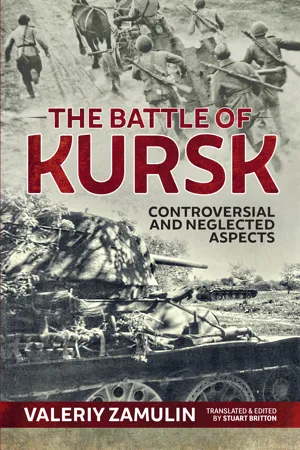
In this book, noted historian of the Battle of Kursk Valeriy Zamulin, the author of multiple Russian-language books on the Battle of Kursk and Destroying the Myth: The Tank Battle at Prokhorovka, Kursk, July 1943: An Operational Narrative takes a fresh look at several controversial and neglected topics regarding the battle and its run-up. He starts with a detailed look at the Soviet and Russian historiography on the battle, showing how initially promising research was swamped by Party dogma and censorship during the Brezhnev area, before being resumed with the collapse of the Soviet Union. Zamulin then transitions to discussions of how the southern shoulder of the Kursk bulge was formed, preparations for the battle on both sides, and the size and composition of Model's Ninth Army. He then examines such controversial topics as whether or not the II SS Panzer Corps was aware of the pending Soviet counterattack at Prokhorovka, and the effectiveness of the Soviet preemptive barrage that struck the German troops that were poised to attack. Zamulin also discusses whether or not General Vatutin, the Commander-in-Chief of Voronezh Front, erred when arranging his defenses. Zamulin also takes a look at how the myth of 1,500 tanks colliding on a narrow strip of farm fields became perpetuated in Soviet and foreign history books, when in fact it was impossible for the 5th Guards Tank Army's tanks to attack in massive wave after wave due to the constrictions of the terrain. Zamulin also reveals incidents of the battle that were long kept "behind the curtain" by Soviet censorship. For example, the 183rd Rifle Division defending the Prokhorovka axis was repeatedly struck by friendly aircraft, and a Soviet tank counterattack overran the positions of one of its battalions. Zamulin discusses other cases of fratricide in the Voronezh Front, including the death of one of the 1st Tank Army's foremost tank commanders in a friendly fire incident. In the process, he reveals that a wave of suicides swept through the junior command staff of the 5th Guards Tank Army immediately prior to the famous counteroffensive on 12 July 1943. All in all, Valeriy Zamulin with this collection of essays and articles, two of which have been reprinted from the Journal of Slavic Military History, makes a new contribution to our knowledge and understanding of this pivotal, epochal battle of the Second World War.
Information
1
A review of the literature on the Battle of Kursk
“‘Give them the black bread of truth.’ Why on earth is this necessary, if it isn’t advantageous to us?”1
If one doesn’t conceal the truth, then history will remain as the authentic history, despite the various attempts to falsify it – primarily through the use of non-disclosures.
Konstantin Simonov2
The history of the Battle of Kursk, despite the more than 70 years that have passed since it took place, continues to attract the focused attention of scholars and the general public. The enormous bibliography, which has gathered around the battle over the past years, as well as the works of historians which continue to come out about the battle in many countries even today with enviable regularity, plainly testifies to this. However, in Russia ever since the battle, it has never yet been subjected to full, and most importantly, objective analysis. One of the Red Army’s main strategic operations (and incidentally, of the entire Great Patriotic War) became an important piece of Communist propaganda, and myths and legends have densely shrouded its events. Some of them have not been conclusively dispelled even today.
Starting from the first days of July 1943, when this epic event began to unfold, all of the information on it was concentrated in two major centers: the General Staff of the Red Army (which collected more reliable and complete information, for the Army’s needs), and the means of mass information (for propaganda work). As it was, civilian historians were distant from both of these channels of information. Thus, right up until the 1960s, Soviet Army historians acted as the “locomotive” in studying the Battle of Kursk. Even though the results of their work at the time remained classified, nevertheless, the main work to analyze the events at Kursk was conducted by officers of the General Staff, and their conclusions became the basis for the first publications in the Soviet Union and paved the way for future study by the civilian academic community and scholars.
In my view, the domestic historiography of the Battle of Kursk can be divided into four main stages. The first, initial stage, which extended from 1943 to 1956, featured primarily the generalization and conceptualization of those events (first of all by military men). The second stage (1957-1970) was more productive. Over these 14 years, scholars and war veterans, although with great difficulty, succeeded in laying down the basis for writing the history of the battle. The third stage (1971-1993), although the lengthiest over the time of the USSR’s existence, proved to be featureless and of little substance due to the “managed degradation” of military-historical research which had started, and the senseless and rampant wave of ideology that swept over this sphere of academic activity. The year 1993 can be considered the beginning of the fourth stage, which continues to the present day. This year marked the 50th Anniversary of the Battle of Kursk, and according to archival regulations, the process of declassifying the 1943 files of the Central Archive of the Russian Federation’s Ministry of Defense began. Scholars gained access to a major source of information – the operational, reporting and captured documents of the acting army, without which an accurate and complete analysis of those events is impossible.
In the initial phase, the “military stage” of the historiography is clearly distinguishable, which continued from 1943 to 1947. Over these years, the study of the Battle of Kursk flowed up channels, from newspaper and journal publications to articles in digests of the General Staff dedicated to assimilating the war’s experience and books on individual battles. This stage concluded with the completion of a two-volume monograph by military specialists, and although it was not approved for publication, it had a substantial influence on subsequent scholarly work.
Soviet military journalists should be considered the first historiographers of the Battle of Kursk. Already in the first half of July 1943, during the repulse of the German offensive according to the Citadel plan, large essays and articles on this subject appeared in the central newspapers. Their authors were primarily describing individual clashes and combats, the heroism of Soviet soldiers, and some of the articles even contained attempts to draw lessons from the experienced gained by the Red Army while conducting the successful operation that summer. After all, up to that moment the Soviet soldiers had never been able to achieve any significant results in the summertime. Then a journalist conceived the name “Kursk bulge”, which subsequently became something of a “brand” name. Today this combination of words is applied to both the configuration of the front lines west of Kursk, which took shape by the end of March 1943, and the battle, which took place there that summer. It appeared for the first time in the open press in the title of an article written by B.A. Galin, a journalist for the Red Army’s main newpaper Kransaia Zvezda [Red Star].3 “Na kurskoi duge” [“At the Kursk bulge”] appeared on page 4 of the newspaper on 15 July 1943. Later it was picked up by other authors. Prior to its appearance, this area was called the “Orel – Kursk direction” or the “Belgorod axis” in the press. In the autumn of 1943, it appeared in journals for propagandists and special Army publications like “Bol’shevik”, “Vestnik vozdushnogo flota” [Air Force Digest], “Zhurnal avtobronetankovykh voisk” [Journal of the Armored Forces] devoted to making known the events on the Kursk bulge.
It should be especially stressed that the articles in these publications (both newspaper and journal publications) were as a rule of a strictly propagandistic orientation and of a superficial, narrative nature, which distinguished all the open military publications of the Soviet Union of that era. In addition, it must be noted that their authors, journalists at all levels (army, front and central editions) were “fighters of the ideological front” (as they were called in documents of the Soviet Party organs), and not only because of censorship restrictions, but also at their own volition, they often distorted the facts and even made up entire military incidents and anecdotes out of whole cloth. This pernicious tendency arose in the very first days of the war, and already had already gathered such momentum after one and a half years of war that even certain clear-headed leaders of military-political work in the armed forces were compelled to note its extremely negative influence on the effectiveness of the propaganda, which is to say the level of trust shown to it on the part of the troops. A directive from a deputy People’s Commissar of the Navy, chief of the Navy’s Main Political Command Commissar Rogov No. 1 dated 22 January 1942 stated:
Recently, all types of falsehoods and lies have a widespread circulation on ships and in units of the Fleet …. Cases of lying, all types of tales, at times incorrect and politically harmful fabrications of political workers are taking place in agitation-propaganda work and the fleet press. Certain political workers, instead of a decisive struggle with falsehoods and harmful ad-libbing in propaganda and agitation, themselves sometimes submit false reports and concocted facts in their speeches, statements and even in print.
…
In the newspaper Krasnyi Chernomorets [Red Sailor of the Black Sea], it was stated in one of the articles that more than 1,000 bombs were dropped on the cruiser Komintern; two days later, in the same newspaper there was mention of “approximately 2,000 bombs”. Both of these reports were false. Tale-telling and lying in propaganda, agitation and the press discredit Party-political work and the fleet press, and cause exceptional harm to the matter of a Bol’shevik upbringing of the masses.
These shameful and harmful manifestations of deceit, in whatever forms they appear, cannot be tolerated on ships and in units of the Navy, and must be mercilessly rooted out.4
However, similar documents were unable to change the situation in a fundamental fashion. Legends and myths continued to occupy a significant place in Soviet periodical literature of the war years, and then a significant portion of them smoothly migrated into brochures, books and even dissertations dedicated to the history of the Great Patriotic War. There are several reasons for this; I will cite only the two most obvious, in my view. First, a significant share of the top leadership responsible for this branch of military-political work believed that such a method to a certain degree was fully allowable for the creation of “Potemkin villages”, with which propaganda was primarily occupied.5 Second, Soviet military journalism was experiencing an acute deficit of qualified workers, and indeed simply well-educated people. Therefore from the first days of the war, not only the flower of Soviet literature was directed into the acting army, but also a significant number of ordinary journalists from purely civilian newspapers and journals, who, naturally, were totally unfamiliar with army life, and indeed were not burning with a desire to learn it at the front among the troops, under the hum of bullets. Thus, articles with storybook, heroic subject matter, describing the “unparalleled feats” of the Red Army’s men, were often born precisely in the quiet of offices.
However, let’s return directly to the historiography of the events at Kursk. Studies using documentary material and the dissemination of the first results of this work to a relatively wide audience (the senior command staff) of the Red Army’s General Staff began in the autumn of 1943. The initial, serious summarizing materials were published in the first issue (November 1943) of a new publication – the “Information Bulletin from the Department of Studying the War’s Experience” and the “Collected Materials on Studying the War’s Experience” [further referred to as the “Sbornik”], which came out at the end of 1943 and the beginning of 1944. The Sbornik was published from 1942 to 1948, and both its volume and range of the themes it touched upon were considerably superior to the “Bulletin”, although there was only one audience for both publications – the Army’s senior command staff and the instructors of military educational institutions. In issues No. 9-11 of the Sbornik, for the first time materials were published that were dedicated to the limited operations in the period of the spring operational pause (a description of the battle conducted by elements of the 13th Army’s 148th Rifle Division to seize the Glazunovka strong point in May 1943), as well as to important episodes of the Battle of Kursk itself (the defensive engagements of the 2nd Tank Army’s 19th Tank Corps from 7 to 10 July on the Samodurovka – Molotychi line, and the Voronezh Front’s counterattack on 12 July 1943.)
Sbornik No. 11 was thematic, fully dedicated to the Battle of Kursk. Thanks to the summarization of significant combat experience on the basis of documentary material that was rich for those times, this was a major, deep work, consisting of 10 chapters and 27 diagrams with a total number of 216 pages. Initially its authors pursued only the practical purpose “to acquaint broad reading circles of generals and individuals of the officers’ staff with certain materials and preliminary conclusions from this most important and extremely instructive operation.”6 However, in essence, it was the first attempt by General Staff officers to lay down a solid foundation for the further academic analysis of this pivotal event of the war. The studies in the Sbornik lay out the course of events and their interrelationship in considerable detail, and give an essentially correct assessment of the decisions taken by the Soviet command during the battle. The applied nature of the research to a significant degree spared the authors from bias and far-fetched arguments when describing the combat operations on all the sectors of the Kursk bulge, including those that would quickly become mythologized and included in the system of propagandizing the achievements of Soviet power. For example, when discussing the counterattack at Prokhorovka on 12 July 1943 on the Voronezh Front, the authors openly point to a number of genuine failures and miscalculations committed by the Soviet side. For example, the authors show that Lieutenant General P.A. Rotmistrov’s 5th Guards Tank Army failed to carry out its assignment on this day. In addition, “at the decision of the commander, the 5th Guards Tank Army launched a frontal assault against crack German panzer divisions, not having a substantial superiority in force, which in the best case might lead only to pushing the enemy back.”7 Even though this decision was taken not by the army commander, but by the leadership of the Voronezh Front and the General Staff (it was they who decided the army’s combat formation and place of deployment), and there was in fact a superiority in strength over the adversary (indeed, a significant one), which couldn’t be exploited because of the restricted terrain conditions, nevertheless one of the main mistakes made in planning the preparation for the counterattack has been stated unambiguously in the Sbornik.
Thirdly, the authors remained silent about the already circulating opinion that a colossal tank clash took place at Prokhorovka, in which supposedly 1,500 tanks and self-propelled guns took part. They made no attempt to exaggerate the already large numbers, which were cited by the 5th Guards Tank Army’s account, and honestly pointed out that the Germans over five days o...
Table of contents
- Cover
- Title
- Copyright
- Contents
- List of Photographs
- List of Maps
- List of Tables
- Introduction
- 1 A review of the literature on the Battle of Kursk
- 2 The Kastornoe Cauldron: The beginning of the process of forming the Kursk bulge
- 3 Stopping von Manstein’s “Backhand Blow”, 13–21 March 1943
- 4 Could Germany have won the Battle of Kursk if it had started in late May or the beginning of June 1943?
- 5 Did Vatutin err when planning the defense of the Voronezh Front while preparing for the Battle of Kursk?
- 6 With what forces did General W. Model begin the Battle of Kursk?
- 7 On the eve of the fundamental turning point – the role of Central Front’s reconnaissance and intelligence in determining the start date for Operation Citadel
- 8 The counter-artillery preparation – a successful decision, or a case of “firing cannons at sparrows”?
- 9 The Kursk turning point – What remained behind the curtain?
- 10 Prokhorovka – the unknown clash of the Great Patriotic War
- 11 Two commanders at the Battle of Kursk (a case of biographical research)
- 12 Prokhorovka – the evolution of a myth
- Appendix I The Prokhorovka Staging Area
Trusted by 375,005 students
Access to over 1.5 million titles for a fair monthly price.
Study more efficiently using our study tools.
Frequently asked questions
Yes, you can cancel anytime from the Subscription tab in your account settings on the Perlego website. Your subscription will stay active until the end of your current billing period. Learn how to cancel your subscription
No, books cannot be downloaded as external files, such as PDFs, for use outside of Perlego. However, you can download books within the Perlego app for offline reading on mobile or tablet. Learn how to download books offline
Perlego offers two plans: Essential and Complete
- Essential is ideal for learners and professionals who enjoy exploring a wide range of subjects. Access the Essential Library with 800,000+ trusted titles and best-sellers across business, personal growth, and the humanities. Includes unlimited reading time and Standard Read Aloud voice.
- Complete: Perfect for advanced learners and researchers needing full, unrestricted access. Unlock 1.5M+ books across hundreds of subjects, including academic and specialized titles. The Complete Plan also includes advanced features like Premium Read Aloud and Research Assistant.
We are an online textbook subscription service, where you can get access to an entire online library for less than the price of a single book per month. With over 1.5 million books across 990+ topics, we’ve got you covered! Learn about our mission
Look out for the read-aloud symbol on your next book to see if you can listen to it. The read-aloud tool reads text aloud for you, highlighting the text as it is being read. You can pause it, speed it up and slow it down. Learn more about Read Aloud
Yes! You can use the Perlego app on both iOS and Android devices to read anytime, anywhere — even offline. Perfect for commutes or when you’re on the go.
Please note we cannot support devices running on iOS 13 and Android 7 or earlier. Learn more about using the app
Please note we cannot support devices running on iOS 13 and Android 7 or earlier. Learn more about using the app
Yes, you can access The Battle of Kursk by Valeriy Zamulin, Stuart Britton in PDF and/or ePUB format, as well as other popular books in History & Eastern European History. We have over 1.5 million books available in our catalogue for you to explore.