eBook - ePub
Israeli Air Force Operations in the 1956 Suez War
29 October–8 November 1956
- 80 pages
- English
- ePUB (mobile friendly)
- Available on iOS & Android
eBook - ePub
About this book
By participating in 1956 Suez Crisis Israel exploited an opportunity to join forces with France and the United Kingdom in an attack against Egypt in order to accomplish diplomatic, military and political objectives: to open the Red Sea international shipping lane to ships sailing from and to Eilat; to strengthen its alliance with France; to end – or at least to scale down – Egyptian hosted Palestinian terror attacks against Israel; to launch a preventive war in order to crush Egyptian military power before its completion of the transition to Soviet weapons could tempt Egypt to attack Israel and in order to accomplish a profound victory to deter Egypt from pursuing a another round of war policy. Operation KADESH was the Israeli part in the Anglo-French attack and this title chronicles Israeli Air Force operations along the timeline of Operation KADESH – from day 1 on 29 October 1956 until day 11 on 8 November 1956 – in thus far unmatched depth and detail; all known Israel Air Force missions and sorties are listed and described and all air combats between Israeli Mysteres and Egyptian MiGs and Vampires are presented and analyzed. The large variety of aircraft flown – Dassault Mysteres, Dassault Ouragans and Gloster Meteors; B-17 Flying Fortresses, P-51 Mustangs and De Havilland Mosquitoes; T-6 Texans (Harvards) and T-17 Kaydets (Stearmans); Nord 2501 Noratlases, C-47 Skytrains (Dakotas), Pipers and Consuls and even a pair of Sikorsky S-55 helicopters – are all covered in this title, which presents Israeli Air Force operations during the Suez War in a depth and detail unseen in previous publications. The text is supported by numerous photographs and color profiles. Middle East@War - following on from our highly successful Africa@War series, Middle East@War replicates the same format - concise, incisive text, rare images and high quality color artwork providing fresh accounts of both well-known and more esoteric aspects of conflict in this part of the world since 1945.
Information
Day 1
29 OCTOBER 1956
ILDF objectives for Day 1 were to preserve deception and surprise until H-Hour and to drop Battalion 890 over Mitle sector, a relatively short distance from the Suez Canal.
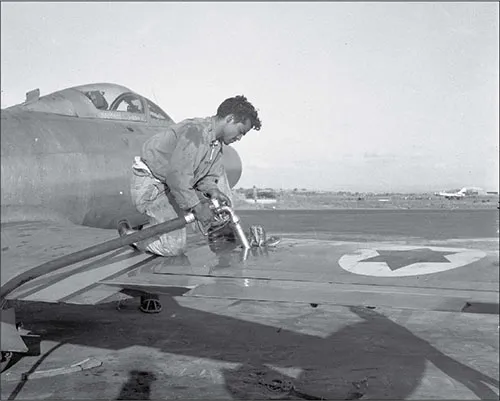
A Squadron 113 maintainer refuels an Ouragan at Hatzor; the Ouragan is painted with the first version of ILAF Suez War IFF stripes.
SUEZ WAR STRIPES
MAT2 repeated, in a telegram that was circulated at 0420, an earlier order to paint IFF stripes on ILAF aircraft:
Paint a stripe around the rear part of the fuselage, perpendicular to aircraft longitudinal axis, in between leading edge of the tail section and trailing edge of wing and around each wing perpendicular to aircraft lateral axis, halfway between wing tip and root. The stripe will be painted with two colors: center, 30 centimeters wide, in yellow; two edges, seven centimeters wide each, in black. Painting will start on the morning of 28 October [1956] and will be completed ASAP… This telegram refers to all aircraft in country and not only to ILAF aircraft…
The stipulated stripes were actually a variation of the ultimate Suez War coalition IFF stripes, primarily because at the time the coalition did not exist. Reference to all aircraft in country covered the arrival of FRAF aircraft; Tel Nof reported, at 0640, the arrival of 10 FRAF Noratlases.
ATTACHMENT TO ARMY
Squadron 100 – with the main body deployed from Ramla to Beer Sheba from 28 October 1956 – was tasked to assign four Pipers to Command South, one Piper to Division 38, one Piper to Division 77, one Piper to Eilat HQ and eight Pipers to Brigade 202; Phase B assignment was to be four Pipers to Command South, three Pipers to Division 38, one Piper to Eilat HQ, two Pipers to Brigade 9 and three Pipers to Brigade 202. At 0600, the flight commanders were reported: Division 38 Flight Commander, Zvi Armon; Division 77 Flight Commander, Josef Aaroni; Eilat HQ Flight Commander, Benjamin Kahane; and Brigade 202 Flight Commander, Isaac Hirsh.
SURVEILLANCE SINAI
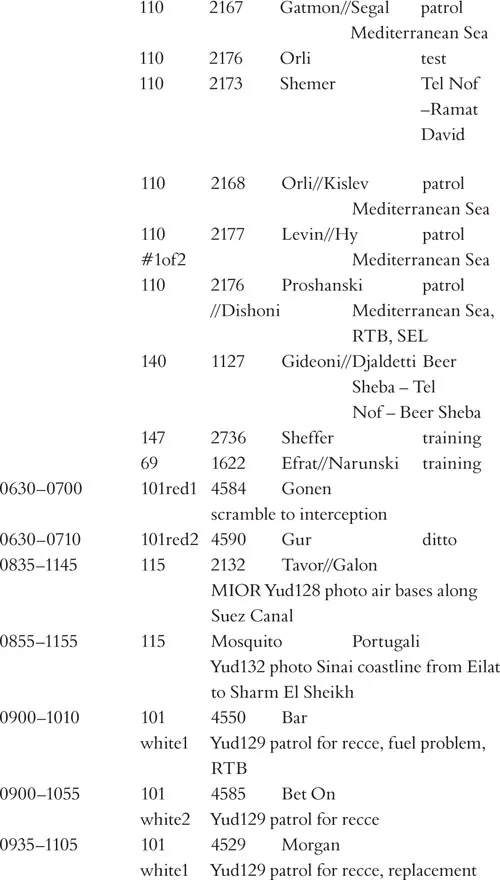
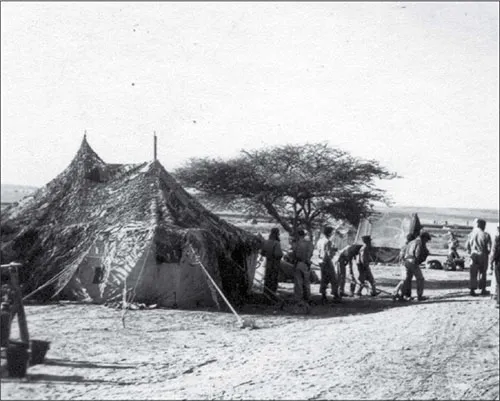
Squadron 140 deployed to tents at Teman Field, north-west of Beer Sheba.
Squadron 110 maritime patrol missions were possibly related to Operation COCK that took place prior to the start of KADESH Day 1 events.
MIOR Yud128 photographic interpretation revealed 17 MiGs at Kabrit; eight MiGs and one Il-14 at Abu Sueir; 16 Vampires, eight Meteors and one Il-14 at Fayid; and no aircraft at Firdan, Kasfareet and Shalufa. The MiGs at Kabrit were dispersed and AIR4 reported that Cairo West was ordered, at 1300, to disperse aircraft. Traffic between Suez and Mitle was reported as sparse. Both Squadron 115 crews reportedly sensed EGAF aircraft in flight but AIR4 did not detect take-offs from Suez Canal air bases and Squadron 101 Mysteres were not vectored to engage.
READINESS STATE C
AIR3 ordered all units, at 0930, to prepare for Readiness State C, one level below war, from 1300. Instructions included:
Aircraft dispersal from 1730; assembly of Squadron 160 (dummy) aircraft from 1730… blackout from 1730.
MONITOR MITLE
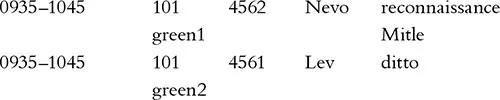
Israel undertook to pose a threat to the Suez Canal and the ILDF planned to position paratroopers west of Mitle Pass, some 30 kilometers east of the Suez Canal. The ILAF recced Mitle; by 0300 ILDF//I finished interpretation of the 28 October 1956 recce and concluded that EGDF troops were present west of Mitle, near the planned drop zone. Discussions continued until 0930, when the drop of dummies was canceled, and until 1000, when ILDF//G//Operations ordered a change of drop zone to east of Mitle; the new drop zone was some ten kilometers east of Mitle and five kilometers south-west of the Mitle//Bir Hasana//Nekhel road junction. It was therefore during discussions that Squadron 101 was tasked to fly visual reconnaissance over Mitle; pilots reported that the drop zone was clear of enemy forces.
STILL SINAI

Squadron 117 pilots were scrambled to intercept a radar track but found nothing. The Squadron 115 crew flew a largely uneventful mission over Sinai, the exception being the observation of an enemy jet flying between El Arish and Rafah.
CABLE CUTTERS
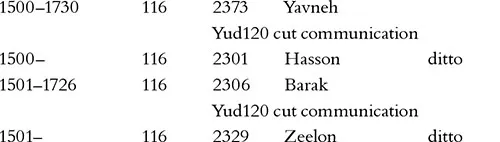
The change of drop zone impacted the MIOR Yud120 cable cut mission that tasked P-51s to cut communication lines in Sinai at two points, along CARROT, from 1600. Yud120 stipulated a low altitude flight, radio silence except for an emergency and that pilots would make certain that the lines were indeed cut.
Following ILDF//G//Operations notification to AIR3, at 1200, about a shift to the east of the telephone lines cutting points, due to a change in drop zone, AIR3 issued, at 1235, a revision to MIOR Yud120: the former eastern first cutting point was transformed into the western second cutting point, while a new first eastern cutting point replaced the old western second cutting point. TOT over the first target was changed to 1545. Dan Barak recalled:
Our mission was to cut lines in two places… My cable was detached during take-off so I had to land and mount another cable. We flew low and arrived over target. I took part in [pre-war] tests which were so classified that I did not know the purpose but there was one line between two poles over flat terrain and I cut it like butter. Suddenly, [there was] not one line but many lines and sand dunes so my cable was torn away. I remembered that an aircraft accidently cut lines with [its] propeller so I decided to do it [to cut the lines with the propeller]. I circled, signaled to my wingman to fly in line astern, descended [and headed to the lines] but at the last moment I instinctively pulled up. I tried again, fully fine so that RPM would be high, more than 2,000 RPM… and I sensed something like a black shadow for a split second. I circled to see [the] impact and could not find the place so I did it again… We flew to the second place… and did it again. Post-war we toured the area, not only [had] I cut the lines but I pulled out poles! … on the way back we saw the paratroopers at the Mitle.
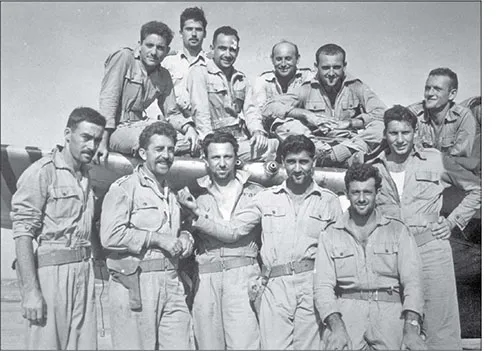
Squadron 116 pilots, standing Squadron 116 Commander Zahik Yavneh, Squadron 116 Deputy A Dan Barak, Squadron 116 Intelligence Officer, Cheetah Cohen, Arie Fredilis and Amnon Bloch; on wing Israel Burstein, Ami Hativa, Shlomo Geva, Squadron 116 Deputy B Arie Zeelon, Zvi Kohorn and Zeev Sharon. This photo was taken after 0600 on 2 November 1956 as P-51 is marked with ILAF Suez War IFF stripes version 2 and after 1700 on 2 November 1956 when a Squadron 100 Piper returned Shlomo Geva, with a bandaged forehead, to Tel Nof; Day 1 cable cutter missing from this photo is Amity Hasson.
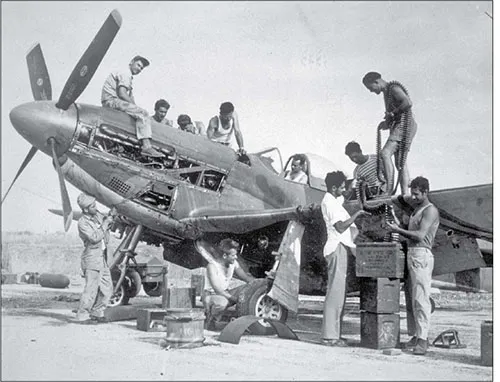
Squadron 116 servicemen, most if not all reserves, turn around a P-51 during the Suez War; the cable cut P-51s were target tug equipped and were planned to cut cables with a long steel cable. This photo was taken after 0600 on 2 November 1956 as P-51 is marked with ILAF Suez War IFF stripes version 2.
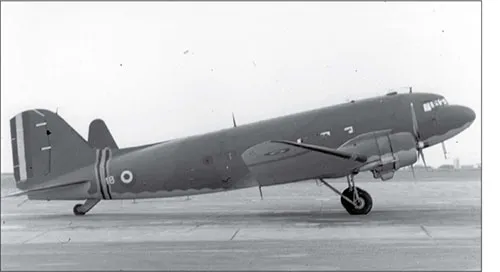
In order to enable Squadron 103 to drop a battalion in one round trip, Israel loaned C-47s from France and these were issued with ILAF Numbers 1414 to 1432 in even numbers only; this image of 1418 - in which Squadron 103 pilot Yossi Ofer flew MIOR Yud118 on 29 October 1956 - was taken after its return to France but still with ILAF Number 1418 and still marked with ILAF Suez War IFF stripes version 2.
DROP MITLE
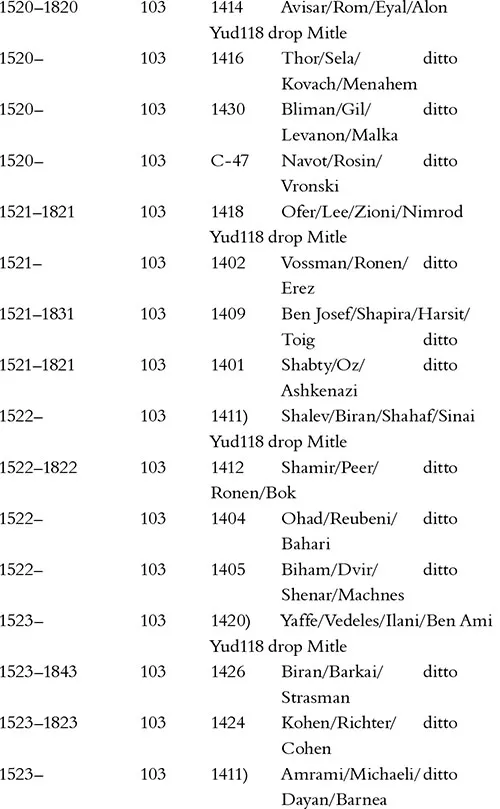
AIR3...
Table of contents
- Cover
- Title
- Contents
- Map
- Copyright
- Note
- Acknowledgements
- Glossary
- Brief Background
- Military Balance
- Day 1: 29 October 1956
- Day 2: 30 October 1956
- Day 3: 31 October 1956
- Day 4: 1 November 1956
- Day 5: 2 November 1956
- Day 6: 3 November 1956
- Day 7: 4 November 1956
- Day 8: 5 November 1956
- Day 9: 6 November 1956
- Day 10: 7 November 1956
- Day 11: 8 November 1956
- plate Session
Trusted by 375,005 students
Access to over 1.5 million titles for a fair monthly price.
Study more efficiently using our study tools.
Frequently asked questions
Yes, you can cancel anytime from the Subscription tab in your account settings on the Perlego website. Your subscription will stay active until the end of your current billing period. Learn how to cancel your subscription
No, books cannot be downloaded as external files, such as PDFs, for use outside of Perlego. However, you can download books within the Perlego app for offline reading on mobile or tablet. Learn how to download books offline
Perlego offers two plans: Essential and Complete
- Essential is ideal for learners and professionals who enjoy exploring a wide range of subjects. Access the Essential Library with 800,000+ trusted titles and best-sellers across business, personal growth, and the humanities. Includes unlimited reading time and Standard Read Aloud voice.
- Complete: Perfect for advanced learners and researchers needing full, unrestricted access. Unlock 1.5M+ books across hundreds of subjects, including academic and specialized titles. The Complete Plan also includes advanced features like Premium Read Aloud and Research Assistant.
We are an online textbook subscription service, where you can get access to an entire online library for less than the price of a single book per month. With over 1.5 million books across 990+ topics, we’ve got you covered! Learn about our mission
Look out for the read-aloud symbol on your next book to see if you can listen to it. The read-aloud tool reads text aloud for you, highlighting the text as it is being read. You can pause it, speed it up and slow it down. Learn more about Read Aloud
Yes! You can use the Perlego app on both iOS and Android devices to read anytime, anywhere — even offline. Perfect for commutes or when you’re on the go.
Please note we cannot support devices running on iOS 13 and Android 7 or earlier. Learn more about using the app
Please note we cannot support devices running on iOS 13 and Android 7 or earlier. Learn more about using the app
Yes, you can access Israeli Air Force Operations in the 1956 Suez War by Shlomo Aloni in PDF and/or ePUB format, as well as other popular books in History & Middle Eastern History. We have over 1.5 million books available in our catalogue for you to explore.